
Jaguar stencil evaluation

Vet the jaguar before it becomes a stencil

Jaguars live or die on rosette breakup, central-dot survival, and head plus profile readability. Vet the ring-plus-dot unit at your exact final size, simplify the coat without borrowing leopard density or stripe logic, then prepare a clean stencil that transfers as one readable jaguar.

Built for working artists preparing jaguar pieces. This page covers jaguar rosette vetting with central dots, head and profile readability checks, coat simplification, and transfer-ready prep only, not tattoo application or healing advice. Mayan jaguar motif choice stays on the Mayan owner, leopard density depth stays on the leopard owner, and cross-animal comparison stays on the animals owner, linked below.

What makes a jaguar stencil-viable

Rings, dots, head, and gaps decide the result.

A jaguar is large broken rings with central dots on one stocky body construction. These three pillars predict whether that combination survives reduction, print, and transfer.

Rosette breakup with central dots

A jaguar reads first as large broken rings with thicker walls and one or more central dots inside each ring, scattered over a stocky body. Jaguar rosettes run larger, darker, and fewer per patch than leopard rosettes, with solid spots on the head, neck, and legs and elongated marks along the spine. Transfer needs countable rings with open centers and visible central dots that survive at true size, because walls that touch and dots that plug turn the coat into leopard-like solid spots or one dark field.

Check: Cover the head and legs and look at one palm-sized flank patch at true size. If every ring keeps its own wall, its own open center, and a readable central dot with air around it, breakup is sound. If three or more rings share one outline or the central dots vanish into fill, that patch needs merging or removal before print.
Head and profile readability

Jaguar heads carry a broad, square muzzle, a defined nose, forward eyes with strong lids, rounded ears, and a heavy jaw and neck. Full-body views add a compact muscular torso, shorter stocky legs, and a thick tail. Stencil viability comes from one clean head contour with separated eyes and ears before any coat work, because rosette texture cannot rescue a head that already reads as a generic cat or a leopard.

Check: Cover every rosette and look at the head plus body outline alone. If the square muzzle, jaw mass, ear placement, and compact body line still read as jaguar at a glance, the hierarchy is sound. If removing spots leaves a generic feline, lock head and body construction before touching the coat.

Coat simplification at final size

Jaguar coats simplify by breakup management, not by redrawing anatomy. Keep fewer, larger, better-spaced rings with open centers, protect one central dot per kept ring at larger sizes, and convert faint fur value into open skin or spaced stipple. When dots close at small sizes, remove the dot and keep the open ring rather than thinning every wall to save both.

Check: Ask whether the fix protects the ring-plus-dot unit or only the ring. If the dot survives open at 1:1, keep it. If the dot plugs, drop dots first, then merge neighbor rings, then enlarge or recrop. If the fix talks about band angle, it belongs to a stripe workflow instead.

Head versus profile versus seated

Choose the construction the placement can actually hold.

View choice is the highest-cost decision on a jaguar stencil. Set it against width, limb axis, and ring-plus-dot density before refining a single rosette.

Jaguar head portrait

Best for: Shoulder, outer forearm, calf, chest-corner, and upper-back panels where one close heavy-jawed read matters more than coat coverage.

Build: One head angle with broad square muzzle, nose placement, forward eyes with lids, rounded ears, and a short neck or shoulder cutoff. Protect muzzle width, jaw mass, eye separation, and ear placement.

Failure mode: Forehead rosettes plus cheek dots plus whisker marks crowd the face first. Central dots touching the eyes or nose bridge erase the landmarks that carry the species read.

Size floor: Holds from about 8 cm upward for bold head work; below that, drop central dots near the face first, then forehead rings, before touching eyes or muzzle.

Full-body jaguar in profile

Best for: Thigh, side, back, and rib panels with room for a long compact body, deep chest, four separated legs, and the thick tail.

Build: One walking or standing profile with a level back line, deep chest, four separated stocky legs, and the tail following one clean curve. Protect back line, chest depth, leg separation, and tail path with its gap from the rear leg.

Failure mode: Flank rings plus leg spots plus belly fur compete for the same lower field, and central dots plug before ring walls do. Leg and tail contacts merge before the back does.

Size floor: Holds from about 14 cm upward when central dots, leg gaps, and tail separation stay countable at 1:1; do not force a full body into a narrow limb band.

Seated or crouched jaguar

Best for: Forearm, calf, flank, and shoulder-blade placements where a compact coiled body fits the available height better than a long stride.

Build: One compact body mass with folded legs, paws grouped near the chest, and the tail wrapped along one edge. Protect the outer body mass, head placement, and the tail gap from the belly.

Failure mode: Folded legs, grouped paws, tail wrap, and dense shoulder rings stack into one dark center. The tail touching the belly or paws touching the chin closes the only skin breaks in the piece.

Size floor: Holds from about 10 cm upward when paw gaps and the tail-to-belly channel stay open at 1:1; below that, recrop to the head alone.

Cross-species big-cat silhouette comparison stays on the animals owner. Mayan jaguar motif choice with stepped symmetry and carving hierarchy stays on the Mayan owner. This comparison exists to place one naturalistic jaguar construction correctly, not to replace those owners.

Jaguar evaluation framework

Score the reference in minutes, then act on the weakest check.

Four jaguar constructions at labeled sizes. Each one names the protected structure, the fix, and the go or no-go verdict at that exact size. Confirm with a measured 1:1 print.

HOLDS AT STATED SIZE

Jaguar head portrait at 10 cm

Intended height 100 mm

Reference read

Close three-quarter jaguar head with broad square muzzle, defined nose, forward eyes, rounded ears, heavy jaw, and scattered forehead and cheek rosettes with central dots. Strong on screen because muzzle and eye contrast is high, but cheek dots and forehead rings narrow every separation near the face at this height.

Protect
Muzzle width with jaw mass and nose placement, both eye shapes with the bridge gap between them, and both ear placements on the head contour.
Fix
Reduce each eye to one outline plus one inner ring, hold forehead rings to spaced open fragments with one central dot each, and convert cheek stipple and whisker marks into open skin or a few spaced dots. Keep central dots only where each dot holds its own air at 1:1.
Candidate stencil
Same jaguar with an open-bridge face, separated ears, spaced open-center rings with readable central dots where dots hold air, grouped paws with gaps, an open tail channel, and any grass, branch, or foliage cue kept outside the body silhouette at transferable mass.
Final-size verdict
Holds at 10 cm once eyes and muzzle are single-path construction at 1:1. The square muzzle plus jaw mass carries the jaguar read while spaced ring-plus-dot fragments keep the species signal without touching face landmarks.

MERGE RINGS BEFORE PRINT

Walking jaguar profile at 14 cm

Intended width 140 mm

Reference read

Full-body walking jaguar in side profile with a level back, deep chest, four stocky legs in stride, thick tail trailing, and large flank and shoulder rosettes with central dots. Demanding on screen because flank rings stack large closed shapes that share walls at this width, and central dots plug first.

Protect
Back line with head placement, chest depth, all four leg separations, and the tail path with its gap from the rear leg.
Fix
Merge touching neighbor rings into fewer larger rings with open centers, keep one central dot per ring only where the dot holds air, open every kept center to skin, and convert faint belly fur value into open skin. Keep leg gaps and the tail channel fully open and shorten only the shortest overlapping ring arm where two touch.
Candidate stencil
Same jaguar with an open-bridge face, separated ears, spaced open-center rings with readable central dots where dots hold air, grouped paws with gaps, an open tail channel, and any grass, branch, or foliage cue kept outside the body silhouette at transferable mass.
Final-size verdict
Holds at 14 cm after a dot-first density merge. Legs keep their own skin breaks at 1:1, the tail stays separated from the body, and the flank reads as spaced rings with dots rather than one plugged field.

OPEN PAW AND TAIL GAPS FIRST

Seated jaguar with wrapped tail at 11 cm

Intended height 110 mm

Reference read

Compact seated jaguar with folded forelegs, grouped paws, chin near the paws, and the tail wrapped along the belly edge. Strong composition for narrow fields, but paws, chin, tail wrap, and shoulder rings share one crowded center at this height.

Protect
Outer body mass with head placement, both paw shapes with gaps between them and the chin, and the tail edge with its channel from the belly.
Fix
Group paw shapes into countable forms with visible gaps, hold the tail to one clean edge with an open channel along its full length, drop central dots inside the three densest shoulder rings first, then merge or remove the rings if walls still touch. Do not keep full paw separations plus tail wrap plus dotted shoulder rings together at 11 cm.
Candidate stencil
Same jaguar with an open-bridge face, separated ears, spaced open-center rings with readable central dots where dots hold air, grouped paws with gaps, an open tail channel, and any grass, branch, or foliage cue kept outside the body silhouette at transferable mass.
Final-size verdict
Holds at 11 cm once paws and tail each keep their own skin breaks at true size. The coiled mass reads as jaguar while opened gaps keep the center from printing as one dark knot.

ENLARGE OR RECROP

Dense realistic jaguar with full coat detail at 6 cm

Intended height 60 mm

Reference read

Dense realistic jaguar with full rosette coverage, central dots in every ring, layered fur value, fine eye and whisker detail, plus paws and tail sharing one small field. Rich on screen with hairline ring walls and dotted centers sharing the same room.

Protect
Head direction with eye placement, and the back-to-tail angle that gives the piece its intent.
Fix
Enlarge past the point where every ring center, central dot, eye gap, paw separation, and tail channel transfers as open skin, or recrop to the head alone without body coat. Do not keep full ring-plus-dot coverage plus fur value plus paw detail together at 6 cm.
Candidate stencil
Same jaguar with an open-bridge face, separated ears, spaced open-center rings with readable central dots where dots hold air, grouped paws with gaps, an open tail channel, and any grass, branch, or foliage cue kept outside the body silhouette at transferable mass.
Final-size verdict
At 6 cm the ring walls plus central dots function as one dark field and paws print as a single pad. Enlarge, recrop to the head alone, or choose a bolder minimal construction with a few open rings and no central dots for this height.

Rings, dots, face, paws, and tail at final size

Judge the white space at the size you will print.

Screens forgive crowding that paper and skin do not. Set the size first, then inspect each feature below at true physical size with scaling off.

About 6 cm and below

Finger-adjacent panels, behind-ear marks, and small gap fillers.

Carry a recrop only, such as a head fragment with spaced open rings and no central dots, or one minimal seated mass with a few open-center marks. If a ring center, dot, eye gap, or paw separation closes at 1:1, enlarge or reselect rather than forcing reduction.

About 8 to 12 cm

Common shoulder, outer forearm, calf, and chest-corner jaguar heads and compact seated bodies.

The most flexible band for head portraits and seated work. A muzzle-led head with spaced forehead rings or a seated jaguar with grouped paws and an open tail channel can work when every face gap and body separation is verified at true size.

About 13 cm and above

Thigh, side, back, and rib panels with room for full-body profiles and full flank coverage.

Room for walking profiles with full ring fields, but only when open skin separates every ring, every central dot, every leg, and the tail path. Larger size does not rescue plugged dots, closed eye gaps, or texture-bridged paws.

Jaguar feature checks by size band
FeatureAbout 6 cm and belowAbout 13 cm and above
Rosette rings and central dotsKeep a few spaced open ring fragments with open centers and no central dots, with open skin between neighbors. Full rings plus inner dots plus shared walls merge first and dots should be removed before rings are merged at small heights.One central dot per kept ring can work when each dot holds its own air and each ring keeps its own separation from neighbors at 1:1. Verify dots with a squint test at true size.
Eyes, nose, and muzzleKeep one eye outline plus one inner ring with a clear bridge gap, and one clean nose shape with open skin around it. Whisker dots, iris ticks, nostril texture, and forehead dots merge first and should be removed at small heights.Two ranked rings per eye plus a defined nose edge can work when each keeps its own spacing at 1:1 and the square muzzle contour stays dominant over nearby spots.
Legs, paws, and tailGroup paws into countable shapes with visible gaps and keep the tail to one clean edge with an open channel. Individual toes and leg spots should go before paw gaps close.Separated toes and spaced leg marks can work when each gap keeps its own spacing. Paws and tail still need their own skin breaks from belly and leg lines.
Fur value and background cuesKeep no shaded fur value, grass texture, branch detail, or moon and foliage cues. Plan any coat modeling as open skin or a few spaced dots on the stencil itself.Spaced stipple can carry coat depth when each mark keeps its own spacing. Ground, branch, or foliage cues need their own skin breaks outside the body silhouette.

Jaguar, leopard, panther, and Mayan read tests

Run the species check before simplifying anything.

Most failed jaguar stencils are mislabeled references. Confirm the ring-plus-dot unit and the build first, then simplify inside the right owner.

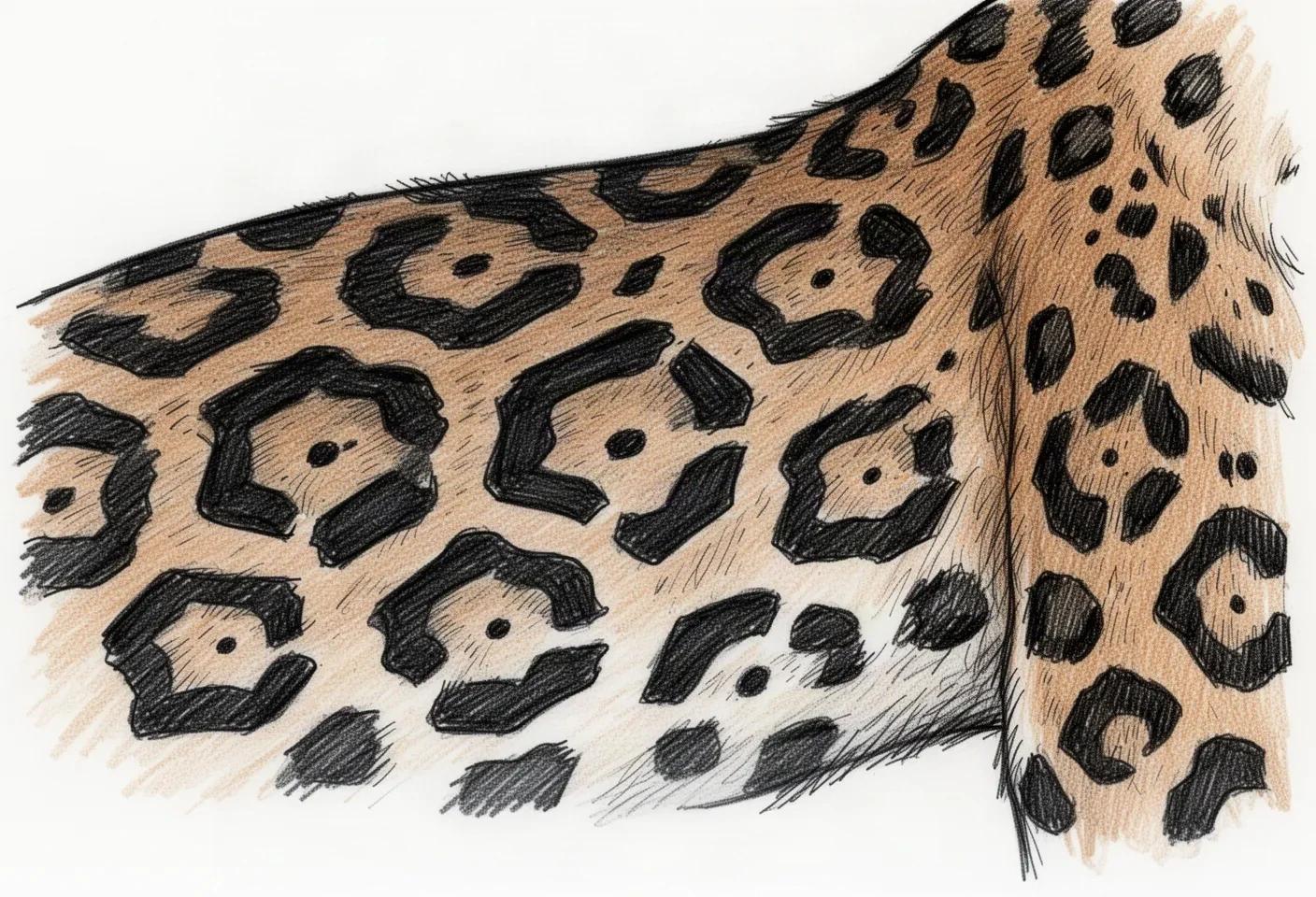
Illustrated close-up of jaguar flank rosettes: large thick-walled broken rings, each with an open center and one or two small central dots, spaced across warm tawny fur.
What to compare at 1:1: fewer and larger rings, each keeping its own wall, its own open center, and one or two central dots with air around them. This is the unit that separates a jaguar read from leopard density, where rings are smaller, more numerous, and reliably dotless. Judge your own reference patch against these two traits at true print size, not on screen. Original synthetic reference illustration, not StencilStudio app output or a customer's tattoo.

Jaguar: broken rings with central dots

Look for larger, fewer, thicker-walled rings with one or more dots inside, on a stocky compact body with a broad square muzzle. At stencil size the test is whether each ring keeps an open center and the dot keeps air around it.

Leopard: smaller denser rings, no central dots

Leopard coats pack smaller rings with paler centers and no reliable central dot, and the animal reads leaner. If the reference rings are small, many, and dotless, vet it on the leopard owner instead of forcing a jaguar label.

Panther and Mayan jaguar: different jobs

A solid-black cat with no coat rings is a panther density job, not a jaguar breakup job. A stepped, carved, glyph-framed jaguar head is a Mayan motif job. Keep those references on their owners linked below.

Confirmed leopard references stay with the leopard owner, which holds rosette-density depth. Confirmed solid-black panther references stay with the panther owner. Stepped carved jaguar motifs stay with the Mayan owner. This section exists so a naturalistic jaguar is never simplified with the wrong logic.

Reference to clean stencil

Build from the head outward, then protect the gaps.

Work in this order so one change at a time can be judged at the same size. Stop when head, rings, dots, paws, tail, and cues each read correctly.

  1. 01

    Lock view, size, and placement first

    Set the view in one line (head, full-body profile, or seated), the intended physical width or height in millimeters, and the named body area. A walking jaguar that holds at 14 cm on a thigh can fail at 6 cm on a wrist with no line being wrong on its own. Use the size calculator when target dimensions are still open.

  2. 02

    Verify the view against the placement

    Match long walking bodies to wide flat fields and head or seated masses to narrow or curved fields. Confirm the view fits the available span, then rank the composition: head plus body silhouette first, ring breakup with central dots second, fur value and background cues last. Resolve paw crowding, tail contact, and dot plugging before touching line weight.

  3. 03

    Set lead versus support roles

    Assign every mark a role: lead structure that carries the first read, support that shapes the animal, and texture that can be removed. Strengthen head contour, eye and nose shapes, outer body edge, and tail path first, keep rosette rings lighter than the silhouette and central dots lightest of all, and mark one removable ring cluster or cue that can go if gaps close.

  4. 04

    Simplify rings, dots, face, paws, and tail at 1:1

    Drop plugged central dots first, merge touching rings into fewer larger rings with open centers, group paws with visible gaps, and hold the tail channel open along its full length. Run the jaguar read test below, then a squint check: step back until fine rings blur and confirm the head, back line, and tail still read. The line-weight guide covers fine, normal and bold behavior on the same stencil.

  5. 05

    Verify print and transfer path

    Export a true-size PDF with no fit-to-page scaling, inspect the tightest ring center, the narrowest central-dot air gap, the narrowest eye gap, the smallest paw separation, and the tail channel on plain paper, then measure the physical print with a ruler. If the digital file passes and only paper fails, move to print-stage evidence instead of simplifying again.

Placement and composition decisions

Long bodies want flat width, heads want a cap or limb axis

A jaguar is either a long walking profile, a close head portrait, or a compact seated mass. Flat placements preserve stride and tail with little compensation, while curved placements demand the matching view.

Thigh and side

Large panels with room for full-body walking profiles and full flank ring fields. The flat span preserves leg separation and tail path with little compensation.

Check: Center the body on the flattest span, spend the extra room on ring spacing and central-dot air first, then decide whether belly value or background cues earn their detail.

Shoulder and chest corner

Curved cap fields where a jaguar head or compact seated mass follows the deltoid curve well, while long walking bodies wrap fast and crowd paws and tail tips.

Check: Choose a head portrait or seated recrop aligned with the cap flow, keep forehead rings and dots clear of the eyes, and confirm head, paw, and tail clearance at the exact millimeter size.

Back and ribs

Tall panels where seated or standing bodies fit the vertical axis. Breathing movement shifts the read, so tail and paw contacts that look open on paper can touch on skin.

Check: Align the spine with the body axis, keep the tail channel wider than the paper minimum, and verify every paw gap at 1:1 before print.

Forearm, calf, wrist, and ankle

Narrow wrapped fields where only head portraits or minimal seated masses survive. Full walking bodies, complete ring fields, and tail plus paw detail forced into these bands merge first.

Check: Recrop to head plus a few open rings or one minimal seated mass with grouped paws or none, align the body axis with the limb line, then run the small-size checks at the exact height.

Stencil-ready checklist

Approve the jaguar only when every line passes

Run this short sequence with scaling off and a ruler in hand. One failed line means fix, enlarge, or reselect before transfer.

  • Confirm the head, profile, or seated choice with intended size in millimeters and the named placement.
  • Confirm every kept ring shows its own open center and its own separation from neighbors at 1:1.
  • Confirm every kept central dot holds its own air, or the dot is removed and the open ring remains.
  • Confirm eyes stay separated with an open bridge gap and the square muzzle plus nose keep their own skin breaks.
  • Confirm paws group into countable shapes with visible gaps and the tail holds an open channel from the body.
  • Export a true-size PDF with scaling off and measure the physical print.
Dots need air first Verify gaps at 1:1 Paws and tail stay separate

FAQ

Jaguar stencil decisions, answered

Short answers for the ring-plus-dot, jaguar-versus-leopard, head, size, and placement checks that recur when a jaguar reference moves toward transfer-ready output.

It is ready when five checks pass at the exact physical size: every kept ring shows its own open center and separation from neighbors, every kept central dot holds its own air, both eyes stay separated with an open bridge gap, paws group into countable shapes with visible gaps, and the tail holds an open channel from the body. If any check fails, the fix list on this page names what to drop, merge, reopen, enlarge, or recrop before print.

Next steps

Use the neighboring owners for adjacent jobs.

This guide covers naturalistic jaguar view choice, size-tied ring-plus-dot vetting, head and profile readability, coat simplification, placement decisions, and reference-to-stencil preparation. Use the links below for related jobs such as sizing, print checks, paper, and placement.

Leopard density depth, panther fill depth, Mayan motif depth, cross-animal comparison, photo conversion mechanics, board curation, paper manufacturing detail, and placement mechanics stay in their specialist owners. The links above hand off instead of repeating that detail.

From evaluated reference to working stencil

Turn the approved jaguar into a stencil draft.

Start from the jaguar that passed the ring, dot, head, paw, and tail checks, then continue on iPhone for body fit, exact-size print, mirror and professional export.