

Feather-with-birds combo evaluation

Vet the feather-to-flock handoff before it becomes a stencil

A feather-with-birds combo lives or dies on its transition. Check that the flock launches along the shaft exit direction, decide bird count and spacing at your exact length, keep barb detail separate from bird silhouettes, then prep a fine-line stencil that transfers as one clean dispersal.

Built for working artists preparing feather-with-birds pieces. This page covers shaft-to-flock transition, dispersal count and spacing, barb-to-silhouette continuity, and gap-holding transfer prep for combos only, not tattoo application or healing advice. Single-plume vetting, whole-bird species choice, and photo conversion each live with their own owners and are linked, not repeated, below.

What makes a feather-with-birds combo stencil-viable

Transition, dispersal, and continuity decide the result.

A combo is one shaft arc plus one ranked flock. These three pillars predict whether that pairing survives reduction, print, and transfer.

Shaft-to-flock handoff

The combo reads as one object only when the birds leave the feather along the shaft exit direction. The shaft sets a launch line from quill base to tip, and each bird should sit on or near that line with growing gaps as the flock rises. Failure starts when birds peel off the mid-vane at a cross angle, sit beside the feather with no shared axis, or touch the vane edge, because then the eye reads two pasted motifs instead of one dispersal.

Check: Cover the birds. If the bare feather still points at the flock like an arrow, the handoff line holds. If covering the birds leaves a feather pointing at empty skin, re-aim the launch before touching bird detail.
Dispersal count and spacing ownership

Legibility comes from countable birds with open skin between every pair, not from bird count. Small silhouettes merge first, so each bird needs its own separation plus a flight gap that grows with distance from the feather. A three-bird rise with ranked sizes and widening gaps reads cleanly at lengths where a seven-bird scatter prints as one textured band.

Check: Squint at the combo at the exact physical length until fine barbs disappear. If every bird still reads as a separate mark with visible skin around it, dispersal holds. If two birds merge into one blob, remove or reseat the weakest bird before changing line mass.

Barb-to-silhouette continuity plus gap ownership

The feather keeps ranked barbs with open channels while each bird stays a solid readable silhouette, and the two systems must never share one ink mass. The danger zone is the tip region where the finest barbs meet the nearest bird: if a barb tip touches a wing edge, transfer closes both into one smudge. Transfer needs one clean handoff gap between the last barb detail and the first bird, plus open skin between every bird pair.

Check: Trace every contact between feather texture and bird edges at true size. If the nearest bird keeps a visible skin break from the last barb and every bird pair keeps its own gap, continuity holds. If any barb touches any bird, open that contact first.

Combo evaluation framework

Score the reference in minutes, then act on the weakest check.

Four feather-with-birds constructions at labeled lengths. Each one names the protected structure, the fix, and the go or no-go verdict at that exact length. Confirm with a measured 1:1 print.

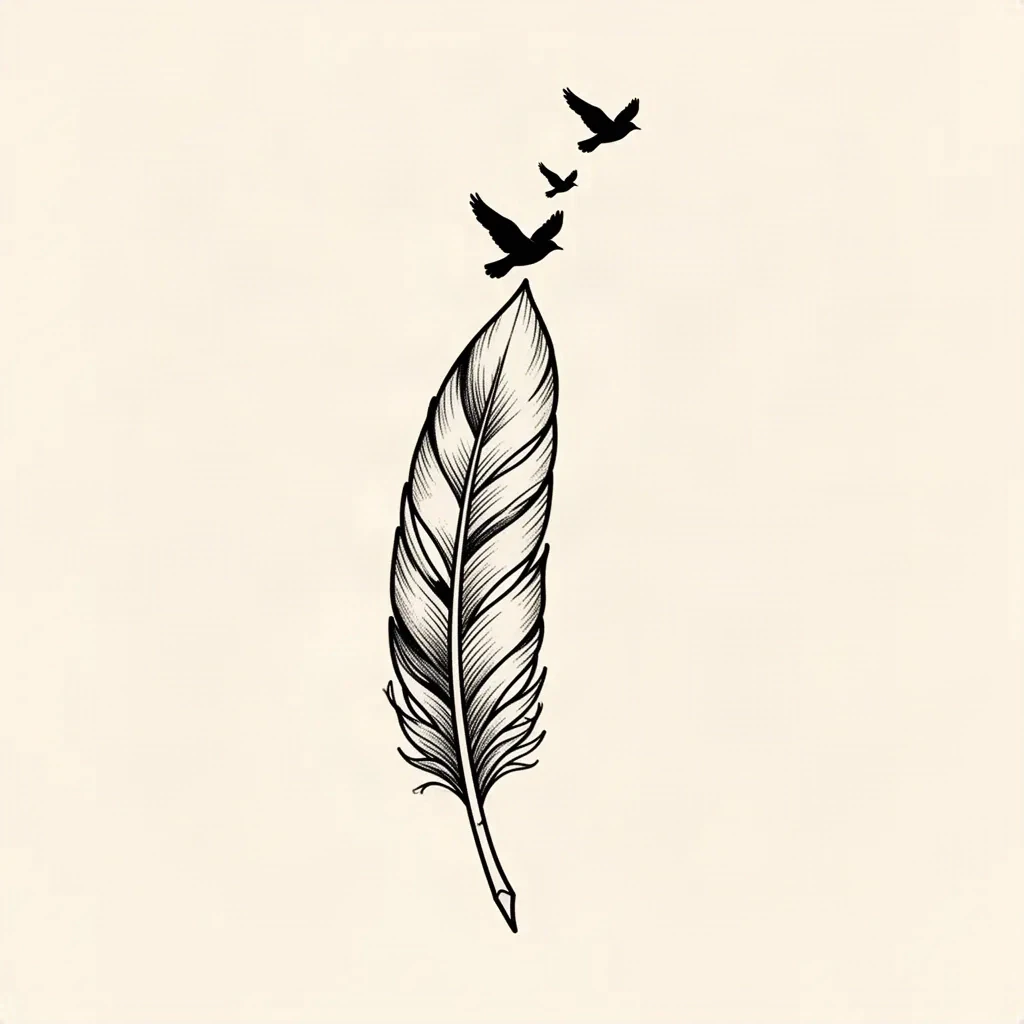
Editorial line illustration of a curved feather with three bird silhouettes rising from the tip along the shaft direction, with open paper between the last barb and the first bird and between every bird pair

Handoff holds

Flock seated on the shaft exit line

The birds leave the tip zone along the axis the shaft points toward, with one open break after the last barb and visible space between each pair. This is the arrangement the combo check looks for, drawn to show the axis rather than a measured template.

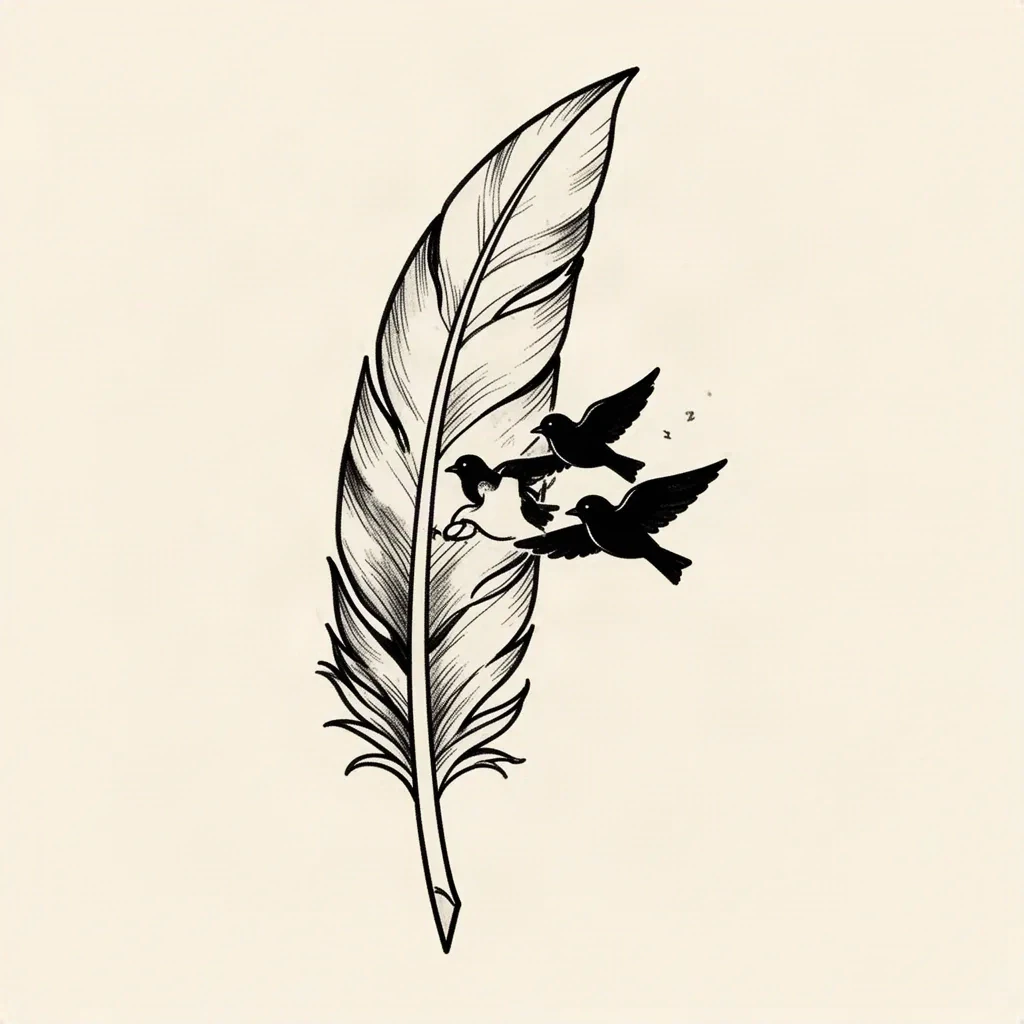
Editorial line illustration of a feather with three crowded bird silhouettes leaving the middle of the vane sideways, with one wing touching the vane edge

Handoff fails

Flock peeling sideways off the mid-vane

The birds exit across the shaft at a cross angle and crowd into one mass, so the eye reads a feather with a pasted-on flock. Re-route the flock onto the launch line before adjusting any bird detail.

Original editorial illustrations generated with FLUX.2 Flash to show composition logic. They are not StencilStudio app output, customer work, or measured templates. Verify every gap on your own 1:1 print.

HOLDS AT STATED SIZE

Single feather with a three-bird rise at 12 cm

Intended length 120 mm

Reference read

One gently curved feather with a continuous shaft and ranked barbs, releasing three small birds that grow smaller and wider spaced as they rise from the tip zone. Calm on screen because the flock follows the shaft exit direction with one clear handoff gap.

Protect
Shaft path from quill to tip with its exit direction, the handoff gap between the last barb detail and the first bird, and the ranked bird sizes with widening gaps between all three.
Fix
Keep one ranked barb family per side, hold the handoff gap visibly open at 1:1, and rank the birds so each keeps open skin around it. If one bird gap closes, reseat the closest bird farther along the launch line before removing any bird.
Candidate stencil
Same feather with one ranked barb family per side, a clean handoff gap at the tip zone, and a countable ranked flock on one launch line at transferable mass.
Final-size verdict
Holds at 12 cm after a handoff and gap check. Every barb separation and every bird gap stays open at true size, and the piece reads as one feather releasing one flock.

THIN THE FLOCK FIRST

Full feather with a seven-bird scatter at 9 cm

Intended length 90 mm

Reference read

Dense feather with full barb rows plus seven small birds scattered across two directions from the mid-vane and tip. Rich on screen because bird count suggests motion, which is exactly what closes first on paper when small silhouettes share one short field.

Protect
Shaft flow with its curve, the overall vane taper, and the two or three strongest bird positions nearest the launch line.
Fix
Reduce the flock to three or four birds on one launch line, widen every inter-bird gap until each bird keeps open skin at 1:1, and convert the weakest birds into spaced stipple or remove them. Do not keep full barb density plus a full scatter at 9 cm.
Candidate stencil
Same feather with one ranked barb family per side, a clean handoff gap at the tip zone, and a countable ranked flock on one launch line at transferable mass.
Final-size verdict
Not stencil-ready until the flock is thinned and re-aimed. Shaft curve and vane taper can stay, because inter-bird gaps merge before barb detail does at this length.

RE-ROUTE THE HANDOFF

Feather with birds peeling off the mid-vane at 10 cm

Intended length 100 mm

Reference read

Smooth feather with birds exiting sideways off the middle of the vane at a cross angle to the shaft, plus one bird touching the vane edge. Dynamic on screen, but the cross exit breaks the launch line and the contact point closes first in transfer.

Protect
Quill base position, shaft direction with tip placement, and the bird silhouettes that can be reseated without redrawing.
Fix
Move every bird onto the shaft exit line rising from the tip zone, open a clean handoff gap between the last barb and the first bird, and rank the remaining birds with widening gaps. If the sideways exit must stay for style, enlarge past the point where the vane contact holds open skin.
Candidate stencil
Same feather with one ranked barb family per side, a clean handoff gap at the tip zone, and a countable ranked flock on one launch line at transferable mass.
Final-size verdict
Holds at 10 cm only after the flock is re-routed onto the launch line with a held handoff gap. Motion should come from ranked spacing along one axis, not from cross-angle exits.

ENLARGE OR RECROP

Frayed tip with five small birds and fine filaments at 6 cm

Intended length 60 mm

Reference read

Small feather with a split tip, fine filaments past the vane edge, and five small birds packed into the tip zone sharing one short field. Delicate on screen with hairline separations where barb detail and bird edges compete for the same room.

Protect
Shaft direction with tip placement, and the one or two strongest bird positions that carry the dispersal read.
Fix
Enlarge past the point where every filament, barb gap, and inter-bird gap transfers as a separate mark, or recrop to one clean tip plus two or three ranked birds with the filaments removed. Do not keep split tips plus filaments plus a packed flock together at 6 cm.
Candidate stencil
Same feather with one ranked barb family per side, a clean handoff gap at the tip zone, and a countable ranked flock on one launch line at transferable mass.
Final-size verdict
At 6 cm the filaments and nearest birds function as one smudge. Enlarge, recrop to fewer birds with a clean tip, or choose a bolder smooth construction for this length.

Dispersal count and spacing at final size

Judge the white space between birds at the length you will print.

Screens forgive crowding that paper and skin do not. Set the length first, choose a countable flock, then inspect each gap below at true physical size with scaling off.

About 6 cm and below

Finger sides, behind-ear marks, wrist accents, and small gap fillers.

Carry two birds maximum on one short launch line with a clean feather tip. If one inter-bird gap or the handoff gap closes at 1:1, drop to one bird or enlarge rather than forcing reduction.

About 8 to 12 cm

Common forearm, ankle, shoulder, and sternum combo pieces.

The most flexible band for combos. Three to four ranked birds with widening gaps work when the handoff gap, every inter-bird gap, and every barb separation is verified at true size.

About 14 cm and above

Thigh, upper back, chest, and showcase fine-line compositions.

Room for five or more birds with a longer dispersal run, but only when open skin separates every bird pair and the handoff gap stays clean. Extra length does not rescue cross-angle exits or barb-to-bird contact.

Combo continuity checks by length band
FeatureAbout 6 cm and belowAbout 14 cm and above
Handoff gapOne wide clean break between the last barb detail and the first bird. At small lengths this gap is the load-bearing separation of the whole combo.Same priority, with room to show a short dispersal trail of stipple or fading barbs inside the gap as long as open skin still separates feather from bird.
Bird rankingLargest bird nearest the feather, smaller birds farther out, with the gap widening along the run. Even two birds must rank or they read as twins.Full rank across five or more birds with counted gaps. Mirror spacing loosely rather than measuring equal gaps, because equal gaps flatten the motion read.
Launch directionOne straight launch line continuing the shaft exit direction. No cross-angle exits at small lengths.One held curve allowed when every bird sits on the same arc and gaps stay countable at 1:1. Protect entry angle at the tip and exit direction of the last bird.
Silhouette separationSolid bird silhouettes with no inner detail and open skin between every pair. If two wings touch, the pair becomes one bird.Counted wing notches allowed only when each keeps its own skin break at 1:1. Inner feather hints inside birds stay out unless every notch holds.

Reference to clean stencil

Build from the shaft outward, then protect the gaps.

Work in this order so one change at a time can be judged at the same length. Stop when shaft, launch line, handoff, birds, and barbs each read correctly.

  1. 01

    Lock length, placement, and combo read first

    Set the intended physical length in millimeters, name the body area, and name the combo in one line: feather with a three-bird rise, curved feather with dispersing flock, or minimal feather with a bird pair. A combo that holds at 12 cm on a sternum can fail at 6 cm on a wrist with no line being wrong on its own. Use the size calculator when target dimensions are still open.

  2. 02

    Verify the handoff against the placement

    Match the shaft exit direction to the body line: vertical shafts suit sternums and outer forearms where the flock can rise, while curved shafts suit flat panels with room for the arc. Confirm the full dispersal run fits the available length, then rank the composition: shaft path and launch line first, bird count and gaps second, barb detail and tip third. Resolve cross-angle exits and vane contact before touching line weight.

  3. 03

    Set feather-versus-flock roles

    Assign every mark a role: shaft, handoff gap, and bird silhouettes that carry the first read, support barbs that shape the vane, and texture that can be removed. Strengthen the shaft edges, the handoff gap edges, and each bird outline first, keep inner barbs lighter, and mark one removable bird or barb row that can go if gaps close.

  4. 04

    Simplify count, spacing, and continuity at 1:1

    Reduce the flock to a countable number on one launch line, widen gaps until every bird keeps open skin, hold the handoff gap clean of barb filaments, and rank bird sizes along the run. Run a squint check: step back until fine barbs disappear and confirm the shaft arc, the launch line, and every bird still read. The line-weight guide covers fine, normal and bold behavior on the same stencil.

  5. 05

    Verify print and transfer path

    Export a true-size PDF with no fit-to-page scaling, inspect the handoff gap, the tightest inter-bird gap, and the narrowest barb channel on plain paper, then measure the physical print with a ruler. Keep lines at a transferable mass for fine-line work and avoid hairlines that look clean on screen but skip on skin. If the digital file passes and only paper fails, move to print-stage evidence instead of simplifying again.

Placement and composition decisions

Vertical shafts want rising flocks, curves want flat width

A combo is either a vertical shaft line with a rising flock or one held arc with birds on the same curve. Wrapped placements demand the matching shaft line.

Sternum and upper chest

Vertical flat panels where the feather shaft can run centerline and the flock can rise with room. Symmetry is visible, so a crooked launch line shows fast.

Check: Center the shaft on the flattest span, run the flock straight up the launch line, and verify the handoff gap and every inter-bird gap at 1:1 before print.

Outer forearm and calf

Long fields where a straight shaft follows the limb axis and the flock rises along it. Cross-limb dispersal crowds bird gaps fast and tendon movement punishes fine barbs.

Check: Align the shaft and launch line with the limb axis, keep all birds on that axis, and confirm tip and last-bird clearance at the exact millimeter length.

Shoulder blade and upper back

Broad panels with room for longer dispersal runs and a held launch curve. The extra room tempts extra birds that still need separations.

Check: Spend the extra length on inter-bird gaps and the handoff gap first, then decide whether another bird earns its place.

Ribs, wrist, ankle, and behind ear

Curved or small wrapped fields where dispersal runs compress. Flat reference curves distort on ribs, and small fields merge birds before barbs.

Check: Open the launch arc past the point where bird gaps hold on a curve preview, or drop to a two-bird rise with a clean tip. Preview on a body photo and enlarge or reselect at the first closed gap.

Stencil-ready checklist

Approve the combo only when every line passes

Run this short sequence with scaling off and a ruler in hand. One failed line means fix, enlarge, or reselect before transfer.

  • Confirm intended length in millimeters, the named placement, and the combo read.
  • Confirm one launch line continuing the shaft exit direction with no cross-angle exits.
  • Confirm a clean handoff gap between the last barb detail and the first bird at 1:1.
  • Confirm countable birds with open skin between every pair and ranked sizes along the run.
  • Confirm barb-to-silhouette continuity with no barb touching any bird edge.
  • Export a true-size PDF with scaling off and measure the physical print.
Launch line first Verify gaps at 1:1 Handoff, birds, barbs stay separate

FAQ

Feather-with-birds decisions, answered

Short answers for the transition, dispersal, continuity, size, and placement checks that recur when a combo reference moves toward transfer-ready output.

Seat every bird on the shaft exit line rising from the tip zone, keep one clean handoff gap between the last barb detail and the first bird, and rank bird sizes with widening gaps along the run. The pasted-on read comes from birds peeling off the mid-vane at a cross angle or touching the vane edge. Cover the birds: if the bare feather points at the flock like an arrow, the transition holds.

Next steps

Use the neighboring owners for adjacent jobs.

This guide covers shaft-to-flock transition, dispersal count and spacing, barb-to-silhouette continuity, and gap-holding transfer prep for combos. Use the links below for related jobs such as single-plume vetting, bird choice, sizing, print checks, paper, and placement.

Single-plume barb and shaft depth, flying versus perched species comparison, winged-cross composition, photo-conversion mechanics, flash gallery browsing, paper manufacturing detail, and placement mechanics stay in their specialist owners. The links above hand off instead of repeating that detail.

From evaluated reference to working stencil

Turn the approved combo into a stencil draft.

Start from the combo that passed the transition, dispersal, and continuity checks, then continue on iPhone for body fit, exact-size print, mirror and professional export.