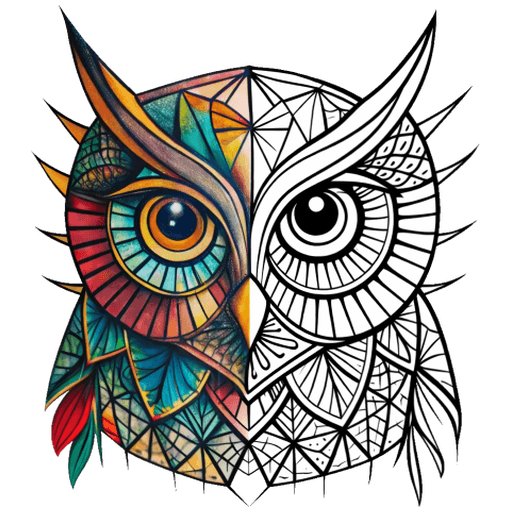

Bird stencil evaluation

Judge any bird reference before it becomes a stencil

Birds live or die on pose fit and feather separation. Compare flying against perched, confirm the species silhouette, simplify beak and feet, then prepare a clean stencil that transfers as one readable bird at your exact size.

Built for working artists preparing bird pieces. This page covers generic bird variant choice, species silhouette readability, and feather, beak, and feet preparation only, not tattoo application or healing advice. Dove memorial and pair logic, owl eye and facial-disc work, and origami folded-plane construction each live with their own owners and are linked, not repeated, below.

What makes a bird stencil-viable

Pose, silhouette, and separations decide the result.

A bird is one pose plus one species read. These three pillars predict whether that combination survives reduction, print, and transfer.

Pose and silhouette hierarchy

A bird stencil reads first as one body angle plus one silhouette cue: spread wings and tail fan for flight, folded wings and upright breast for a perch. Species follows from beak shape, tail length, and leg posture, not from feather texture. Stencil viability comes from naming the pose and the species cue before judging any feather, because photo reference shows layered barbs and soft overlaps that merge into one band on skin.

Check: Cover every feather row. If the bare body angle plus beak direction and tail shape still reads as the intended bird at a glance, the hierarchy is sound. If removing texture leaves an unplaceable generic shape, lock pose and silhouette before touching line weight.

Feather, beak, and feet simplification

Flight feathers carry ranked primaries with open skin between them, coverts sit above as a second row, and breast plumage is texture, not structure. Beaks fail when the upper and lower edges close into one blob, and feet fail when individual toes share one narrow field with branch or ground cues. Transfer needs countable separations: each primary gap, each tail channel, each beak edge, and each toe gap traced from open skin to open skin.

Check: Trace every separation at true size. If a channel dead-ends into shaded down or a toe gap closes against a branch line, that row or contact needs reopening, conversion to stipple, or removal before print.

First-read outline at final size

Small birds are judged by outline, not plumage. Wingspan width for flight, body column height for a perch, tail length and spread, and head-to-beak angle carry the read from across the room. Branch hints, ground lines, and foliage are second-read detail that must stay outside the body silhouette with their own skin breaks, or the bird and its perch print as one mass.

Check: Squint at the reference at the exact physical height until fine rows disappear. If pose, tail, and beak still read as the intended bird, the silhouette holds. If branch, feet, or foliage merge into the body edge, reopen those contacts first.

Flying versus perched

Choose the pose the placement can actually hold.

Pose is the highest-cost decision on a bird stencil. Set it against width, limb axis, and species before refining a single feather.

Flying

Best for: Freedom, motion, and chest, shoulder-blade, or thigh compositions with horizontal room.

Build: One body axis with both wings extended, tail fanned as counterweight, head and beak setting direction. Protect full wingtip span on both wings, the body angle, and the tail fan outline.

Failure mode: Inner coverts crowd outer primaries near the wing bend, and mirrored wingtips close the center gap on symmetric compositions. Keep two feather rows maximum with open skin between them.

Size floor: Needs width. Holds from about 8 cm upward for compact swallows, about 12 cm and above for broad raptors with fingered primaries.

Perched

Best for: Calm, watchfulness, and narrow limb fields such as wrist, forearm, ankle, and behind-ear placements.

Build: One upright body column with folded wings, rounded or sleek breast, tail resting along one line, head and beak carrying species character. Protect body angle, folded wing edge, tail length, and beak placement.

Failure mode: Tail barbs stack into one dark band and breast shading merges without a stencil mark. Reduce the tail to one fan with two or three separations and convert breast wash into one contour or stipple.

Size floor: Fits narrow fields. Holds from about 5 cm upward for compact songbirds when reduced to one feather row with a clean tail.

Dove-specific pose meanings such as memorial pairs and olive-branch release stay on the dove owner. Owl perched-versus-flight logic driven by eyes and facial disc stays on the owl owner. This comparison exists to place a generic bird body correctly, not to replace those owners.

Species silhouette readability

Pick the outline that survives your size.

Each common stencil bird reads by a different two- or three-part cue. Protect that cue and the species holds even after texture is removed.

Swallow and swift

Reads by: Long swept wings, forked tail, compact body. Reads by wing sweep plus tail fork alone, so it survives small sizes better than most birds.

Simplify: Protect the fork depth with a skin break between tail points. Keep one primary row per wing and drop inner coverts below 7 cm.

Watch: Tail fork fills first. If the fork closes at 1:1, deepen the notch or enlarge before touching wing mass.

Sparrow, robin, and songbirds

Reads by: Rounded body, short conical or pointed beak, medium tail, thin legs. Reads by breast curve plus beak plus tail length.

Simplify: Keep one folded-wing edge with one primary row, one clean breast contour, and beak as two separated edges. Convert belly shading to open skin or light stipple.

Watch: Feet and branch contact merge first. Keep the branch to one short bar or remove it under 8 cm.

Crow and raven

Reads by: Heavy straight beak, wedge or fan tail, broad wings with fingered tips in flight. Reads by beak mass plus tail shape.

Simplify: Protect beak outline with a throat gap below it. Keep primary fingers countable with open channels between each tip.

Watch: All-black mass tempts solid fill. Hold open skin inside wing bends and tail channels or the bird prints as one silhouette with no feather read.

Eagle and hawk

Reads by: Hooked beak, broad fingered primaries, wide fan tail, heavy talons. Reads by beak hook plus splayed wingtips.

Simplify: Protect the hook notch with its own skin break. Rank primaries so every finger keeps a channel to open air, and reduce talons to grouped shapes with toe gaps.

Watch: Needs the most width. Do not force a spread-wing raptor under about 12 cm without recropping to a head-and-shoulder or perched construction.

Crane and heron

Reads by: Long legs, long dagger beak, S-curved neck, trailing plumes. Reads by neck curve plus leg length.

Simplify: Protect neck flow as one continuous contour and keep legs as two separated lines with a gap between them along their full length.

Watch: Legs close into one line on curved placements. Align the leg axis with the limb and verify the inter-leg gap at 1:1 before print.

Hummingbird (boundary)

Reads by: Tiny body, needle beak, blurred wings in life. Reads by beak-to-body ratio plus hovering posture.

Simplify: This owner covers only the boundary decision: hovering posture with one wing pair and a flower cue held clear of the beak. Full hovering-mechanics and flower-composition depth belongs to a dedicated hummingbird owner when it exists.

Watch: Do not build a detailed hummingbird composition here. If the client wants hovering detail at small size, enlarge past the point where beak and wing gaps hold, or hand off to species-specific research.

Broad cross-animal comparison across big cats, wolves, pets, birds, and sea life stays on the animals collection. Geometric folded-plane bird construction stays on the origami-birds sample. This section exists to separate naturalistic bird outlines at size, not to replace those owners.

Bird evaluation framework

Score the reference in minutes, then act on the weakest check.

Four bird constructions at labeled sizes. Each one names the protected structure, the fix, and the go or no-go verdict at that exact size. Confirm with a measured 1:1 print.

HOLDS AT STATED SIZE

Flying swallow with forked tail at 9 cm

Intended width 90 mm

Reference read

Side-view swallow in level flight with swept wings raised, a deep forked tail, and a compact body. Minimal cue load, which is why the structure transfers well once the fork is ranked.

Protect
Body flight angle with beak direction, full wingtip span on both wings, and the fork depth between tail points.
Fix
Keep one primary row per wing with open skin between feathers, and hold the fork notch visibly open at 1:1. If a wingtip gap closes, shorten only the shortest overlapping tip before changing wing mass.
Candidate stencil
Same bird with ranked primaries, separated beak edges, grouped toes with gaps, tail fan or fork held open, and any branch or foliage kept outside the body silhouette at transferable mass.
Final-size verdict
Holds at 9 cm after a fork-clearance check. Every primary separation and the tail notch stay open at true size, and the piece reads as swallow from a normal viewing distance.

SIMPLIFY TAIL AND FEET FIRST

Perched songbird on a branch hint at 7 cm

Intended height 70 mm

Reference read

Upright perched bird with folded wings, a rounded breast, a medium tail, thin legs, and a short branch bar. Quiet on screen, which is why the structure transfers well once tail and feet are ranked.

Protect
Perched body angle, head and beak placement, folded wing edge with one primary row, and the tail length that sets the species read.
Fix
Reduce the tail to one fan with two or three separations, convert breast shading into one clean contour with open skin inside it, keep toes to grouped shapes with visible gaps, and keep the branch to one short bar or remove it. Do not keep layered tail barbs plus shaded down plus full toes at 7 cm.
Candidate stencil
Same bird with ranked primaries, separated beak edges, grouped toes with gaps, tail fan or fork held open, and any branch or foliage kept outside the body silhouette at transferable mass.
Final-size verdict
Not stencil-ready until tail, feet, and breast shading are reduced. Folded wings and the perched angle can stay, because tail channels and toe gaps merge first at this height.

CONFIRM SPAN OR RECROP

Spread-wing raptor in flight at 14 cm

Intended width 140 mm

Reference read

Bird of prey with wings fully spread, fingered primaries splayed on both sides, hooked beak, fanned tail. Suited to broad flat placements because the composition runs wide rather than tall.

Protect
Full wingtip span on both wings, body axis with head and beak hook, tail fan outline, and the gap between covert rows and primary rows.
Fix
Keep two feather rows maximum with open skin between coverts and primaries, mirror primary counts so both wings read as one bird, and protect the hook notch with its own skin break. If the span still crowds the placement, widen the field or recrop to a perched column before thinning either wing.
Candidate stencil
Same bird with ranked primaries, separated beak edges, grouped toes with gaps, tail fan or fork held open, and any branch or foliage kept outside the body silhouette at transferable mass.
Final-size verdict
Holds at 14 cm once every primary channel and the beak notch stay open at true size. Width carries the raptor read while the hook and tail confirm species.

ENLARGE OR RECROP

Detailed perched bird with foliage at 5 cm

Intended height 50 mm

Reference read

Small perched bird with full feather rows, individual toes, layered leaves, and soft breast shading sharing one small field. Rich on screen with hairline separations and fine foliage sharing the same room.

Protect
Body angle with tail position, and beak placement that carries the species read.
Fix
Enlarge past the point where every primary separation, toe gap, and leaf gap transfers as a separate mark, or recrop to the bird alone with foliage removed. Do not keep full feather rows plus toes plus leaves together at 5 cm.
Candidate stencil
Same bird with ranked primaries, separated beak edges, grouped toes with gaps, tail fan or fork held open, and any branch or foliage kept outside the body silhouette at transferable mass.
Final-size verdict
At 5 cm the toes fill in, leaves touch the body edge, and feathers function as one band. Enlarge, recrop to the bird alone, or choose a bolder minimal construction for this height.

Feathers, beaks, feet, and tails at final size

Judge the white space at the height you will print.

Screens forgive crowding that paper and skin do not. Set the size first, then inspect each feature below at true physical size with scaling off.

About 5 cm and below

Finger sides, behind-ear marks, and small gap fillers.

Carry one minimal bird with one feather row, a two-edge beak, and no branch or foliage. If a wingtip gap, tail notch, or toe gap closes at 1:1, enlarge or reselect rather than forcing reduction.

About 6 to 10 cm

Common wrist, forearm, ankle, and shoulder songbird pieces.

The most flexible band for perched birds and compact fliers such as swallows. A perched bird with a ranked tail or a flying swallow with a held fork can work when every feather gap, beak edge, and foot contact is verified at true size.

About 12 cm and above

Upper chest, shoulder blade, thigh, and spread-wing compositions.

Room for raptors with fingered primaries, cranes with leg length, or paired flight paths, but only when open skin separates every feather row, every toe, and every cue. Larger height does not rescue merged tails, touching branches, or filled beaks.

Bird feature checks by height band
FeatureAbout 5 cm and belowAbout 12 cm and above
Flight feathersOne outer primary row only. Keep the heaviest lines on the outer edge; if a wingtip edge disappears, the wing becomes a plain fin.Two rows maximum with open skin between coverts and primaries. Mirror counts wing to wing on symmetric compositions.
BeaksTwo separated edges with a throat gap below. If upper and lower edges touch, the head reads as one blob.Same priority plus species notch: hook for raptors, fork-adjacent point for swallows, dagger length for herons. The notch needs its own skin break.
Feet and legsGrouped toe shapes with visible gaps, or omit feet entirely on a flying bird. Never share one narrow field with branch texture at this band.Individual toes allowed only when every gap holds at 1:1. Long legs need a continuous gap between them along their full length.
TailsOne fan with two or three separations, or one fork with a held notch. Tail shape carries species, so protect outline before inner detail.Wider fans allowed when every channel stays countable at 1:1. Tail contact with script, branches, or foliage still needs a skin break.

Reference to clean stencil

Build from the body angle outward, then protect the gaps.

Work in this order so one change at a time can be judged at the same size. Stop when pose, species cue, feathers, beak, feet, and tail each read correctly.

  1. 01

    Lock size, placement, and species read first

    Set the intended physical width or height in millimeters, name the body area, and name the bird in one line: swallow in flight, perched songbird, crow, raptor, heron, or similar. A swallow that holds at 9 cm on a forearm can fail at 5 cm on a finger with no line being wrong on its own. Use the size calculator when target dimensions are still open.

  2. 02

    Verify pose against the placement

    Match flying constructions to wide flat fields and perched constructions to narrow limb fields. Confirm the pose fits the available width or height, then rank the composition: body angle and silhouette first, feather rows and tail second, branch or foliage cues third. Resolve wingtip contact, tail crowding, and cue overlap before touching line weight.

  3. 03

    Set bird-versus-cue roles

    Assign every mark a role: bird structure that carries the first read, support that shapes it, and texture that can be removed. Strengthen the body contour, beak edges, tail outline, and outer primary edge first, keep inner coverts and foliage lighter, and mark one removable feather row or leaf that can go if gaps close.

  4. 04

    Simplify feathers, beak, and feet at 1:1

    Reduce feather rows, hold beak edges and notches open, group toes with visible gaps, and keep branch or foliage cues outside the body silhouette with their own skin breaks. Run a squint check: step back until fine rows disappear and confirm the body angle, tail, and beak still read. The line-weight guide covers fine, normal and bold behavior on the same stencil.

  5. 05

    Verify print and transfer path

    Export a true-size PDF with no fit-to-page scaling, inspect the narrowest primary gap, the tightest tail channel, and the smallest beak or toe contact on plain paper, then measure the physical print with a ruler. If the digital file passes and only paper fails, move to print-stage evidence instead of simplifying again.

Placement and composition decisions

Flying birds want flat width, perched birds want a limb axis

A bird is either a horizontal wingspan or a vertical body column. Flat placements preserve both with little compensation, while wrapped placements demand the matching pose.

Chest and shoulder blade

Broad flat panels with room for level flight and full wingspan. The sternum centerline becomes part of the design, so any wing asymmetry is immediately visible.

Check: Center the body on the flattest span, mirror primary rows, keep tail and cue contacts clear of wingtips, and verify every feather gap at 1:1 before print.

Wrist and forearm

Narrow wrapped fields where wide-spread wings crowd fast and long tails overhang the bone edge. Tendon movement punishes fine feather rows.

Check: Choose a compact flier or a perched recrop aligned with the limb axis, shorten cross-limb wingtips while edits are still cheap, and confirm tail and beak clearance at the exact millimeter height.

Thigh and upper back

Large fields where raptors, herons, and wide flight compositions can breathe. Curvature at the edges still distorts wingtips and long legs.

Check: Spend the extra room on primary channels, tail fans, and leg gaps first, then decide whether inner coverts or foliage earn their detail.

Ankle, finger, and behind ear

Small curved fields where only minimal constructions survive. Toes, beak edges, and tail notches fill faster than wings do.

Check: Carry one feather row, grouped toes or none, and no foliage. Preview on a body photo before locking the layout, and enlarge or reselect at the first closed gap.

Stencil-ready checklist

Approve the bird only when every line passes

Run this short sequence with scaling off and a ruler in hand. One failed line means fix, enlarge, or reselect before transfer.

  • Confirm intended size in millimeters, the named placement, and the species read.
  • Confirm ranked primary rows with open skin between feathers at 1:1.
  • Confirm beak edges and species notch hold their own separations.
  • Confirm toes or leg gaps stay open and branch cues sit outside the body silhouette.
  • Confirm tail fan or fork stays countable with no cue contact.
  • Export a true-size PDF with scaling off and measure the physical print.
Pose fits placement first Verify gaps at 1:1 Beak, feet, tail stay separate

FAQ

Bird stencil decisions, answered

Short answers for the pose, species, feather, beak, feet, and placement checks that recur when a bird reference moves toward transfer-ready output.

Match the pose to the placement and the available room. Flying constructions suit wide flat fields such as the chest, shoulder blade, or thigh, and need horizontal width for the wingspan. Perched constructions suit narrow limb fields such as the wrist, forearm, or ankle, where a vertical body column fits the bone axis. When the placement is still open, this page recommends deciding pose first, because a pose change rebuilds the whole stencil while feather edits only refine it.

Next steps

Use the neighboring owners for adjacent jobs.

This guide covers generic bird variant choice, species silhouette readability, feather, beak, and feet simplification, and reference-to-stencil preparation. Use the links below for related jobs such as sizing, print checks, paper, and placement.

Dove memorial and pair depth, owl eye and disc depth, origami folded-plane geometry, 28-animal gallery comparison, photography documentation, patchwork-sleeve planning, and generic board, grid, and checker tool mechanics stay in their specialist owners. The links above hand off instead of repeating that detail.

From evaluated reference to working stencil

Turn the approved bird into a stencil draft.

Start from the bird that passed the pose, silhouette, feather, beak, and feet checks, then continue on iPhone for body fit, exact-size print, mirror and professional export.