

Winged-cross stencil evaluation

Judge any cross-with-wings reference before it becomes a stencil

Winged crosses live or die on two bargains at once: cross proportion plus bilateral wing symmetry, and open feather gaps where wings meet cross arms. Check both at your exact width, triage reverence at final size, then prepare a clean symmetric transfer.

Built for working artists preparing winged-cross pieces. This page covers integrated cross-plus-wings composition vetting, junction gap retention, scoped reverence triage, and symmetric transfer prep only, not tattoo application or healing advice. Cross-only variant depth stays on the cross owner, family-level triage on the religious owner, and figure wings on the angel owner.

What makes a winged cross stencil-viable

Proportion, symmetry, and junction gaps decide the result.

A winged cross is one cross plus two mirrored wings sharing one centerline. These three pillars predict whether that integrated composition survives reduction, print, and transfer.

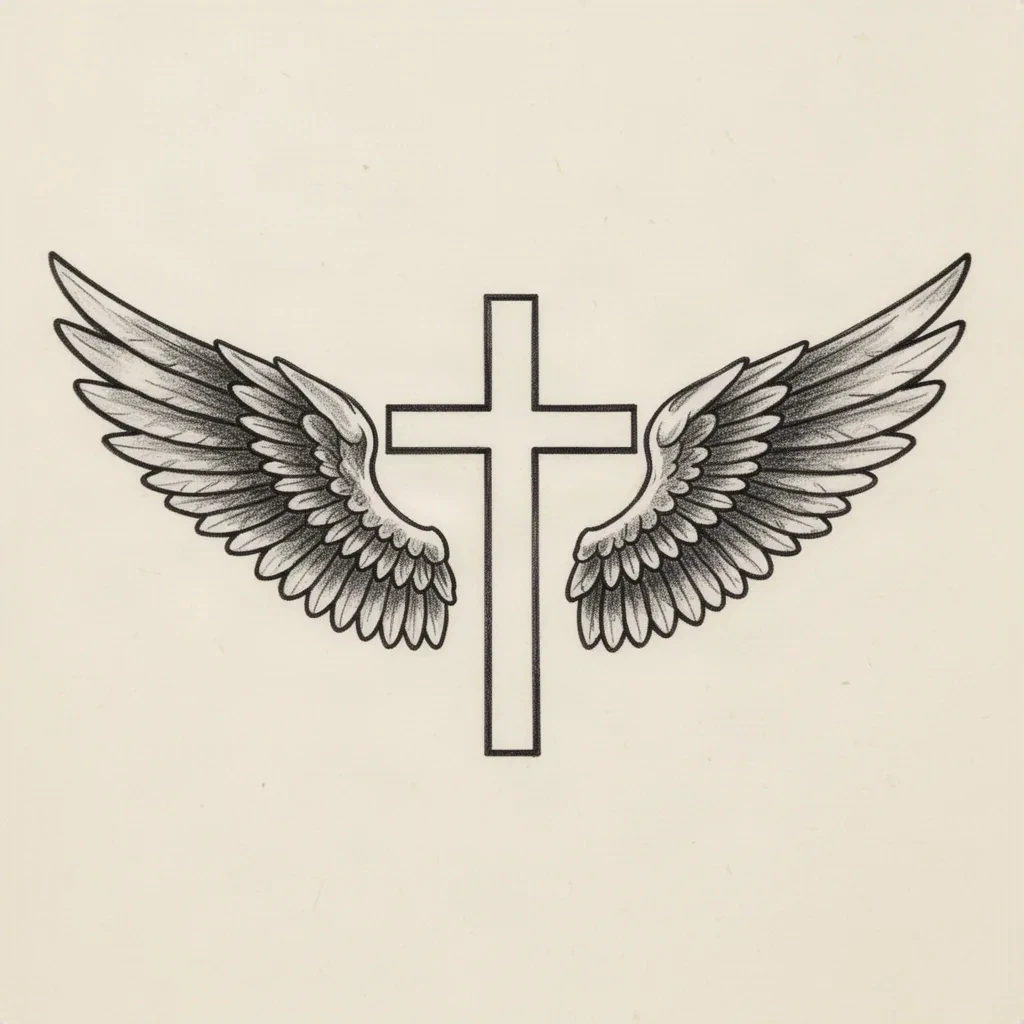
Synthetic pencil-style illustration of a centered plain Latin cross in front of two matching spread wings, with one primary feather row per side and open space between each wing base and the cross edge.
Synthetic reference illustration, not a candidate stencil, app output, or measured proof. It shows the composition under review: a plain cross read first, matched wings read second, and visible separation at both wing bases.

What the illustration is for

Use it to orient the conversation, then judge the actual reference at your physical width. The drawing settles vocabulary, not viability: shading, feather density, and gap widths in any illustration or gallery image still have to pass the 1:1 checks below.

  • Cross first. Cover both wings and confirm the bare cross still reads as the intended family.
  • Wings matched. Compare span, tip height, and feather-row count across the vertical center.
  • Junctions open. Trace each wing base to the cross edge on paper at true size, not on screen.

Cross proportion

The cross still reads first as two bars with one stable vertical axis and a deliberate crossbar position. A winged cross fails when wings pull attention before the cross silhouette is settled, so lock arm length, crossbar height, and end shapes before judging any feather.

Check: Cover both wings with two fingers. If the bare cross still reads as the intended family (plain Latin, flared, or restrained ornate) at a glance, proportion is sound. If it reads as a plus sign or a dagger, fix arms before touching wings.

Bilateral symmetry

A winged cross carries one strong vertical mirror axis through the cross center. Left and right wings must match in span, tip height, and feather-row count, because any drift reads instantly on chest, sternum, and upper-back centerlines.

Check: Fold the reference through the vertical center. If opposite wing tips stop at different heights, or one side carries an extra feather row, fix the axis before judging line weight or gaps.

Feather-gap retention

The junctions where wings meet cross arms are the failure zone. Each feather separation and each skin break between wing base and cross edge must trace from open skin to open skin at true size. Photo shading across that junction prints as one merged pocket.

Check: Trace every wing-to-cross contact at 1:1 on plain paper. If a feather tip touches the cross arm without an open skin break, or two feather separations share one grey bridge, reopen the gap or remove the weakest feather before print.

Winged-cross evaluation framework

Score the reference in minutes, then act on the weakest check.

Four winged-cross constructions at labeled widths. Each one names the protected structure, the fix, and the go or no-go verdict at that exact size. Confirm with a measured 1:1 print.

HOLDS AT STATED SIZE

Spread memorial winged cross at 12 cm

Intended width 120 mm

Source
Plain Latin cross with a vertical bar clearly longer than the arms, centered on the midline, with two symmetric spread wings behind the crossbar. One primary feather row per side, plain ends, no halo, no script.
Protect
Vertical axis with crossbar position, matched left and right wingspan, the longest primary feather row on each side, and the open skin break between each wing base and the cross edge.
Fix
Shorten only the shortest secondary feathers if tips crowd at 1:1. Keep span, cross proportion, and wing-to-cross breaks unchanged.
Candidate stencil
Same winged cross with cross proportion set, span matched across the center, junction breaks reopened, and one ranked feather row held at transferable mass.
Final-size verdict
Holds at 12 cm after a junction check. Every feather separation stays countable at 1:1 and the cross reads first from a normal viewing distance.

SIMPLIFY JUNCTION FIRST

Compact chest emblem with layered wings at 9 cm

Intended width 90 mm

Source
Short Latin cross with flared ends and two layered wing rows tucked close behind the arms. Strong emblem on screen, but inner feather rows touch the cross arms and share narrow grey bridges.
Protect
Cross silhouette and arm flare, outer wing silhouette on both sides, and the longest primary feather row per side.
Fix
Drop to one feather row per side, reopen the skin break between each wing base and the cross edge, and merge shaded inner rows into open skin. Do not keep two full rows plus flare at 9 cm.
Candidate stencil
Same winged cross with cross proportion set, span matched across the center, junction breaks reopened, and one ranked feather row held at transferable mass.
Final-size verdict
Not stencil-ready until the junction is reopened. Layered inner feathers and arm flare merge first while the cross and outer wings can stay.

ENLARGE OR RECROP

Ornate fine-line winged cross at 6 cm

Intended width 60 mm

Source
Tall narrow cross with thin inner borders, dot accents, and hairline feather separations on long swept wings. Elegant on screen with hairline gaps between many fine feathers.
Protect
The vertical axis with the crossbar position and the one outer wing direction that carries the composition.
Fix
Enlarge past the point where every feather separation transfers as open skin, or recrop to a plain cross with one short wing suggestion per side. Do not keep full feather counts plus thin borders at 6 cm.
Candidate stencil
Same winged cross with cross proportion set, span matched across the center, junction breaks reopened, and one ranked feather row held at transferable mass.
Final-size verdict
At 6 cm the feathers function as one band and borders print as broken scratches. Enlarge, recrop, or choose a bolder construction for this width.

REBALANCE SYMMETRY FIRST

Swept gothic wings with tall cross at 14 cm

Intended width 140 mm

Source
Tall gothic cross with pointed ends and long upswept wings at different angles, one wing visibly higher and longer than the other. Dramatic on screen, reverent in intent, but asymmetric by construction.
Protect
Cross height and pointed-end family, the stronger wing side as the rebuild anchor, and the centerline position on the placement.
Fix
Mirror the stronger wing to set matched span and tip height, then re-cut feather rows to equal counts per side. If the client wants deliberate asymmetry, move it to feather length only, never to span or tip height on a centerline placement.
Candidate stencil
Same winged cross with cross proportion set, span matched across the center, junction breaks reopened, and one ranked feather row held at transferable mass.
Final-size verdict
Holds at 14 cm once span and tip height match across the midline. Extra height rescues feather detail, never a drifted axis.

Cross-only arm construction stays on the cross owner. Family-level religious comparison stays on the religious owner. Angel-figure wing and drapery work stays on the angel owner. This framework exists to judge the integrated cross-plus-wings composition at a stated width, not to replace those owners.

Variant comparison

Four winged-cross structures, four different stencil bargains.

Each variant below names what carries the first read, where it shines, what closes first at transfer size, and when to pick it. Detailed cross-only or angel-figure construction stays in the linked owners.

Spread memorial

Reads through
Plain cross centered over two evenly spread wings.
Strengths
Most forgiving stencil bargain. Cross reads first, wings read second, and one feather row per side survives modest reduction. Suits remembrance and faith pieces.
Stencil risk
Wing bases that touch cross arms without a skin break, and extra inner rows added for richness that close the junction.
Choose when
Choose when the job needs quiet remembrance or faith on a centerline placement with about 10 cm or more of width.

Compact emblem

Reads through
Short flared or bold cross with tight wings tucked close.
Strengths
Compact footprint for chest, forearm, and calf pieces where a full spread cannot fit. Flare carries identity at small widths.
Stencil risk
Tucked wings crowd the cross edge fast. Inner rows and flare points compete for the same narrow gaps.
Choose when
Choose when width is capped near 8 to 10 cm and the placement cannot carry a spread. Budget for one feather row and verified junction breaks.

Ornate fine-line

Reads through
Narrow cross with thin borders plus long elegant feather separations.
Strengths
Lightest visual weight for sternum and upper-back pieces with room. Suits clients who want delicacy over boldness.
Stencil risk
Hairline feather gaps and thin borders merge first. Needs the largest width of the four to hold its detail count.
Choose when
Choose only when width reaches about 12 cm or more on flat skin and every separation is verified at 1:1.

Swept or gothic

Reads through
Tall pointed cross with long upswept wings.
Strengths
Strongest vertical flow for spine, sternum, and full-back centerlines. Drama comes from height and sweep, not feather count.
Stencil risk
Sweep invites asymmetric wings and crossed tips. Span mismatch shows immediately on centerline skin.
Choose when
Choose when the placement is a vertical centerline with room for height. Enforce matched span and tip height before approving sweep.

Reverence and recognition at final size

Triage the winged cross before judging lines.

Winged-cross failures are rarely about line weight alone. They come from a vague promise, a lost anchor, or crowded devotional extras that simplification cannot fix. This scoped triage covers winged crosses only.

01

Confirm the one-line intent

Ask the client to name the meaning in one sentence: remembrance of a named person, faith statement, protection, or gratitude. A memorial winged cross, a faith emblem, and a guardian statement are different promises even when the drawing looks similar. Resolve the intent before comparing wing spreads, because no gap fix rescues the wrong promise.

02

Name the recognition anchor

Every winged cross has one element that must still read from across the room: the cross silhouette for memorial and faith pieces, or the matched wingspan for guardian pieces. Cover everything else and check whether that anchor still reads at a glance. If it needs its surroundings to make sense, the reference is not ready for reduction.

03

Reject or recrop early

Decline casual mixing of sacred systems, caricatured holy figures added beside the cross, or devotional faces forced into the wing field at small widths. Offer a plain spread memorial, a compact emblem, or a cross-only recrop instead, and send family-level questions to the religious owner before locking the winged-cross reference.

Family-level triage across cross, Jesus, angel, and praying hands stays on the religious owner. Use that owner when the job is still choosing between families. Stay here once the decision is a winged cross at a known width and placement.

Junctions and feathers at final size

Judge the white space at the width you will print.

Screens forgive crowding that paper and skin do not. Set the width first, then inspect each feature below at true physical size with scaling off.

About 8 cm and below

Wrist accents, ankle marks, and small gap fillers.

Carry a plain cross with one short wing suggestion per side and one feather row maximum. No layered rows, no thin borders, no script. If any wing-to-cross break closes at 1:1, enlarge or reselect rather than forcing reduction.

About 8 to 12 cm

Common forearm, chest, calf, and shoulder winged-cross pieces.

The most flexible band. A spread memorial or compact emblem with one ranked feather row per side can work when every junction break and feather separation is verified at true size.

About 12 cm and above

Upper chest, sternum, shoulder blade, upper back, and thigh compositions.

Room for longer sweep or restrained ornate detail, but only when open skin separates every feather, every wing base from the cross edge, and every border. Larger width does not rescue drifted span or filled junctions.

Winged-cross feature checks by width band
FeatureAbout 8 cm and belowAbout 12 cm and above
Wing-to-cross junctionsEvery wing base needs a continuous open skin break from the cross edge. If the break closes, shorten feathers or widen the break before changing any other line.Junctions can sit closer relative to width, but each one must still trace from open skin to open skin without a grey bridge.
Feather separationsKeep the heaviest lines on the outer primary row. If an outer feather edge disappears, the wing becomes a plain fin.Same priority. Larger widths allow slightly finer inner rows, but separability still beats uniform thinness.
Cross arms and outer contourProtect arm length relationship and crossbar position with the heaviest contour. Thin arms plus fine feathers fail together.Arms can carry one restrained border family when every border keeps its own separation from feather gaps.
Secondary detail and scriptNo names, dates, halos, rays, or dot fields at small widths. Each competes directly with junction gaps for the same room.One small anchor (short name, date, or dot accent) can work when it sits clear of wings and arms with its own skin margin.

Reference to clean stencil

Build from the centerline outward, then protect the junctions.

Work in this order so one change at a time can be judged at the same width. Stop when proportion, symmetry, junctions, and reverence each read correctly.

  1. 01

    Lock width, placement, and intent first

    Set the intended physical width in millimeters, name the body area, and name the intent in one line. A spread memorial that holds at 12 cm on an upper back can fail at 7 cm on a wrist with no line being wrong on its own. Use the size calculator when target dimensions are still open.

  2. 02

    Verify cross proportion and bilateral symmetry

    Confirm arm length, crossbar position, and end shapes first, then fold the reference through the vertical center and match wingspan, tip height, and feather-row count. Resolve drifted arms and asymmetric wings before touching line weight.

  3. 03

    Set cross-versus-wing roles

    Assign every mark a role: cross structure that carries the first read, wing support that shapes it, and texture that can be removed. Strengthen the outer cross contour and outer primary feather rows first, keep inner rows lighter, and mark one removable row or border that can go if junctions close.

  4. 04

    Reopen junctions and simplify feathers at 1:1

    Reduce feather rows, widen wing-to-cross breaks, and convert photo shading into clean lines or spaced stipple. Run a squint check: step back until fine separations disappear and confirm the cross plus matched wingspan still reads. The line-weight guide covers fine, normal and bold behavior on the same stencil.

  5. 05

    Verify print and transfer path with the centerline marked

    Export a true-size PDF with no fit-to-page scaling, mark the vertical centerline on the proof, and inspect the narrowest junction break and the tightest feather separation on plain paper. Align the marked centerline to the body centerline at transfer so symmetric wings do not rotate. If the digital file passes and only paper fails, move to print-stage evidence instead of simplifying again.

Placement and composition decisions

Symmetric wings want flat skin that preserves the centerline

A winged cross is a wide symmetric composition with a strict vertical axis. Flat placements preserve matched span with little compensation, while wrapped placements demand a compact recrop.

Chest and sternum

Broad flat panel with room for spread memorial wings, but the body midline becomes part of the design. Any span mismatch or drifted cross axis is immediately visible.

Check: Center the crossing on the flattest span, mirror wing tips against the midline, and preview on a body photo before locking feather count.

Upper back and shoulder blade

Large flat fields where spread and swept wings breathe. Extra room suits vertical flow, with wings extending along the shoulder line.

Check: Spend the extra room on junction breaks and feather separations first, then decide whether borders or secondary rows earn their detail.

Outer forearm and calf

Long narrow fields where the composition should follow the limb axis. Wide-spread wings wrap fast and crowd feather tips and junctions.

Check: Choose a compact emblem with tucked wings, align the cross axis with the limb, and shorten cross-limb tips while edits are still cheap.

Wrist and ankle

Small wrapped fields where only a recrop survives. Full spreads with layered feathers merge first in these bands.

Check: Recrop to a plain cross with one short wing suggestion per side, then run the small-width junction checks at the exact millimeter width.

Stencil-ready checklist

Approve the winged cross only when every line passes

Run this short sequence with scaling off and a ruler in hand. One failed line means fix, enlarge, or reselect before transfer.

  • Confirm intended width in millimeters, the named placement, and the one-line intent.
  • Confirm cross arm proportion and crossbar position with the wings covered.
  • Confirm matched wingspan, tip height, and feather-row count across the vertical center.
  • Confirm every wing-to-cross junction traces from open skin to open skin at 1:1.
  • Confirm one ranked feather family with no merged contacts or grey bridges.
  • Export a true-size PDF with scaling off, centerline marked, and measure the physical print.
Proportion plus symmetry Verify junctions at 1:1 Centerline stays straight

FAQ

Winged-cross stencil decisions, answered

Short answers for the variant, symmetry, junction, reverence, placement, and print checks that recur when a cross-with-wings reference moves toward transfer-ready output.

It is usable when three checks pass at the exact physical width: the bare cross reads with wings covered, left and right wings match in span, tip height, and row count across the center, and every wing-to-cross junction plus feather separation stays visibly open at 1:1. If any check fails, the fix list on this page names what to simplify, reopen, rebalance, or enlarge before print.

Next steps

Use the neighboring owners for adjacent jobs.

This guide covers integrated winged-cross proportion plus symmetry checks, junction gap rules, scoped reverence triage, placement-size decisions, and symmetric transfer prep. Use the links below for related jobs such as sizing, print checks, and placement.

Cross-only arm tables stay on the cross owner, family-level triage on the religious owner, figure wing and drapery tables on the angel owner, and step-by-step execution in the transfer guide. The links above hand off instead of repeating that detail.

From evaluated reference to working stencil

Turn the approved winged cross into a stencil draft.

Start from the composition that passed the proportion, symmetry, junction, and reverence checks, then continue on iPhone for body fit, exact-size print, mirror and professional export.