
Warrior stencil evaluation

Choose a warrior direction you can prove at final size

Warrior references span Spartans, knights, samurai, Aztec fighters, Norse builds, and fantasy hybrids, but a stencil only cares about one thing: whether the figure silhouette, the armor, and the weapon each keep their own separations at your exact height. Compare the five directions below, pick with explicit criteria, then vet the choice for print and transfer.

Built for working artists preparing warrior pieces. This page covers cross-style warrior direction choice plus silhouette, armor, weapon, and background vetting only, not tattoo application or healing advice. Samurai armor depth stays on the samurai owner, Aztec fretwork and sun-stone depth stays on the Aztec owner, creature and lore depth stays on the fantasy collection, and portrait likeness depth stays on the people and portrait owners linked below.

Warrior variant map

Five directions with different stencil costs. Pick deliberately.

Each direction below names its construction, its selection logic, and when to hand depth to a specialist owner instead of solving it here.

Historical armor figure

Spartan with spear and round shield, knight in plate with sword, gladiator with helmet and short blade

Reads through plate or muscle contours plus one weapon line plus a stable stance. Armor bands and weapon edges compete for the same separations, so stencil work is mostly ranking armor mass below the silhouette and keeping the weapon path clear.

Choose when: Choose when the client wants a recognizable warrior from history and the placement offers 12 cm or more of height. Spartan and knight builds suit thigh, back, and outer limb panels where shield discs and blade lengths keep their own room.
Cultural warrior figure

Samurai with katana, Aztec warrior with stepped regalia, Maori or Polynesian warrior with patterned bands

Reads through culturally specific armor plus ornament systems: lamellar rows and crest work, stepped fretwork and sun-stone focals, or blackwork band rhythm. Each system has its own separation logic that a generic warrior simplification will break.

Choose when: Choose when the client names the culture explicitly. Then hand construction depth to the specialist owner: the samurai owner for armor, kabuto, menpo, and katana specifics, the Aztec owner for fretwork bands and sun-stone focals. This page judges only the cross-style direction choice, not the specialist construction.

Mythic and fantasy warrior

Norse warrior with axe, winged guardian figure, dark hybrid fighter with creature features

Reads through an exaggerated silhouette: oversized pauldrons, horned or crested helmets, wings, claws, or paired weapons. Exaggeration survives reduction well when one silhouette leads, but creature texture and layered weapons fuse fast at small heights.

Choose when: Choose when the client wants drama over historical accuracy and the placement supports a dominant silhouette. Hold creature and lore depth on the fantasy collection and judge here only whether the figure silhouette protects its own read at the stated height.

Portrait-led warrior

Helmeted face study, scarred veteran bust, hooded figure with visible eyes

Reads through the face first and the armor second: eye line, nose bridge, and beard or mask separations carry the piece while plate and weapon marks become support. Likeness-style landmark hierarchy applies even when the subject is fictional.

Choose when: Choose when the face is the point of the piece. Hand likeness and recognition-anchor depth to the people and portrait owners, and use this page only to decide that a portrait-led construction, not a full-figure one, fits the size and placement.

Emblem and minimal warrior mark

Helmet icon, crossed weapons, shield device, single spear with banner

Reads through one contour family with wide internal gaps. The lowest density choice on this page and the only warrior construction that survives wrists, ankles, fingers, and behind-ear placements without a recrop fight.

Choose when: Choose when the available height is about 8 cm or below, or when the warrior is a gap filler inside a larger composition such as a sleeve. One emblem with two separations maximum beats any full figure forced small.

What makes a warrior stencil-viable

Silhouette, separated weapon, and ranked background decide the result.

A warrior is one armored body plus one separated weapon on one pose axis. These three pillars predict whether that construction survives reduction, print, and transfer.

Armor, weapon, and pose read

A warrior reads first as one armored body plus one separated weapon on one pose axis: standing guard, forward stride, or seated rest. Stencil viability comes from the torso silhouette plus the weapon path plus the stance each keeping open skin around them, not from engraved texture, cloth folds, or photo shading.

Check: Cover all armor texture, cloth folds, and background marks. If the figure silhouette, the weapon line, and the stance still read as three separate marks at true size, the construction is sound and texture is removable. If any two merge, repair the separations before judging detail.

Figure silhouette protection

The outer contour of helmet, shoulders, torso, and grounded feet carries the first read from across the room. Shields, crests, wings, capes, and raised weapons extend that contour and are the first marks to touch background or placement edges. When the full outer contour traces without lifting a finger, the warrior survives transfer.

Check: Trace the full outer contour at 1:1, including shield rims, crest tips, and weapon ends. Every contact with a background mark, a second figure, or a placement edge is a repair point, not a style choice.

Background restraint

Wind bars, petals, clouds, banners, sun discs, architecture, and second figures compete with the helmet and weapon gaps for the same room. One restrained background family can add motion at large heights; two equal-weight families plus a dense figure merge into one band on paper and skin.

Check: Count background families, not marks. Zero or one family ranks below figure mass at every height. Two or more families means removing or demoting at least one before print.

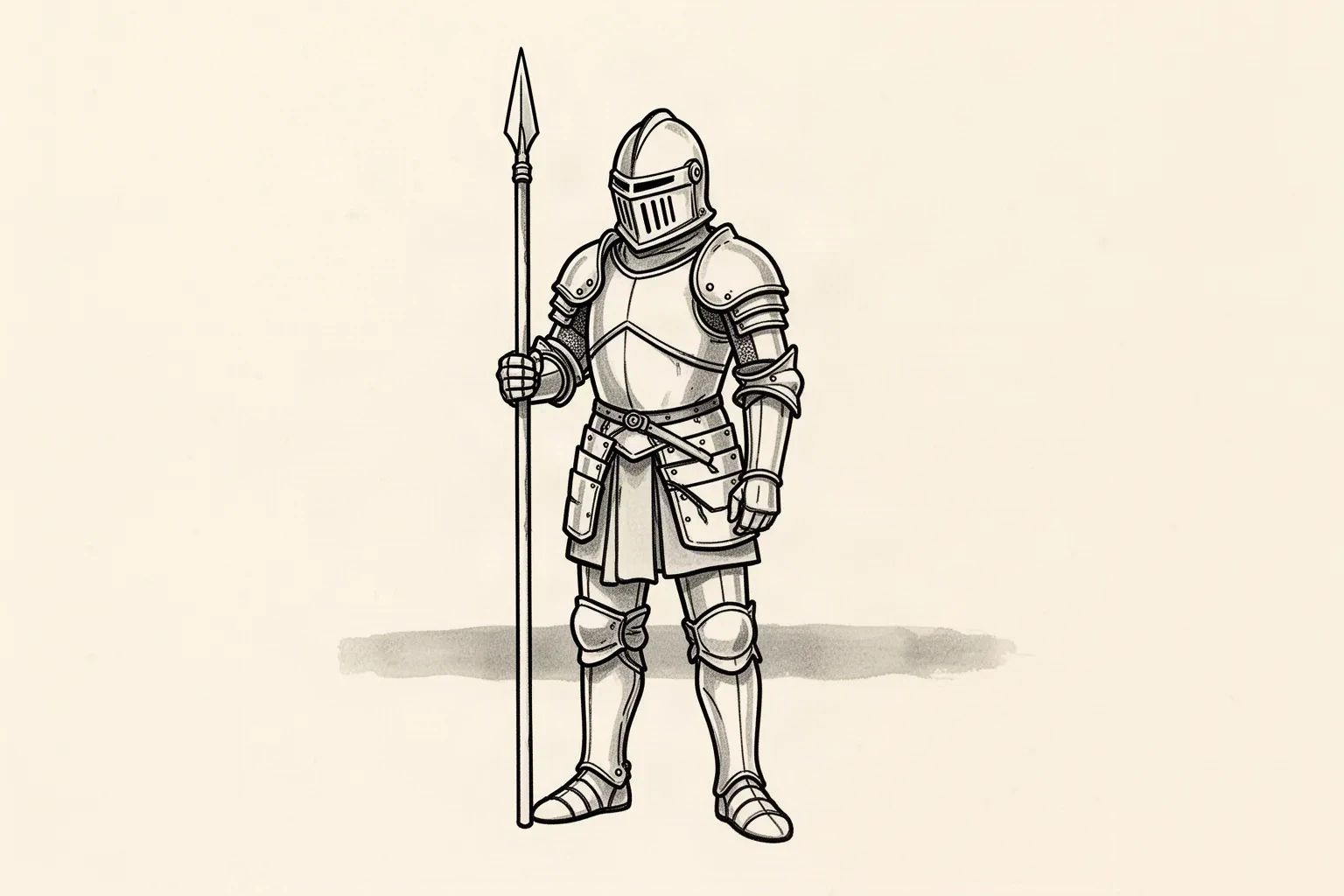
Monochrome linework study of a standing armored warrior with a spear held clear of the torso, countable armor bands on chest and shoulder, and a single light background band behind the legs
Synthetic illustration, not app output and not a client tattoo. This standing guard construction shows all three checks at once: a readable outer silhouette, a spear path separated from the torso by open space, ranked armor bands kept countable, and one restrained background band ranked below figure mass.

Warrior evaluation framework

Score the reference in minutes, then act on the weakest check.

Four warrior constructions at labeled heights. Each one names the protected structure, the fix, and the go or no-go verdict at that exact size. Confirm with a measured 1:1 print.

HOLDS AT STATED SIZE

Standing guard with spear and round shield at 15 cm

Intended height 150 mm

Source
Full standing figure in a guard stance with a vertical spear along the body axis, a round shield held clear of the torso, simple plate bands on chest and shoulders, and no background field. Strong presence with one weapon path and one shield disc competing for separations.
Protect
Body axis from helmet to grounded feet, full spear length and standoff from the torso, shield rim separation from chest bands, and the outer shoulder contour.
Fix
Confirm open skin runs along the full spear path and between the shield rim and the nearest armor band at true size. Reduce inner plate texture to one removable repeat before changing any contour.
Candidate stencil
Same warrior with silhouette separations kept, weapon path separated from the figure, armor bands ranked, and protected helmet plus weapon contours held at transferable mass.
Final-size verdict
Holds at 15 cm when the spear, shield, and torso each read as separate marks at arm's length. Guard authority comes from a separated weapon plus a clear stance, not from armor texture density.

REOPEN WEAPON AND FACE GAPS

Helmeted warrior bust with crossed blades at 12 cm

Intended height 120 mm

Source
Chest-up bust with a crested helmet, visible eye line and nose bridge, layered shoulder guards, and two blades crossed behind the shoulders. Compact and popular on screen, but one blade edge touches a shoulder band and the eye line shares a merged edge with the helmet shadow.
Protect
Helmet dome contour, eye and nose separations, shoulder band edges, and both blade angles.
Fix
Shift or shorten the rear blade until open skin separates steel from shoulder at true size, then reopen the eye-line channel. Remove crest texture and hilt-wrap detail before changing blade or shoulder mass.
Candidate stencil
Same warrior with silhouette separations kept, weapon path separated from the figure, armor bands ranked, and protected helmet plus weapon contours held at transferable mass.
Final-size verdict
Holds at 12 cm once the weapon-to-shoulder gap and the eye-line clearance both stay open at 1:1. Crossed-weapon drama works only when steel never joins the figure it is meant to frame.

RESTRAIN BACKGROUND FLOW

Charging stride with banner and cloud bands at 20 cm

Intended height 200 mm

Source
Forward-striding warrior with raised sword, flowing cape, one banner band, two cloud bands, and a partial sun disc behind the helmet. Narrative is rich but cloud edges cross the blade path and one banner corner touches the crest.
Protect
Stride axis and raised-arm blade path, helmet-to-shoulder hierarchy, and the single strongest motion band that sets direction.
Fix
Keep one background family only: one banner or one cloud drift, reduced to half weight with open skin to the figure on all sides. Remove the sun disc or hold it as an unclosed arc well clear of the helmet. Do not keep banner plus clouds plus disc together at this height.
Candidate stencil
Same warrior with silhouette separations kept, weapon path separated from the figure, armor bands ranked, and protected helmet plus weapon contours held at transferable mass.
Final-size verdict
Holds at 20 cm once background ranks below figure mass. Stride energy carries the composition while one restrained band supplies motion at 1:1.

ENLARGE OR RECROP

Detailed battle scene with two fighters and fortress at 8 cm

Intended height 80 mm

Source
Outline-only battle scene with two full warriors, interlocked weapons, fortress walls, distant banners, full armor texture on both figures, and ground hatching. Attractive on screen but drawn with almost no line mass and six competing detail families.
Protect
Lead figure helmet position and weapon direction that give the scene its warrior read.
Fix
Enlarge past the point where every armor separation, weapon channel, and face gap transfers as open skin, or recrop to one bust with one weapon and no background. Do not keep two armored figures plus architecture plus banners together at 8 cm.
Candidate stencil
Same warrior with silhouette separations kept, weapon path separated from the figure, armor bands ranked, and protected helmet plus weapon contours held at transferable mass.
Final-size verdict
At 8 cm the armor, weapons, faces, and walls function as one band and blades print as broken scratches. Enlarge, recrop to one figure, or choose an emblem construction for this height.

Samurai armor, kabuto, menpo, and katana construction stays on the samurai owner. Aztec fretwork bands and sun-stone focals stay on the Aztec owner. Hybrid warrior, dragon, and witchy-creature silhouette control stays on the fantasy collection. Portrait and figure recognition anchors stay on the people collection and the portrait maker. This framework exists to judge cross-style warrior direction choice plus armor, weapon, pose, silhouette, and background vetting at a stated height, not to replace those owners.

Armor, weapon, and background at final size

Judge the white space at the height you will print.

Screens forgive crowding that paper and skin do not. Set the height first, then inspect each feature below at true physical size with scaling off.

About 8 cm and below

Wrist and ankle accents, behind-ear marks, finger panels, and small gap fillers.

Carry an emblem only: one helmet icon, one shield device, or one crossed-weapon mark with two separations maximum. If any internal gap closes at 1:1, enlarge or reselect rather than forcing a full figure small.

About 10 to 16 cm

Common forearm, calf, shoulder, and thigh warrior pieces.

The most flexible band. A portrait-led bust or a single standing guard with one separated weapon can work when every armor, face, and weapon gap is verified at true size. Check helmet contour, eye and nose clearance, torso band count, and weapon standoff before approving ornament.

About 18 cm and above

Large thigh panels, back pieces, chest, and full sleeve sections.

Room for a full striding figure with one weapon and one background family, but only when open skin separates the helmet, the face marks, the armor bands, and the full weapon path. Larger height does not rescue a merged face, touching armor plates, or a weapon fused to the torso.

Warrior feature checks by height band
FeatureAbout 8 cm and belowAbout 18 cm and above
Armor bands and plate textureKeep the heaviest lines on outer silhouette edges only. If an outer chest or shoulder edge disappears, the armor loses its stacked read and becomes plain shading.Same priority. Larger height allows slightly finer inner texture hints, but separability still beats uniform thinness.
Helmet, face, and crest marksEach head element must read as a separate mark with open skin around it plus clearance to any crest base. Merge means a bolder dome or a larger height, not thinner crest detail.Crest flourishes and layered guards can carry more shape when each keeps its own spacing at 1:1. Check the full head with a squint test at true size.
Weapons, shields, and hiltsCarry at most one weapon plus one guard shape with visible skin between steel and figure. Wrapped hilts, engraved blades, and shield device detail merge first at small heights.A full weapon with guard and hilt hints plus one shield band can work when each keeps its own channel and open skin. Steel should never join the torso or close a face gap.
Background families and second figuresKeep no banners, clouds, architecture, or second figure. Background lines compete with helmet and weapon gaps for the same room and should be recropped away.One background family plus one compositional anchor can add narrative when the lead figure clearly dominates. Equal-weight double background fields need hierarchy work before print.

Reference to clean stencil

Build from the silhouette and weapon outward, then rank the rest.

Work in this order so one change at a time can be judged at the same height. Stop when silhouette, weapon, armor, and background each read correctly.

  1. 01

    Lock direction, height, and placement first

    Name one of the five directions on this page, set the intended physical height in millimeters, and name the body area before judging the reference. A striding figure that holds at 20 cm on a back panel can fail at 8 cm on a wrist with no line being wrong on its own. Use the size calculator when target dimensions are still open.

  2. 02

    Verify silhouette, face, and weapon hierarchy

    Confirm the outer contour traces cleanly, the face marks (or the decision that the face stays covered) fit the direction, then rank the composition: silhouette first, weapon path second, armor bands third, background last. Resolve contour contacts, face merges, and weapon-to-torso touches before touching line weight.

  3. 03

    Set figure versus ornament roles

    Assign every mark a role: lead structure that carries the first read, support that shapes it, and ornament that can be removed. Strengthen helmet, weapon, and torso contours first, keep armor texture and flourishes lighter, and mark one removable background family or texture row that can go if gaps close.

  4. 04

    Simplify density and reopen gaps at 1:1

    Reduce armor rows, crest detail, weapon ornament, and background families before thinning contours. Keep open skin between armor bands, around face marks, along the full weapon path, and between background marks, and run a squint check: step back until fine texture disappears and confirm the warrior still reads. The line-weight guide covers fine, normal, and bold behavior on the same stencil.

  5. 05

    Verify print and transfer path

    Export a true-size PDF with no fit-to-page scaling, inspect the narrowest armor gap, the face clearance, and the weapon-to-figure channel on plain paper, then measure the physical print with a ruler. If the digital file passes and only paper fails, move to print-stage evidence instead of simplifying again.

Transfer-ready simplification

Thin dense detail in this order before print

Reduction fuses texture first and contours last. Remove in the sequence below so the warrior keeps its read while the file loses its transfer risk.

  • Rank every mark: lead structure that carries the first read, support that shapes it, ornament that can be removed.
  • Reduce armor texture rows first: keep two or three countable outer bands per zone and mark inner rows as removable.
  • Reduce crest, wing, and cape flourishes to one anchor each, with open skin to the helmet and shoulders.
  • Reduce weapon detail before weapon mass: drop engraving, wraps, and secondary blades before shortening the lead weapon.
  • Reduce background families to one or zero, and demote the survivor to half weight with open skin on all sides.
  • Reopen every closing gap at 1:1: weapon-to-torso channels, shield-rim separations, face clearances, and armor band splits.
  • Run the squint check at true size: fine texture should disappear while the warrior silhouette still reads.

Placement and background restraint

Flat skin preserves figures, curves demand simpler builds

A warrior is a vertical armored figure with a long weapon path. Placements with a clear flat span preserve helmet height and weapon length, while narrow limbs demand a guard run or an emblem.

Back and thigh

Broad flat fields where a full striding figure with one weapon and one background family can spread without wrapping. The width is the asset, so crest spread and weapon length need spacing checks rather than compression.

Check: Center the face or helmet on the flattest span, mirror shoulder bands, and verify crest and weapon-tip spacing at 1:1 before print.

Outer forearm and calf

Long narrow fields where the figure should follow the limb axis. Wide shield discs and horizontal weapon angles wrap fast and crowd the helmet.

Check: Choose a standing guard with the weapon running along the limb for these fields, align the body axis with the limb, and shorten cross-limb shield spans while edits are still cheap.

Chest and shoulder

Large curved panels with room for a bust or a half-figure with a raised weapon. The curve compresses one side of wide frontal compositions in photos and transfers.

Check: Center the face or helmet on the flattest span, let support ornament fall toward the slope, and keep background to one family maximum.

Wrist, ankle, hand, and behind ear

Small wrapped fields where only an emblem survives. Full warriors with weapons, crests, and background forced into these bands merge first.

Check: Choose one helmet icon, shield device, or single weapon mark, then run the small-size checks at the exact height.

Stencil-ready checklist

Approve the warrior only when every line passes

Run this short sequence with scaling off and a ruler in hand. One failed line means fix, enlarge, or reselect before transfer.

  • Confirm the chosen direction, the intended height in millimeters, and the named placement.
  • Confirm armor bands stay countable with open skin between rows at 1:1.
  • Confirm face marks read as separate marks, or confirm the covered-face decision fits the direction.
  • Confirm the full weapon path keeps open skin to the figure with guard and hilt separable.
  • Confirm background totals one family or zero at small heights, with no mark touching helmet or weapon.
  • Export a true-size PDF with scaling off and measure the physical print.
Separated silhouette plus weapon first Verify gaps at 1:1 One background family maximum

FAQ

Warrior stencil decisions, answered

Short answers for the direction, armor, weapon, background, line-weight, and placement checks that recur when a warrior reference moves toward transfer-ready output.

Match the direction to the request and the available height. Historical armor figures suit clients who name a Spartan, knight, or gladiator look with 12 cm or more of height. Cultural figures go to their specialist owners once named: samurai construction to the samurai owner, Aztec fretwork and sun-stone focals to the Aztec owner. Mythic and fantasy warriors suit drama-led requests with room for a dominant silhouette, portrait-led busts suit face-first pieces with likeness depth from the people and portrait owners, and emblems are the only warrior construction for heights about 8 cm and below.

Next steps

Use the neighboring owners for adjacent jobs.

This guide covers cross-style warrior direction choice with height-tied armor, weapon, pose, silhouette, and background vetting plus transfer-ready simplification. Use the links below for related jobs such as sizing, print checks, paper, and placement.

Samurai armor depth, Aztec fretwork and sun-stone depth, fantasy creature and lore depth, portrait likeness depth, generic conversion, broad gallery browsing, paper manufacturing detail, and placement mechanics stay in their specialist owners. The links above hand off instead of repeating that detail.

From evaluated reference to working stencil

Turn the approved warrior into a stencil draft.

Start from the warrior direction that passed the silhouette, armor, weapon, and background checks, then continue on iPhone for body fit, exact-size print, mirror and professional export.