

Generic leaf stencil evaluation

Judge any leaf before it becomes a stencil

Leaves live or die on edge and vein discipline. Choose the single, sprig, or cluster construction that fits your width, protect the open channels beside veins and the stem path, and confirm every separation at your exact size for a clean transfer-ready stencil.

Built for working artists preparing generic leaf pieces. This page covers lamina shape, vein openness, edge continuity, stem transferability, variant choice, and transfer prep only, not tattoo application or healing advice. Clover symmetry, bloom construction, and vine-run vetting stay with the specialist owners linked below.

Reading a leaf plate

  • Lamina: Trace the outer edge base to tip. Gaps at serration teeth and hairline segments fail before veins do.
  • Veins: Find the midrib, then confirm open skin on both sides and that no side vein touches the margin.
  • Stem: Follow one confident path from lamina base to cut end. Fading hairline stems break first on transfer.

Use this checklist to read any leaf reference, then verify your own reference at the width you will print.

Leaf variant chooser

One lamina, one sprig, or one ranked cluster decides the read.

A leaf piece is an edge plus its veins and stem. Pick the construction that fits the placement width, then protect the channels that keep it separable.

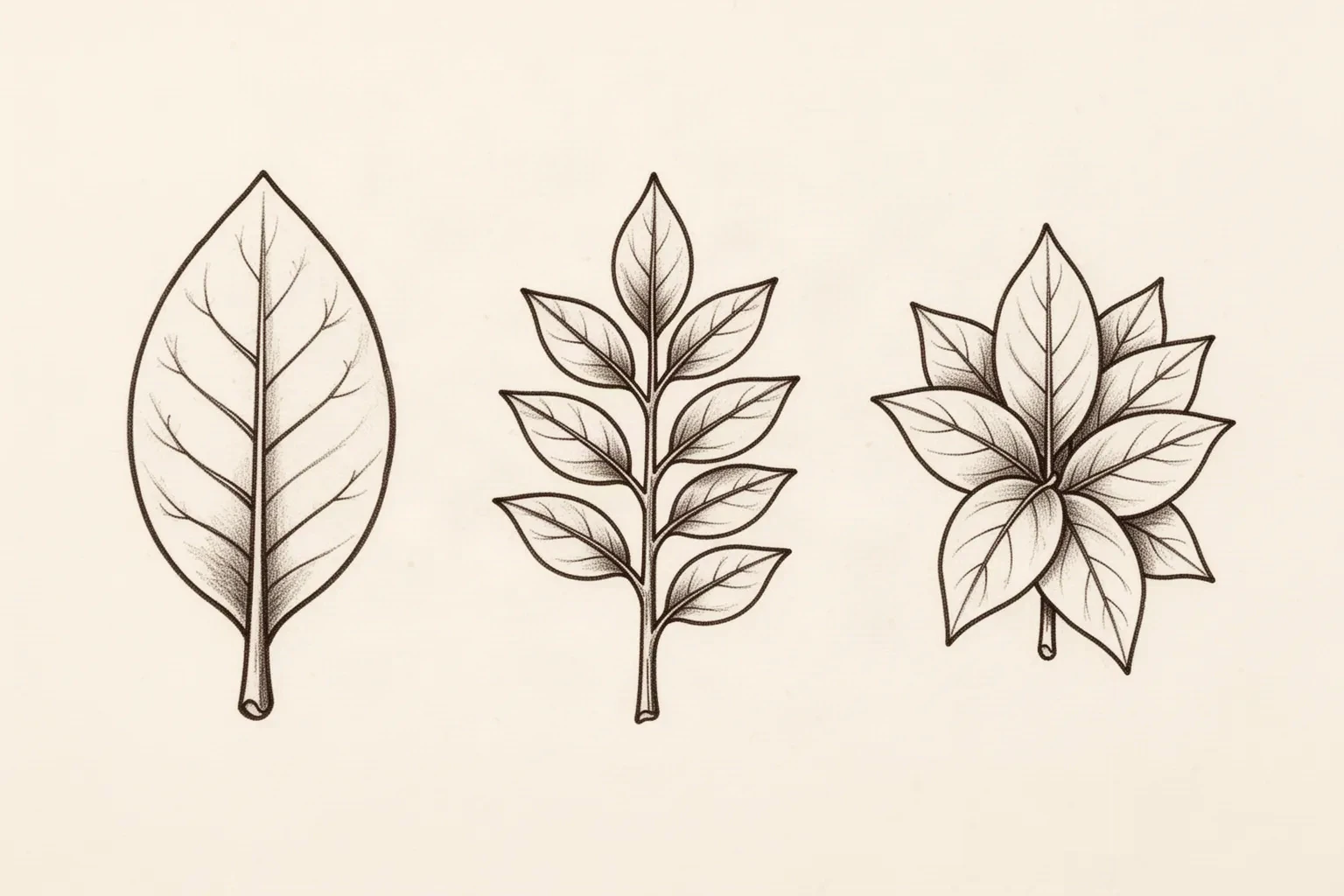
Synthetic illustration of three leaf tattoo stencil constructions: a single ovate leaf with an open midrib and stem, a graduated multi-leaf sprig on one lead stem, and a cluster of overlapping leaves with one complete front leaf.
Synthetic illustration of the three construction families, not app output and not a scale or spacing reference. Read the single lamina for open midrib channels, the sprig for leaf size graduating toward the tip on one lead stem, and the cluster for one complete front leaf with the rest tucked behind it. Judge your own reference with the rules and checks below.

Single leaf

Use when: Small focal accents, finger and wrist marks, behind-ear pieces, and minimalist compositions where one readable leaf carries the idea.

Construction: One complete lamina with a clear tip and base, one midrib running base to tip, and one petiole stem with its own weight. Keep the outline closed and let open skin carry at least one side of the midrib.

Failure mode: Fails when a second partial leaf or tendril is added without room, or when the midrib touches both edges and splits the lamina into two sealed pockets that fill first.

Sprig with two to five leaves

Use when: Collarbone lines, sternum drops, ankle and forearm accents, and filler-to-focal pieces where direction and rhythm matter more than one leaf alone.

Construction: One lead stem with leaves set alternately and graduated in size toward the tip. Keep open skin between every leaf base and the stem, and keep the tip leaf smallest so the run tapers.

Failure mode: Fails when leaves sit opposite at equal size in a tight row with no taper. That run prints as a scalloped band instead of a sprig with direction.

Cluster of overlapping leaves

Use when: Shoulder caps, thigh and calf panels, and gap-fill compositions where volume and overlap are the point and the width is large enough to keep separations open.

Construction: Rank leaves front to back, give the front leaf a complete outline, and let back leaves tuck behind it with a clear overlap edge. Keep one skin channel at every overlap at 1:1.

Failure mode: Fails when every leaf is drawn complete with all edges crossing at equal weight. Equal-weight overlaps read as a tangle once reduced and bridge first on transfer.

Texture-forward leaf

Use when: Larger botanical pieces where serrated edges, lobes, or one vein tier add character and the width supports it, generally from about 7 cm up.

Construction: Lock the readable silhouette first, then carry at most one vein tier with open skin on both sides of every vein. Drop serration count rather than drawing every tooth a photo shows.

Failure mode: Fails when fine serrations plus full vein tiers are forced into a small width. Detail added after the silhouette is set merges first, so simplify texture before thinning the outline.

Leaf evaluation framework

Score the reference in minutes, then act on the weakest check.

Four leaf constructions at labeled widths. Each one names the protected structure, the fix, and the go or no-go verdict at that exact size. Confirm every verdict with a measured 1:1 print.

HOLDS AT STATED SIZE

Single oval leaf with open veins at 6 cm

Intended width 60 mm

Source
One oval lamina with a smooth edge, one midrib with clear skin on both sides, three short side veins per side kept clear of the edge, and one confident petiole stem.
Protect
The closed outer edge, the open channels beside the midrib, and the unbroken stem path from lamina base to tip of stem.
Fix
No structural fix needed. Confirm edge, midrib channels, and stem clearance at 1:1 and print true size with scaling off.
Candidate stencil
Same leaf with the variant set, veins pulled clear of the margin, overlaps ranked front to back, and edge plus stem at transferable weight.
Final-size verdict
Holds at 6 cm. Lamina, veins, edge, and stem each keep their own skin separation, so the leaf reads from structure alone without shading.

REOPEN VEINS FIRST

Pretty leaf with packed vein net at 5 cm

Intended width 50 mm

Source
An attractive photo-style leaf where a midrib plus two full vein tiers run edge to edge, leaving small enclosed separations between every vein and the margin.
Protect
The lamina outline rhythm and the stem direction the reference is reaching for.
Fix
Reduce to the midrib plus at most three short side veins per side, pull every vein end back from the edge, and reopen skin on both sides of the midrib before touching outline weight.
Candidate stencil
Same leaf with the variant set, veins pulled clear of the margin, overlaps ranked front to back, and edge plus stem at transferable weight.
Final-size verdict
Not stencil-ready until veins hold open skin at true size. A packed vein net functions as one textured fill below about 6 cm.

REPAIR EDGE AND STEM FIRST

Serrated leaf with thin edge breaks at 4 cm

Intended width 40 mm

Source
A serrated leaf with a thin outline that breaks at two teeth, plus a hairline stem that fades toward its end and one side vein touching the margin.
Protect
The leaf silhouette proportion and the intended stem direction.
Fix
Close the outline into one continuous edge with slightly stronger weight, reduce serration count, pull the touching vein back from the margin, and give the stem one confident weight from lamina base to cut end.
Candidate stencil
Same leaf with the variant set, veins pulled clear of the margin, overlaps ranked front to back, and edge plus stem at transferable weight.
Final-size verdict
At 4 cm a broken edge plus a fading stem fails on transfer. Repair edge continuity and stem weight first, because veins cannot rescue a leaf with no readable boundary.

SEPARATE OR ENLARGE FIRST

Five-leaf cluster with contact overlaps at 8 cm

Intended width 80 mm

Source
A full cluster where five leaves overlap at equal weight with shared edges and no planned front-to-back order, plus stems crossing under leaves with no clearance.
Protect
The front-leaf shape and the overall cluster direction worth keeping.
Fix
Rank one front leaf, tuck the rest behind it with one skin channel at every overlap, subordinate crossing stems, and enlarge only after separations are planned at true size.
Candidate stencil
Same leaf with the variant set, veins pulled clear of the margin, overlaps ranked front to back, and edge plus stem at transferable weight.
Final-size verdict
Not stencil-ready while overlaps share contact. Separate the stack or enlarge past the point where every overlap channel stays open.

Clover, bloom, and vine-run vetting stays out of this framework. Four-leaflet symmetry is judged on the four-leaf-clover page, petal layering and fruit pairing on the aster, gladiolus, and cherry pages, and stem paths on the vine page, while this framework judges lamina edge continuity, vein openness, overlap separation, and stem transferability on the generic leaf. Broad visual browsing stays on the stencils and subject hubs.

Edge, veins, and stem at final size

Judge the white space at the width you will print.

Screens forgive crowding that paper and skin do not. Set the width first, then inspect each feature below at true physical size with scaling off.

About 4 cm and below

Finger, behind ear, wrist, and tiny ankle accents.

Carry a single leaf or a two-leaf sprig with smooth or lightly serrated edges, midrib only, and no side-vein tier. If any vein channel closes at 1:1, remove veins before thinning the outline.

About 5 to 8 cm

The most common leaf band: wrist, ankle, collarbone, shoulder accents, and small forearm pieces.

The flexible band for single leaves and short sprigs with one short side-vein tier. Verify lamina edge continuity, midrib channels, and stem weight at true size with scaling off.

About 9 cm and above

Forearm, calf, thigh, shoulder, and cluster compositions with overlap and texture.

Room for sprigs with taper, small clusters with ranked overlaps, and one vein tier, but only when every overlap and vein channel stays open at 1:1. Larger width never rescues shared edges.

Leaf feature checks by width band
FeatureAbout 4 cm and belowAbout 9 cm and above
Lamina edgeKeep one continuous closed outline with smooth or lightly serrated teeth. Broken or hairline edges vanish first, so strengthen the boundary before adding veins.Serrations and lobes can sharpen when each tooth keeps its own edge at 1:1. If teeth share one merged boundary, reduce tooth count before touching vein detail.
Midrib and side veinsCarry the midrib with open skin on both sides and at most three short side veins per side, each ending clear of the margin. Drop the side tier entirely if any channel closes.One full side-vein tier can work when every vein keeps skin on both sides and no vein touches the margin at true size. Never carry two vein tiers below about 9 cm.
Stem continuityGive the petiole or lead stem one confident weight from lamina base to cut end with open skin on both sides. A fading hairline stem breaks while the lamina survives.Same priority. Larger widths allow a finer secondary branch, but the lead stem must still dominate and stay unbroken from entry to tip leaf.
Overlap separationsCarry none. Single leaves and open sprigs only. Small widths suit one readable lamina plus stem, and any overlap forced into these bands bridges first.Rank front-to-back order and keep one skin channel at every leaf-over-leaf and leaf-over-stem crossing. Check the full cluster with a squint test at true size.

Fine-detail fallout risk checklist: veins, edges, and stems

  • Packed vein nets: midrib plus full side tiers running edge to edge merge into one textured fill at small widths.
  • Veins touching the margin: side veins that meet the edge seal small pockets that close first on transfer.
  • Broken lamina edges: thin outlines with gaps at serration teeth erase the leaf boundary while veins survive.
  • Fading hairline stems: thin petioles that taper to nothing break first and leave a floating lamina.
  • Equal-weight overlaps: cluster leaves drawn complete at the same weight bridge at every crossing.
  • Stem-to-leaf contact: leaves sitting flush against the stem with no gap turn sprig rhythm into one band.

Reference to clean stencil

Lock the lamina, then build outward along the stem.

Work in this order so one change at a time can be judged at the same width. Stop when edge, veins, stem, placement, and print each read correctly.

  1. 01

    Lock width, variant, and placement first

    Set the intended physical width in millimeters, choose one construction (single leaf, short sprig, cluster, or texture-forward leaf), and name the body area before judging the reference. A leaf that holds at 10 cm on a flat thigh can fail at 4 cm on a curved finger with no line being wrong on its own. Use the size calculator when target dimensions are still open.

  2. 02

    Rank lamina, veins, and stem

    Name the lamina outline, the midrib, the side veins, and the stem, then assign every mark a role: the outer edge that carries the first read, the midrib that carries direction, side veins as support, and the stem that carries the plant connection. Strengthen edge and stem first, and mark one removable vein tier that can go if channels close.

  3. 03

    Simplify veins and reopen gaps for final size

    Pull veins back from the margin and reopen skin on both sides of the midrib before thinning any outline. Reduce side veins to three short marks per side or remove the tier entirely, resolve overlaps to ranked front-to-back order, then run a squint check: step back until veins disappear and confirm the lamina plus stem still read. The line-weight guide covers fine, normal and bold behavior on the same stencil.

  4. 04

    Set variant rhythm and flow on the body

    Point single-leaf tips with the body line, run sprig stems along the longest span with leaves tapering toward the tip, and seat cluster mass on the flattest area with overlap order resolved. Shorten cross-axis stems while edits are still cheap. Preview the placement on a body photo when curve, wrap, or viewing angle could change the leaf read.

  5. 05

    Verify print and transfer path

    Export a true-size PDF with no fit-to-page scaling, inspect the narrowest vein channel and the stem-to-skin clearance on plain paper, then measure the physical print with a ruler. If the digital file passes and only paper fails, move to print-stage evidence instead of simplifying again.

Placement and size decisions

Narrow leaves want long spans that keep direction honest

A leaf is a directional mark with a tip and a base. Placements with a clear long axis preserve that direction with little compensation, while small wrapped placements demand a simplified recrop.

Finger, behind ear, and wrist

Very small curved fields with movement and friction. Only single leaves or two-leaf sprigs with smooth edges and midrib-only veins hold here.

Check: Recrop to lamina plus one confident stem, drop the side-vein tier, and confirm edge and stem clearance at the exact width before print.

Ankle, collarbone, and sternum line

Narrow linear fields where sprig direction matters most. Tips should travel with the bone or limb line, not across it.

Check: Run the stem along the longest span, taper leaf size toward the tip, and keep every leaf base clear of the stem at 1:1.

Forearm, calf, and shoulder

Medium panels with room for sprigs with one vein tier and small ranked clusters, plus graceful stem curves along the limb or bone line.

Check: Seat the largest leaf on the flattest area, resolve overlap order, and confirm vein and overlap channels stay open at true size.

Thigh, chest, and back accents

Large panels with room for clusters and texture-forward leaves, but wide compositions compress on curves in photos and transfers.

Check: Spend extra room on overlap separation first, keep one vein tier maximum, and verify margin clearance separately at 1:1.

Leaf versus neighboring motifs

Route the motif to the right vetting logic

Leaves share botanical vocabulary with clovers, flowers, and vines, but stencil decisions differ by job: lamina readability here, symmetry, bloom construction, or stem paths there. Use this table to confirm the brief before judging it as a generic leaf.

Leaf versus neighboring motifs for stencil vetting
MotifConstructionStencil call
Generic leaf (this page)One lamina or a small leaf set judged on edge continuity, vein openness, and stem transferability at final size.Vet lamina, vein, edge, and stem with the framework on this page.
Four-leaf cloverFour heart-shaped leaflets with tight notches around one center junction, judged on four-way symmetry and gap retention.Judge four-leaflet symmetry and inter-leaflet gaps on the four-leaf-clover stencil page. Link there when the brief is a luck emblem, not a generic leaf.
Floral bloom (aster, gladiolus, cherry)Layered petals, ray tiers, spikes, or round fruit judged on bloom density, branch hierarchy, or fruit separation.Judge petal layering, ray count, or fruit pairing on the aster, gladiolus, or cherry stencil pages. Link there when the brief is a flower head or fruit.
Trailing vine runA continuous stem system judged on path continuity, wrap bridges, and leaf rhythm along a traveling run.Judge stem paths and wrap bridges on the vine stencil page when the brief is a traveling vine, not one leaf, sprig, or cluster.

Stencil-ready checklist

Approve the leaf only when every line passes

Run this short sequence with scaling off and a ruler in hand. One failed line means fix, enlarge, or reselect before transfer.

  • Confirm intended width in millimeters, the chosen leaf variant, and the named placement.
  • Confirm the lamina edge runs continuous and closed with its own deliberate weight at 1:1.
  • Confirm the midrib holds open skin on both sides and no side vein touches the margin.
  • Confirm the stem runs unbroken from lamina base to cut end with clearance on both sides.
  • Confirm every overlap keeps its own skin channel with a ranked front-to-back order.
  • Export a true-size PDF with scaling off and measure the physical print.
Lamina, veins, edge, stem Verify gaps at 1:1 Stem survives transfer

FAQ

Leaf stencil decisions, answered

Short answers for the vein, variant, placement, and handoff checks that recur when a generic leaf reference moves toward transfer-ready output.

It is usable when four checks pass at the exact physical width: the lamina edge runs continuous and closed at 1:1, the midrib holds open skin on both sides, no side vein touches the margin, and the stem runs unbroken with clearance on both sides. If any check fails, the fix list on this page names what to simplify, respace, or enlarge before print.

Next steps

Use the neighboring owners for adjacent jobs.

This guide covers generic lamina vetting, vein and edge checks, stem transferability, single versus sprig versus cluster choice, and leaf transfer preparation. Use the links below for adjacent jobs such as clover symmetry, bloom vetting, vine paths, sizing, print checks, and placement.

Four-leaflet symmetry, petal layering, ray-tier depth, fruit pairing, vine path mechanics, broad gallery browsing, paper manufacturing detail, and placement mechanics stay in their specialist owners. The links above hand off instead of repeating that detail.

From evaluated reference to working stencil

Turn the approved leaf into a stencil draft.

Start from the leaf construction that passed the edge, vein, and stem checks, then continue on iPhone for body fit, exact-size print, mirror and professional export.