Pick the Japanese direction before you draw the stencil
Koi flow, sakura branch movement, samurai armor and pose, kitsune mask work, and bodysuit layout are different stencil jobs with different risks. Compare them by placement and size, vet background restraint and pairing at final size, then leave with a shortlist plus a pass or fail readability check.
Built for working artists choosing between Japanese directions. This page covers style-level comparison and stencil-readiness vetting only: motif execution stays with the motif owners, and generic transfer steps stay with the stencil-making guide. Each section below hands off instead of repeating that depth.
Japanese-traditional work fails as a system before it fails as a single image. These three pillars predict whether any direction survives simplification, print, and transfer.
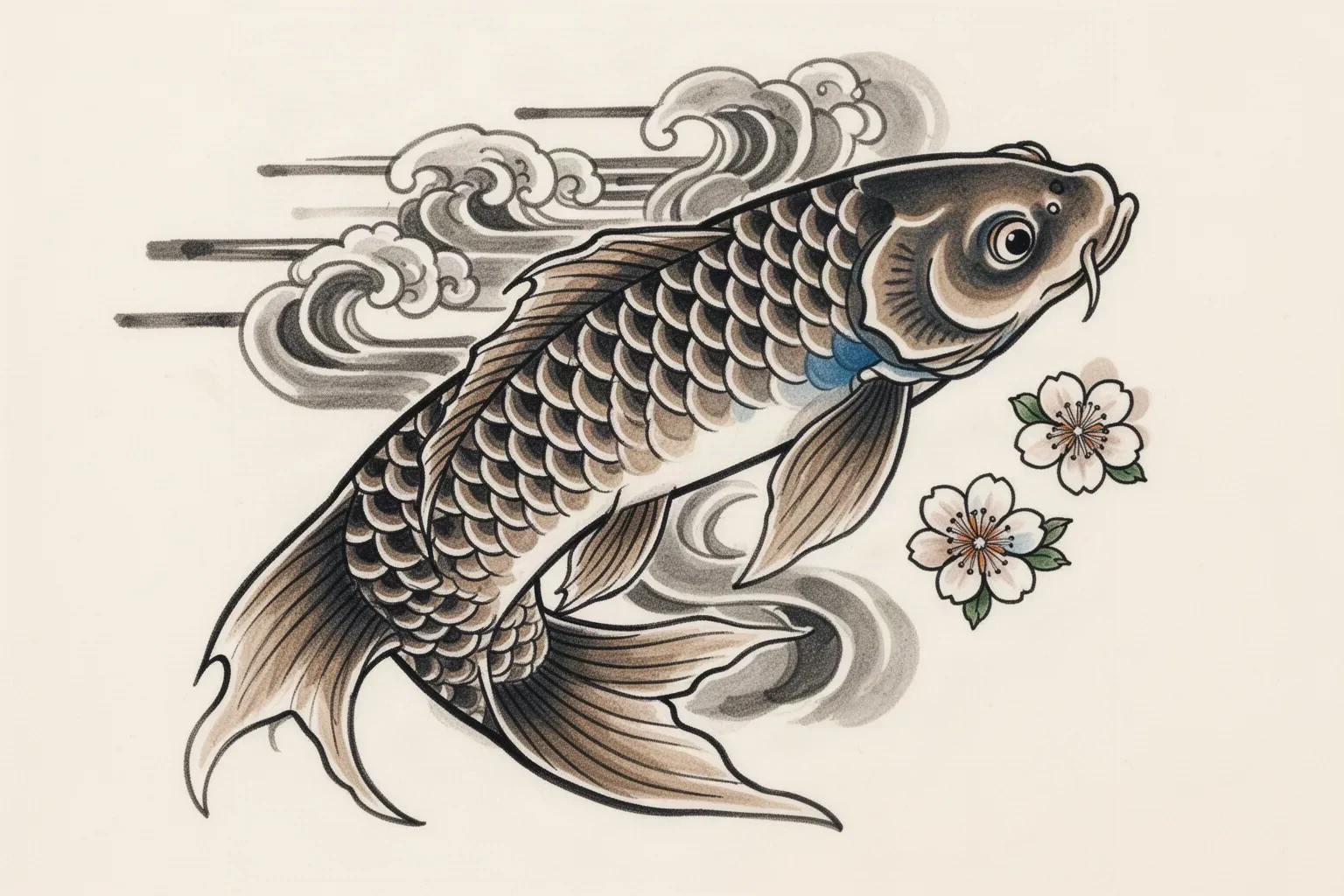
Synthetic editorial illustration of the composition principle, not a stencil file, client piece, or app output: one hero anchor, one background family, accents kept below anchor scale, and open skin channels between masses.
One story, one background direction
Japanese-traditional work reads as one composition because background ties motifs together: wind bars set pace, clouds place figures in the sky and frame faces, water gives swimming subjects a current. When two background families compete at equal weight in one zone, both lose and the anchors lose with them. A reference with five strong motifs and no shared weather is a collage, not a plan.
Check: Name one background family per zone before judging any motif. If removing the background leaves every motif floating with no world, it is structural and stays, simplified. If removing it changes nothing, it is decoration and goes.
Motif hierarchy before detail
Each direction keeps one protected read: the koi through body arc and tail drive, sakura through branch path and bud spacing, samurai through helmet plus mask plus blade separation, kitsune work through mask or portrait symmetry, bodysuit work through back-panel anchor and sleeve flow. Detail inside a merged silhouette never rescues it.
Check: Cover all inner texture and trace each anchor mass at true size. If every anchor still reads as a separate mass with its own direction, hierarchy holds. If two anchors merge into one dark field, separate or remove one before touching line weight.
Gaps decide transfer, not screens
Wind-bar channels, cloud lobe separations, wave fingers, petal gaps, armor plate separations, and grille clearance close first at inner corners and between parallel edges. Open skin between marks is the structural material. Screens forgive crowding that paper and skin do not.
Check: Print at 100 percent with scaling off and confirm the narrowest must-keep channel stays visibly open at arm's length. If a channel closes, remove a neighboring family or enlarge the piece rather than thinning lines.
Direction comparison
Five Japanese directions, five different stencil jobs.
Each direction below names its construction, its strengths, its constraints, and the placement plus size test that selects it. Choose one before vetting, because each direction fails in a different place.
Koi flow
A curved swimming body with ranked fins, tail drive, and whisker hints, read through one body arc and one current direction. Upstream struggle and downstream drift are different stories told by the same animal, so water direction is part of the choice.
Strengths: Strongest single-animal flow for sleeves, thighs, and back runs. The arc wraps limbs naturally and the current gives filler a job without a second focal.
Constraints: Needs room for the arc plus open water channels. Small diameters force scale texture and fin detail to merge, and a second current in the same panel dissolves the read.
Choose when: Choose it when the brief centers on movement along a limb or torso run and the final size can keep the body arc plus one current separated at 1:1.
A woody branch path with clustered small blossoms and buds, read through one primary branch with ordered side shoots. Petal layering and bud spacing decide the result, not petal count.
Strengths: Best Japanese accent for marking season and softening edges around a harder anchor. Branch paths bridge zones gracefully at moderate sizes.
Constraints: Crossing or forked branches of equal weight read as tangle once reduced. Dense bud clusters touch the anchor silhouette first and should be capped well below anchor scale.
Choose when: Choose it as the lead when the brief is a branch spray on a shoulder, rib, or thigh, or as support when a koi, figure, or bodysuit panel needs seasonal softening.
Layered plate bands with lacing, a kabuto plus menpo head, and one katana path on one body axis: armored bust, standing guard, or striding figure. Armor restraint and weapon separation decide the result.
Strengths: Strongest figurative presence with a clear vertical axis for backs, thighs, chests, and outer limbs. The bust recrop survives smaller sizes than most Japanese figures.
Constraints: The most detail-dense single direction. Crest tines, lacing rows, and grille marks merge first, and any background beyond one restrained family crowds the helmet and blade.
Choose when: Choose it when the brief needs a warrior figure with armor weight, and the height can keep plate bands countable plus the full blade path separated at 1:1.
A fox mask or fox-associated portrait read through symmetry, eye and snout placement, and clean contour hierarchy. Mask work behaves like emblem work: one center, ranked ornament, no competing focal at the same weight.
Strengths: Compact and placement-flexible. A single mask carries chest, shoulder, thigh, and calf panels where a full figure would crowd, and pairs cleanly with blossom or maple accents.
Constraints: Fine muzzle detail, teeth, and layered ornament merge first at small diameters. Two masks at equal weight in one panel behave like double heroes and need hierarchy work.
Choose when: Choose it when the brief centers on one mask or spirit presence rather than body flow or armor narrative, and the size can keep mask contours plus one ornament ring separated at 1:1.
A back-panel anchor with chest continuation, sleeve modules, and legs under one background system, read as one planned skeleton with a finished edge where work stops against bare skin. Backpiece first sets the story; sleeves and legs obey it.
Strengths: Only direction that answers large-scale commitment: one story across zones with a clean session sequence. Highest planning cost, strongest single-piece read.
Constraints: Demands a full zone map before any segment prints. Opposing background systems at a joint, equal-weight double heroes, and missing finished edges are the common failures.
Choose when: Choose it when the client commits to a back piece, sleeve system, or full suit rather than one standalone tattoo, and every zone can name its anchor, background, and edge.
Petal layering and branch spacing detail stays with the sakura owner, scale and fin rendering stays with the koi owner, armor plus kabuto plus blade detail stays with the samurai owner, and sleeve plus back-piece sequencing stays with the bodysuit owner. This comparison exists to choose between directions, not to replace that motif depth.
Background restraint at final size
Restrain the weather so the anchors survive it.
Wind, clouds, and water each do one structural job. Judge each family below at true physical size with scaling off, and cut the family that competes instead of serves.
Background families: role, restraint rule, and failure mode
Family
Restraint rule at final size
Failure mode
Wind barsRhythm and pace. Wind bars carry the eye along the composition and fill long gaps with motion that adds no new focal.
Keep one bar direction per zone and one bar width family per composition. Bars pass behind anchors with open skin to every figure edge and never cross a face, claw, blade path, or mask contour. When bars above and below a joint point at each other, delete or reverse one set.
Two opposing wind systems, bars crossing a focal, or bars packed so tightly they read as stripes instead of motion.
CloudsSetting and framing. Clouds place figures and masks in the sky, frame faces, and fill the awkward space a large anchor leaves around it.
Size cloud lobes to the anchor they serve: lobes stay clearly smaller than the head or mask they frame. Keep separating skin between adjacent lobes at true size, and keep clouds off swimming-subject water. One cloud scale per panel reads as weather; three mixed scales read as clutter.
Cloud lobes touching a face or mask edge, lobes merging into a solid cap over the anchor, or clouds plus wind bars plus water all filling the same gap.
Water and wavesCurrent and story. Water gives koi and dragons the current they live in. For a koi the water direction is the story direction.
Lock current direction before drawing a single wave crest, then keep every crest, foam gap, and flow line subordinate to it. Wave fingers must keep open channels at 1:1, and the current must round the limb the way water moves, not lie flat like wallpaper.
Directionless chop with no readable current, wave fingers sealing into a solid band, or water fighting the wind-bar direction in the same zone.
The practical simplification order is fixed: halve background mass first, open every focal-adjacent channel second, and touch anchor linework last. A useful control is the corridor check: trace every reserved skin path from open skin to open skin at true size. If a background mark pinches that path shut, remove the mark, not the corridor.
Traditional pairings are working instructions, not decoration ideas. Judge each combination below by silhouette protection and shared direction.
Koi with water and waterfall
Strong when the current is single
The waterfall gives the koi something to work against, which is the story. One current, one waterfall break, and an open channel for the body arc. Lotus or blossom accents stay clearly smaller than the fish.
Sakura with koi, figure, or mask
Support only, never the skeleton
Blossom softens edges and marks season, but a composition built from accents with no anchor is decoration. Cap blossom clusters below anchor scale and remove any cluster that touches a focal silhouette.
Samurai with one background family
Strong with framed clearance
One wind-bar band or one petal drift at half weight supplies motion without crowding the helmet and blade. Armor lamination and weapon separation detail stays with the samurai owner; this page only asks that the figure keep open skin on all sides.
Kitsune mask with blossom or maple
Strong as emblem plus accent
Seasonal accents frame the mask without adding a second focal. Keep the mask center dominant, hold one ornament rank only, and keep every accent clear of the muzzle and eye contours.
Bodysuit anchors with shared background
Strong when one system governs
Dragon with clouds, tiger with wind, koi with water, figures with clouds: traditional pairings work because each anchor gets its own weather. Full zone mapping and sleeve sequencing stay with the bodysuit owner linked below.
Two heroes at equal weight
Restructure before print
Dragon plus tiger at the same size, or two full figures sharing one panel with no hierarchy, merge into one dark field at transfer size. Demote one to support, move one to its own zone, or enlarge the field.
Bodysuit versus small-piece decision
Match the scale choice to the commitment
Three scale bands with different planning costs. Each names what the field can carry and the vetting test that decides whether the choice holds.
Roughly wrist to forearm-panel sizes where one anchor must carry the read alone
Small standalone piece
One direction, one anchor, background at zero or one whisper family. Koi recrop to arc plus tail, sakura recrop to one branch run, samurai recrop to kabuto with menpo or hilt with guard, mask recrop to one mask with one ornament rank. If any protected gap closes at 1:1, enlarge or reselect rather than forcing reduction.
Typical fits: Mask on shoulder or calf, single koi arc on inner forearm, short sakura branch on rib or ankle, kabuto bust on outer forearm.
Thigh, chest, shoulder cap, or half sleeve where two to three families share one field
Compositional panel
One hero plus ranked support under one background direction. Name the hero, name the support, name the background, and hold open skin between all three at true size. This is the band where most Japanese pieces live, and where hierarchy decisions pay off most.
Typical fits: Koi plus waterfall with blossom accents on a thigh, samurai bust with one wind band on a chest, mask with maple on a shoulder cap.
Back piece, full sleeve, or multi-zone suit where zones must obey one system
Bodysuit or bodysuit module
Back anchor first, then outward one zone per session with overlap registration marks. Every zone names one anchor, one background family, and one finished edge before any segment prints. Hand full zone mapping to the bodysuit owner below; this page only sets the go or redirect decision.
Typical fits: Back panel anchor with chest continuation, sleeve module obeying the back background direction, short suit with side panels above the knee.
Reference to vetted shortlist
Vet in an order the plan can survive
Work in this order so one change at a time can be judged at the same size. Stop when direction, hierarchy, and gaps each read correctly.
01
Lock direction, placement, and size
Write down one direction from the comparison above, the named body area, and the intended physical dimensions in millimeters. A koi that holds on a thigh can fail on a wrist with no line being wrong on its own. Use the size calculator when target dimensions are still open.
02
Rank anchor, support, and background
Assign every mark a role: anchor mass that carries the first read, support that shapes it, background weather that ties zones together, ornament that can go. Traditional pairings in the matrix above are the shortcut: give each anchor its own weather and demote everything else.
03
Prove gaps at true size on paper
Export a true-size PDF with scaling off and inspect the narrowest channel in the plan: bar-to-figure gaps, lobe separations, wave channels, petal-to-anchor skin, plate separations, mask contour clearance. Squint from a normal viewing distance. If two anchors merge, return to ranking before blaming the printer.
04
Hand off to the execution owner
Motif-specific flow, petal and scale rendering, armor and blade detail, sleeve and back-piece sequencing, board organization, and generic transfer steps stay with their owners linked below. This page delivers the shortlist plus the pass or fail verdict; the linked owner delivers the execution depth.
Stencil-ready checklist
Approve the direction only when every line passes
Run this sequence with scaling off and a ruler in hand. One failed line means fix, enlarge, or reselect before transfer prep.
One direction is named from the comparison, with placement and millimeter dimensions written down.
One background family runs each zone with no opposing system at a joint.
Every anchor keeps open skin to its neighbors and to the background at true size.
No background mark touches a face, mask contour, claw, blade path, or koi body arc.
Pairing follows the matrix: one hero per zone, accents clearly smaller, no equal-weight double heroes.
The narrowest channel stays open on a measured 1:1 paper print with scaling off.
One background direction One hero per zone Prove gaps at 1:1
FAQ
Japanese stencil decisions, answered
Short answers for the direction, background, pairing, and checklist checks that recur when a Japanese reference moves toward transfer-ready output.
Match the direction to the field and the story. Koi flow suits limb and torso runs where movement carries the read, sakura suits branch sprays and seasonal support, samurai suits figurative armor presence with a clear axis, mask work suits compact emblem placements, and bodysuit layout suits back-piece and sleeve commitments. The comparison on this page names the construction, strengths, constraints, and choose-when test for each of the five so the shortlist happens before motif execution.
Background is the weather each motif lives in, not decoration around it. One background family per zone keeps anchors readable; a second family filling the same gap merges silhouettes at transfer size. Gaps are judged on a measured 1:1 print with scaling off: the narrowest bar-to-figure channel, lobe separation, wave finger, petal gap, or plate separation must stay visibly open. Integration holds when each zone has one hero and every other motif serves it in scale, mass, and direction.
This page recommends deciding by field and commitment. Small standalone pieces carry one anchor with background at zero or one whisper family. Compositional panels carry one hero plus ranked support under one background direction. Bodysuit work carries a back anchor first with every zone naming its anchor, background, and finished edge. The pairing matrix above gives the working combinations: koi with single-current water, blossom as support only, samurai with one background family, mask with seasonal accents, and bodysuit anchors under one shared system.
It passes when three checks hold at the exact physical size: one background direction per zone, every anchor keeps open skin to its neighbors on a 1:1 paper print, and no background mark touches a focal silhouette. After the pass, motif-specific depth goes to the linked motif owner (koi flow, sakura branch, samurai armor, bodysuit layout), sizing and print checks go to the calculator and print checker, and reference organization goes to the board maker. Each link hands off instead of repeating that detail.
Treat mask work as emblem work on this page: one center, ranked ornament, compact placements such as chest, shoulder, thigh, or calf. When the concept grows into armor, sleeve flow, or bodysuit scope, redirect to the samurai or bodysuit owner for that depth. Broad mask browsing stays with the stencil collections linked below.
The generic guide covers reference-to-transfer steps such as line hierarchy and size plus orientation that apply to every style. This page covers the Japanese-specific decision layer on top of it: direction comparison, irezumi background restraint, pairing grammar, and the bodysuit versus small-piece choice. Use this page to shortlist and vet, then use the generic guide for the transfer mechanics it already covers.
Next steps
Use the neighboring owners for adjacent jobs.
This guide covers Japanese direction comparison, background restraint at final size, pairing plus scale decisions, and the vetting checklist. Use the links below for related jobs held elsewhere.
Motif-specific rendering, bodysuit zone sequencing, reference-board organization, photo-quality scoring, generic conversion steps, and print mechanics stay in their specialist owners. The links above hand off instead of repeating that detail.
From vetted direction to working stencil
Turn the approved Japanese plan into a stencil draft.
Start from the direction that passed the background, pairing, and gap checks, then continue on iPhone for body fit, exact-size print, mirror and professional export.