

Dream catcher stencil evaluation

Vet a dream catcher before it becomes a stencil

A dream catcher lives or dies on three systems at once: a true circular hoop, a countable web with open skin between strings, and hanging lanes that stay separate. Check all three at your exact hoop size, then prepare a stencil that transfers as one clean circle with readable drops.

Built for working artists preparing dream catcher pieces. This page covers hoop, web, and hanging-element evaluation and stencil preparation only, not tattoo application or healing advice.

What makes a dream catcher stencil-viable

Hoop, web, and hang decide the result.

A dream catcher is one circle plus one net plus vertical drops. These three pillars predict whether that combination survives reduction, print, and transfer.

Hoop circularity and symmetry

One true circle that anchors everything below it. Dream catchers fail when the hoop is slightly oval, flattened on one side, or wrapped unevenly, because every web anchor and hanging string inherits that error. A reference can look charming on screen while its web attaches to a hoop that could never hold even tension.

Check: Trace the hoop edge to edge. If opposite halves mirror across both a vertical and a horizontal axis and the ring mass stays even all the way around, the hoop holds. If one side bulges, pinches, or thickens, rebuild the circle before judging the web.
Web density and string thinness

The web is a set of countable strings with open skin between them, not texture. Webs collapse when many fine concentric passes share one narrow ring band, when spokes converge into one crowded center, or when hairline strings look clean on screen but fall below transferable mass. Judge strings and the gaps between them together, always at the exact hoop diameter.

Check: Count the web rings and the spokes that reach the hoop. If every string keeps its own separation at 1:1 and the center pocket still reads as open skin, density holds. If strings share one gray band, simplify before touching hoop mass.

Hanging system separation

Strings, beads, and feathers hang in vertical lanes below the hoop. Hanging work fails when three or four strands crowd one narrow span, when beads touch each other or the feather tips, or when small feathers lose their barb gaps at the stated length. Each lane needs its own air from the tie point to the lowest tip.

Check: Cover the hoop and web. If each hanging lane still reads as a separate strand with a bead that has skin around it and a feather with a visible tip, spacing holds. If lanes merge into one tassel, widen spacing or reduce the lane count.

Hoop, web, and hang evaluation framework

Score the reference in minutes, then act on the weakest check.

Four dream catcher constructions at labeled hoop diameters. Each one names the protected structure, the fix, and the go or no-go verdict at that exact size. Confirm with a measured 1:1 print.

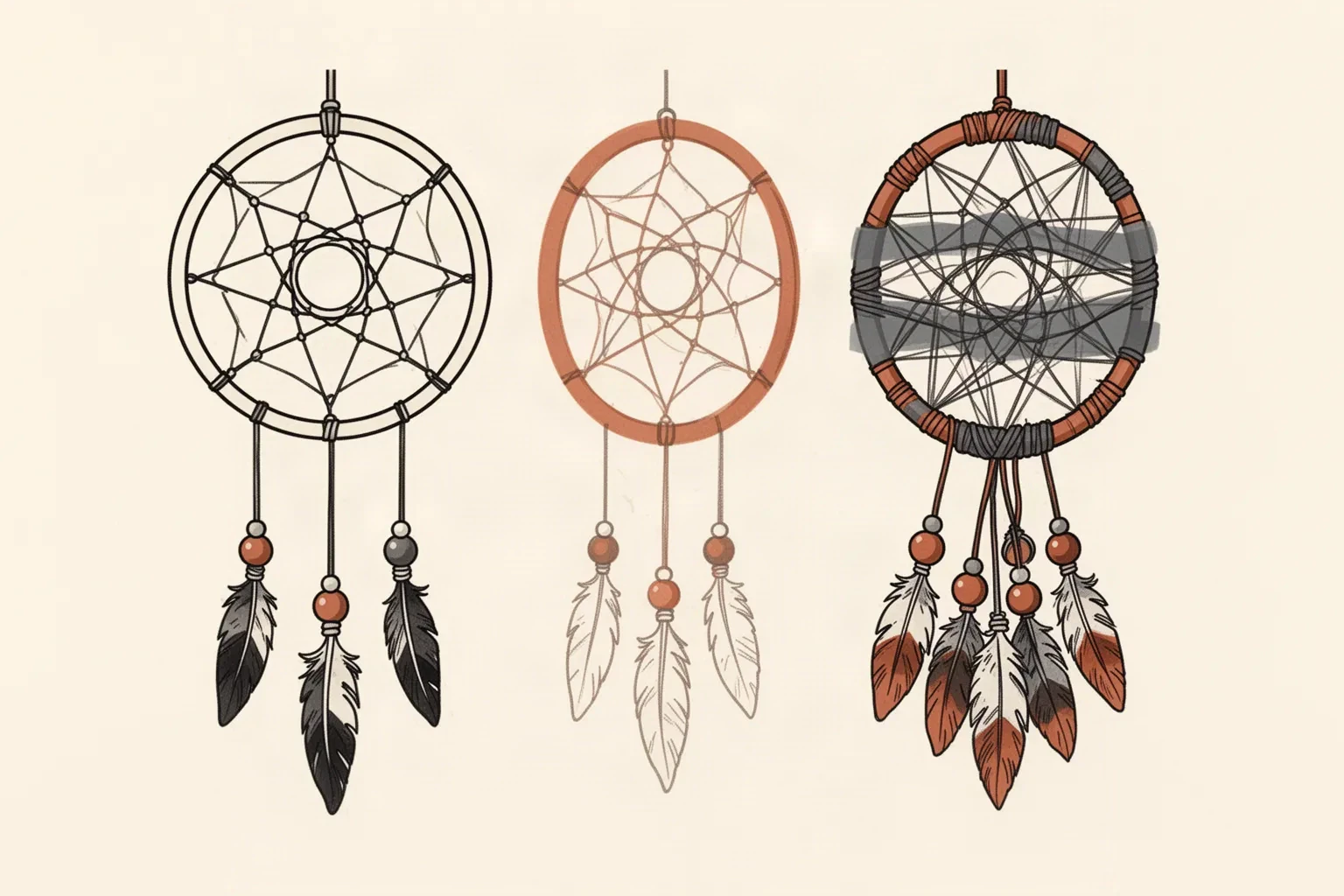
Conceptual line-art comparison of three dream catchers: an even circular hoop with countable web passes and three separated hanging lanes, an oval hoop with uneven wrap and anchor spacing, and a dense web with crowded hanging beads and feathers touching
Conceptual illustration of the three structural reads: even hoop with countable web and separated lanes, oval hoop with uneven anchors, and a merged web with crowded hanging elements. Synthetic artwork, not app output and not a scale drawing. Judge your own reference on a measured 1:1 print.

HOLDS AT STATED SIZE

Even hoop with countable web at 12 cm

Hoop diameter 120 mm, total drop about 200 mm

Reference read

One even circular hoop with steady ring mass, a web of two to three open passes with countable spokes, a small open center pocket, and three hanging lanes with spaced beads and simple feather tips.

Protect
Hoop circularity with even ring mass, the two structural web passes nearest the hoop and center, the open center pocket, and the widest lane separations between hanging strands.
Fix
Thin only the finest middle web pass if two strings touch at 1:1. Keep hoop mass, spoke anchors, bead positions, and feather tips unchanged.
Candidate stencil
Same dream catcher with a true circular hoop, countable web passes with an open center, and spaced hanging lanes with skin around every bead and tip at transferable mass.
Final-size verdict
Holds at 12 cm after a web-gap check. Every string keeps separation at true size, the center pocket stays open, and each hanging lane reads separately.

REBUILD HOOP FIRST

Oval hoop with uneven wrap at 12 cm

Hoop diameter 120 mm (widest axis), total drop about 200 mm

Reference read

Appealing web geometry, but the hoop runs oval with one flattened side and thicker wrap on the lower right. Spokes on the flat side sit closer together while spokes on the round side spread apart.

Protect
The intended hoop diameter, the web center location, and the longest clean spoke run as the rebuild reference.
Fix
Redraw the hoop as one true circle on the stated diameter, re-space spoke anchors evenly around it, then re-hang the center pocket on the corrected axis. Do not thicken web strings to hide the oval.
Candidate stencil
Same dream catcher with a true circular hoop, countable web passes with an open center, and spaced hanging lanes with skin around every bead and tip at transferable mass.
Final-size verdict
Not stencil-ready until the hoop is rebuilt. Web detail cannot compensate for a hoop whose anchors sit at uneven spacing.

SIMPLIFY WEB DENSITY

Dense multi-pass web that merges at 9 cm

Hoop diameter 90 mm, total drop about 160 mm

Reference read

Clean hoop with a rich web of five or more fine concentric passes, many spokes, and a decorated center with small beads worked into the net. Dense on screen because fine strings fill every gap, which is exactly what closes first on paper.

Protect
Hoop mass, the two structural passes that define the web read, the center pocket position, and the three main spoke directions.
Fix
Reduce the web to two or three countable passes with open skin between them, move small beads out of the net onto one or two hanging strands, and hold the center to one open pocket. Re-check with a squint test at 1:1.
Candidate stencil
Same dream catcher with a true circular hoop, countable web passes with an open center, and spaced hanging lanes with skin around every bead and tip at transferable mass.
Final-size verdict
Not stencil-ready until web passes are reduced. At 9 cm the middle passes function as one gray band, so simplify or enlarge the hoop past the point where every string transfers separately.

SPACE OR REDUCE HANGING LANES

Crowded beads and feather tips at 10 cm

Hoop diameter 100 mm, total drop about 180 mm

Reference read

Sound hoop and readable web, but four hanging strands crowd one narrow span below center. Beads touch each other, two feather barbs overlap, and one tip touches a neighboring bead with no skin break.

Protect
Hoop and web as built, the center lane position, and the cleanest single feather tip as the spacing reference.
Fix
Reduce to three lanes with a clear gap between each, give every bead open skin on all sides, and stagger feather tips so no tip touches a bead or a neighboring vane. If the design needs four lanes, widen the tie span across the lower hoop or lengthen the drop.
Candidate stencil
Same dream catcher with a true circular hoop, countable web passes with an open center, and spaced hanging lanes with skin around every bead and tip at transferable mass.
Final-size verdict
Holds at 10 cm only after lanes are spaced or reduced. Hanging detail reads from separation, not from strand count, at this drop length.

Generic compact-symbol comparison stays on the symbols collection. Broad visual browsing stays on the stencils and subject hubs. This framework exists to judge dream catcher hoop circularity, web collapse, and hanging separation at a stated size, not to replace those owners.

Hoop, web, beads, and feathers at final size

Judge the white space at the diameter you will print.

Screens forgive crowding that paper and skin do not. Set the hoop diameter and drop length first, then inspect each feature below at true physical size with scaling off.

Hoop about 8 cm and below

Wrist, ankle, behind-ear scale tests, and small gap fillers.

Carry one clean hoop, two open web passes maximum, one open center pocket, and at most two hanging lanes with simple tips. If a web channel, bead gap, or feather tip closes at 1:1, enlarge or reselect rather than forcing reduction.

Hoop about 10 to 13 cm

Common forearm, shoulder, calf, and rib dream catcher pieces.

The most flexible band. A three-pass web with a held center plus three spaced hanging lanes can work when every string gap, bead separation, and feather tip is verified at true size.

Hoop about 15 cm and above

Thigh, upper back, and showcase compositions with long drops.

Room for a finer web gradient, beaded net accents, or longer feather drops, but only when open skin separates every string, every bead, and every vane. Extra diameter does not rescue an oval hoop or merged lanes.

Dream catcher feature checks by hoop band
FeatureHoop about 8 cm and belowHoop about 15 cm and above
Hoop ringOne even closed circle with steady mass. If the ring thins or flattens anywhere, the whole piece reads tilted.Same priority. Larger diameters allow wrapped or beaded hoop detail only when the underlying circle stays true and anchors stay evenly spaced.
Web stringsTwo countable passes with open skin between them. Keep spokes few and evenly anchored; if a pass touches its neighbor, remove the pass.Three passes maximum with a planned gradient from hoop to center: open near the hoop, one controlled middle pass, open center pocket. Move decorative beads out of the net.
Center pocketOne small open center with skin around it. Decorated centers merge first at small diameters.A held center motif is allowed when every surrounding string keeps its own gap at 1:1. Protect the pocket before adding center detail.
Beads, strings, and feathersAt most two lanes, small beads with skin around each, and smooth simple feather tips with no fray. Stagger tip heights so no two tips share one line.Three lanes with counted beads and ranked feather barbs allowed only when each lane keeps its own air from tie point to lowest tip. Widen the tie span before adding a fourth lane.

Reference to clean stencil

Build from the hoop outward, then protect the gaps.

Work in this order so one change at a time can be judged at the same hoop size. Stop when hoop, web, beads, lanes, and tips each read correctly.

  1. 01

    Lock hoop diameter, drop length, and placement first

    Set the physical hoop diameter in millimeters, the total drop from hoop top to lowest tip, and the named body area before judging the reference. A dream catcher that holds at 13 cm on a thigh can fail at 8 cm on a wrist with no line being wrong on its own. Use the size calculator when target dimensions are still open.

  2. 02

    Verify hoop circularity and anchor spacing

    Confirm one true circle with even ring mass, then count the web spokes that reach the hoop and compare spacing around the full ring. Rebuild an oval or unevenly wrapped hoop and re-space anchors before touching web weight or hanging detail. A stable hoop with even anchors is already halfway to stencil-ready.

  3. 03

    Set hoop-versus-web-versus-hang hierarchy

    Assign every mark a role: hoop and structural web passes that carry the first read, support strings that shape the net, and hanging beads and feathers that finish the piece. Strengthen the hoop and structural passes first, keep secondary strings lighter, and mark one removable web pass or hanging lane that can go if gaps close.

  4. 04

    Simplify web, beads, and feathers at 1:1

    Reduce web passes to countable strings with open skin, give every bead its own separation, simplify feathers to ranked barbs with clean tips, and stagger lane heights. Run a squint check: step back until fine strings disappear and confirm the hoop, web read, and lane rhythm still hold. The line-weight guide covers fine, normal and bold behavior on the same stencil.

  5. 05

    Verify circular print and transfer path

    Export a true-size PDF with no fit-to-page scaling, inspect the narrowest web channel, the smallest bead gap, and the tightest feather tip on plain paper, then measure the physical print with a ruler. Confirm the hoop still closes as one even circle after transfer curvature is considered. If the digital file passes and only paper fails, move to print-stage evidence instead of simplifying again.

Placement and size decisions

Circles want flat skin, drops want vertical room

A dream catcher is a flat circle with vertical drops. Flat placements preserve the hoop with little compensation, while wrapped placements demand a smaller hoop or wider lane spacing.

Thigh and upper back

Broad, gently curved fields where the full hoop plus a long feather drop fits without compression. The best place to test a three-lane hang or a finer web gradient.

Check: Size the web density to this placement rather than copying proportions from a smaller reference photo, and confirm lane clearance below the hoop before print.

Forearm and calf

Long vertical fields that suit the hoop-over-drop composition when the hoop fits the flat span. Cross-limb hoops wrap into ovals and crowd one side of the web.

Check: Align the hoop with the flattest available span, keep the drop along the limb line, and shorten cross-limb lane spread while edits are still cheap.

Ribs and side torso

Curved breathing panels where a true circle photographs as an oval and hanging lanes compress on the curve side. Flat reference circles distort when wrapped.

Check: Preview the hoop on a curve before locking the layout, widen lane spacing past the point where gaps hold on the preview, and verify every web channel at 1:1.

Wrist, ankle, and behind ear

Small wrapped fields where only minimal dream catchers survive. Dense webs, beaded nets, and multi-feather drops forced into these bands merge first.

Check: Carry one clean hoop, two open web passes, and at most two simple lanes. Preview on a body photo before locking the layout, and enlarge or reselect at the first closed gap.

Stencil-ready checklist

Approve the dream catcher only when every line passes

Run this short sequence with scaling off and a ruler in hand. One failed line means fix, enlarge, or reselect before transfer.

  • Confirm hoop diameter in millimeters, total drop length, and the named placement.
  • Confirm one true circular hoop with even ring mass and evenly spaced spoke anchors.
  • Confirm countable web passes with open skin between strings and an open center pocket at 1:1.
  • Confirm every bead has open skin on all sides with no bead-to-bead or bead-to-tip contact.
  • Confirm each hanging lane reads separately with staggered feather tips and no vane overlap.
  • Export a true-size PDF with scaling off and measure the physical print.
Rebuild hoop first Verify web gaps at 1:1 Keep lanes separate

FAQ

Dream catcher stencil decisions, answered

Short answers for the hoop, web, hanging, size, and print checks that recur when a circular web piece moves toward transfer-ready output.

It holds when three checks pass at the exact hoop diameter and drop length: the hoop is one true circle with evenly spaced anchors, every web string keeps its own separation with an open center pocket at 1:1, and each hanging lane reads separately with beads and feather tips clear of contact. If any check fails, the fix list on this page names what to rebuild, simplify, space, or enlarge before transfer.

Next steps

Use the neighboring owners for adjacent jobs.

This guide covers dream catcher hoop circularity, web collapse checks, feather and bead spacing, and circular print prep. Use the links below for related jobs such as sizing, print checks, paper, and placement.

Generic symbol linework theory, broad gallery browsing, photo-conversion mechanics, paper manufacturing detail, and placement mechanics stay in their specialist owners. The links above hand off instead of repeating that detail.

From evaluated reference to working stencil

Turn the approved dream catcher into a stencil draft.

Start from the dream catcher that passed the hoop, web, and hanging checks, then continue on iPhone for body fit, exact-size print, mirror and professional export.