
Birth-flowers comparison hub for stencil work

Compare birth month flowers, then stencil the right one

Ten months offer two flowers, not one. Answer three triage questions, read the tie-breaker for the month in the comparison index, then follow one link to the month guide or species page that owns the depth.

Built for working artists resolving a client birth-flower request in session. This hub covers month-to-flower comparison, dual-flower tie-breakers, symbolism threads, and routing only, not tattoo application or healing advice.

Selection logic first

Three questions resolve most birth-flower briefs.

Work these in order before opening any month guide. They separate the comparison decision this hub owns from the depth work the linked owners hold.

01

Which month are you designing for?

Find the month in the comparison index below. Ten months carry two flowers, so read the tie-breaker line before committing to linework. March and November carry one flower each, which makes them pure style and placement decisions.
02

One flower, or a meaningful pair?

A single bloom suits small widths and clean placements. A two-flower posy suits couples, siblings, and memorial briefs, but only when the placement holds a clear skin channel between the two structures at true size. Decide this before prep, not during it.

03

What width and placement must carry it?

Set the physical width in millimeters and name the body area first. Dense tiered heads need room for tiers, open faces need protected gaps, trumpets need restrained centers, and spikes need vertical fields. The width decides which flower of a dual month survives.

12-month comparison index

Every month, both flowers, one tie-breaker each.

Find the birth month, read which bloom fits the placement and the message, then follow the single linked guide. Flower mappings follow the widely documented Old Farmer's Almanac list used by the month guides on this site.

Birth month to flower comparison with tie-breaker and routing
MonthBirth flowersTie-breaker ruleOpen next
JanuaryCarnation + snowdropPick carnation for a full ruffled head with color-led meaning; pick snowdrop for a minimal single bell accent on a tight placement.January guide: carnation vs snowdrop
FebruaryViolet + primrosePick violet for a small five-petal face with heart leaves and a devotion message; pick primrose for an open rosette cluster and a new-beginnings message.February guide: violet vs primrose
MarchDaffodilSingle-flower month. The decision is trumpet restraint plus petal-ring spacing at your width, not which bloom.Daffodil species depth
AprilDaisy + sweet peaPick daisy for one flat ray head around a disk; pick sweet pea for a soft ruffled cluster climbing a vine. Pair them only with a verified skin channel.April guide: daisy vs sweet pea
MayLily of the valley + hawthornPick lily of the valley for a strand of tiny bells (simplify early below 5 cm); pick hawthorn for a small blossom spray on a woody twig.Line-weight guide for fine bell detail
JuneRose + honeysucklePick rose for a layered spiral with color-led meaning; pick honeysuckle for paired tubular trumpets on a vine with a devotion message.Rose construction depth
JulyLarkspur + water lilyPick larkspur for a tall spurred spike on a vertical placement; pick water lily for a layered bloom over broad pads with calm, rebirth meaning.Water-lily species depth
AugustGladiolus + poppyPick gladiolus for a stacked vertical spike on slim placements; pick poppy for an open cup with a dark center kept open, on remembrance briefs.Gladiolus species depth
SeptemberAster + morning gloryPick aster for a narrow-ray composite (denser than a daisy, so ray count decides reduction); pick morning glory for an open trumpet face on a vine.Aster species depth
OctoberMarigold + cosmosPick marigold for a dense tiered head with remembrance warmth; pick cosmos for an open broad-petal face where petal gaps decide survival.October guide: marigold vs cosmos
NovemberChrysanthemumSingle-flower month. The decision is tier density and placement, with long loose layered tiers that read differently from a compact marigold head.Chrysanthemum species depth
DecemberHolly + narcissus (paperwhite)Pick holly for spiked leaves plus berries as a geometric companion motif; pick narcissus for a trumpet cluster with several blooms per stem.Set exact width for fine winter detail

List variations exist: some studio lists name iris for February or peony for April, and March and November carry one canonical flower each on the Almanac list. When a client brings an alternative bloom, confirm which flower they picture before committing to linework rather than debating the list.

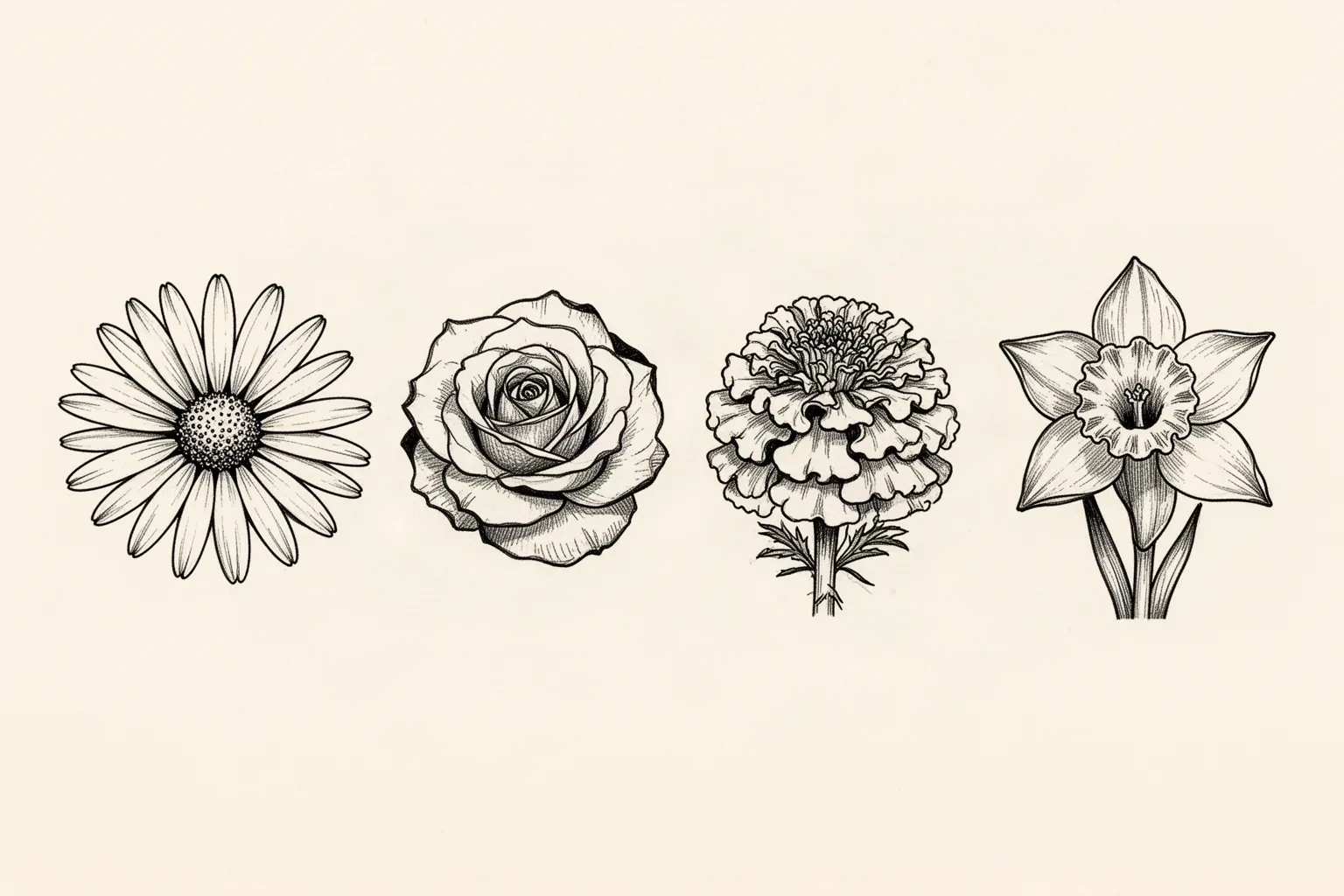
Monochrome line study of four stencil-scale flower constructions on white: a daisy with ray petals around a disk, a rose with layered spiral petals, a marigold with stacked ruffled tiers, and a daffodil with a trumpet center ringed by petals.
Four construction families behind the tie-breakers, left to right: daisy ray ring around a disk, rose spiral bloom, marigold tiered head, daffodil trumpet with petal ring. Dual-flower months almost always pair two different families from this plate, which is why the tie-breaker reads construction before meaning. Original synthetic illustration made for the birth-flower hub set; it is not StencilStudio app output.
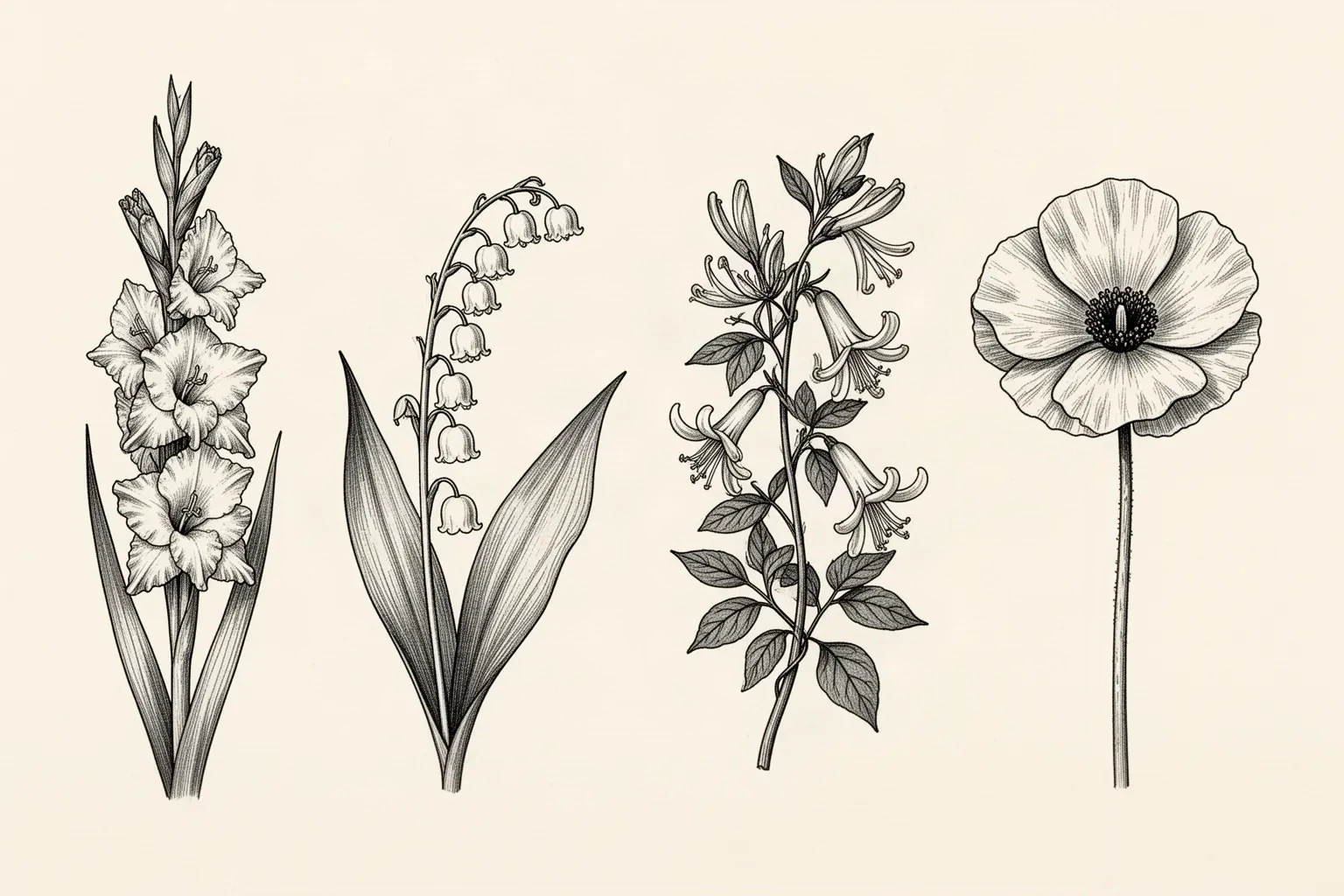
Monochrome ink line study of four additional stencil-scale flower constructions on off-white: a gladiolus spike of stacked funnel blooms on one vertical stem, a lily of the valley stem descending into small bells with broad leaves, a honeysuckle vine with paired tubular trumpet blooms, and a poppy open cup of broad petals around a dark seed center.
The other four families, left to right: gladiolus spike, lily of the valley bell strand, honeysuckle tubular trumpet on a vine, poppy open cup with a compact center. Months that pair these with a head family, such as May, July, August, and December, read as two different spacing budgets rather than two versions of one bloom. Original synthetic illustration made for the birth-flower hub set; it is not StencilStudio app output.

Symbolism threads

Meanings clients expect, grouped so ties break faster.

Comparison depth only. Full symbolism framing with client-wording examples stays in the month guides, which turn each meaning into inscription decisions.

Remembrance and comfort

Marigold, poppy, and gladiolus carry memorial weight. These briefs often pair the bloom with a name, date, or short script, so reserve lettering clearance beside denser heads before prep.

New beginnings and hope

Snowdrop, daffodil, narcissus, and primrose suit births, recoveries, and fresh starts. Open faces and trumpets leave natural room for small inscriptions without crowding petal edges.

Devotion and affection

Violet, honeysuckle, and aster suit partner, family, and friendship pieces. Vine and spray constructions in this thread need stem hierarchy checks so tendrils do not touch blooms at final size.

Strength and quiet joy

Gladiolus, chrysanthemum, and larkspur suit milestones and character pieces. Spikes want vertical placements and tiered heads want width, so match the thread to a field that can carry it.

Color changes the message for carnation and rose, so lock color intent with the client before prep. When two blooms fit the placement equally, the thread above that matches the brief wins, and the month guide linked in the index turns that win into lettering and layout.

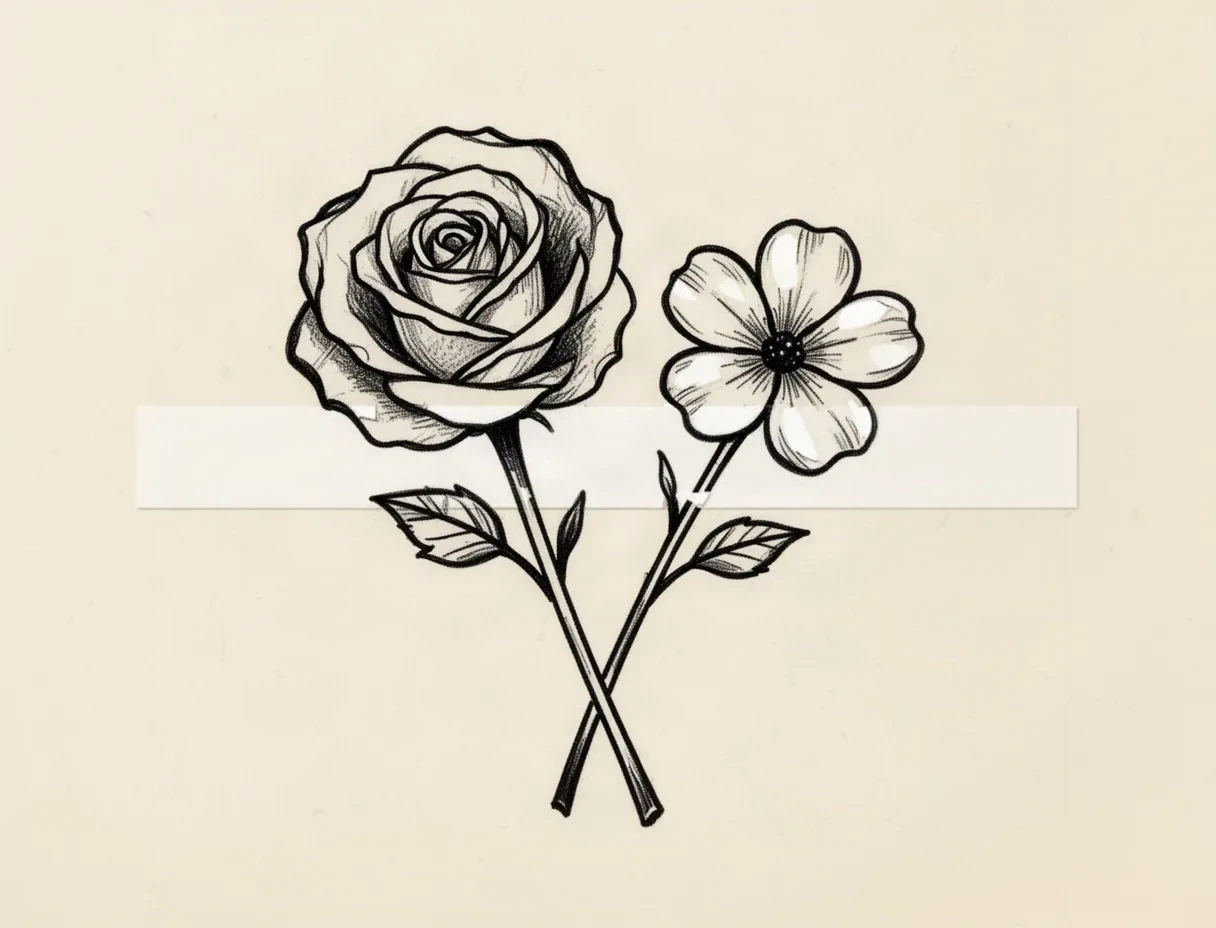
Monochrome line study of a two-flower posy with a larger layered rose bloom and a smaller open five-petal bloom, with open space kept between the two petal masses.
The pairing case this hub triages: one layered focal bloom, one smaller open bloom, and a visible band of open space held between the two petal masses. Two flowers means two spacing budgets, so rank the focal bloom and keep the stems from converging wherever the placement narrows. Original synthetic illustration made for the birth-flower hub set; it is not StencilStudio app output.

Stencil-ready checklist

Approve the comparison winner before depth work

Run this short sequence with scaling off and a ruler in hand. One failed line means fix, enlarge, split, or reselect before transfer. Species-level gap workflows stay in their owners.

  • Confirm the month, the chosen flower or pair, the message carried, the intended width in millimeters, and the named placement.
  • Confirm the construction family (tiered head, open face, trumpet or bell, spike, cup, or spray) and its known failure mode at this width.
  • Confirm every petal, ray, tier, or bell separation stays open at 1:1 with scaling off.
  • Confirm centers (disks, trumpets, cups, keels) stay compact with visible skin between marks, never one filled pocket.
  • Confirm dual-flower posies keep a clear skin channel between blooms with no crossing stems.
  • Export a true-size PDF and measure the physical print with a ruler before transfer.
12-month comparison with tie-breakers Symbolism threads, then route to owners Summarize, then link to depth

FAQ

Birth-flower comparison decisions, answered

Short answers for the mapping, dual-flower, symbolism, size, and routing checks that recur when a birth-flower choice moves toward transfer-ready output.

January: carnation and snowdrop. February: violet and primrose. March: daffodil. April: daisy and sweet pea. May: lily of the valley and hawthorn. June: rose and honeysuckle. July: larkspur and water lily. August: gladiolus and poppy. September: aster and morning glory. October: marigold and cosmos. November: chrysanthemum. December: holly and narcissus. The comparison table above adds a tie-breaker rule and a routing link for every month.

From compared choice to working stencil

Turn the chosen birth flower into a stencil draft.

Start from the month and flower resolved above, then continue on iPhone for body fit, exact-size print, mirror and professional export.