Name, date, or month numeral in script
Suits the commemorative tone of most birth-flower briefs, especially remembrance and new-parent pieces. Set lettering on its own curve with open skin between text and petals, and size the script independently.


Birth-flower hub for stencil work
Every month maps to one or two flowers, and each flower needs different linework. Locate the month in the index below, compare the dual-flower choice and the symbolism the client expects, then follow one link to the month guide or species page that owns the depth.
Built for working artists resolving a client birth-flower request in session. This hub covers the 12-month index, symbolism and inscription overview, dual-flower decisions, and routing only, not tattoo application or healing advice.
12-month index
Find the birth month, read the symbolism snapshot and the stencil construction note, then follow the single linked guide. Flower mappings follow the widely documented Old Farmer's Almanac list used by the month guides on this site.
| Month | Birth flowers | Symbolism snapshot | Stencil read | Open next |
|---|---|---|---|---|
| January | Carnation + snowdrop | Carnation: love and distinction, color-led (pink affection, white innocence). Snowdrop: hope and compassion. | Carnation is a ruffled layered ball where tier density decides reduction. Snowdrop is one small nodding bell, best as a single accent. | January guide: carnation vs snowdrop |
| February | Violet + primrose | Violet: modesty, humility, loyalty. Primrose: youth, young love, new beginnings. | Violet is a small five-petal face with heart leaves. Primrose is an open flat rosette cluster. Both live or die on petal spacing at small widths. | February guide: violet vs primrose |
| March | Daffodil (jonquil type) | Rebirth, new beginnings, hope. Single-flower month, so the choice is style and placement, not which bloom. | A trumpet cup ringed by six petals. Restrain the trumpet center and keep the petal ring separable at final size. | Daffodil species depth |
| April | Daisy + sweet pea | Daisy: innocence, purity, true love. Sweet pea: gratitude, fondness, fond farewell. | Daisy is a flat ray ring around a textured disk. Sweet pea is a ruffled cluster on a climbing vine. Different gap problems, different checks. | April guide: daisy vs sweet pea vetting |
| May | Lily of the valley + hawthorn | Lily of the valley: sweetness, humility, return of happiness. Hawthorn: hope. | Lily of the valley is a strand of tiny bells that merge fast below 5 cm. Hawthorn is a small blossom spray on a woody twig, judged like branch-spray work. | Line-weight guide for fine bell detail |
| June | Rose + honeysuckle | Rose: love and beauty, strongly color-led. Honeysuckle: devotion, affection, fond memories. | Rose is a layered spiral where rank order decides reduction. Honeysuckle is paired tubular trumpets on a vine, judged on tube separation. | Rose construction depth |
| July | Larkspur + water lily | Larkspur: positivity, dedication, cheerful spirit. Water lily: purity, rebirth, calm. | Larkspur is a tall spurred spike that wants vertical placements. Water lily is a layered bloom over broad pads, judged on layer separation. | Water-lily species depth |
| August | Gladiolus + poppy | Gladiolus: strength, integrity, remembrance. Poppy: peaceful remembrance, comfort, sleep. | Gladiolus is a stacked vertical spike, slim placements only. Poppy is an open cup with a dark center that must stay open, not filled. | Gladiolus species depth |
| September | Aster + morning glory | Aster: wise and patient love, faith. Morning glory: affection, playful and fleeting love. | Aster is a narrow-ray composite, denser than a daisy, so ray count decides reduction. Morning glory is an open trumpet face on a vine. | Aster species depth |
| October | Marigold + cosmos | Marigold: warmth, creativity, joyful and sorrowful remembrance. Cosmos: order, harmony, peace. | Marigold is a dense tiered head where tier count decides survival. Cosmos is an open broad-petal face where petal gaps decide it. | October guide: marigold vs cosmos |
| November | Chrysanthemum | Loyalty, friendship, joy. Single-flower month, so the choice is tier density and placement, not which bloom. | Long loose layered tiers with a distinct center build. Do not substitute a compact marigold head; the tier rhythm is different. | Chrysanthemum species depth |
| December | Holly + narcissus (paperwhite) | Holly: protection, goodwill, hope. Narcissus: purity, rebirth, new beginnings. | Holly is spiked leaves plus berries, a geometric companion problem. Narcissus is a trumpet cluster with several blooms per stem, judged on bloom separation. | Set exact width for fine winter detail |
List variations exist: some studio lists name iris for February or peony for April, and March and November carry one canonical flower each on the Almanac list. When a client brings an alternative bloom, confirm which flower they picture before committing to linework rather than debating the list.
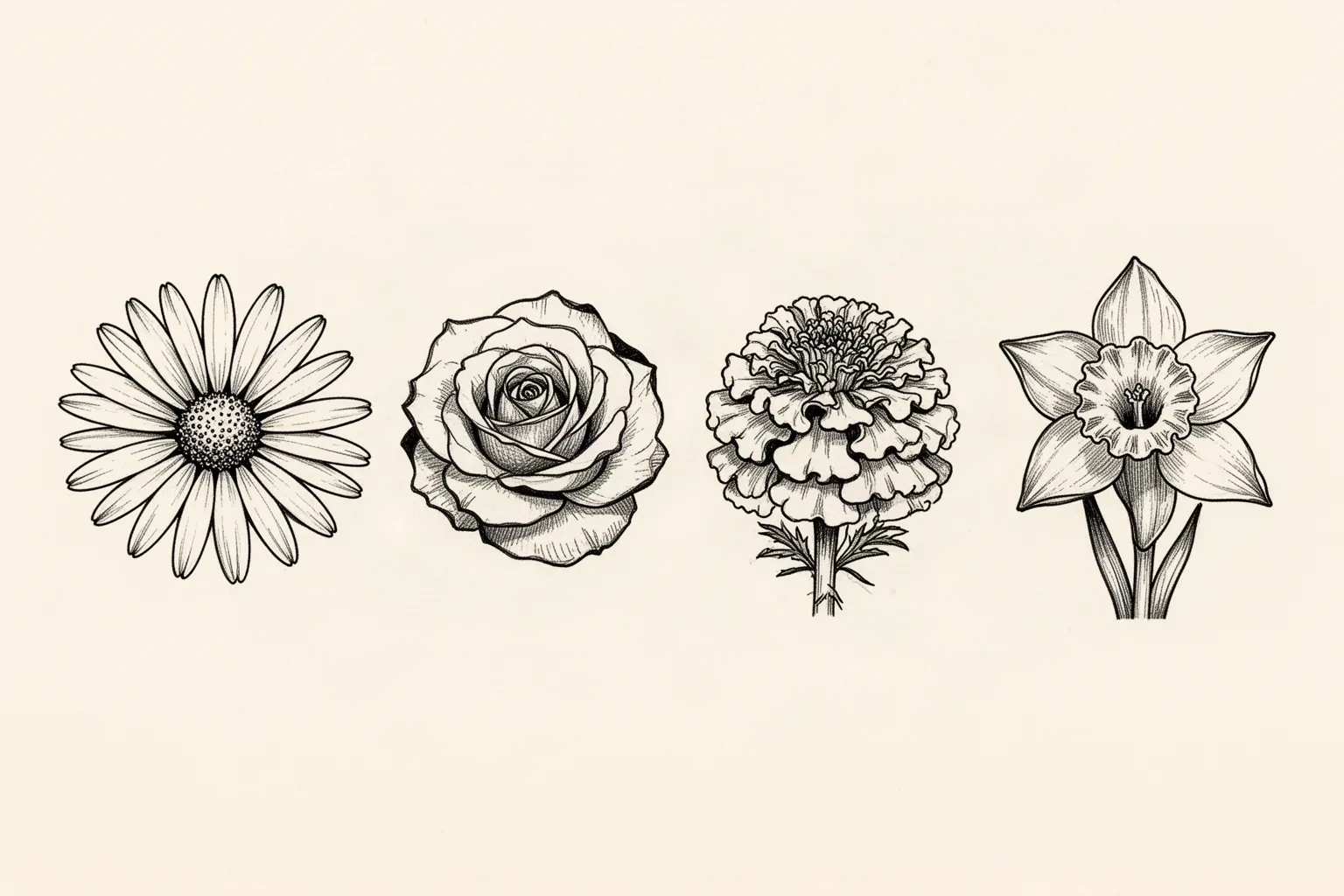
January: carnation vs snowdrop
Ruffle-ball versus bell-accent decision with symbolism and inscription framing.
Open the month guideFebruary: violet vs primrose
Small-face spacing checks with symbolism and inscription framing.
Open the month guideApril: daisy vs sweet pea
Ray-disk versus vine-cluster vetting with delicate placement fit.
Open the month guideOctober: marigold vs cosmos
Tiered-head versus open-face decision with small-size prep.
Open the month guideDual-flower decision framework
Listicles stop at meanings. For stencil work the deciding question is which construction the placement can carry at final size. Work the five steps below, then leave this hub for the linked owner.
Ask the client to point at a reference before any linework. In dual-flower months the two blooms need completely different construction, and guessing wrong means rebuilding the piece. March and November skip this step: one canonical flower each.
Dense tiered heads (carnation, marigold, chrysanthemum) fail on tier crowding. Open faces (violet, primrose, cosmos, poppy) fail on gap closure. Trumpets and bells (daffodil, snowdrop, narcissus, honeysuckle, lily of the valley) fail on center fill. Spikes (larkspur, gladiolus) fail on stacking. Pick the construction the placement can actually carry.
When both blooms fit the placement, choose by message: remembrance weight favors marigold, poppy, or gladiolus; new-beginning briefs favor snowdrop, daffodil, narcissus, or primrose; devotion briefs favor violet, honeysuckle, or aster. Then check the inscription plan: fine script beside dense heads needs extra clearance, while open faces leave more lettering room.
A two-flower posy for couples, siblings, or memorials is legitimate, but it is a two-structure composition. Rank one flower as focal, give each its own spacing budget, and protect a clear skin channel between them at true size. On wrist, ankle, or behind-ear widths, one flower with clean gaps beats a crowded pairing.
Once the flower is locked, leave this hub. Month guides own the dual-flower vetting for January, February, April, and October. Species pages own single-flower gap workflows for daffodil, daisy, sweet pea, rose, water lily, gladiolus, poppy, aster, marigold, and chrysanthemum. The routing map below names each handoff.
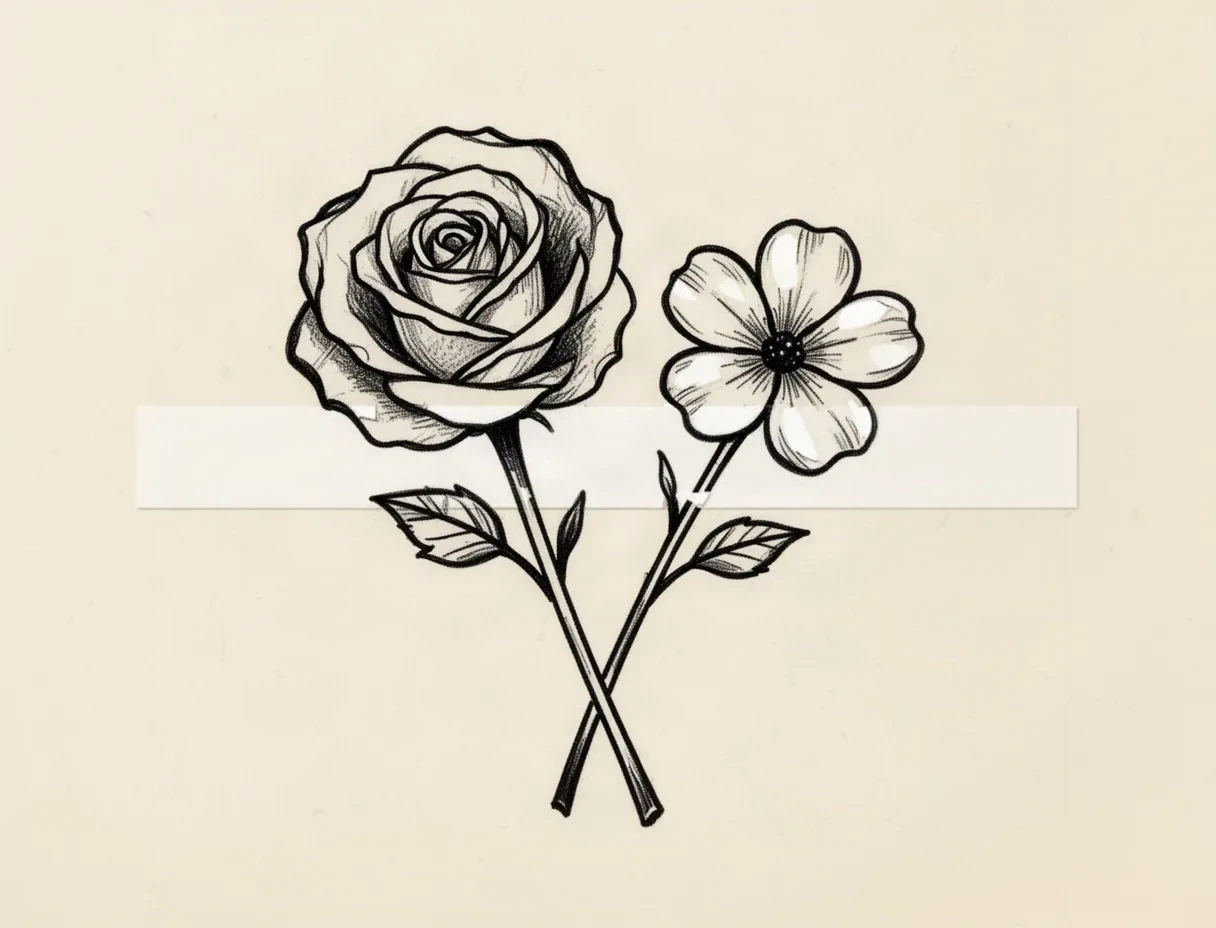
Symbolism and inscription overview
Comparison depth only. Full symbolism framing with client-wording examples stays in the month guides, which quote the meanings clients arrive with and turn them into inscription decisions.
Suits the commemorative tone of most birth-flower briefs, especially remembrance and new-parent pieces. Set lettering on its own curve with open skin between text and petals, and size the script independently.
Partner, child, or memorial posies combine the birth flower with another month bloom. Rank focal versus secondary explicitly and keep the two structures from interlocking at final size.
Birthstones, tiny stars, or short Roman numerals add personal weight. Treat any hard geometric companion as a separate focal object with its own spacing budget so it frames the bloom instead of crowding petal edges.
Meaning threads to compare: remembrance through marigold, poppy, and gladiolus; new beginnings through snowdrop, daffodil, narcissus, and primrose; devotion through violet, honeysuckle, and aster; quiet strength through gladiolus and chrysanthemum. Color changes the message for carnation and rose, so lock color intent with the client before prep.
Stencil-ready checklist
Run this short sequence with scaling off and a ruler in hand. One failed line means fix, enlarge, split, or reselect before transfer. Species-level gap workflows stay in their owners.
Line-weight guide
Compare fine, normal, and bold behavior on the same stencil before changing floral line mass.
Print preflight
Inspect fine petals, tier edges, and tight bud gaps at the intended width before blaming the printer.
Body-fit preview
Check flower placement and stem direction on curved placements while edits are still cheap.
Transfer guide
Follow generic print and transfer mechanics after the birth-flower file passes its checks.
FAQ
Short answers for the mapping, dual-flower, symbolism, size, and routing checks that recur when a birth-flower request moves toward transfer-ready output.
January: carnation and snowdrop. February: violet and primrose. March: daffodil. April: daisy and sweet pea. May: lily of the valley and hawthorn. June: rose and honeysuckle. July: larkspur and water lily. August: gladiolus and poppy. September: aster and morning glory. October: marigold and cosmos. November: chrysanthemum. December: holly and narcissus. The index table above adds the symbolism and stencil read for each month at comparison depth.
Routing map
This hub covers the 12-month index, symbolism and inscription overview, dual-flower decisions, and routing. Use the links below for month depth, species depth, sizing, print, and browsing.
February month depth
Violet vs primrose choice with symbolism and inscription framing.
ContinueJanuary month depth
Carnation vs snowdrop choice with symbolism and inscription framing.
ContinueApril month vetting
Daisy vs sweet-pea identification, gap vetting, and delicate placement fit.
ContinueOctober month depth
Marigold vs cosmos choice with layered-head and open-face prep.
ContinueSweet-pea species depth
Ruffle hierarchy, keel reads, and vine flow for dedicated sweet-pea work.
ContinueDaisy species depth
Ray-disk construction and gap retention for dedicated daisy work.
ContinueViolet species depth
Small-face petal construction for dedicated violet work.
ContinueExact size and true-size PDF
Set physical width and calibration for the chosen birth flower.
ContinueFinished-file preflight
Check fine petals and tight gaps at the intended width.
ContinueMonth-specific cultivar detail, species-level petal and gap workflows, bouquet bunching, lotus flow structure, sizing math, print manufacturing, and placement mechanics stay in their specialist owners. The links above hand off instead of repeating that detail.
From decided concept to working stencil
Start from the month and flower resolved above, then continue on iPhone for body fit, exact-size print, mirror and professional export.