

October birth-flower stencil evaluation

Vet any October birth flower before it becomes a stencil

October means two flowers, not one: marigold plus cosmos. Confirm which construction the reference actually shows, choose the cultivar form the width can carry, pair the inscription without crowding the bloom, then prep a clean transfer-ready stencil for the birth-meaning placement.

Built for working artists preparing October birth-flower pieces. This page covers marigold vs cosmos identification, cultivar-form choice, symbolism and inscription pairing, small-size gap checks, and transfer-ready prep only, not tattoo application or healing advice. Chrysanthemum heads and daisy faces need different vetting logic.

October baseline and identification

Two October flowers, two different stencil problems.

Meaning brings the client in: warmth, creativity, passion, and remembrance for marigold; order, harmony, and peace for cosmos. Construction decides the stencil. Confirm the build below before judging any line.

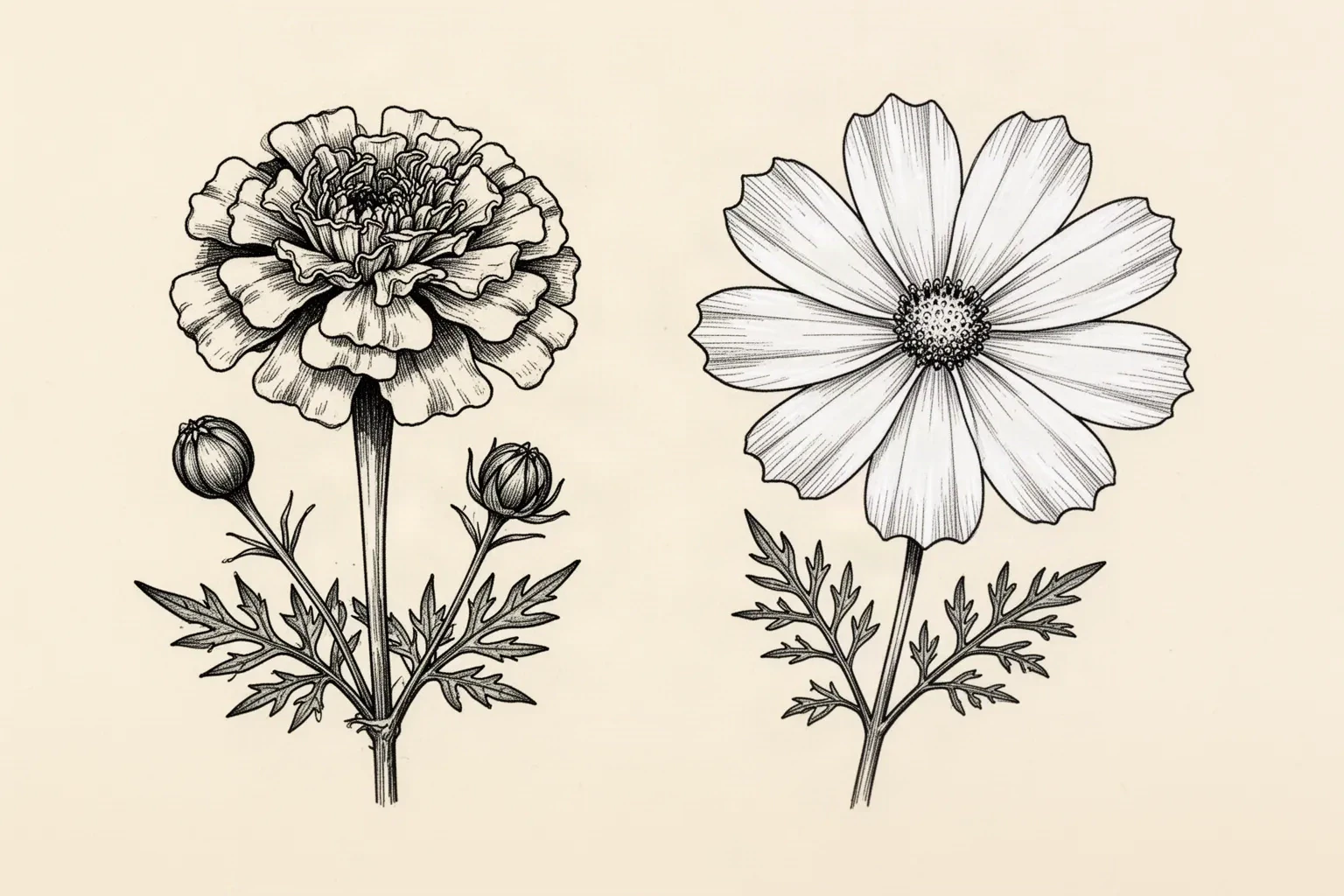
Side-by-side ink line study: on the left a dense marigold head with ruffled petal tiers around a contained center, two tight buds on their own stalks and pinnate leaves; on the right an open cosmos face with eight broad evenly spaced petals around a compact disk and a branching stem with ferny leaves

Construction comparison, marigold beside cosmos

Left, marigold: a dense ball of ruffled tiers stacked around a small center, upright stem, tight single-contour buds on their own stalk gaps, spaced pinnate leaves. Right, cosmos: one open ring of broad petals around a visible compact disk on a branching stem with fine ferny leaves, so the two builds are told apart by head and center before any line is judged. The drawing is an illustrative study made for this guide, not an app export or a measured print, and its cosmos petal gaps tighten near the disk; the tables below are where every tier and petal separation is verified open at 1:1.

Marigold (primary October flower)

Warmth, creativity, passion, and remembrance, with both joyful and sorrowful remembrance attached. Clients usually request it as a dense golden head: deep gold and orange read as warmth and creative fire, red as deep love.

A dense rounded head of many ruffled florets stacked in concentric tiers around a small or hidden center, on a slender upright stem with spaced pinnate leaves. Stencil viability comes from keeping each tier readable with open skin between stacks and from restraining the center, not from copying every ruffle a photo shows.

Cosmos (secondary October flower)

Order, harmony, peace, and quiet joy. Its name comes from the Greek word for order and harmony, a reference to the evenly arranged petals. Clients usually request it as a light open face in white, pink, or crimson.

An open flat face of typically eight broad petals in one open ring around a visible compact disk, on a slender branching stem with fine ferny leaves. Stencil viability comes from keeping every petal separable from disk edge to tip and the disk open, not from drawing leaf intricacy.

Marigold tier-center build

A marigold reads as a dense tiered ball: ruffled stacks in concentric tiers around a contained center. Stencil viability comes from ranking the outer ruffle rhythm above inner tiers, keeping two readable tiers at small widths, and holding one clean tonal break around the center.

Check: Trace one outer ruffle from the head rim toward the center at 1:1. If two neighboring stacks share one merged edge before reaching open air, that head needs fewer tiers or a wider head before anything else changes.

Cosmos open-face build

A cosmos reads as a flat open face: broad evenly spaced petals around a compact disk with visible skin between every petal. Stencil viability comes from protecting petal-to-petal separations and keeping the disk a compact open center rather than a packed pocket.

Check: Follow each petal gap from the disk edge to open air at 1:1. If any two neighboring petals share one edge with no skin between them, that face needs fewer petals or a wider face before anything else changes.

Shared inscription clearance

October pieces usually carry a name, date, or numeral beside the bloom. Both flowers fail the same way here: fine script drawn against ruffle edges or petal tips merges first, and a dense marigold head needs more lettering clearance than an open cosmos face. Keep every inscription on its own baseline with open skin between text and petals.

Check: Squint until lettering detail disappears. If the bloom still reads and the script still reads as a separate band with a visible gap between them, the pairing is close. If text and petals squint into one mass, separate the baselines before touching flower detail.

Cultivar-form choice for tattoo readability
OptionBuildStencil call
Full double pom-pom marigoldDense ball of many ruffle tiers with a hidden center. The classic large garden form.Needs the most width: plan 8 cm or more, or reselect to a semi-double or single form. Forcing a pom-pom into a 4 cm wrist piece merges every tier.
Semi-double or French compact marigoldFewer tiers with a partly visible center. The middle ground most clients picture.The most flexible October marigold: one head with two readable tiers and a compact center can hold from about 5 to 8 cm when every gap is verified at true size.
Single open marigoldOne ring of ruffled petals around a clearly visible center, closest to a cosmos read.Cleanest marigold below 5 cm. Judge it like an open face: petal separations plus a compact open center, not tier stacking.
Cosmos color formsWhite, pink, or crimson faces with the same eight-petal open construction and yellow disk.Color does not change the stencil. Choose by meaning, keep the eight-petal spacing identical, and judge every face on petal gaps plus disk openness.
Marigold vs cosmos for stencil use
TraitMarigoldCosmos
Flower headOne dense rounded head of many ruffled florets in concentric tiers, no single focal petal ring.One open flat face of typically eight broad petals in a single ring, each petal separable from its neighbors.
CenterA small or hidden center. Keep it as one compact button or clean cup with a tonal break from the surrounding ruffles.A visible compact disk with countable marks and open skin between them. A packed disk prints as one dark pocket.
Stem and leavesSlender upright stem with spaced pinnate leaves. One stem direction should dominate.Slender branching stem with fine ferny divided leaves. Keep leaves as a few spaced fronds, never fine texture.
BudsA tight round bud with almost no interior separations, often paired beside an open bloom. Keep one contour with a short sepal cup.Slender buds on branching stalks. Keep one bud on its own stalk gap or recrop; touching bud-to-bloom contacts merge first.
Stencil callJudge tier count, center restraint, and bud clearance at final size. Deep layered-head work routes to the marigold species owner linked below.Judge petal count, petal-gap spacing, and disk openness at final size. If the reference shows many narrow rays instead of eight broad petals, it is a daisy and belongs to the April guide linked below.

Symbolism and inscription pairing

Let the meaning choose the pairing, then protect the gaps.

October clients usually arrive with a meaning already in mind. Frame it with one of three pairing patterns, each with its own spacing budget, so the inscription reads as part of the piece instead of crowding the bloom.

Name, date, or numeral in script

Suits the commemorative tone of both flowers. Set the wording on its own curve or baseline with open skin between text and petals, parallel to the limb on wrist and forearm pieces, never wrapped around them.

Sizing logic: Run the lettering through its own size check with the small-lettering guide linked below. Fine script beside a dense marigold head needs extra clearance: ruffle edges and hairline letters merge first, so widen the text-to-petal gap before enlarging the bloom.

A second bloom for a person

Partner, child, or memorial posies combining the October flower with another month bloom. Rank the October flower as focal or secondary explicitly and protect a clear skin channel between the two structures at final size.

Sizing logic: Give each bloom its own spacing budget: the marigold keeps its tier rhythm, the cosmos keeps its open disk, and no stem crosses a petal edge. On wrist, ankle, or behind-ear widths, one flower with clean gaps beats a crowded pairing.

A small companion mark

October birthstone accents, tiny stars, or short Roman numerals add personal weight. Treat any hard geometric companion as a separate focal object that frames the bloom instead of crowding ruffle edges or petal gaps.

Sizing logic: Hold the companion on its own spacing budget with open skin on all sides. Confirm the date format, numeral style, and spelling with the client before prep: lettering corrections after transfer are expensive.

October evaluation framework

Score the reference in minutes, then act on the weakest check.

Four October constructions at labeled widths: a holding cosmos face, a holding marigold head, a crowded pairing, and a merged pom-pom. Each one names the protected structure, the fix, and the go or no-go verdict at that exact size. Confirm every verdict with a measured 1:1 print.

HOLDS AT STATED SIZE

Single open cosmos face with spaced petals at 5 cm

Intended width 50 mm

Source
One open cosmos face with eight broad petals, visible skin between every neighboring petal from disk to tip, a compact disk with spaced marks, and a short slender stem stub with two spaced ferny fronds.
Protect
Every petal-to-petal separation, the compact disk with its open mark spacing, and the stem-to-face clearance.
Fix
Shorten only the longest petal if it touches a neighbor at 1:1. Keep petal count, disk marks, and stem direction unchanged.
Candidate stencil
Same October construction with the flower and cultivar form set, petal and bud density adjusted, inscription spaced on its own baseline, and protected contours kept at transferable mass.
Final-size verdict
Holds at 5 cm. Petals stay separable at 1:1 and the face reads as cosmos from open spacing plus a clean disk, not shading.

HOLDS AT STATED SIZE

Single marigold head with ranked tiers at 7 cm

Intended width 70 mm

Source
One open marigold bloom with two readable ruffle tiers, a contained center with a clean tonal break, one slender upright stem, and one spaced leaf fully clear of the lowest ruffles.
Protect
The outer ruffle rhythm, the center break, and the uninterrupted stem path with its leaf clearance.
Fix
Remove only the weakest inner-tier ruffle if it bridges to a neighbor at 1:1. Keep tier rhythm, center restraint, and stem direction unchanged.
Candidate stencil
Same October construction with the flower and cultivar form set, petal and bud density adjusted, inscription spaced on its own baseline, and protected contours kept at transferable mass.
Final-size verdict
Holds at 7 cm. Tier separations stay open at 1:1 and the bloom reads as marigold from tier rhythm plus a contained center.

SIMPLIFY FIRST

Marigold plus cosmos pairing that crowds at 6 cm

Intended width 60 mm

Source
A birth-meaning pairing with one marigold head beside one cosmos face, but tier edges touch petal tips and the cosmos stem crosses behind the marigold stem with no skin between crossings.
Protect
The marigold outer tier rhythm with its center, the cosmos petal ring with its disk, and one leading stem direction for the pairing.
Fix
Separate the two flowers with a clear skin channel at 1:1: stack them vertically instead of side by side, keep short script on its own baseline below the blooms, and remove the crossing stem. Do not invent spacing from merged tier-to-petal contacts.
Candidate stencil
Same October construction with the flower and cultivar form set, petal and bud density adjusted, inscription spaced on its own baseline, and protected contours kept at transferable mass.
Final-size verdict
Simplify first. If the skin channel still closes at true size, enlarge the width or run the flowers as two separate small pieces.

RESTRUCTURE OR RECROP

Full double pom-pom with packed center at 4 cm

Intended width 40 mm

Source
A lush double marigold head where short inner stacks sit directly over lower tiers, the center is packed with dense texture edge to edge, and almost no separations survive at this width.
Protect
The outer ruffle rhythm and the stem direction below the head.
Fix
Reselect to a semi-double or single marigold form for this width, or keep the pom-pom only after enlarging past the point where inner separations stay open. Do not keep tier count by thinning lines.
Candidate stencil
Same October construction with the flower and cultivar form set, petal and bud density adjusted, inscription spaced on its own baseline, and protected contours kept at transferable mass.
Final-size verdict
At 4 cm every tier contact functions as one mass. Recrop, reselect the cultivar form, or enlarge before print.

Chrysanthemum heads and daisy faces stay out of this framework. A chrysanthemum stencil judges long loose tiers with a different center build, and a daisy stencil judges narrow ray rings around a textured disk on the April guide, while this framework judges tiered marigold heads and open cosmos faces with inscription pairing for October birth-meaning work. Broad visual browsing stays on the stencils and subject hubs.

Tiers, petals, script, and buds at final size

Judge the white space at the width you will print.

Screens forgive crowding that paper and skin do not. Set the width first, then inspect each feature below at true physical size with scaling off.

About 2 to 4 cm

Behind ear, finger-adjacent accents, inner wrist dots, and tiny gap fillers.

Cosmos-only territory: one simplified open face with plain petals and a compact disk, no buds, no script forced into the same width. Marigold doubles do not survive here; a single open marigold is the only marigold that can work, and only when every gap stays open at 1:1.

About 4 to 7 cm

Wrist, ankle, collarbone accents, and small forearm pieces.

The most requested October band. A single marigold head with two readable tiers and a restrained center, or one cosmos face with a short stem and at most a short script baseline, can work when every separation is verified at true size. Pairings need a clear skin channel here or they read as one mass.

About 7 cm and above

Forearm, shoulder, calf, thigh, and family-posy pieces.

Room for a layered marigold bloom plus a bud accent, a cosmos stem with two blooms, or a composed marigold plus cosmos pairing with separated stems and its own script baseline. Larger width never rescues stacked tiers, packed centers, script-to-petal contacts, or crossed stems.

October flower feature checks by width band
FeatureAbout 4 cm and belowAbout 7 cm and above
Tiers and petal separationsKeep the heaviest lines on outer contours. If a tier edge or petal edge disappears, the flower loses its October read and becomes a plain cup.Same priority. Larger width allows slightly finer inner-tier edges, but separability still beats uniform thinness.
Centers: marigold button and cosmos diskMarigold: one compact button or clean cup with a break. Cosmos: a compact disk with open skin between marks. Merge means fewer marks with clear gaps, not thinner texture.Light center texture can work when each mark keeps open skin at 1:1. If either center reads as one dark pocket, reopen it.
Script and inscription clearanceCarry short wording only on its own baseline with open skin between text and petals. Dense marigold heads need a wider text gap than open cosmos faces at the same width.A name plus date baseline can work when the script keeps its own curve and every letter holds clearance from ruffle edges and petal tips at 1:1.
Stems, leaves, and budsKeep one unbroken stem segment with open skin on both sides. Ferny cosmos leaves that touch a petal at 1:1 get removed or recropped.One or two spaced leaves can add movement when the stem clearly dominates. A bud works when it keeps its own stalk length and open skin from the open bloom.

Fine-detail fallout risk checklist: tiers, petals, script, buds

  • Tier stacking: short upper marigold ruffles drawn directly over lower stacks with no skin between tiers merge into one band on transfer.
  • Packed center: a marigold center or cosmos disk drawn as dense texture edge to edge with no break prints as one dark pocket.
  • Petal bridging: neighboring cosmos petals drawn edge to edge with no skin between them merge into one scalloped disc at small widths.
  • Script-to-petal contact: fine lettering set against ruffle edges or petal tips without a clear gap merges first on transfer.
  • Stem crossing: a stem touching a petal edge, or two stems of equal weight crossing, tangles once reduced.
  • Bud-to-head contact: a bud drawn directly against the bloom with no stalk gap closes into one band on delicate placements.

Reference to clean stencil

Lock the flower, then build outward along the stem.

Work in this order so one change at a time can be judged at the same width. Stop when flower choice, petal gaps, inscription spacing, stem hierarchy, and placement each read correctly.

  1. 01

    Lock flower, meaning, inscription, width, and placement

    Name the construction first: marigold head, cosmos face, or a composed pairing, plus the meaning carried (warmth, creativity, passion, or remembrance for marigold; order, harmony, or peace for cosmos). Set the intended physical width in millimeters, name the body area, and agree the exact inscription wording, spelling, and date format with the client. A pairing that holds at 10 cm on a flat forearm can fail at 5 cm on a curved wrist with no line being wrong on its own. Use the size calculator when target dimensions are still open.

  2. 02

    Rank every flower, stem, and line of script

    Name the focal bloom, count its readable tiers or petals, and assign every mark a role: outer contours that carry the first read, the stem that directs the piece, the inscription baseline that sits apart from the bloom, and leaves or buds that accent it. Strengthen focal contours first, keep secondary blooms compact, and mark one removable bloom, bud, or frond that can go if gaps close.

  3. 03

    Simplify tiers, petals, and buds for final size

    Reduce tier count, petal count, and bud count before thinning outer contours. Reselect the cultivar form when the reference fights the width: a semi-double or single marigold beats a forced pom-pom below 6 cm. Keep open skin between tiers, between petals, between the flowers in a pairing, and between the bloom and every stem, leaf, bud, and letter, then run a squint check: step back until fine detail disappears and confirm each flower plus the script still reads. The line-weight guide covers fine, normal and bold behavior on the same stencil.

  4. 04

    Vet the delicate placement and the inscription run

    Match the construction to the placement matrix below: narrow wrapped fields need a recrop to one flower with a short stem, while flat fields can carry a pairing with a verified skin channel. Seat the focal bloom on the flattest span, run stems and script baselines along the body line, keep the inscription on a gentle curve parallel to the limb, and preview wrap on a body photo while edits are still cheap.

  5. 05

    Verify print and transfer path

    Export a true-size PDF with no fit-to-page scaling, inspect the narrowest tier gap, petal separation, center opening, and the smallest script-to-petal clearance on plain paper, then measure the physical print with a ruler. If the digital file passes and only paper fails, move to print-stage evidence instead of simplifying again.

Placement and size decisions

Delicate October pieces want flat spans with clear stem runs

A marigold is a dense tiered head on an upright stem and a cosmos is an open face on a branching stem. Placements with a clear run preserve both with little compensation, while small wrapped placements demand a recrop to one flower.

Wrist and inner wrist

Narrow wrapped field where October birth-meaning pieces are most requested. One marigold head or one cosmos face with a short script baseline fits; pairings and bud runs crowd fast.

Check: Recrop to the strongest bloom with at most a short stem stub, set script on its own baseline parallel to the limb, and confirm every separation stays open at the exact width.

Ankle

Small curved field with footwear friction near the transfer. Slim vertical compositions survive; wide pairings wrap and bridge.

Check: Keep the composition slim and vertical, hold one bud at most on its own stalk gap, and verify the stencil survives the shoe line before locking width.

Behind ear

Tiny recessed field for the smallest October accents. Only a simplified single bloom holds here.

Check: Run the smallest size band rules, drop all script, tendrils, and buds, and confirm the center still reads at the exact width.

Collarbone and shoulder line

Long gently curved field that suits a marigold head or a cosmos stem, and the best small field for a separated pairing with script.

Check: Run the stem and the inscription baseline along the bone line, seat the focal bloom on the flattest span, and verify the skin channel between paired blooms at 1:1.

Forearm and calf

Narrow fields where the stem should follow the limb line. Side-set pairings that sit across the limb wrap fast and crowd tier and petal edges.

Check: Align stems with the limb axis, tilt the focal bloom to the flattest spot, and shorten cross-limb leaves or script flourishes while edits are still cheap.

Thigh, upper back, and ribs

Large panels with room for a cluster or a family posy combining October blooms with other months, but breathing movement and curvature punish wide compositions.

Check: Keep posies slim with a protected skin channel between every bloom, center on the flattest span, and preview on a torso photo before print.

Transfer-ready handoff

Know when to print in Studio and when to brief a redraw

A passing reference moves to exact-size print and transfer. A reference that keeps failing the same gap check needs an artist redraw brief with the failing check named, not another cleanup pass.

Print and transfer in Studio

The reference passed every check above: flower and cultivar form locked, separations open at 1:1, inscription spaced and spelling confirmed, placement vetted, and the file needs exact-size print, placement template, and transfer prep.

Next: Use the size calculator for exact dimensions, the print checker for finished-file preflight, and the transfer guide for print-to-skin mechanics.

Artist redraw brief

The reference keeps failing the same check: tiers or petals bridge at every candidate width, a center fills in, script crowds the bloom, or the pairing cannot hold a skin channel on the chosen placement.

Next: Hand the artist the failing check plus the fix from this page (reduce tier or petal count, reselect the cultivar form, split the pairing, separate the baseline, or enlarge past the verified width) instead of asking for a generic cleanup.

Stencil-ready checklist

Approve the October piece only when every line passes

Run this short sequence with scaling off and a ruler in hand. One failed line means fix, reselect, enlarge, split, or reverify spelling before transfer.

  • Confirm the flower choice (marigold, cosmos, or composed pairing), the meaning carried, the inscription wording and spelling, the intended width in millimeters, and the named placement.
  • Confirm chrysanthemum and daisy redirect checks passed for the chosen reference.
  • Confirm every marigold tier separation and petal gap, and every cosmos petal separation, stays open at 1:1.
  • Confirm the marigold center reads contained and the cosmos disk reads open, never as one filled pocket.
  • Confirm script sits on its own baseline with open skin between text and petals, and paired blooms keep a clear skin channel.
  • Export a true-size PDF with scaling off and measure the physical print.
Tiered head or open face Verify gaps at 1:1 Script on its own baseline

FAQ

October birth-flower stencil decisions, answered

Short answers for the flower-choice, cultivar, symbolism, gap, placement, and handoff checks that recur when an October reference moves toward transfer-ready output.

Choose by construction, not by meaning alone. Pick marigold when the brief wants a dense rounded head of ruffled tiers around a contained center, carried on an upright stem. Pick cosmos when the brief wants a light open face of broad evenly spaced petals around a visible disk. Match the cultivar form to the width: full double pom-poms need about 8 cm or more, semi-double heads hold from about 5 cm, and single open forms suit the smallest widths. Run a pairing only when the placement has room for a verified skin channel between the flowers at final size; on wrist, ankle, or behind-ear widths, one flower with clean gaps beats a crowded pairing.

Next steps

Use the neighboring owners for adjacent jobs.

This guide covers October flower choice, cultivar-form selection, symbolism and inscription pairing, tier and petal gap vetting, delicate placement fit, and transfer-ready prep. Use the links below for related jobs such as deep marigold technique, sizing, print checks, conversion, and browsing.

Marigold layered-head depth

Vet a dedicated marigold head for layered petal-stack separation, bud-density relief, and disk-center contrast once the October choice is marigold.

Continue

Small-flower sizing

Follow generic 2 to 5 cm readability rules when the job is small size without a species or inscription question.

Continue

April birth-flower vetting

Use the April guide when the reference actually shows a daisy face or sweet-pea sprig rather than October construction.

Continue

All twelve months

Compare every month pair and route family posies that combine October with other months.

Continue

Photo to stencil path

Start from an October flower photo when the reference itself still needs conversion into stencil-ready linework.

Continue

Exact size and true-size PDF

Set physical width, calibration, and page layout for the evaluated October piece.

Continue

Finished-file preflight

Check fine tiers, petal gaps, tight bud contacts, and script clearance at the intended width.

Continue

Body-fit preview

Preview flower placement and inscription baseline on a real body photo while edits are still cheap.

Continue

Transfer guide

Follow generic print and transfer mechanics after the October file passes its checks.

Continue

Lettering size check

Verify the name, date, or numeral run at its own size before locking the bloom plus script composition.

Continue

Browse floral collections

Return to broad floral browsing once the October construction is decided.

Continue

Create a stencil draft

Start from the evaluated October reference once the go decision is made.

Continue

Layered petal-stack separation in full depth stays with the marigold owner, generic 2 to 5 cm sizing stays with the small-flower owner, daisy construction stays with the April owner, and paper manufacturing detail plus placement mechanics stay in their specialist owners. The links above hand off instead of repeating that detail.

From evaluated reference to working stencil

Turn the approved October flower into a stencil draft.

Start from the marigold or cosmos reference that passed the gap, inscription, and placement checks, then continue on iPhone for body fit, exact-size print, mirror and professional export.