

April birth-flower stencil evaluation

Vet any April birth flower before it becomes a stencil

April means two flowers, not one: daisy plus sweet pea. Confirm which construction the reference actually shows, check thin petals, fine stems, and bud gaps at your exact width, then prep a clean transfer-ready stencil for the birth-meaning placement.

Built for working artists preparing April birth-flower pieces. This page covers daisy vs sweet pea identification, final-size gap checks, delicate placement vetting, and transfer-ready prep only, not tattoo application or healing advice. Woody branch sprays and single-subject sweet-pea clusters need different vetting logic.

April baseline and identification

Two April flowers, two different stencil problems.

Meaning brings the client in: innocence and loyal love for daisy, blissful pleasure and gratitude for sweet pea. Construction decides the stencil. Confirm the build below before judging any line.

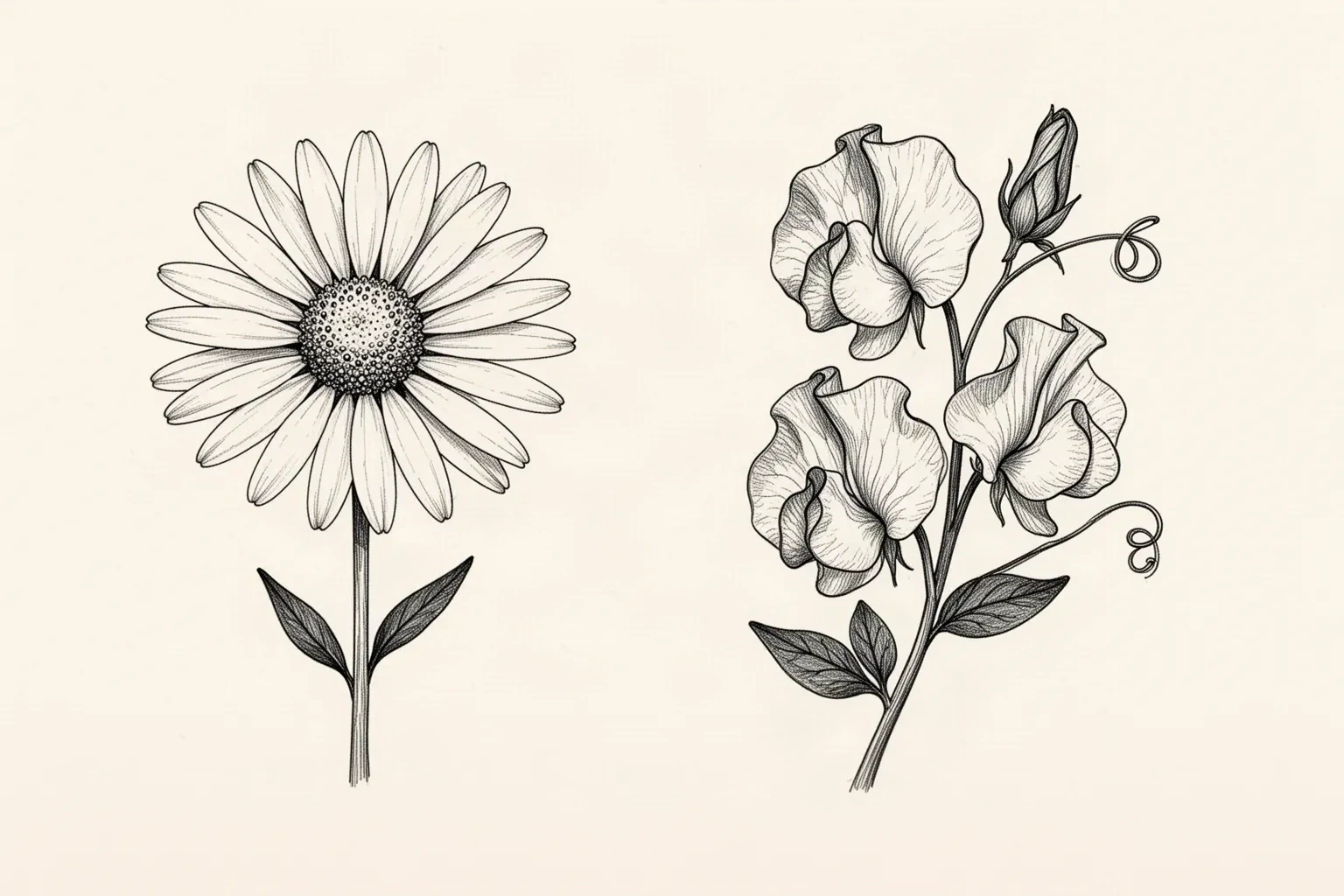
Synthetic ink line study comparing a daisy composite head with narrow ray petals around a textured disk on an upright stem, beside a sweet-pea sprig with two ruffled blooms, one bud, and tendril curls on a climbing vine, with open white gaps between every petal and bloom

Construction reference, not a ready stencil

Left, daisy: one ring of narrow ray petals around a compact stippled disk on a slender upright stem. Right, sweet pea: two ruffled blooms stacked on a climbing vine with one bud and tendril curls. The open white gaps between petals and blooms are exactly the separations the final-size checks below protect. Synthetic illustration created for this guide, not an app export or a measured print.

Daisy (primary April flower)

Innocence, loyal love, and new beginnings. Clients usually request it as a clean open head with white rays around a yellow disk.

A composite head: one ring of narrow ray petals around a compact textured disk, on a slender upright stem with small leaves. Stencil viability comes from ray separation plus disk restraint, not from copying every petal a photo shows.

Sweet pea (secondary April flower)

Blissful pleasure, gratitude, and fond farewell. Clients usually request it as a soft climbing sprig with ruffled blooms.

A stepped cluster of two to five ruffled blooms on a slender climbing vine with curling tendrils and small oval leaflets. Stencil viability comes from ruffle-edge separation plus vine hierarchy, not from copying every fold a photo shows.

Daisy ray-disk build

A daisy reads as a flat radial head: narrow ray petals in one open ring around a small disk with short floret texture. Stencil viability comes from keeping every ray separable with open skin between neighbors and from restraining the disk to a compact textured center instead of a dense shaded mass.

Check: Count the rays that stay individually readable at the target width, then trace one ray from disk edge to tip. If two neighboring rays share one merged edge at 1:1, that head needs fewer rays or one wider spacing tier before anything else changes.

Sweet-pea cluster-vine build

A sweet pea reads as a soft vertical sprig: ruffled blooms stacked along a climbing vine with one tendril accent. Stencil viability comes from keeping every ruffle edge separable with open skin between blooms while one vine direction leads and the tendril stays an accent.

Check: Follow the vine from base to tip bloom with a finger. If the path crosses a ruffle edge, a second stem of equal weight, or a tendril touching a bloom at 1:1, restructure that hierarchy before judging petal detail.

Shared thin-line gap discipline

Both April flowers are thin-petaled and small-stemmed, so both fail the same way: separations close, stems bridge into petals, and buds merge into neighboring blooms. A stencil-ready April piece keeps the heaviest lines on outer contours, reduces inner marks before thinning outer edges, and verifies every gap at true size.

Check: Squint until inner detail disappears. If the daisy still reads as rays around a disk, or the sweet pea still reads as separate ruffled cups on a vine, it is close. If either reads as one scalloped pocket, remove inner marks before touching outer contours.

Daisy vs sweet pea for stencil use
TraitDaisySweet pea
Flower headOne flat composite head: a single ring of narrow ray petals around a compact central disk.Two to five separate ruffled blooms in a stepped cluster, each a hooded cup with wings and a folded keel.
CenterA round textured disk (floret dots or short marks). Keep it compact with open skin between marks.No disk. Each bloom centers on a short keel fold; keep each keel opening unfilled.
Stem habitSlender upright stem with small narrow leaves, carrying one head (or a loose few, never a vine).Slender climbing vine with curling tendrils and small oval leaflets, carrying the cluster upward.
BudsA daisy bud is a single closed oval on its own short stem. One bud accents a head; a run of buds means a different brief.Sweet-pea buds sit along the vine near open blooms. Keep one bud with its own node gap or recrop; touching bud-to-bloom contacts merge first.
Stencil callJudge ray count and spacing, disk restraint, and stem clearance at final size. Small widths suit one head with plain or lightly marked rays.Judge bloom count, ruffle spacing, and vine hierarchy at final size. Route deep sweet-pea cluster work to the sweet-pea owner linked below.

April evaluation framework

Score the reference in minutes, then act on the weakest check.

Four April constructions at labeled widths: a holding daisy head, a holding sweet-pea sprig, a crowded pairing, and a merged bud run. Each one names the protected structure, the fix, and the go or no-go verdict at that exact size. Confirm every verdict with a measured 1:1 print.

HOLDS AT STATED SIZE

Single daisy head with spaced rays at 5 cm

Intended width 50 mm

Source
One open daisy head with a single ring of narrow rays, visible skin between neighboring rays, a compact dotted disk, and a short slender stem stub with no leaves touching the head.
Protect
Every ray-to-ray separation, the compact disk with its open dot spacing, and the stem-to-head clearance.
Fix
Shorten only the longest ray if it touches a neighbor at 1:1. Keep ray count, disk texture, and stem direction unchanged.
Candidate stencil
Same April construction with the flower choice set, petal and bud density adjusted, and protected contours kept at transferable mass.
Final-size verdict
Holds at 5 cm. Rays stay separable at 1:1 and the head reads as a daisy from ray ring plus disk, not shading.

HOLDS AT STATED SIZE

Two-bloom sweet-pea sprig with spaced ruffles at 7 cm

Intended width 70 mm

Source
Two open ruffled blooms in a stepped pair on one slender vine, one short tendril curl, open skin between the blooms, and no leaflet touching a ruffle edge.
Protect
The bloom-to-bloom separation, the outer ruffle contours with their fold spacing, and the uninterrupted vine path.
Fix
Trim only the longest ruffle ripple if it bridges to the neighboring bloom at 1:1. Keep bloom count, tendril curl, and vine direction unchanged.
Candidate stencil
Same April construction with the flower choice set, petal and bud density adjusted, and protected contours kept at transferable mass.
Final-size verdict
Holds at 7 cm. Ruffles stay separable at 1:1 and the sprig reads as sweet pea from cluster plus vine flow.

SIMPLIFY FIRST

Combined daisy plus sweet-pea motif that crowds at 6 cm

Intended width 60 mm

Source
A birth-meaning pairing with one daisy head beside a three-bloom sweet-pea sprig, but ray tips touch ruffle edges and the vine crosses behind the daisy stem with no skin between crossings.
Protect
The daisy ray ring with its disk, the strongest sweet-pea bloom pair, and one leading stem direction for the pairing.
Fix
Separate the two flowers with a clear skin channel at 1:1: recrop to one daisy head plus a two-bloom sprig, stack them vertically instead of side by side, and remove the crossing stem. Do not invent spacing from merged ray-to-ruffle contacts.
Candidate stencil
Same April construction with the flower choice set, petal and bud density adjusted, and protected contours kept at transferable mass.
Final-size verdict
Simplify first. If the skin channel still closes at true size, enlarge the width or run the flowers as two separate small pieces.

RESTRUCTURE OR RECROP

Dense bud run with merged contacts at 4 cm

Intended width 40 mm

Source
A delicate-looking sprig where small buds sit directly against open blooms and ray tips touch bud edges, leaving almost no preserved separations at this width.
Protect
The single strongest open bloom as the recrop anchor, plus the stem direction below it.
Fix
Keep one open bloom with at most one bud held on its own node gap, or recrop to the bloom alone. Remove every touching bud-to-bloom and tip-to-bud contact. Do not keep bud count by thinning lines.
Candidate stencil
Same April construction with the flower choice set, petal and bud density adjusted, and protected contours kept at transferable mass.
Final-size verdict
At 4 cm every touching contact functions as one mass. Recrop, reselect, or enlarge before print.

Woody branch sprays stay out of this framework. A cherry-blossom stencil judges branch hierarchy and bud spacing on a woody spray, while this framework judges ray-disk heads and soft vine clusters for April birth-meaning work. Broad visual browsing stays on the stencils and subject hubs.

Thin petals, fine stems, and buds at final size

Judge the white space at the width you will print.

Screens forgive crowding that paper and skin do not. Set the width first, then inspect each feature below at true physical size with scaling off.

About 2 to 4 cm

Behind ear, finger-adjacent accents, inner wrist dots, and tiny gap fillers.

One motif only: a simplified daisy head with plain rays and a dotted disk, or a single sweet-pea bloom with a short stem stub. No tendrils, no bud runs, no pairings. If any ray, ruffle, or disk gap closes at 1:1, reselect a plainer reference rather than forcing reduction.

About 4 to 7 cm

Wrist, ankle, collarbone accents, and small forearm pieces.

The most requested April band. A single daisy head with spaced rays and a restrained disk, or a two-bloom sweet-pea sprig with one tendril curl at most, can work when every separation is verified at true size. Combined daisy plus sweet-pea motifs need a clear skin channel here or they read as one mass.

About 7 cm and above

Forearm, shoulder, calf, and thigh birth-flower pieces.

Room for a daisy head with fuller ray tiers or a three-bloom sweet-pea sprig with one bud accent, and for a composed daisy plus sweet-pea pairing with separated stems. Larger width never rescues stacked ray tiers, packed ruffle bands, crossed stems, or touching bud contacts.

April flower feature checks by width band
FeatureAbout 4 cm and belowAbout 7 cm and above
Ray petals and ruffle foldsKeep the heaviest lines on outer contours. If a ray or ruffle edge disappears, the flower loses its April read and becomes a plain cup.Same priority. Larger width allows slightly finer inner folds, but separability still beats uniform thinness.
Disk and keel centersDaisy: compact dotted disk with open skin between marks. Sweet pea: one short keel fold per bloom. Merge means fewer marks with clear gaps, not thinner texture.A fuller disk or keel fan can work when each mark keeps open skin at 1:1. If a center reads as one dark pocket, reopen it.
Stems, tendrils, and leavesKeep one unbroken stem segment with open skin on both sides. Tendrils and leaves that touch a bloom at 1:1 get removed or recropped.One tendril plus one or two small leaves can add movement when the main stem clearly dominates. Equal-weight stems need hierarchy work before print.
Buds and pairingsCarry none. Small widths suit one open flower; a bud forced into these bands merges first.A single bud accent can work when it keeps its own node length and open skin. A daisy plus sweet-pea pairing needs a verified skin channel between the flowers.

Fine-detail fallout risk checklist: rays, ruffles, stems, buds

  • Ray bridging: daisy rays drawn edge to edge with no skin between them merge into one scalloped disc on transfer.
  • Ruffle packing: sweet-pea inner folds drawn as dense ripples with no separations close into one pocket at small widths.
  • Disk fill: daisy disk texture packed as dense hatch or solid shading prints as one dark blob below 5 cm.
  • Keel fill: sweet-pea keel folds packed with no opening print as one dark pocket.
  • Stem crossing: a vine or stem touching a petal edge, or two stems of equal weight crossing, tangles once reduced.
  • Bud bridging: a bud drawn directly against a bloom with no node gap closes into one band on delicate placements.

Reference to clean stencil

Lock the flower, then build outward along the stem.

Work in this order so one change at a time can be judged at the same width. Stop when flower choice, petal gaps, stem hierarchy, and placement each read correctly.

  1. 01

    Lock flower choice, meaning, width, and placement

    Name the construction first: daisy head, sweet-pea sprig, or a composed pairing, plus the birth meaning the client wants carried (innocence and loyal love for daisy, blissful pleasure and gratitude for sweet pea). Set the intended physical width in millimeters and name the body area before judging the reference. A pairing that holds at 10 cm on a flat forearm can fail at 5 cm on a curved wrist with no line being wrong on its own. Use the size calculator when target dimensions are still open.

  2. 02

    Rank every flower, stem, and accent

    Name the focal flower, count the readable blooms, and assign every mark a role: outer contours that carry the first read, the stem or vine that directs the piece, and tendrils, leaves, or buds that accent it. Strengthen focal contours first, keep secondary blooms compact, and mark one removable bloom, bud, or tendril that can go if gaps close.

  3. 03

    Simplify petals and reopen gaps for final size

    Reduce ray count, ruffle density, and bud count before thinning outer contours. Keep open skin between rays, between ruffle folds, between the flowers in a pairing, and between the cluster and every stem, tendril, and leaf, then run a squint check: step back until fine detail disappears and confirm each flower plus the stem still reads. The line-weight guide covers fine, normal and bold behavior on the same stencil.

  4. 04

    Vet the delicate placement

    Match the construction to the placement matrix below: narrow wrapped fields need a recrop to one flower with a short stem, while flat fields can carry a pairing with a verified skin channel. Seat the focal flower on the flattest span, run stems along the body line, and preview wrap on a body photo while edits are still cheap.

  5. 05

    Verify print and transfer path

    Export a true-size PDF with no fit-to-page scaling, inspect the narrowest ray gap, ruffle separation, disk or keel opening, and stem clearance on plain paper, then measure the physical print with a ruler. If the digital file passes and only paper fails, move to print-stage evidence instead of simplifying again.

Placement and size decisions

Delicate April pieces want flat spans and clear stem runs

A daisy is a radial head on an upright stem and a sweet pea is a stepped cluster on a climbing vine. Placements with a clear run preserve both with little compensation, while small wrapped placements demand a recrop to one flower.

Wrist and inner wrist

Narrow wrapped field where birth-meaning pieces are most requested. One daisy head or a one to two bloom sweet-pea sprig fits; pairings and bud runs crowd fast.

Check: Recrop to the strongest flower with at most a short stem stub, run stems along the wrist line, and confirm every separation stays open at the exact width.

Ankle

Small curved field with footwear friction near the transfer. Slim vertical sprigs survive; wide pairings wrap and bridge.

Check: Keep the composition slim and vertical, hold one bud at most on its own node gap, and verify the stencil survives the shoe line before locking width.

Behind ear

Tiny recessed field for the smallest April accents. Only a simplified single head or single bloom holds here.

Check: Run the smallest size band rules, drop all tendrils and buds, and confirm the disk or keel still reads at the exact width.

Collarbone and shoulder line

Long gently curved field that suits a daisy head with stem or a stepped sweet-pea sprig, and the best small field for a separated pairing.

Check: Run the stem along the bone line, seat the focal flower on the flattest span, and verify the skin channel between paired flowers at 1:1.

Forearm and calf

Narrow fields where the stem should follow the limb line. Side-set pairings that sit across the limb wrap fast and crowd petal edges.

Check: Align stems with the limb axis, tilt the focal flower to the flattest spot, and shorten cross-limb leaves or tendrils while edits are still cheap.

Sternum edge and ribs

Vertical fields that suit slim stacked pairings, but breathing movement and curvature punish wide compositions.

Check: Keep the pairing slim and vertical with a protected skin channel, center on the flattest span, and preview on a torso photo before print.

Transfer-ready handoff

Know when to print in Studio and when to brief a redraw

A passing reference moves to exact-size print and transfer. A reference that keeps failing the same gap check needs an artist redraw brief with the failing check named, not another cleanup pass.

Print and transfer in Studio

The reference passed every check above: flower choice locked, separations open at 1:1, placement vetted, and the file needs exact-size print, placement template, and transfer prep.

Next: Use the size calculator for exact dimensions, the print checker for finished-file preflight, and the transfer guide for print-to-skin mechanics.

Artist redraw brief

The reference keeps failing the same check: rays or ruffles bridge at every candidate width, the disk or keel fills in, buds merge, or the pairing cannot hold a skin channel on the chosen placement.

Next: Hand the artist the failing check plus the fix from this page (reduce bloom or bud count, respace one tier, split the pairing, or enlarge past the verified width) instead of asking for a generic cleanup.

Stencil-ready checklist

Approve the April piece only when every line passes

Run this short sequence with scaling off and a ruler in hand. One failed line means fix, enlarge, split, or reselect before transfer.

  • Confirm the flower choice (daisy, sweet pea, or composed pairing), the birth meaning carried, the intended width in millimeters, and the named placement.
  • Confirm every daisy ray separation and the compact disk stay open at 1:1.
  • Confirm every sweet-pea ruffle separation and keel opening stays open at 1:1.
  • Confirm paired flowers keep a clear skin channel with no ray-to-ruffle or stem-crossing contacts.
  • Confirm buds read as separate accents with visible node gaps, not merged bands.
  • Export a true-size PDF with scaling off and measure the physical print.
Daisy head or sweet-pea sprig Verify gaps at 1:1 Skin channel in pairings

FAQ

April birth-flower stencil decisions, answered

Short answers for the flower-choice, gap, placement, and handoff checks that recur when an April reference moves toward transfer-ready output.

Choose by construction, not by meaning alone. Pick daisy when the brief wants one flat radial head with rays around a disk, carried on a short upright stem. Pick sweet pea when the brief wants a soft vertical sprig of ruffled blooms on a climbing vine with a tendril accent. Run a pairing only when the placement has room for a verified skin channel between the flowers at final size; on wrist, ankle, or behind-ear widths, one flower with clean gaps beats a crowded pairing.

Next steps

Use the neighboring owners for adjacent jobs.

This guide covers April flower choice, ray and ruffle gap vetting, delicate placement fit, and transfer-ready prep. Use the links below for related jobs such as deep sweet-pea cluster work, sizing, print checks, conversion, and browsing.

Board organization, grid overlays, photo-quality scoring, generic conversion, broad gallery browsing, paper manufacturing detail, and placement mechanics stay in their specialist owners. The links above hand off instead of repeating that detail.

From evaluated reference to working stencil

Turn the approved April flower into a stencil draft.

Start from the daisy or sweet-pea reference that passed the gap and placement checks, then continue on iPhone for body fit, exact-size print, mirror and professional export.