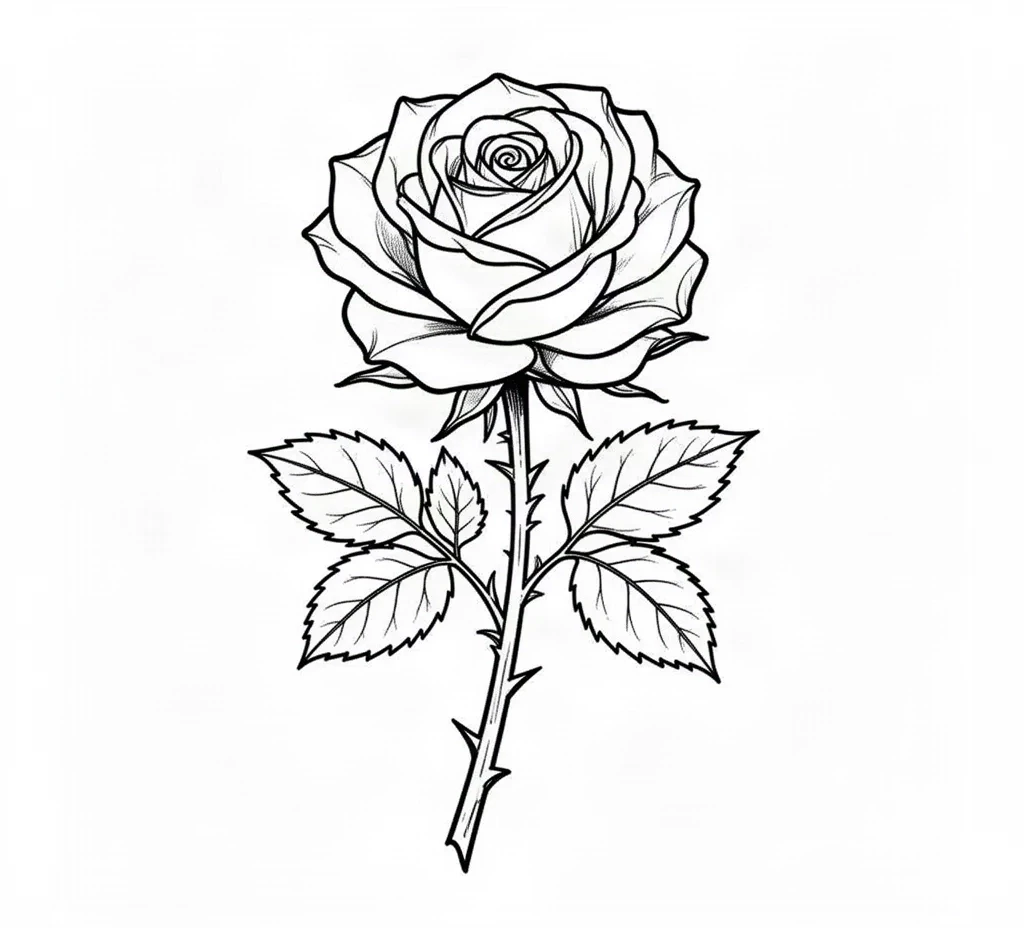

Simple-only rose vetting

Choose a simple rose that still transfers as a rose

Simple means clean contours, open petal gaps, and restrained detail by choice, not by shrinking. Compare simple-only rose constructions against that bar, then run a final-size readability check before print.

Built for working artists selecting a simple rose reference. This page covers simple-only outline selection and transfer-ready checks, not tattoo application or healing advice. Realistic layering, fill execution, hand fit, and broad composition stay with the owners linked below.

What counts as simple

Three checks decide whether a rose is simple.

Run every candidate through these checks in order. A design that fails one check is not rescued by passing the other two. Simple is independent of size: a large rose can be simple and a tiny rose can still be crowded.

Clean contours

One continuous outer system carries the rose: cup direction, petal rims, and stem direction read as single lines with no doubled echoes. Interior marks stay subordinate. Trace each petal rim once from tuck point to rim: a clean contour returns without a parallel twin joining it for part of the route.

Pass when the bloom reads from silhouette alone at working distance, the cup direction stays clear, and no second line chases the same petal edge on the true-size print.

Reject when two near-parallel lines chase one petal edge, when inner curls read as loudly as the rim at working distance, or when hierarchy changes between screen zoom and the 1:1 print.
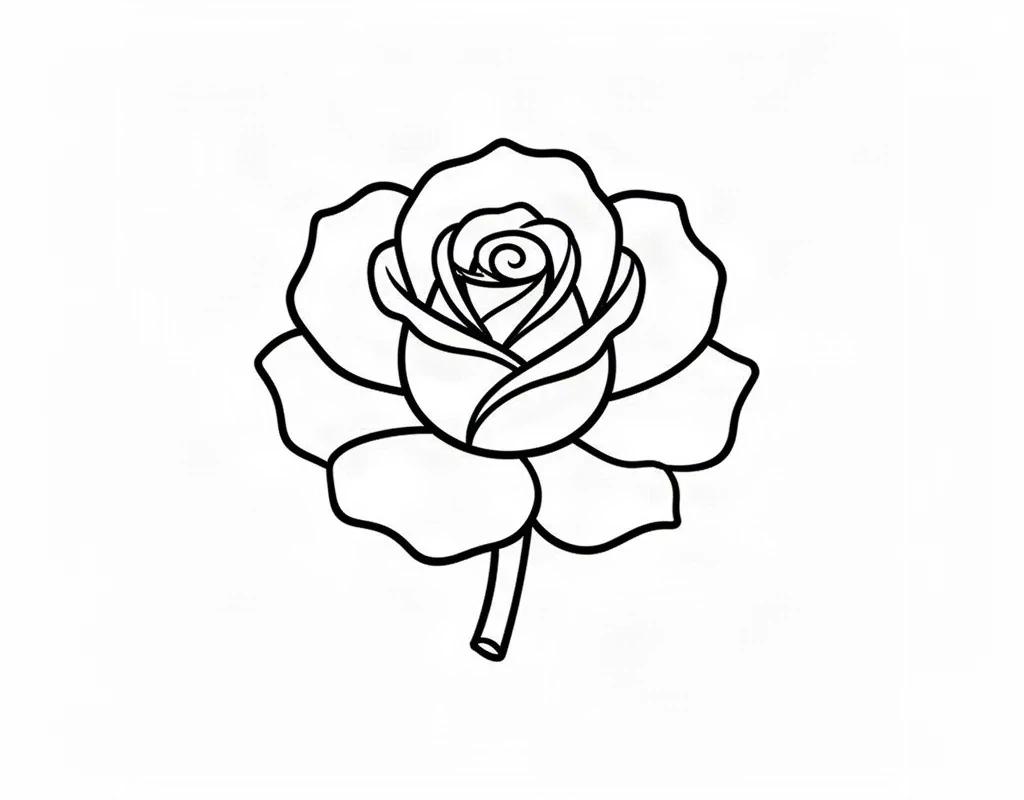

Open gaps

Every must-keep separation stays visibly open at the intended width: cup counter, petal-to-petal channels, bloom-to-leaf clearance, and stem accent spacing. Judge the single tightest must-keep opening, not the average openness. Spacing is a structural transfer decision, not decoration.

Pass when the narrowest petal channel and the cup counter stay open on a measured true-size print, read as background rather than a hairline, and survive a brief squint check.

Reject when one channel or the cup counter needs zoom to confirm, when two petal edges touch at true size, or when the gap passes on screen but closes on paper.

Restrained detail

Keep only marks that change recognition: cup anchor, petal tuck points, one representative fold per bloom at most, one leaf with a clean rim, and thorns only when each keeps open skin on both sides. When in doubt, apply the remove-one-mark test: cover one interior mark, and if the rose still reads the same, that mark was competing for room the narrowest gap needs.

Pass when removing any remaining mark would change what the rose is, and the narrowest gap still reads as background after the squint check.

Reject when secondary folds, serration, vein branches, or thorn runs repeat a cue already carried by stronger structure, or when support detail survives zoom but merges into one band on the 1:1 print.

Cross-subject clean-contour principles stay with their owner. Use the simple outline filter for clean-contour rules across subjects. This page applies those ideas to roses only: cup, petal channels, and restrained support detail on one motif.

Simple-only rose comparison

Compare simple rose constructions, including one collapse.

Four illustrative example constructions judged at a locked final width. Each one names the protected structure, the removed family, and the go or no-go verdict. Confirm every verdict with a measured 1:1 print.

PASSES AS SIMPLE

Side-view open bloom with cup and five petals

Illustrative example, judged at your locked final width

Illustrative line drawing of a simple open rose bloom with a spiral cup, broad plain petals separated by open white space, and a short bare stem without leaves or thorns.
Original line illustration for this guide, not app output and not true-size artwork.
Source
One side-view bloom with a readable cup swirl, five plain petals with full rims, a short stem stub, and no leaves or thorns. Every petal edge keeps open skin along its full length.
Protect
Cup direction, the five petal rims with their tuck points, and the open channels between neighboring petals.
Reduce
Nothing structural. This is the reference simple bloom. Do not add secondary folds, serration, or stem furniture to fill empty skin.
Candidate stencil
Same rose with the removable family reduced, petal channels and cup counter reopened, and protected cup and rim contours kept at transferable mass.
Simplicity verdict
Passes as simple when the cup reads without magnification and every petal channel stays open at the locked width. The bloom reads as a rose from contour and layering alone.

PASSES AS SIMPLE

Front rosette with one petal ring and plain leaf

Illustrative example, judged at your locked final width

Illustrative line drawing of a simple front-facing rose rosette with a compact cup counter, one ring of broad plain petals, a straight stem, and one smooth leaf carrying a center vein.
Original line illustration for this guide, not app output and not true-size artwork.
Source
One front-facing rosette with a compact cup counter, a single ring of broad plain petals, a short stem, and one smooth leaf with a single center vein. No thorns, no second leaf, no vein branches.
Protect
Cup counter, petal ring rhythm, stem direction, and the single leaf rim with its center vein.
Reduce
Second leaf, thorn accents, leaf serration, and extra folds inside the petals. Plain petals carry this construction: added texture narrows the only channels that prove layering.
Candidate stencil
Same rose with the removable family reduced, petal channels and cup counter reopened, and protected cup and rim contours kept at transferable mass.
Simplicity verdict
Passes as simple when the cup counter stays a visible opening and the bloom-to-leaf clearance stays open at the locked width. If the leaf starts competing with the bloom, shorten the stem or remove the leaf before touching petals.

PASSES AS SIMPLE

Compact bud with calyx for narrow fields

Illustrative example, judged at your locked final width

Illustrative line drawing of a simple closed rosebud with two wrapping sepals, a small calyx, an open gap between bud and sepals, and a short plain stem.
Original line illustration for this guide, not app output and not true-size artwork.
Source
One closed bud with two wrapping sepals, a short calyx, and a plain stem segment. Built for narrow placements where a full bloom would crowd every channel. Minimal petal overlap by construction.
Protect
Bud taper direction, the sepal wrap edges, and the open gap between bud and calyx.
Reduce
Thorn ticks along the stem and vein marks inside the sepals. If the bud-to-calyx gap pinches shut, widen local spacing rather than thinning both contours.
Candidate stencil
Same rose with the removable family reduced, petal channels and cup counter reopened, and protected cup and rim contours kept at transferable mass.
Simplicity verdict
Passes as simple when the bud reads as one tapered mark with visible sepal separation. This is a pose choice for narrow fields, not a smaller version of the open blooms above.

COLLAPSED, NOT SIMPLE

Fine-line spray with dense cup, serrated leaves, thorn run

Illustrative example, judged at your locked final width

Illustrative line drawing of a crowded fine-line rose spray with a tight multi-curl cup, overlapping petals, serrated leaves with branching veins, and thorns along a long stem.
Original line illustration for this guide, not app output and not true-size artwork.
Source
A delicate-looking full spray with a tight multi-curl cup, crowded outer folds, two large serrated leaves with branching veins, and a thorn run along a long stem. Attractive zoomed on screen, but several channels sit near or below reliable transfer width at final size.
Protect
Bloom direction, the strongest outer petal rhythm, and stem direction as the recrop anchor.
Reduce
Recrop to one bloom with plain petals and a stem stub, or keep one leaf with a smooth rim and remove the thorn run, serration, vein branches, and secondary folds. Thin lines do not rescue closed gaps.
Candidate stencil
Same rose with the removable family reduced, petal channels and cup counter reopened, and protected cup and rim contours kept at transferable mass.
Simplicity verdict
Fails simplicity even though the lines are thin. The cup curls, leaf counters, and thorn bases merge into connected masses on transfer. One open bloom with gaps beats a fine spray with closed gaps.

Realistic petal-overlap layering stays outside this set. Ranked bloom simplification for photographic roses belongs to the realistic rose owner, and solid or partial fill decisions belong to the black rose owner. This set judges only simple-only contour, gap, and restraint treatment.

Rose readability at final size

Prove the thin rose lines on paper before trusting the screen.

Simple roses fail in predictable places: one petal channel closes, the cup counter fills in, or support texture merges into one band. This sequence finds the failure while it is still cheap to fix. Exact-size calibration method stays with the print owners linked below.

  1. 01

    Lock the final width first

    Write down the intended physical bloom width in millimeters and the named body area before judging simplicity. A clean simple rose at one width can close the same petal channels at a narrower width with no line being wrong on its own. When target dimensions are still open, set them with the size calculator linked below, then return here to judge the design.

  2. 02

    Inspect one print at true size

    Review one true-size print with scaling off and a ruler beside it. Find the tightest must-keep separation: one petal channel, the cup counter, or one bloom-to-leaf clearance. Inspect it at 1:1 without zoom, then at arm's length. If that opening closes on paper, it will not reopen on skin.

  3. 03

    Confirm the bloom reads at distance

    Hold the same print at working distance and run a brief squint check. The outer petal rims and cup direction should read before interior folds or leaf veins, and support marks should stay subordinate. If leaf or thorn texture reads as loudly as the bloom, remove one support family before changing petal mass. Screen zoom hides exactly the crowding this distance check is meant to catch.

  4. 04

    Separate gap failures from print failures

    If the digital file passes and only paper fails, keep the artwork fixed and route the fault to the print path linked below instead of simplifying a passing rose. If the file itself closes a channel on screen at true pixels, fix spacing first: reopen the channel, remove one fold or accent, or grow the width. Recheck on a fresh 1:1 print after any change.

Dropout signals that disqualify a simple rose candidate

  • Cup bridging: tight inner curls with no open counter merge the bloom center into one grey disc on transfer.
  • Petal contact: neighboring rims sharing one drawn edge erase the layering read even when the lines are thin.
  • Fold crowding: two or three secondary folds converging in one petal corner close the only skin proving separation.
  • Leaf counter closure: serrated edges and branching veins create enclosed counters that bridge first at final size.
  • Thorn merger: small thorn bases touching the stem contour print as one thickened stem mark rather than accents.
  • Doubled rims: two near-parallel lines chasing one petal edge compete for the room the channels need.

Size, print, and transfer checklist

Leave with a sized and printed transfer-ready rose

Run this short sequence with scaling off and a ruler in hand. One failed line means reopen spacing, remove one support family, enlarge, or reselect before transfer.

  • Lock the intended bloom width in millimeters and the named placement before exporting.
  • Export a true-size PDF with no fit-to-page scaling and select 100 percent or Actual Size at print.
  • Measure the physical print with a ruler and confirm it matches the locked width.
  • Confirm the cup direction and every petal channel stays open at 1:1 without zoom, then at arm's length.
  • Confirm outer rims read first on the squint check and folds, veins, and thorns stay subordinate.
  • Confirm the tightest opening reads as background, not a hairline, on plain paper.
  • Mirror for the placement side where needed, and keep only the measured print that passed every line for transfer.
Cup and rims first Judge gaps at 1:1 Reduce support before thinning

FAQ

Simple rose decisions, answered

Short answers for the simplicity, final-size, gap, and routing questions that recur when a simple rose moves toward a working stencil.

A simple rose passes three checks at the locked width: one continuous contour system carries the bloom, every petal channel plus the cup counter stays open at true size, and every remaining interior or support mark earns its place. A minimal-looking rose can still fail when a doubled rim, a touching channel, or serrated leaf texture closes the working space. Judge the narrowest opening at 1:1 rather than judging style from a zoomed screen.

Next steps

Use the neighboring owners for adjacent jobs.

This guide covers simple-only rose selection, petal gap vetting, and the final-size dropout check. Use the links below for related jobs such as realistic layering, fill execution, hand fit, pairing, and broad composition.

Realistic petal-overlap workflow, fill hierarchy, hand zone-fit sizing, skull pairing construction, broad composition comparison, and print mechanics stay in their specialist owners. The links above hand off instead of repeating that detail.

From vetted simple rose to working stencil

Turn the approved simple rose into a stencil draft.

Start from the rose that passed the contour, gap, and restraint checks, then continue on iPhone for body fit, exact-size print, mirror and professional export.