

Tiger lily bloom stencil evaluation

Judge any tiger lily bloom before it becomes a stencil

This page covers the tiger lily (Lilium lancifolium), with six broad recurved tepals, dark spotting, and six stamens plus one pistil leaning from a nodding throat. Check petal separation and curl, spot retention vs dropout, and stamen gaps with tonal separation at your exact size for a clean transfer-ready stencil.

Built for working artists preparing tiger lily pieces. This page covers bloom vetting, curl and spot checks, stamen and pistil gaps, size-tied readability rules, and transfer prep only, not tattoo application or healing advice. Comparing lily types? Start with the broad lily variant owner linked below, then return here for tiger-specific construction.

Tiger vs spider vs generic lily

Name the species by construction, then commit to tiger logic.

Tiger, spider, and trumpet lilies fail in different places. Use this distinction aid to confirm the brief is truly a spotted recurved tiger bloom before vetting petal gaps, spots, and spray below. When the brief is still open across lily types, the broad lily subject owner holds that variant-first decision.

Tiger lily distinction aid for stencil choice
BloomConstructionStencil decision
Tiger lily (this page)Six broad orange tepals strongly recurved backward with dark spots, plus six stamens and one central pistil leaning out of the throat of a nodding bloom on a leafy stem.Protect recurved tepal gaps, decide spot size vs dropout, and keep stamen and pistil gaps with tonal separation. Choose this when the brief is the backward curl plus spotting.
Spider lilyAbout six narrow strap petals twisting back with a long protruding stamen spray on a bare leafless stalk, with no spotting and no cupped funnel.Protect thread channels and tip marks on a bare stalk. Choose the spider lily owner when the job is strap petals plus a long spray, not a spotted recurved bloom.
Trumpet and cupped liliesFunnel or cupped blooms (Easter, Asiatic, stargazer) with six flared tepals opening from a throat, shorter contained stamens, and no backward curl or spotting.Protect the funnel mouth as a receding ellipse. Choose the broad lily subject owner when the brief is still open across lily types or the bloom is a cup, not a curl.

Still deciding between cupped, trumpet, calla, and recurved types? Use the broad lily variant owner for that cross-type choice, then return here when the job is specifically the spotted backward curl with a full stamen spray. Spider-specific strap-petal and bare-stalk logic stays on the spider lily owner.

What makes a tiger lily stencil-viable

Backward curl, countable spots, and a separated spray decide the result.

A tiger lily is a nodding bloom of six recurved spotted tepals with six stamens plus one pistil on a leafy stem. These three pillars predict whether that large-bloom construction survives reduction, print, and transfer.

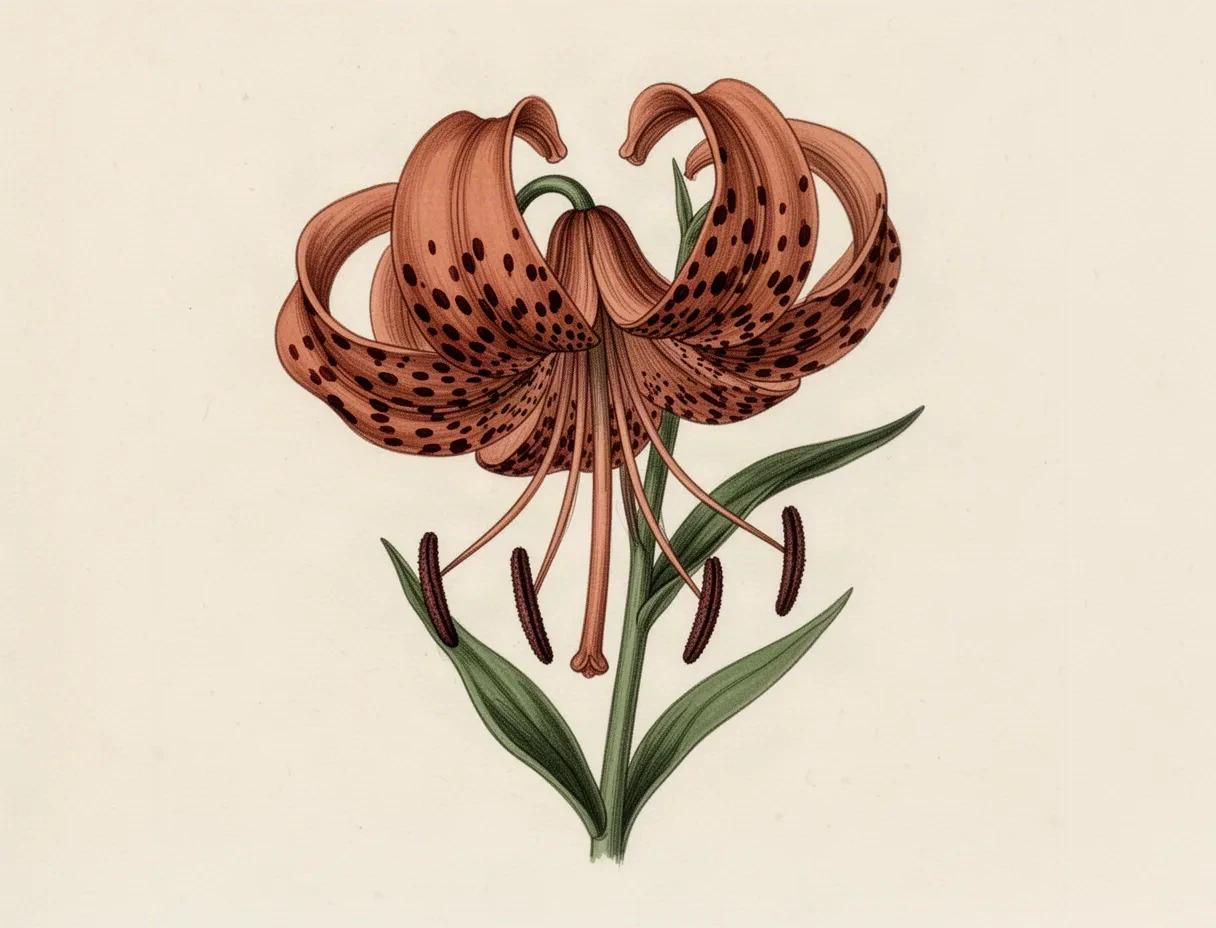
Botanical plate style illustration of a nodding tiger lily with broad recurved orange tepals spotted toward the throat, a leaning spray of stamens with prominent anthers plus a longer central pistil, and green lance-shaped leaves.

Architecture to look for

Nodding bloom, backward tepals, throat-side spots, separated spray.

  • Six broad tepals that flare out and curl behind the nodding throat.
  • Spots clustered toward the throat and thinning toward the curled tips.
  • Six filament channels plus one longer pistil leaning clear of the bloom.

Synthetic botanical illustration made for this guide, not app output, a photograph of a specific reference, or a scale drawing. Use it to name the nodding pose, backward tepal curl, throat-side spotting, and leaning spray, then read those features on your own reference at final size.

Recurved petal separation and curl

A tiger bloom carries six broad tepals that flare out and curl backward, often past the point where the petal tip sits behind the throat from the viewer. Stencil viability comes from each tepal keeping its own edge with open skin between neighbors at final size, not from tracing every ripple and fold a photo shows. Petals that overlap near the throat with shared edges merge first when reduced.

Check: Trace one tepal from throat to curled tip at 1:1 without crossing a neighboring tepal line. If two tepals share one merged edge or the throat reads as one filled cup, remove a tier or open a gap before changing line mass.

Spot retention vs deliberate dropout

Tiger spotting is dark discrete marks scattered over the tepal faces, denser toward the throat. Stencil viability comes from treating spots as a countable set of deliberate marks at transferable size, not as photographic freckling. Fine dense speckles that touch close first on transfer and read as dirt rather than character.

Check: Count the spots per tepal at the stated width. If every spot holds its own skin and the throat still reads open, retention works. If spots join into a band or the throat fills, enlarge the marks or drop the weakest ones first.

Stamen, pistil, and tonal gaps

Six filaments with prominent anthers plus one longer central pistil lean out of the throat at uneven depths, with the anthers as the heaviest small marks. Stencil viability comes from each filament holding its own channel, each anther holding its own mark, and the pistil staying distinguishable by length or tip shape, with tonal values ranked so the bloom reads before the spots do. Symmetric fan stamens with touching anthers collapse first.

Check: Count six anther marks plus one pistil tip at 1:1. If every channel separates and the pistil reads longer or differently tipped, the spray is sound. If two anthers share one blob or the pistil hides among filaments, reopen or remove the weakest filament first.

Bloom comparison framework

Pick the bloom count that fits the placement, then act on the weakest check.

Four tiger lily constructions at labeled heights: an open spotted bloom, a freckled spray, a crowded throat, and a fine-line small. Each one names the stencil behavior, the protected structure, the fix, and the go or no-go verdict at that exact size. Confirm every verdict with a measured 1:1 print.

HOLDS AT STATED SIZE

Single nodding bloom with open curl and counted spots at 12 cm

Intended height 120 mm

Bloom behavior
One nodding tiger bloom with six recurved tepals, open skin between every neighbor, a readable throat, about five to seven separated spots per tepal, and six filaments plus a longer pistil leaning clear of the throat.
Protect
The throat position, the six tepal directions with their backward curl, the counted spot set, and every filament path with its anther mark plus the pistil tip.
Fix
Enlarge only the smallest throat spots if they close at 1:1. Keep tepal count, throat position, spot placement logic, and filament order unchanged.
Candidate stencil
Same tiger lily with the bloom count set, spot count adjusted, filament count adjusted, and protected throat, tepal, and stem contours kept at transferable mass.
Final-size verdict
Holds at 12 cm. Tepal separations, spot gaps, and filament channels stay open at 1:1 and the bloom reads as tiger lily from structure alone, not shading.

SIMPLIFY SPOTS FIRST

Attractive bloom with photographic freckling at 9 cm

Intended height 90 mm

Bloom behavior
A full tiger bloom with good curl and filament order, but dozens of fine speckles across every tepal face with several touching near the throat.
Protect
The throat position, the six tepal directions, and the six strongest filament paths plus the pistil as rebuild anchors.
Fix
Reduce to a counted set of larger spaced spots per tepal, clearing the throat band first, then re-check with a squint test at 1:1. Do not thin tepal contours to rescue crowded freckling.
Candidate stencil
Same tiger lily with the bloom count set, spot count adjusted, filament count adjusted, and protected throat, tepal, and stem contours kept at transferable mass.
Final-size verdict
Simplifies first. If spots still join at true size, enlarge the height or recrop to a three-tepal side view with fewer marks.

REOPEN STAMENS FIRST

Dense throat with touching anthers at 10 cm

Intended height 100 mm

Bloom behavior
A recurved bloom with separated tepals and readable spots, but four neighboring filaments run parallel from the throat and their anther marks touch in one small cluster with the pistil hidden among them.
Protect
The throat position and the three strongest filament paths plus the pistil path as the length anchor.
Fix
Remove or re-angle the weakest of the parallel filaments until every remaining anther holds its own skin and the pistil tip stands apart, then re-check at 1:1. Do not thin every filament to rescue one crowded cluster.
Candidate stencil
Same tiger lily with the bloom count set, spot count adjusted, filament count adjusted, and protected throat, tepal, and stem contours kept at transferable mass.
Final-size verdict
Simplifies first. If anther marks still join at true size, enlarge the height or recrop to fewer filaments.

ENLARGE OR RECROP

Fine-line recurved bloom with hairline curl and filled throat at 6 cm

Intended height 60 mm

Bloom behavior
A delicate outline-only tiger bloom with hairline curled tips, a throat drawn edge to edge, and spot ticks rendered as faint marks in one small field.
Protect
The throat position and the two strongest tepal directions plus the three longest filament paths that set the spray.
Fix
Enlarge past the point where every tepal gap and filament channel transfers as open structure with countable spots, or recrop to a tepal pair with a partial throat and fewer filaments. Do not keep six hairline tepals plus full spotting together at 6 cm.
Candidate stencil
Same tiger lily with the bloom count set, spot count adjusted, filament count adjusted, and protected throat, tepal, and stem contours kept at transferable mass.
Final-size verdict
At 6 cm the throat functions as one filled cup and curls merge. Enlarge or recrop before print.

Cupped and trumpet construction, broad variant selection across lily types, and general lily stem principles stay on the broad lily subject owner. Spider-specific strap-petal and bare-stalk logic stays on the spider lily owner. This framework judges tiger-lily tepal curl, spot retention vs dropout, and stamen plus pistil separation only. Broad visual browsing stays on the stencils and subject hubs.

Petals, spots, and spray at final size

Judge the white space at the height you will print.

Screens forgive crowding that paper and skin do not. Set the height first, then inspect each feature below at true physical size with scaling off.

About 8 cm and below

Wrist, ankle, behind-ear accents, and small gap fillers.

Carry a recropped bloom section or a single side view with three or four separable tepals, a counted spot set with a cleared throat band, and at most four or five separated filaments with distinct anther marks. Keep one open throat. If a tepal gap, spot gap, or filament channel closes at 1:1, enlarge or reselect rather than forcing reduction.

About 9 to 13 cm

Common forearm, shoulder, calf, and collarbone tiger lily pieces.

The most flexible band. One full nodding bloom with six recurved tepals, a counted spot set, and a full filament spray plus pistil can work when every tepal gap, spot gap, anther mark, and throat clearance is verified at true size. Check spot count before approving a second bloom.

About 13 cm and above

Thigh, upper back, shoulder cap, and side-torso compositions.

Room for a two-bloom spray with a real stem run, but only when open skin separates every throat, every tepal, every spot field, and every anther tip. Larger height does not rescue touching throats, photographic freckling, or anther clusters drawn as one mark.

Tiger lily feature checks by height band
FeatureAbout 8 cm and belowAbout 13 cm and above
Tepal edges and throatKeep the heaviest tepal lines here. If a curled edge disappears, the bloom loses its backward-curl read and becomes a flat star.Same priority. Larger height allows slightly finer curled tips, but separability still beats uniform thinness.
Spots: keep, enlarge, or dropCarry fewer, larger, well-spaced spots with a cleared throat band. Merge means fewer spots or wider spacing, never smaller ticks.A fuller spot field can work when each mark holds its own skin at 1:1. If spots read as one dark band near the throat, reopen that band first.
Filaments, anthers, and pistilCarry fewer filaments with one bold anther mark each and a pistil that reads longer or differently tipped. Merge means fewer filaments, not thinner ones.A full six-plus-one spray can work when each channel stays separate and each tip stays its own mark at 1:1. If anthers read as one dark blob, reopen them.
Stem, leaves, and bloom clearanceKeep one unbroken stem segment with subordinate leaves. A second bloom competes with spots and filaments for the same room and should be recropped away.A second bloom can add spray character when the stem clearly dominates and leaves stay subordinate. Equal-weight throats or crossed stems need hierarchy work before print.

Fine-detail fallout risk checklist: curl, spots, and spray

  • Throat fill: tepals drawn edge to edge at the bloom base print as one filled cup.
  • Curl merge: two recurved tepals sharing one merged edge read as one wide strap once reduced.
  • Spot banding: fine speckles touching near the throat print as one dark collar instead of countable marks.
  • Spot dirt: isolated hairline ticks with no skin around them transfer as noise, not character.
  • Anther blob: anther marks drawn touching with no separation print as one dark spot instead of a countable spray.
  • Hidden pistil: a pistil drawn at filament length with a matching tip disappears into the spray.
  • Throat-to-throat contact: two blooms touching at their bases bridge first at small heights.
  • Competing leaves: equal-weight leaf masses crossing filaments tangle the read.

Reference to clean stencil

Lock the bloom count, then build outward from the throat.

Work in this order so one change at a time can be judged at the same height. Stop when bloom count, hierarchy, spots, spray gaps, and nodding flow each read correctly.

  1. 01

    Lock height, bloom count, and placement first

    Set the intended physical height in millimeters, choose one bloom or a named two-bloom spray, and name the body area before judging the reference. A spotted curl that holds at 14 cm on a flat thigh can fail at 7 cm on a curved wrist with no line being wrong on its own. Use the size calculator when target dimensions are still open.

  2. 02

    Rank throat, tepals, spots, and spray

    Name the lead bloom, count its readable tepals, then count spots per tepal and filaments plus the pistil, and assign every mark a role: throat and tepals that carry the first read, the spot set that gives tiger character, the spray that confirms the species, and the stem that directs it. Strengthen throat and tepal contours first, keep spots counted and spaced, keep filaments clean and separated, and mark one removable filament and several removable spots that can go if gaps close.

  3. 03

    Simplify spots and spray for final size

    Reduce spot count and filament count before thinning tepal lines, and subordinate or remove secondary blooms before touching lead-bloom line mass. Keep open skin between tepals, around every spot, along every filament, around every anther, and between every throat, then run a squint check: step back until spot and filament detail disappears and confirm the bloom and stem still read. The line-weight guide covers fine, normal and bold behavior on the same stencil.

  4. 04

    Verify print and transfer path

    Export a true-size PDF with no fit-to-page scaling, inspect the narrowest tepal gap, the tightest spot pair, the tightest filament channel, the smallest anther mark, and the closest throat clearance on plain paper, then measure the physical print with a ruler. If the digital file passes and only paper fails, move to print-stage evidence instead of simplifying again.

Placement and size decisions

Large recurved blooms want skin that keeps curl, spots, and spray separated

A tiger lily is a nodding spotted bloom with a leaning spray on a leafy stem. Placements with a clear directional run preserve the curl and the spray with little compensation, while small wrapped placements demand a lighter bloom count and spot set.

Outer forearm and calf

Long narrow fields where the stem should follow the limb line. Blooms curling across the limb wrap fast and crowd spots and anther tips.

Check: Align the stem with the limb axis, let the nodding bloom open toward the flattest spot with its spray in open skin, and shorten cross-limb filaments while edits are still cheap.

Thigh and upper back

Broad, gently curved fields with room for a two-bloom spray plus a real stem run and subordinate leaves.

Check: Seat the lead bloom on the flattest span, stagger the secondary bloom at its own angle with an open throat gap, then confirm every tepal gap, spot gap, and filament channel stays open at 1:1 before print.

Shoulder and collarbone

Directional fields where nodding flow can follow the bone line. Upright symmetric blooms fight the natural slope and crowd one side.

Check: Angle the stem along the bone, let the bloom nod with gravity rather than against it, and keep the lowest anther tips clear of the bone edge.

Wrist, ankle, and behind ear

Small wrapped fields where only a recropped bloom section survives. Full six-tepal curls with complete spotting forced into these bands merge first.

Check: Recrop to the strongest tepal pair or side view with fewer spots and filaments and at most a short stem stub, then run the small-size checks at the exact height.

Stencil-ready checklist

Approve the tiger lily only when every line passes

Run this short sequence with scaling off and a ruler in hand. One failed line means fix, enlarge, or reselect before transfer.

  • Confirm intended height in millimeters, the chosen bloom count, and the named placement.
  • Confirm every recurved tepal separation stays open with a readable throat at 1:1.
  • Confirm the spot set is countable with open skin around each mark and a cleared throat band.
  • Confirm every filament runs as its own channel with its own anther mark and a distinguishable pistil tip.
  • Confirm bloom-to-bloom throat gaps and stem hierarchy stay open at true size.
  • Export a true-size PDF with scaling off and measure the physical print.
Recurved tepals, open throat Verify spots and spray at 1:1 Nodding flow fits placement

FAQ

Tiger lily stencil decisions, answered

Short answers for the species, curl, spot, spray, size, and handoff checks that recur when a tiger lily reference moves toward transfer-ready output.

Choose tiger lily when the brief is six broad tepals curling backward with dark spotting plus six stamens and one pistil leaning from a nodding throat on a leafy stem. Choose the spider lily page when the job is narrow strap petals with a long protruding spray on a bare stalk and no spots. Choose the broad lily subject owner when the brief is still open across trumpet, cupped, calla, and recurved types, or when the bloom is a funnel rather than a backward curl.

Next steps

Use the neighboring owners for adjacent jobs.

This guide covers tiger lily bloom vetting, recurved petal checks, spot retention vs dropout, stamen and pistil gaps with tonal separation, height-tied readability rules, and transfer prep. Use the links below for related jobs such as sizing, print checks, conversion, and neighboring flower constructions.

Photo to stencil path

Start from a tiger lily photo when the reference itself still needs conversion into stencil-ready linework.

Continue

Exact size and true-size PDF

Set physical height, calibration, and page layout for the evaluated bloom.

Continue

Finished-file preflight

Check fine tepal gaps, spot pairs, filament channels, and anther marks at the intended height.

Continue

Multi-image boards

Organize several tiger lily directions into one source board when the bloom count is still open.

Continue

Photo quality check

Score the bloom photo for blur, exposure, and crop before it enters conversion.

Continue

Broad lily variant choice

Compare trumpet, cupped, calla, and recurved lily types when the brief is still open across lily kinds.

Continue

Spider lily construction

Use the spider owner when the brief is strap petals with a long spray on a bare stalk, not a spotted recurved bloom.

Continue

Lotus symmetry vetting

Judge radial symmetry and petal-rank order when the brief is a symmetric bowl, not a nodding tiger bloom.

Continue

Cherry-blossom branch vetting

Judge petal layering and branch movement when the brief is a woody spray, not a leafy-stem tiger lily.

Continue

Rose construction

Use the rose owner when the brief is a layered rose bloom rather than a recurved spotted lily.

Continue

Browse collections

Return to broad visual browsing once the tiger lily construction is decided.

Continue

Body-fit preview

Preview bloom seating and stem direction on a real body photo while edits are still cheap.

Continue

Create a stencil draft

Start from the evaluated tiger lily once the go decision is made.

Continue

Broad lily variant selection stays on the lily subject owner, spider-specific construction stays on the spider lily owner, and board organization, photo-quality scoring, generic conversion, broad gallery browsing, paper manufacturing detail, and placement mechanics stay in their specialist owners. The links above hand off instead of repeating that detail.

From evaluated reference to working stencil

Turn the approved tiger lily into a stencil draft.

Start from the bloom that passed the curl, spot, and spray checks, then continue on iPhone for body fit, exact-size print, mirror and professional export.