Sugar-skull stencil evaluation

Vet the symmetry, compose the motifs, hold the gaps

A sugar skull reads through mirror symmetry, ranked ornament, and open gaps inside dense decoration. Choose the archetype for your placement, prove eyes, nose, teeth and crown at true size, then compose marigold, Catrina and ofrenda cues with skin between every zone.

Built for working artists preparing Day of the Dead pieces. This page covers sugar-skull archetype choice, symmetrical ornament vetting, motif composition and final-size gap retention only, not tattoo application or healing advice. Generic skull angle and cavity depth stays with the skulls collection, full-skeleton work stays with the skeleton guide, and likeness plus names and dates stays with the memorial guide.

Sugar skull versus neighboring jobs

Name the job before judging the reference.

A sugar skull is a symmetric ornamented calavera with Day of the Dead motif logic. These boundaries keep it out of neighboring owners that solve different stencil problems.

Covered here

Sugar-skull archetype choice, symmetrical vetting of eyes, nose, teeth and floral crown, marigold plus Catrina plus ofrenda composition without crowding, and final-size gap retention for dense decorative linework with respectful professional framing.

Neighboring owners keep

Generic skull silhouette, angle, cavity and tooth-spacing comparison stays with the skulls collection. Full-body, ribcage, hand and dancing skeleton vetting stays with the skeleton guide. Respectful likeness plus names and dates stays with the memorial guide.

Skulls collection for generic skull depth, skeleton guide for full-skeleton articulation, and memorial guide for tribute workflow.

Sugar-skull evaluation framework

Pick the archetype first, then act on the weakest check.

Four sugar-skull constructions at labeled sizes. Each one names the protected structure, the fix, the placement fit, and the go or no-go verdict at that exact size. Confirm with a measured 1:1 print.

MOST FORGIVING STARTER

Classic frontal calavera at 12 cm

Intended width 120 mm

Source
A symmetric front-facing sugar skull: rounded cranium, paired eye sockets with petal rings, heart or inverted-heart nose cavity, full upper teeth row, and chin ornament. Decorative filigree stays inside the skull outline.
Protect
Skull outer contour with left-right mirror symmetry, paired eye rings at equal height and width, nose cavity centered on the midline, and the teeth row with one separation per tooth.
Fix
Mirror one eye ring onto the other side before restyling either. Reduce the nose to one centered cavity mark. Carry teeth as single separations with no double inner lines, and remove crown or cheek filigree that touches an eye ring until every ornament holds its own skin break at 1:1.
Candidate stencil
Same sugar skull with mirrored eye rings, centered nose, single-separation teeth, and ranked crown and motif zones held at transferable mass.
Placement fit
Best for: outer thigh, upper arm, calf and shoulder blade panels with a flat symmetric span.
Trade-off
Avoid when: the field is narrow or wraps fast, because outer crown petals crowd and one eye ring compresses. Choose a half-skull or single-motif recrop instead.
Final-size verdict
Holds at 12 cm once both eye rings match, the nose sits on center, and every tooth keeps its own gap at true size. Symmetry carries the read from a normal viewing distance.


CHECK CROWN BALANCE

Floral-crown calavera at 14 cm

Intended width 140 mm

Source
A frontal sugar skull ringed by a marigold and rose crown, with petal bands above the brow and layered cheek flowers. Festive on screen because the crown adds color and width, but crown petals compete with eye rings for the same upper-skull room.
Protect
Skull contour and eye-ring pair as the anchor, crown band as a secondary ring with countable petals, and open skin between the top of each eye ring and the lowest crown petal.
Fix
Rank the eye rings first and the crown second. Keep crown petals to one countable row, drop the smallest inner petal ticks, and hold a continuous skin channel between crown and skull. Remove one flower before shrinking the whole piece.
Candidate stencil
Same sugar skull with mirrored eye rings, centered nose, single-separation teeth, and ranked crown and motif zones held at transferable mass.
Placement fit
Best for: chest, upper back and thigh panels with width for the crown spread.
Trade-off
Avoid when: the placement is short or the crown must bend around a curve, because petals stack into one band. A classic frontal calavera without the crown survives narrow fields better.
Final-size verdict
Holds at 14 cm once the crown reads as a separate ring with its own gaps at 1:1. The skull must still read as a skull with the crown covered.

NEEDS THE MOST HEIGHT

Catrina-led composition at 18 cm

Intended height 180 mm

Source
A Catrina face or half-face with sugar-skull makeup: symmetric eye ornament, nose accent, lip and teeth styling, plus hat or veil and shoulder flowers. Recognition-led because the face must read as a composed portrait first and a skull second.
Protect
Face midline with matched left-right ornament, eye pair spacing, nose accent on center, mouth and teeth band as one readable zone, and the hat or veil contour that frames the head.
Fix
Lock the face midline before judging any petal. Match ornament pairs across the midline one pair at a time, simplify makeup shading into clean lines or spaced marks, and keep hat brim and flower mass outside the eye and mouth zones with open skin between them.
Candidate stencil
Same sugar skull with mirrored eye rings, centered nose, single-separation teeth, and ranked crown and motif zones held at transferable mass.
Placement fit
Best for: thigh, back and outer calf panels with vertical run for face plus framing.
Trade-off
Avoid when: the field forces the face below portrait scale or the hat must be cropped hard, because asymmetry shows immediately. Choose a classic calavera when the placement cannot carry a face.
Final-size verdict
Holds at 18 cm once the face reads symmetric at true size and the makeup, hat and flower zones each hold separations. Small Catrina faces lose eye symmetry and mouth clarity first.

HIGHEST CROWDING RISK

Ofrenda-scene composite at 20 cm

Intended height 200 mm

Source
A sugar skull anchor plus ofrenda elements: marigold path, candles, papel picado band, and possibly a small portrait frame or cross. The hardest archetype to keep stencil-ready because four motif families compete for the same skin.
Protect
Skull anchor with its own clear zone, marigold path or candle row as one supporting band, papel picado or frame as one compact cue, and open skin between every zone.
Fix
Assign one anchor and demote the rest to support. Keep candles to countable flames with separated sticks, reduce papel picado to one band with countable cuts, and give marigolds one petal row each. Remove one full motif family before shrinking the piece.
Candidate stencil
Same sugar skull with mirrored eye rings, centered nose, single-separation teeth, and ranked crown and motif zones held at transferable mass.
Placement fit
Best for: large thigh panels, back pieces and full sleeve sections with room for zones.
Trade-off
Avoid when: the placement is small or the client wants every ofrenda element at once, because gaps close across all zones together. Split the tribute into two passes instead of compressing it.
Final-size verdict
Holds at 20 cm once each zone holds its own separations at 1:1 and the skull still reads with every support zone covered. The smallest motif usually decides the minimum size.

Generic skull angle and cavity comparison, full-skeleton joint continuity, and memorial likeness plus inscription depth stay with their owners. This framework exists to judge sugar-skull archetype fit, symmetrical ornament, and motif-zone spacing at a stated size, not to replace those guides.

Symmetrical ornament vetting

Mirror every pair before approving the skull.

Sugar skulls fail on asymmetry first: one eye ring drifts, the nose sits off center, or crown petals crowd one side. Run each check below at true size and fix the failed zone before changing line mass elsewhere.

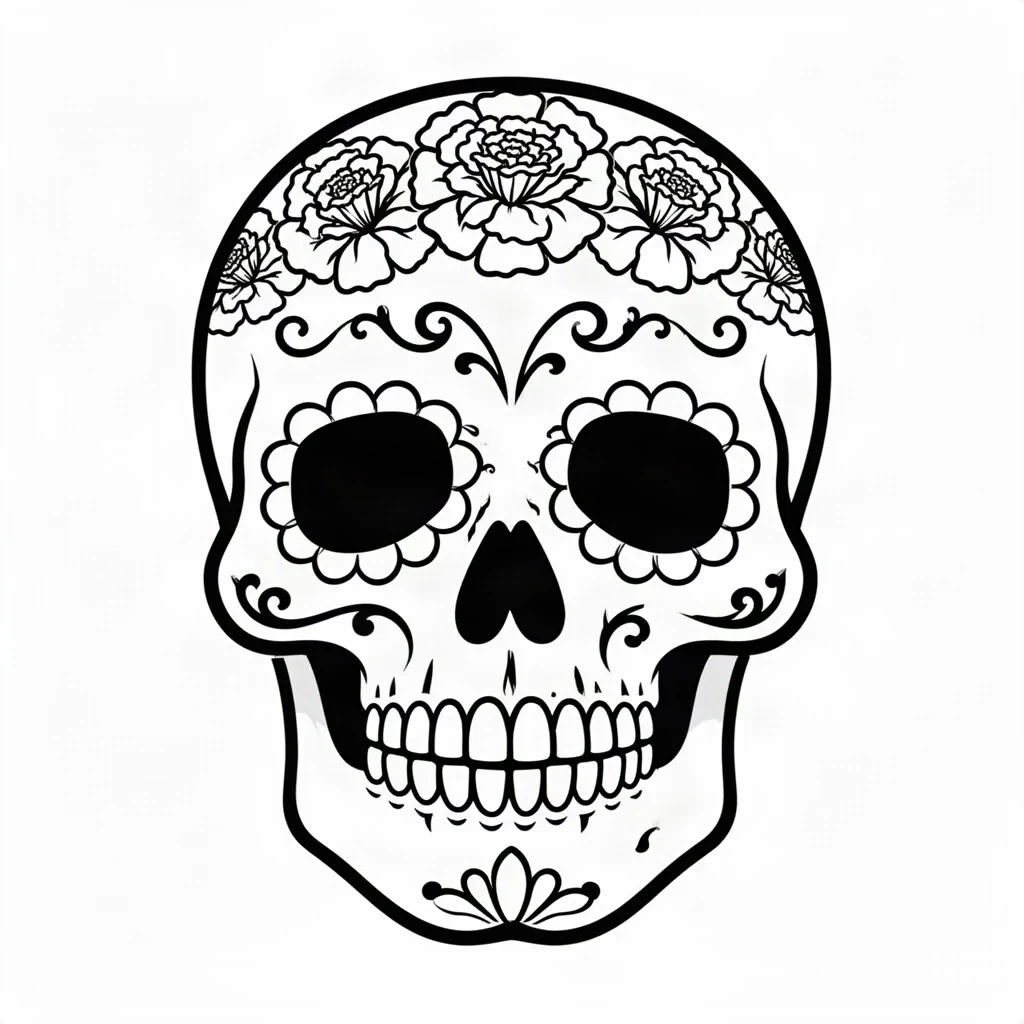
Front-facing sugar-skull calavera line drawing with a marigold crown, matching petal-ringed eye sockets, a centered heart-shaped nose cavity, a separated upper teeth row and a simple chin ornament on a plain white background.
Illustrative synthetic artwork for this guide, not StencilStudio app output and not a printable stencil file. It exists only to show the zones this section asks you to check: the eye-ring pair, midline nose, tooth separations, crown band and the open skin channels between them.

How to read the study

  • Eye-ring pair: compare your own reference against one mirrored pair at equal height, width and density, not against the illustration line for line.
  • Midline: the nose sits on the vertical center with open skin before the first tooth, so the mouth band keeps its own separation.
  • Crown and cheek zones: one countable petal row and a continuous skin channel from the brow band to each eye ring, which is the first gap to close at small sizes.
  • Your print decides: the study has no scale. Measure your exported 1:1 PDF, because the same drawing can pass on a thigh and fail on a wrist.

Eye sockets and petal rings

Fails as: One eye ring sits higher, wider, or denser than the other, or a crown petal touches an eye ring and traps the gap between them.

Fix: Build one eye ring, mirror it across the midline, then judge both at 1:1. Hold a continuous skin channel between each eye ring and the nearest crown or cheek petal.

Nose cavity on the midline

Fails as: A heart, triangle, or inverted-heart nose drifts off center, or double inner lines bridge the nose into the upper teeth row.

Fix: Draw the face midline first and center the nose on it. Keep the nose to one cavity mark with a single contour, and hold open skin between the nose base and the first tooth.

Teeth row and mouth band

Fails as: Teeth share one edge and print as a single grille, usually where vertical separators are doubled or the mouth band is too short for the tooth count.

Fix: Carry one separation per tooth with no double lines. When gaps close, use fewer teeth, a wider mouth band, or a larger size, never thinner separators.

Floral crown and cheek ornament

Fails as: Crown petals vary in size around the brow so the skull tilts visually, or cheek filigree crosses into the teeth or eye zones.

Fix: Size crown petals from the center pair outward so both sides match. Keep cheek ornament inside its own zone with a skin break on every side that faces the eyes, nose, or mouth.

Cranium filigree and dots

Fails as: Forehead webs, dots, and scrolls merge into one textured cap that bridges across the midline at final size.

Fix: Rank one center forehead mark and demote the rest to support. Convert dense webs into spaced dots or single lines, and confirm the midline still reads as a left-right mirror at true size.

Chin and jaw finish

Fails as: Chin ornament, jaw lines, and necklace or collar marks join the lower teeth into one pocket with no exit gap.

Fix: Protect the teeth-to-chin separation as a non-negotiable gap. Keep chin marks below it with open skin between, and remove secondary chin ticks before changing teeth mass.

Motif composition without crowding

One anchor, ranked support, skin between zones.

Marigolds, Catrina framing, and ofrenda cues each need their own zone with open skin around it. Use this framework to decide which motifs earn a place at your size.

Marigolds (cempasuchil)

Role: The lead floral cue: petal paths and round blooms that ring the skull or trail beside it.

Compose
Give marigolds one countable petal row per bloom and one stem path each. Trail blooms along one direction instead of circling the whole skull when room is tight.
Anti-crowding guardrail
When a bloom touches an eye ring, crown band, or candle stick, move the bloom or remove a petal row. Petal tips are the first marks to bridge at final size.

Catrina face and hat

Role: The portrait anchor when the piece is Catrina-led: face, makeup, hat or veil, and shoulder flowers.

Compose
Treat the face as the anchor zone with its own separations, the hat as a framing contour, and shoulder flowers as one subordinate row. The skull-makeup zones must read symmetric before any hat detail is judged.
Anti-crowding guardrail
When the hat brim crowds the eye ornament or shoulder flowers touch the chin, enlarge the field or demote flowers to a single sprig. Never shrink the face to fit the hat.

Candles, papel picado and crosses

Role: Ofrenda support cues: flame rows, cut-paper bands, small frames or crosses that signal remembrance context.

Compose
Allow one support band only at small sizes: either a candle row or a papel picado strip, not both. Keep flames countable with separated sticks and picado cuts wide enough to print as their own marks.
Anti-crowding guardrail
When flames merge into one wick band or picado cuts close into a solid strip, reduce count before reducing spacing. Background texture goes before motif mass.

Butterflies, hearts and secondary emblems

Role: Accent cues that add meaning without carrying the composition: monarch hints, heart charms, or date numerals.

Compose
Place accents in the skull's natural negative space with a skin break on every side. One accent per zone maximum, sized so it reads with the anchor covered.
Anti-crowding guardrail
When an accent touches two zones at once it becomes visual glue and must move or go. Accents are the first family to remove when gaps close.

Respectful professional framing

  • Confirm the client connection and intent during consultation: celebration of heritage, remembrance of a person, or admiration of the style each shapes motif choice differently.
  • Keep remembrance cues accurate. Do not restyle crosses, ofrenda elements, or portrait frames into horror effects or jokes to fill space.
  • Keep tone celebratory and composed: balanced symmetry, aligned ornament, and one clear focal point read as care. Crowded shock styling undermines the piece.
  • When the piece honors a specific person with likeness, names, or dates, hand that workflow to the memorial guide linked below instead of compressing it into ornament.

Final-size gap retention

Judge the white space at the size you will print.

Screens forgive crowding that paper and skin do not. Set the size first, then protect every tooth gap, eye-ring channel, and petal separation below at true physical size with scaling off.

About 8 cm and below

Wrist accents, ankle marks, behind-ear pieces and small gap fillers.

Carry a recrop only: a classic frontal calavera without crown, or a single marigold plus skull fragment. Keep one contour family and two ornament rows maximum. If a tooth gap, eye-ring channel, or petal separation closes at 1:1, enlarge or reselect rather than forcing reduction.

About 10 to 15 cm

Common forearm, calf, shoulder and thigh sugar-skull pieces.

The most flexible band. A classic calavera or floral-crown skull with ranked zones can work when every gap is verified at true size. Check eye pairs, nose centering, teeth separations and crown channels before approving filigree.

About 15 cm and above

Large thigh panels, back pieces, chest and full sleeve sections.

Room for Catrina-led and ofrenda composites with complete zones, but only when open skin separates every motif family. Larger height does not rescue a merged teeth row, an off-center nose, or texture-bridged petals.

Reference to clean stencil

Work in this order so one change can be judged at size.

Sugar-skull preparation is sequencing work. Lock the archetype, prove symmetry, rank the motifs, then prove the print.

  1. 01

    Lock archetype, size and placement first

    Set the intended physical width or height in millimeters, name the body area, and choose classic calavera, floral crown, Catrina-led, or ofrenda composite before judging the reference. A floral crown that holds at 14 cm on a thigh can fail at 8 cm on a wrist with no line being wrong on its own. Use the size calculator when target dimensions are still open.

  2. 02

    Vet symmetry across the midline

    Draw or confirm the face midline and match eye rings, nose position, teeth rhythm and crown petals left to right. Fix asymmetry by mirroring the stronger side, not by adding more ornament to the weaker one.

  3. 03

    Rank motifs and separate zones

    Assign every mark a role: anchor that carries the first read, support that frames it, and accent that can be removed. Hold open skin between the skull, the crown, each motif band and every accent before adjusting line weight anywhere.

  4. 04

    Hold gaps at 1:1 with a true-size print

    Export a true-size PDF with no fit-to-page scaling, inspect the narrowest tooth gap, the tightest eye-ring channel and the smallest petal separation on plain paper, then measure the physical print with a ruler. Run a squint check: step back until fine ticks disappear and confirm the skull, symmetry and motif zones still read.

  5. 05

    Verify print and transfer path

    Confirm the file passes before blaming paper or skin. If the digital file passes and only the paper print fails, move to print-stage evidence: the print checker and the paper guide linked below.

Transfer-ready checklist

Approve the sugar skull only when every line passes

Run this sequence with scaling off and a ruler in hand. One failed line means fix, enlarge, remove a motif, or reselect before transfer.

  • Confirm the archetype, intended millimeter size, and named placement with the reason for the choice.
  • Confirm eye rings match in height, width and density across the midline at 1:1.
  • Confirm the nose cavity sits centered with open skin above the teeth row.
  • Confirm every tooth holds its own separation with no shared edges.
  • Confirm crown, marigold and ofrenda zones each hold skin breaks from the skull and each other.
  • Export a true-size PDF with scaling off and measure the physical print with a ruler.
Mirror every pair first Verify gaps at 1:1 One anchor, skin between zones

FAQ

Sugar-skull stencil decisions, answered

Short answers for the archetype, symmetry, composition, gap, and respect checks that recur when a sugar-skull reference moves toward transfer-ready output.

Match the archetype to the available skin and the required symmetry. A classic frontal calavera suits most flat symmetric panels from about 10 cm. A floral-crown calavera needs extra width for the crown ring. A Catrina-led composition needs the most height because the face must read symmetric at portrait scale. An ofrenda composite needs the largest field because every motif zone must hold its own separations. Small placements suit a classic calavera recrop only.

Next steps

Use the neighboring owners for adjacent jobs.

This guide covers sugar-skull archetype choice, symmetrical ornament vetting, motif composition, gap retention, and respectful framing. Use the links below for related jobs such as sizing, print checks, and specialist skull, skeleton, and tribute depth.

Generic skull cavity and angle comparison, full-skeleton joint continuity, memorial likeness and inscription craft, paper manufacturing detail, and placement mechanics stay in their specialist owners. The links above hand off instead of repeating that detail.

From evaluated reference to working stencil

Turn the approved sugar skull into a stencil draft.

Start from the skull that passed the archetype, symmetry, composition, and gap checks, then continue on iPhone for body fit, exact-size print, mirror and professional export.