

Music-note stencil evaluation

Pick the music-note variant your size can hold

Music notes live or die on head closure and open separation. Compare an isolated note against a beamed pair and a treble-clef pairing, set stem, beam, dot, and gap thickness, avoid staff-line fill, then prepare a clean stencil that transfers readably at 2 to 4 cm.

Built for working artists preparing small music pieces. This page covers music-note variant choice, small-size thickness and gap rules, staff-line avoidance, narrow-field orientation, and final-size print checks only, not tattoo application or healing advice. Broad symbol silhouette and symmetry method plus general cross-symbol readability vetting stay with their existing owners and are linked, not repeated, below.

What makes a music note stencil-viable

Heads, bars, and separations decide the result.

A music note is solid heads plus structural bars with open skin between every small mark. These three pillars predict whether that structure survives reduction, print, and transfer.

Note-head mass

A music stencil reads first as solid note heads with clear stems, not as thin staff lines or hairline flags. Transfer viability comes from filled heads that stay closed, stems with enough mass to survive print, and dots that sit apart from every neighboring mark. Photo reference and engraved notation show fine grey shading that merges into one band on skin.

Check: Cover all staff lines, flags, and beams. If the bare heads plus stems still read as music at a glance, the foundation is sound. If the read depends on thin staff lines, rebuild head and stem mass before judging anything else.
Stem, beam, and flag structure

Stems carry direction, beams join paired notes into one rhythm, and flags mark single-note motion. Beamed pairs fail when the beam thins into a scratch or touches note heads, and single notes fail when the flag narrows into a hairline. Each structural bar needs its own width and its own skin separation from heads, dots, and staff remnants.

Check: Trace every stem, beam, and flag from open skin to open skin at true size. If any bar dead-ends into a head, a dot, or a staff line before reaching open air, that contact needs reopening or removal before print.

Dot, flag, and staff separation

Dots, flags, and staff lines are the smallest marks and the first to fill or vanish. Dots need a full ring of skin, flags need a tapered but countable shape, and staff lines need either removal or a deliberate partial line held outside the note structure. Grey wash without a stencil mark prints as one merged mass at 2 to 4 cm.

Check: Inspect each dot, flag tip, and staff remnant at the exact physical size. If a dot touches a head edge, a flag tip closes, or a staff line crosses a stem, separate, enlarge, or delete that mark before transfer.

Isolated note versus beamed pair versus clef pairing

Choose the construction the placement can actually hold.

Variant is the highest-cost decision on a music stencil. Set it against size and field shape before refining a single stem or flag.

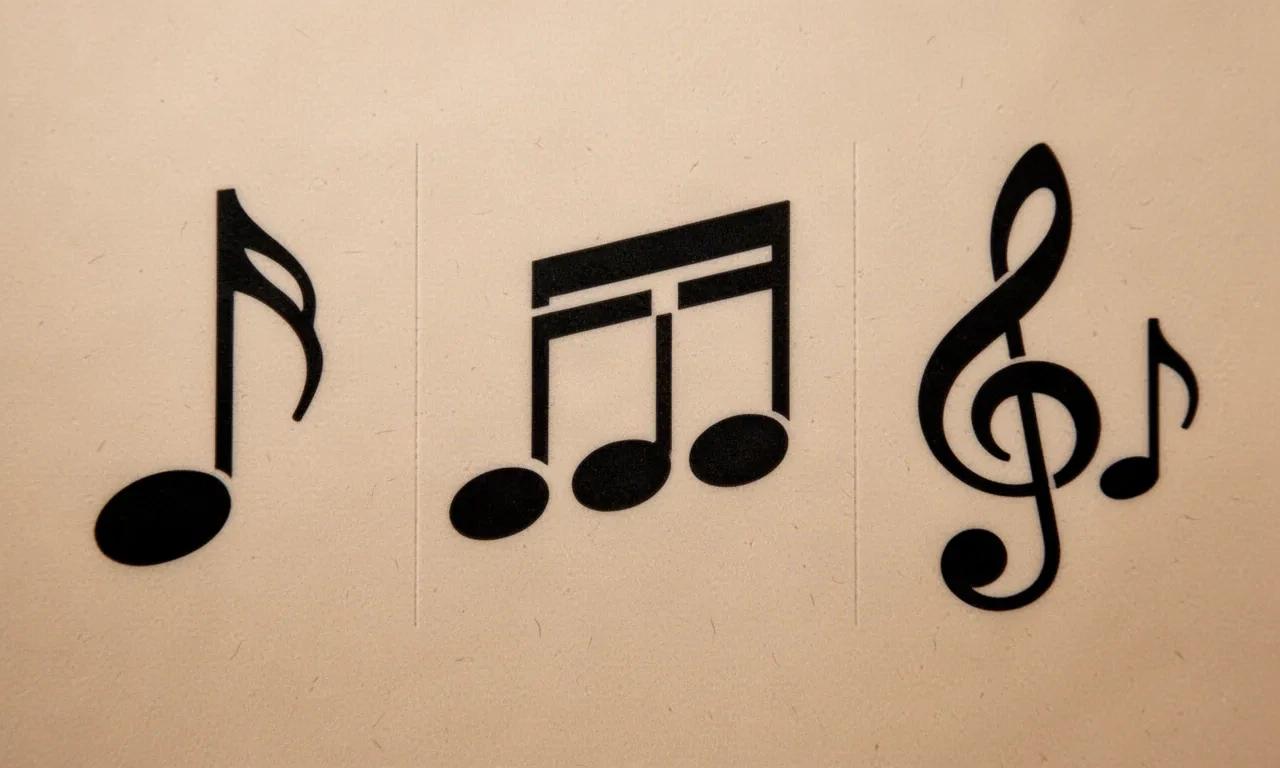
Illustrative synthetic stencil-style comparison of an isolated eighth note, a beamed note pair with one solid beam, and a treble clef with a small note held outside its open spiral, all with closed heads and no staff lines
Illustrative synthetic comparison only, not app output: isolated note for the smallest fields, beamed pair for horizontal rhythm, clef pairing for taller compositions. Staff lines removed and separations held open.

Isolated single note

Best for: Minimal behind-ear, finger side, wrist, and ankle pieces where one clean eighth or quarter note must read alone at 2 to 3 cm.

Build: One filled head, one straight stem, and one flag or one dot family maximum. Protect head closure, stem direction, and the single flag or dot separation.

Failure mode: The flag tip thins into a scratch and the dot drifts toward the head edge. Keep the flag tapered but countable and hold a visible skin ring around any dot.

Size floor: The safest choice at 2 to 3 cm. Holds when head, stem, and one flag or dot each keep their own separation at 1:1.

Beamed pair

Best for: Forearm, wrist band, collarbone, and ankle compositions where two notes joined by one beam read as rhythm and movement.

Build: Two filled heads with two parallel stems joined by one horizontal or slanted beam. Protect both head closures, both stem directions, and the beam as one continuous bar with open counters beside each stem.

Failure mode: The beam thins out, touches a head, or traps staff remnants between the stems. Keep the beam the heaviest horizontal mark and clear the space between stems completely.

Size floor: Needs width. Holds from about 3 to 4 cm upward when the beam and both stem gaps stay open at true size.

Treble-clef pairing

Best for: Sternum-adjacent, forearm, shoulder, and upper-back pieces where the client wants the clef identity alongside one or two notes.

Build: One treble clef with its spiral and tail plus one or two small notes held outside the clef body. Protect the clef spiral opening, the tail direction, and a full skin break between clef and notes.

Failure mode: The spiral closes, the tail touches a note head, or small notes crowd into the clef curl. Reduce the clef interior to one counted opening and keep notes outside the curl with open skin between them.

Size floor: Needs the most height of the three. Holds from about 5 to 6 cm upward, and small clef-plus-note lockups under 4 cm usually need a recrop to notes alone.

Broad symbol silhouette and symmetry method plus general orientation, gap, and readability vetting across symbols stay with their existing owners. This comparison exists to place one music-note construction at a stated size, not to replace those owners.

Music-note evaluation framework

Score the reference in minutes, then act on the weakest check.

Four music-note constructions at labeled sizes. Each one names the protected structure, the fix, and the go or no-go verdict at that exact size. Confirm with a measured 1:1 print.

HOLDS AT STATED SIZE

Isolated eighth note at 3 cm

Intended height 30 mm

Reference read

Single eighth note with a filled oval head, one straight stem, and one tapered flag. No staff lines and no second note sharing the field.

Protect
Head closure, stem direction and mass, and the single flag shape with a countable tip.
Fix
Keep the flag tapered but solid rather than hairline, and hold the head as a closed solid with no staff remnant crossing it. If the flag tip closes at 1:1, shorten the taper before touching head or stem mass.
Candidate stencil
Same music construction with closed heads, solid stems, one countable beam or flag, ringed dots, clef notes held outside the curl where present, and staff lines removed or isolated with open skin.
Final-size verdict
Holds at 3 cm after a flag-tip check. Head, stem, and flag each stay countable at true size, and the piece reads as music from a normal viewing distance.

SIMPLIFY BEAM FIRST

Beamed pair with staff remnant at 4 cm

Intended width 40 mm

Reference read

Two eighth notes joined by one beam with one partial staff line still crossing behind the stems. Strong rhythm on screen with a narrow channel between the stems and one thin line crossing both.

Protect
Both head closures, both stem directions, and the beam as one continuous bar.
Fix
Remove the staff remnant entirely or keep at most one short partial line fully outside the note structure with its own skin break. Rebuild the beam as the heaviest horizontal mark and clear the inter-stem channel to open skin. Do not keep a full staff plus a thin beam at this width.
Candidate stencil
Same music construction with closed heads, solid stems, one countable beam or flag, ringed dots, clef notes held outside the curl where present, and staff lines removed or isolated with open skin.
Final-size verdict
Not stencil-ready until the staff contact is resolved and the beam holds its own mass. Heads and stems can stay, because the beam and the staff crossing merge first at this width.

SEPARATE CLEF AND NOTES FIRST

Treble clef with two small notes at 6 cm

Intended height 60 mm

Reference read

Treble clef with a full spiral and descending tail plus two small eighth notes tucked beside the curl. Complete musical read on screen with tight contacts where note heads approach the clef body.

Protect
Clef spiral opening, tail direction, and one note head plus stem per small note as the rebuild anchor.
Fix
Move both notes fully outside the curl with a continuous skin break between clef and notes, reduce the clef interior to one counted opening, and drop any staff lines. If a note head still touches the curl at 1:1, enlarge or recrop to the clef alone before thinning the spiral.
Candidate stencil
Same music construction with closed heads, solid stems, one countable beam or flag, ringed dots, clef notes held outside the curl where present, and staff lines removed or isolated with open skin.
Final-size verdict
Holds at 6 cm once the spiral stays open and both notes sit clear of the clef body at true size. Clef identity carries the piece while notes confirm it, but only with separation between them.

ENLARGE OR RECROP

Full staff phrase with many notes at 3 cm

Intended width 30 mm

Reference read

Short staff with five lines and several small notes, beams, dots, and articulation marks sharing one small field. Rich notation on screen with hairline staff lines and crowded note spacing.

Protect
The one or two note heads and stems that carry the musical idea, plus the beam direction if rhythm matters.
Fix
Enlarge past the point where every head, stem, beam, and dot transfers as a separate mark, or recrop to one isolated note or one beamed pair with staff lines removed. Do not keep five staff lines plus full notation density at 3 cm.
Candidate stencil
Same music construction with closed heads, solid stems, one countable beam or flag, ringed dots, clef notes held outside the curl where present, and staff lines removed or isolated with open skin.
Final-size verdict
At 3 cm the staff lines fill, dots touch heads, and beams print as broken scratches. Enlarge, recrop to one variant, or choose a bolder minimal construction for this size.

Heads, stems, beams, flags, dots, and staff lines at final size

Judge the white space at the size you will print.

Screens forgive crowding that paper and skin do not. Set the size first, then inspect each feature below at true physical size with scaling off.

About 2 to 3 cm

Behind-ear marks, finger sides, wrist accents, and small gap fillers.

Carry one isolated note with a closed head, one solid stem, and at most one flag or dot. No staff lines and no second construction. If a flag tip or dot ring closes at 1:1, enlarge or reselect rather than forcing reduction.

About 3 to 5 cm

Common wrist, forearm, ankle, and collarbone music pieces.

The most flexible band. An isolated note with confident mass or a compact beamed pair with one heavy beam can work when every head, stem, dot, and inter-stem gap is verified at true size.

About 5 to 6 cm and above

Forearm, shoulder, upper back, and sternum-adjacent compositions.

Room for a treble-clef pairing with one counted spiral opening and notes held outside the curl. Larger height does not rescue closed spirals, touching notes, or retained staff lines.

Music-note feature checks by size band
FeatureAbout 2 to 3 cmAbout 5 to 6 cm and above
Note headsFilled and fully closed solids. If a head outline breaks or a staff line crosses it, the note loses its read before any other mark matters.Same priority. Larger height allows slightly smaller heads relative to stems, but closure still beats uniform thinness.
StemsOne solid straight mark with enough mass to survive print at 2 to 4 cm. Keep stem mass equal to or heavier than any flag on the same note.Same priority. Longer stems allowed, but each stem needs a continuous skin break from beams, dots, and clef bodies along its length.
Beams and flagsBeams must read as one bar, flags as one tapered but countable shape. Hairline beams and needle flags vanish or print as scratches at small size.Double beams and elaborate flags allowed only when each bar keeps its own separation and its own skin channel at 1:1.
Dots and staff linesDots need a full ring of open skin. Staff lines should be removed at this band, since five thin parallels fill first.At most one short partial staff accent held outside the note structure with a continuous skin break. Full staff systems belong at larger display sizes, not transfer stencils.

Reference to clean stencil

Build from heads and stems outward, then protect the gaps.

Work in this order so one change at a time can be judged at the same size. Stop when variant, heads, stems, beams, dots, and staff handling each read correctly.

  1. 01

    Lock size, placement, and variant first

    Set the intended physical height or width in millimeters, name the body area, and name the construction in one line: isolated note, beamed pair, or treble-clef pairing. A beamed pair that holds at 4 cm on a forearm can fail at 2 cm behind an ear with no line being wrong on its own. Use the size calculator when target dimensions are still open.

  2. 02

    Verify variant against the field

    Match isolated notes to narrow or tiny fields, beamed pairs to horizontal runs with room for two stems plus a beam, and clef pairings to taller fields with room for spiral plus notes. Confirm the construction fits the available width or height, then resolve head, stem, and beam crowding before touching line weight.

  3. 03

    Set note-versus-support roles

    Assign every mark a role: note structure that carries the first read, support that shapes it, and texture that can be removed. Strengthen heads, stems, and the beam or clef outline first, keep flags and dots secondary, mark staff lines and shading as removable, and keep one removable accent that can go if gaps close.

  4. 04

    Simplify heads, stems, beams, and dots at 1:1

    Close heads, solidify stems, rebuild thin beams as one bar, taper flags to a countable tip, ring each dot with skin, and remove or isolate staff lines. Run a squint check: step back until fine marks disappear and confirm the variant still reads as music. The line-weight guide covers fine, normal, and bold behavior on the same stencil, and the handwriting preparation guide covers thin-stroke preservation vocabulary when stems behave like script hairlines.

  5. 05

    Verify print and transfer path

    Export a true-size PDF with no fit-to-page scaling, inspect the narrowest stem gap, the tightest beam or flag contact, and the smallest dot ring on plain paper, then measure the physical print with a ruler. If the digital file passes and only paper fails, move to print-stage evidence instead of simplifying again.

Placement and composition decisions

Isolated notes want tiny flat axes, beams want horizontal runs

A music note is either one vertical stem or one horizontal rhythm bar. Flat placements preserve both with little compensation, while wrapped placements demand the matching variant.

Behind ear and finger side

Tiny curved fields where only one isolated note survives. Stems bend with the curve and dots drift toward head edges fast.

Check: Keep one note with a closed head and one solid stem, align the stem with the flattest axis, and confirm the flag tip and any dot ring stay open at the exact millimeter size.

Wrist and ankle

Narrow wrapped fields where beamed pairs crowd fast and clef tails overhang the bone edge. Tendon movement punishes hairline beams.

Check: Choose an isolated note or a compact beamed pair with one heavy beam, keep staff lines out, and verify both stem gaps and beam mass at 1:1 before print.

Forearm and collarbone

Horizontal runs where beamed pairs read best, with room for two stems plus one beam along the limb axis.

Check: Align the beam with the limb, protect the inter-stem channel as open skin, and keep dots and flags clear of clothing friction edges.

Sternum-adjacent, shoulder, and upper back

Taller flat fields where a treble-clef pairing can breathe. The body midline makes clef asymmetry visible, and curvature at the edges distorts tails.

Check: Center the clef on the flattest span, hold notes outside the curl with a continuous skin break, and preview on a body photo before locking spiral and tail position.

Stencil-ready checklist

Approve the music note only when every line passes

Run this short sequence with scaling off and a ruler in hand. One failed line means fix, enlarge, or reselect before transfer.

  • Confirm intended size in millimeters, the named placement, and the chosen variant.
  • Confirm closed note heads with no staff line crossing any head.
  • Confirm solid stems with open skin along each stem at 1:1.
  • Confirm one countable beam or flag per construction with no head or dot contact.
  • Confirm each dot ringed by open skin and each clef spiral open, where present.
  • Export a true-size PDF with scaling off and measure the physical print.
Variant fits size first Verify gaps at 1:1 Staff lines stay out

FAQ

Music-note stencil decisions, answered

Short answers for the variant, thickness, staff-line, orientation, and print checks that recur when a music reference moves toward transfer-ready output.

Match the variant to the size and the field. An isolated single note suits 2 to 3 cm placements such as behind the ear, finger side, wrist, or ankle, where one head plus one stem must carry everything. A beamed pair suits 3 to 4 cm horizontal runs such as forearm, collarbone, or ankle, where two stems plus one beam have room. A treble-clef pairing needs about 5 to 6 cm or more, because the spiral plus tail plus separate notes only survive with real height.

Next steps

Use the neighboring owners for adjacent jobs.

This guide covers music-note variant choice, small-size thickness and gap rules, staff-line avoidance, narrow-field orientation, and reference-to-stencil preparation. Use the links below for related jobs such as sizing, print checks, paper, and placement.

Broad symbol silhouette and symmetry depth, general cross-symbol gap vetting, symbol collection browsing, generic photo conversion, reference-board and quality-check mechanics, and beginner stencil-choosing theory stay in their specialist owners. The links above hand off instead of repeating that detail.

From evaluated reference to working stencil

Turn the approved music note into a stencil draft.

Start from the music note that passed the variant, thickness, gap, and staff-line checks, then continue on iPhone for body fit, exact-size print, mirror and professional export.