
Combined-motif stencil vetting

Vet the lion and the flowers before they share one stencil

A dense mane and soft blooms compete for the same skin. Pick one dominant motif, prove the mane-to-petal gaps and face-vs-bloom readability at your exact size, then set bloom framing so the pairing transfers as two readable marks.

Built for working artists preparing combined lion-with-flowers pieces. This page covers dominance choice, mane-to-petal retention, face-vs-bloom readability, bloom framing and wrap flow, and combined print prep only. Faceted geometric heads, lioness profiles, tiger-floral and skull or rose dominance, single-flower vetting, and broad gallery comparison stay with their specialist owners.

Dominance first

One motif leads, the other supports.

Combined pieces fail when mane texture and petal texture share equal mass and stems fill whatever is left. These three dominance options decide the hierarchy before a single gap is measured.

Lion-led portrait

The lion face and mane carry the first read at roughly sixty percent of the visual mass, with one or two compact blooms parked at the mane edge or below the jaw as accents. This build suits clients who want strength and gaze first with botanical softness second, and it survives reduction best because the heaviest marks are the face landmarks and the outer mane contour, not layered petal mass.

Check: Cover the flowers. If the lion still reads as one complete portrait with a clear gaze, nose, and mane silhouette at 1:1, the dominance is sound. If the eye goes to petal texture first even with blooms covered mentally, the blooms are too large or parked too close to the face.
Bloom-framed halo

A floral crown or side spray carries the framing mass around a calmer lion face, with blooms arcing over the mane crown or falling along one or both cheeks. This build suits clients who want softness and decoration first with the lion gaze held inside the frame, but it fails fastest when a petal edge lands on an eye, when a bloom cup covers a mane landmark, or when petal separations compete with mane separations at equal weight.

Check: Trace the face oval from brow to muzzle as one closed read. If the eyes, nose, and mouth keep visible skin on all sides at true size with blooms parked fully clear of each landmark, the frame works. If any petal tip touches an eye corner or the nose bridge, move the bloom fully clear before print.

Balanced wrap flow

Lion and florals share comparable mass along one wrap axis, usually a three-quarter portrait with blooms trailing from the mane toward open skin along the shoulder, arm, or thigh line. This build suits larger flat or gently curved fields where the pairing can breathe, but it needs a continuous skin channel between every mane edge and every petal edge because mane texture and petal texture merge into one dark band on wrap curves when they touch.

Check: Draw one imaginary channel between every mane lock and every petal tip. If the channel runs unbroken from crown to stem end at true size with no mane-to-petal contact, the balance holds. If one bloom crowds the mane edge or a stem crosses a mane lock, reopen before judging line weight.

When the combination fits but neither motif should dominate, keep this page as the working surface. When the job is really a placement, sizing, or printer question rather than a pairing question, hand off to the fit-to-body owner or the inkjet printer guide instead of forcing the pairing to answer it.

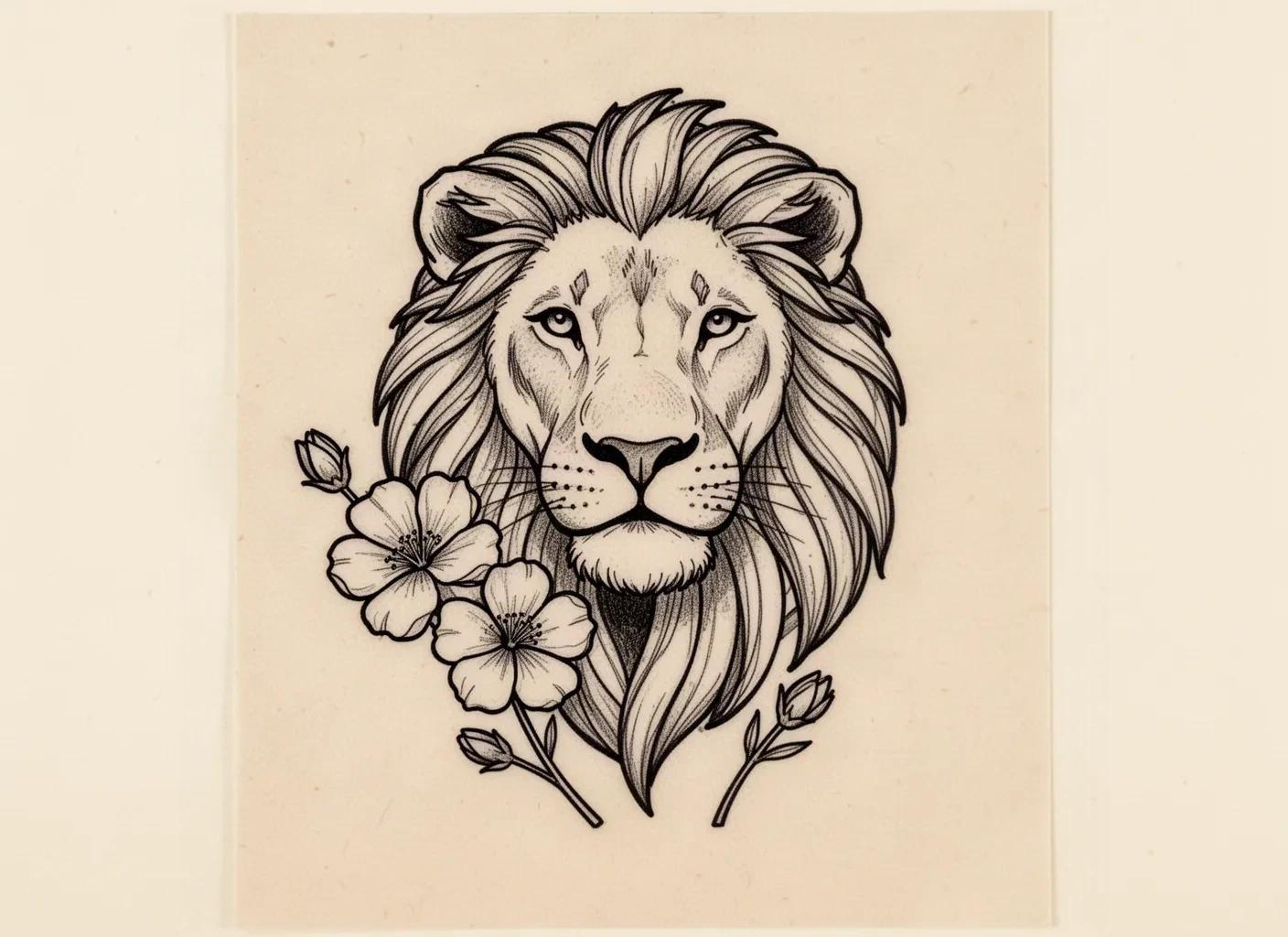
Ink line-art illustration of a front-facing lion head with compact blossoms and buds parked at the lower left mane edge and stems falling toward open skin
Framing reference for a lion-led build: the face and mane carry the mass, compact blooms and buds sit at the lower mane edge, and stems fall toward open skin instead of crossing a lock. Synthetic illustration for composition orientation only, not app output and not a downloadable stencil file. Confirm mane-to-petal clearance on your own 1:1 print.

Combined evaluation framework

Score the reference in minutes, then act on the weakest check.

Four combined constructions at labeled widths. Each one names the protected structure, the fix, and the go or no-go verdict at that exact size. Confirm every verdict with a measured 1:1 print.

HOLDS AT STATED SIZE

Lion-led portrait with two mane-edge blooms at 12 cm

Intended width 120 mm

Source
Front-facing lion portrait with a full but simplified mane, two compact open-face blooms parked at the lower left mane edge, short stems falling toward open skin, and one continuous skin channel between every mane lock and every petal tip.
Protect
The full face oval with eye, nose, and muzzle clearance, the outer mane contour with countable lock separations, and both bloom cups with one open petal tier each.
Fix
Shorten only the stem tip nearest the lower mane lock if the channel narrows at 1:1. Keep face mass, mane shape, and bloom cups unchanged.
Candidate stencil
Same pairing with dominant motif set, face axis aligned, texture thinned to surviving bridges, and outer contours kept at transferable mass.
Final-size verdict
Holds at 12 cm after a mane-to-petal channel check. Separated mane mass and petal mass mean the eye reads lion first, flowers second, with no shared pocket.

SEPARATE FIRST

Bloom-framed halo with petal tips touching the eyes at 10 cm

Intended width 100 mm

Source
Calm lion face inside a floral crown arc, but two upper petal tips land on the brow line and a side bloom crowds the left eye corner, closing the skin ring the gaze needs.
Protect
The face oval with eye placement and the crown arc shape as the framing anchor.
Fix
Pull the crown arc outward until visible skin rings each eye, move the side bloom fully clear of the eye corner or remove it, and recheck at 1:1 before any mane or petal detail work.
Candidate stencil
Same pairing with dominant motif set, face axis aligned, texture thinned to surviving bridges, and outer contours kept at transferable mass.
Final-size verdict
Not stencil-ready at 10 cm. A petal that touches the brow or eye turns the gaze into a petal edge, so separate first, then recheck before ornament.

THIN TEXTURE FIRST

Balanced wrap with full mane rows plus layered petals at 9 cm

Intended width 90 mm

Source
Three-quarter portrait with repeated inner mane locks plus double-tier layered blooms and leaf filler trailing along the wrap axis. Several mane-to-petal and petal-to-petal separations sit near one millimeter on screen.
Protect
The face landmarks with gaze direction, one mane contour ring with lock rhythm, and one focal bloom cup with its outer petal tier.
Fix
Reduce inner mane rows to spaced locks on the outer ring only, cut blooms to one focal plus one bud, remove leaf filler touching the mane edge, and recheck each surviving gap for open skin at 1:1. Reduce texture count before thinning any contour.
Candidate stencil
Same pairing with dominant motif set, face axis aligned, texture thinned to surviving bridges, and outer contours kept at transferable mass.
Final-size verdict
Simplify first. If the wrap zone still reads as one grey band at true size, the pairing needs fewer mane locks and petals, not finer lines.

ENLARGE OR RECROP

Full portrait nested in dense blooms with equal-weight detail at 6 cm

Intended width 60 mm

Source
Compact lion face nested inside layered bloom cups with fine mane ticks, stamen dots, and bud chains sharing the same line weight as the eyes and nose at a width where none of the gaps survive paper.
Protect
The nested face-plus-frame silhouette and one anchor, either the gaze with mane contour or the lead bloom cup, not both at full density.
Fix
Lift the blooms clear of the eyes and nose, merge layered petals into one open tier, drop stamen dots and bud chains at this size, and recheck with a squint test. Below about 8 cm, nested face detail plus equal-weight petal detail merge into one pocket.
Candidate stencil
Same pairing with dominant motif set, face axis aligned, texture thinned to surviving bridges, and outer contours kept at transferable mass.
Final-size verdict
At 6 cm the shared fine weight flattens the contrast hierarchy. Enlarge past 10 cm, recrop to the portrait plus one separated bloom, or cut the crown to a single side spray for this size.

Faceted geometric heads, lioness profiles, tiger portraits with floral framing, and skull-led or rose-led dominance stay with their specialist owners. This framework exists to judge combined lion-floral dominance, mane-to-petal separations, face-vs-bloom contrast, and stem bridging at a stated size, not to replace those owners.

Mane-to-petal gaps and face-vs-bloom contrast at final size

Judge the bridge channel at the size you will print.

Screens forgive combinations that paper and skin do not. Set the pairing width first, then inspect each feature below at true physical size with scaling off.

About 6 to 8 cm

Wrist, ankle, and compact shoulder accents.

Carry one texture only at this width: a simplified lion portrait with one plain bloom, or one focal bloom with a short mane hint and no inner lock rows. Keep a single contour family and treat inner mane ticks, stamen dots, and buds as removable. If any mane-to-petal gap closes at 1:1, remove that texture rather than shrinking it further.

About 9 to 13 cm

Common forearm, shoulder blade, collarbone, and calf combined pieces.

The most flexible band for a true combined read. One clear dominant motif, spaced mane locks, open bloom shapes, and a restrained stem bridge can work when every gap is verified at true size. Check mane lock spacing, eye clearance, petal separations, and bridge clearance before approving inner detail or bud runs.

About 14 cm and above

Thigh, upper back, rib, and shoulder-cap panels with room for mane, crown, and stems.

Room for fuller mane rings, a bloom crown plus a side bud, and a one-pass stem sweep, but only when open skin separates every mane edge from every petal edge. Larger size does not rescue eyes nested in bloom cups, mane locks fused to petals, or equal-weight micro detail that competes with face landmarks.

Combined feature checks by size band
FeatureAbout 6 to 8 cmAbout 14 cm and above
Mane locks vs petal edgesKeep inner lock rows off the stencil or hold a few spaced outer locks only. Keep one open petal tier with clear separations. Any mane-to-petal contact is a removal call, not a thinning call.Spaced inner locks can work when each keeps open skin from every petal edge. Judge channel continuity, not count: one pinched pass fails the frame even when the rest looks airy.
Face landmarks vs bloom cupsKeep the face fully clear of every bloom with a visible skin ring around both eyes, the nose, and the muzzle. Drop buds near the eyes and keep the jaw as one clean edge.A bloom parked near the mane crown can work when the eyes, nose, and muzzle each keep open skin. Check gaze clearance with a squint test at true size before adding whisker or nose detail.
Stems, buds, and dot chainsKeep at most one bridge element, and keep it fully clear of both mane locks and petal edges. Dots below about 1.5 mm on the print are removal candidates.A single stem sweep plus one spaced bud can work when each keeps open skin on all sides. Judge bridge density, not count: clustered buds merge even when the count looks modest.
Mane ring separationsEvery neighboring mane lock must read as open skin at 1:1. Merge means fewer locks or a wider layout, not thinner mane contours.Locks can sit closer relative to width, but each one must still survive print and transfer as a separate opening. Crown-seated blooms need the widest bridge check.

Reference to clean stencil

Set the dominant motif first, then thin the bridge.

Work in this order so one change at a time can be judged at the same size. Stop when dominance, axis, gaps, and hierarchy each read correctly.

  1. 01

    Name the dominant motif, size, and placement

    State the build in one sentence, lion-led, bloom-framed, or balanced wrap, then set the intended physical width in millimeters and the named body area. A balanced wrap that holds at 12 cm on a flat thigh can fail at 7 cm on a wrist with no line being wrong on its own. Use the size calculator when target dimensions are still open.

  2. 02

    Set the face axis and open every mane-to-petal gap

    Seat blooms at the mane edge or along the wrap axis with stems falling toward open skin, keep every petal fully clear of the eyes, nose, and muzzle, and confirm a continuous skin channel separates every mane edge from every petal tip at true size. Resolve face-to-bloom contacts, nested crowns, and stem bridges before touching line weight.

  3. 03

    Rank three line levels

    Assign heaviest mass to the face landmarks and outer mane contour plus the bloom cups, middle mass to one mane lock family or one petal tier, and lightest removable mass to inner ticks, stamen dots, buds, and leaves. Mark at least two small textures that can be removed without changing identity. Strengthen the dominant contour first and never promote buds to contour weight to fill empty skin.

  4. 04

    Simplify texture and recheck at 1:1

    Reduce mane, petal, and bud count before thinning contours. Keep open skin between mane locks, around the eyes and nose, between every petal, and along the full stem bridge, then run a squint check: step back until texture disappears and confirm the pairing still reads as lion plus flowers. The line-weight guide covers fine, normal, and bold behavior on the same stencil.

  5. 05

    Verify print and transfer path

    Export a true-size PDF with no fit-to-page scaling, inspect the narrowest mane lock, the tightest eye-to-petal clearance, and the stem bridge on plain paper, then measure the physical print with a ruler. If the digital file passes and only paper fails, move to print-stage evidence instead of simplifying again.

Bloom framing and wrap flow

Combined pairs want flat skin that preserves their separations

A lion-plus-flowers pairing is a two-texture gap composition wrapped around one axis. Flat placements preserve mane, petal, and stem separations with little compensation, while tight curves and centered fields demand strict axis control.

Wrist, ankle, and compact spots

Small curved fields where only a simplified pair survives: an open portrait with one plain bloom, or one bloom with a short mane hint. Full mane rings, layered crowns, and bud trails forced into these spots merge first.

Check: Recrop to the dominant motif with at most one bridge element, then run every mane-to-petal check at the exact width.

Outer forearm and calf

Long flat fields where balanced wrap pairings read best. Keep the portrait-to-bloom axis along the limb line so mane locks and bloom cups do not drift across the curve.

Check: Align gaze, mane center, lead bloom, and stem bridge to the flattest span and confirm separations at 1:1 before print.

Shoulder, thigh, and upper back

Broad panels with room for fuller manes, bloom crowns, and a restrained stem sweep. The most forgiving area for blooms seated at the mane edge.

Check: Spend the extra room on mane-to-petal separation first, seat the gaze on the flattest span, and let stems fall toward open skin.

Ribs, sternum, and spine

Centered or breathing fields where axis drift and crown crowding show fastest. Curved rib placements foreshorten lower blooms first and pinch mane gaps the screen hides.

Check: Lay out center alignment on skin before locking the file, keep bud counts low near the midline, and preview the full pairing on a body photo.

Stencil-ready checklist

Approve the pairing only when every line passes

Run this short sequence with scaling off and a ruler in hand. One failed line means keep, simplify, rescale, or relocate before transfer.

  • Confirm dominant build, intended width in millimeters, and named placement in one sentence.
  • Confirm mane locks stay countable with open skin between neighboring locks at 1:1.
  • Confirm the face sits clear of every bloom with open skin around both eyes, the nose, and the muzzle.
  • Confirm every mane-to-petal and petal-to-petal gap stays open at 1:1.
  • Confirm each surviving bud, stem, and dot keeps open skin on all sides with no contact to mane or petals.
  • Confirm line hierarchy with heaviest face and mane plus bloom cups, middle lock or petal tier, and lightest removable texture.
  • Export a true-size PDF with scaling off and measure the physical print.
One motif leads Verify mane-to-petal gaps at 1:1 Keep, simplify, rescale, or relocate

FAQ

Combined stencil decisions, answered

Short answers for the dominance, gap retention, hierarchy, and placement checks that recur when a lion-with-flowers reference moves toward transfer-ready output.

Judge by placement shape and width. Small curved spots suit a lion-led portrait with one plain bloom, or one focal bloom with a short mane hint and no inner lock rows. Flat mid-size fields suit a balanced wrap with blooms trailing from the mane edge. Broad panels suit fuller manes with a crown plus one side bud. Do not force full mane rings plus layered petals plus a bud trail into a wrist-width piece, and do not nest the eyes inside a bloom cup across a sharp curve.

Next steps

Use the neighboring owners for adjacent jobs.

This guide covers combined dominance choice, size-tied mane and gap rules, three-level hierarchy, and reference-to-stencil preparation. Use the links below for related jobs such as sizing, print checks, paper, and placement.

Faceted geometric heads, lioness profiles, tiger portraits with floral framing, skull-led and rose-led dominance, single-flower petal vetting, and broad 28-animal gallery comparison stay in their specialist owners. The links above hand off instead of repeating that detail.

From evaluated reference to working stencil

Turn the approved pairing into a stencil draft.

Start from the pairing that passed the dominance and gap checks, then continue on iPhone for body fit, exact-size print, mirror and professional export.