Fleur de lis stencil evaluation

Pick the fleur de lis that survives transfer

A fleur de lis reads through a sharp center petal, mirrored side scrolls, and open skin around the waist band. Choose the variant for your width, prove petal symmetry and gaps at true size, then transfer with an orientation and mirror plan.

Built for working artists preparing fleur de lis emblem pieces. This page covers fleur de lis variant choice, central-petal, side-petal, and band gap checks at final size, plus orientation, mirror, and placement notes only, not tattoo application or healing advice. Generic first-read silhouette work stays with the symbol depth, centerpiece framing stays with the ornament guide, and botanical flower construction stays with the lily owners.

Fleur de lis versus neighboring jobs

Name the emblem job before judging the reference.

A fleur de lis is an upright heraldic emblem judged on center-petal point, side-scroll mirror, band channels, and orientation. These boundaries keep it out of neighboring owners that solve different stencil problems.

Covered here

Fleur de lis variant choice across classic heraldic, minimal, ornate, and wide ceremonial constructions, throat, scroll, and band gap checks plus mirror symmetry at final size, and transfer-ready orientation, mirror, and placement notes scoped to this emblem.

Neighboring owners keep

Generic ornament symmetry and body-flow adaptation stays with the ornament guide, botanical lily petal and stem work stays with the lily owners, and crown, cross, clover, compass, and filigree specifics stay with those emblem owners.

Ornament guide for frame depth, spider-lily guide for botanical lily depth, and crown guide for the parallel symmetric-emblem pattern.

Fleur de lis evaluation framework

Pick the variant first, then act on the weakest check.

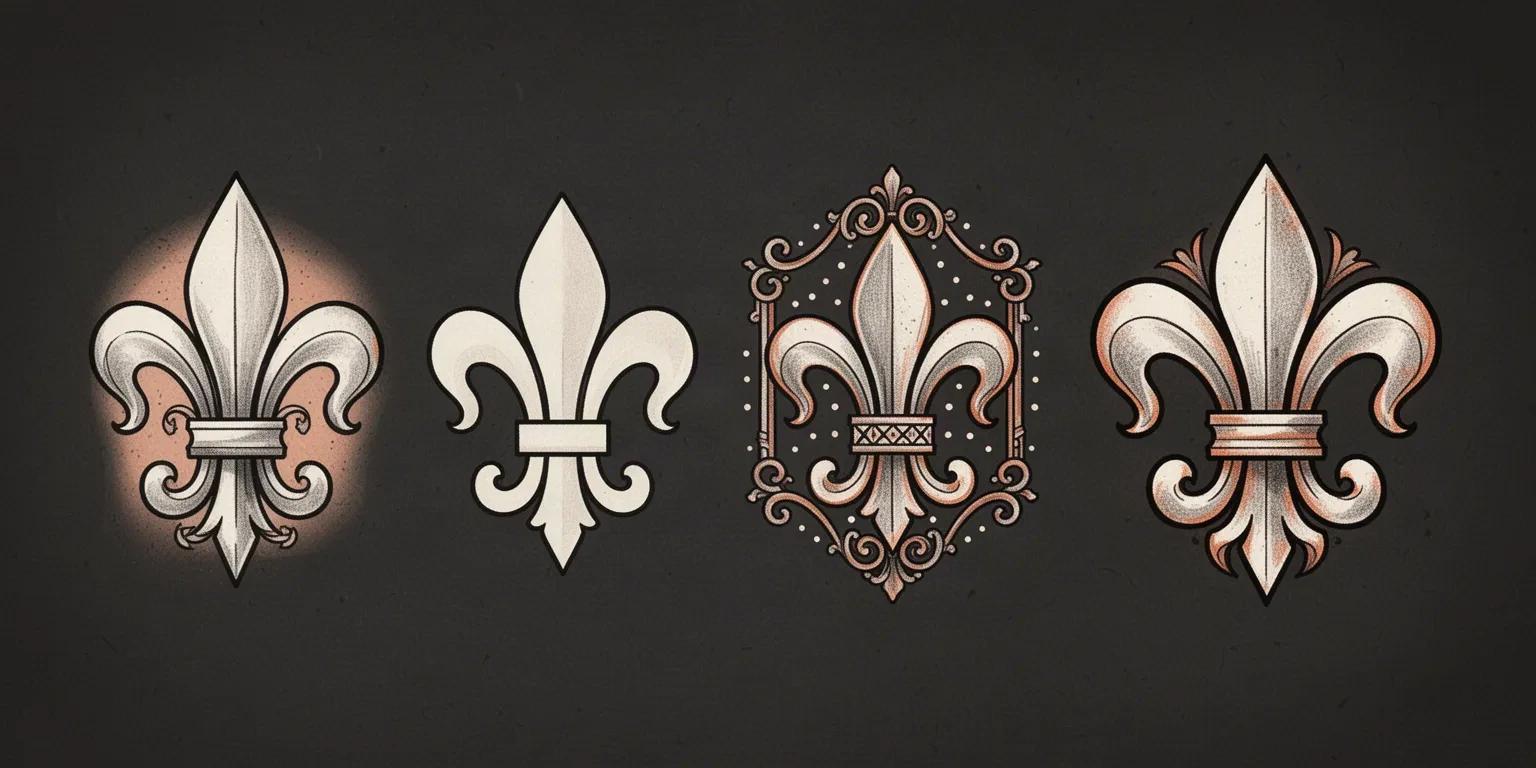
Four fleur de lis constructions at labeled widths. Each one names the protected structure, the fix, the placement fit, and the go or no-go verdict at that exact size. Confirm with a measured 1:1 print.

Editorial ink illustration comparing four fleur de lis emblems side by side: classic heraldic with a plain band and lower curls, stylized minimal with simplified side petals, ornate with an anchored scrollwork frame, and wide ceremonial with widely flared side petals.
Construction comparison, left to right: classic heraldic, stylized minimal, ornate with an anchored scroll frame, and wide ceremonial. The center petal, mirrored side scrolls, waist band, and base spike stay separable in each. Use it to choose a construction, not as a printable stencil or app output, and still confirm every gap at true size.

MOST FORGIVING STARTER

Classic heraldic fleur de lis at 8 cm

Intended width 80 mm

Source
The traditional upright emblem: one tall pointed central petal, two side petals that sweep out and curl down into scrolls, a plain horizontal band across the waist, and a short base spike with two small lower curls. The established stencil default because the silhouette reads from the center petal alone.
Protect
The vertical midline with the central petal centered on it, the mirrored pair of side scrolls, the plain band with open skin above and below it, and the short base spike kept clear of the band.
Fix
Build the central petal first, mirror one side scroll onto the other, and keep the band as a single contour with no doubled inner line. Remove inner petal veining that touches a scroll edge before shrinking the piece.
Candidate stencil
Same emblem with leveled band, mirrored side petals and lower curls, single band contour, and ranked scroll and ornament zones held at transferable mass.
Placement fit
Best for: forearm, outer calf, shoulder cap, chest panels, and upper back fields with a vertical run.
Trade-off
Avoid when: the field forces the emblem below about 5 cm, because the side scroll counters fill first. Choose the minimal construction for small fields.
Final-size verdict
Holds at 8 cm once the central petal reads centered at true size, both side scrolls hold open counters, and the band keeps a visible skin channel on each side. When a scroll counter closes, open the scroll rather than thinning the band.


SMALL-FIELD PICK

Stylized minimal fleur de lis at 5 cm

Intended width 50 mm

Source
A reduced emblem with the same three-part read but simplified scrolls: straight or softly curved side petals with no tight inner curl, a short clean band, and a compact base with no lower filigree. Built for wrists, ankles, fingers, and behind-ear placements.
Protect
The tall center petal with a clean point, the widened throat gaps between center and side petals, and the simplified band plus compact base with every edge separated.
Fix
Widen each throat gap so open skin runs from the top of the emblem down to the band at 1:1. Drop the lower curls entirely and shorten the base spike rather than letting it touch the band at small width.
Candidate stencil
Same emblem with leveled band, mirrored side petals and lower curls, single band contour, and ranked scroll and ornament zones held at transferable mass.
Placement fit
Best for: wrist, ankle, finger side, behind ear, and small gap fillers on a short vertical run.
Trade-off
Avoid when: the client wants period heraldic character with curled scrolls and layered band detail, because that detail has nowhere to live at this width. Reserve scroll curls for larger fields.
Final-size verdict
Holds at 5 cm once all three petals stay separable at true size with no shared edges. The silhouette carries the meaning at this width, so any interior line that bridges two petals must go.

CHECK EVERY COUNTER

Ornate and filigree-anchored fleur de lis at 12 cm

Intended width 120 mm

Source
A decorative emblem where the fleur de lis anchors scrollwork, dot rows, a diamond band, or Art Nouveau style extensions. Rich on screen with many small enclosed counters inside the scrolls, the band, and the surrounding ornament.
Protect
The core emblem silhouette with mirrored side scrolls, the band position with its own skin break, and the surrounding ornament ranked as removable support rather than structure.
Fix
Rank one ornament row and demote the rest to plain skin. Keep scroll counters countable with open centers at 1:1, convert the smallest dots to spaced marks or remove them, and hold open skin between the band pattern and the petal edges.
Candidate stencil
Same emblem with leveled band, mirrored side petals and lower curls, single band contour, and ranked scroll and ornament zones held at transferable mass.
Placement fit
Best for: thigh, sternum, upper back, and outer upper arm panels with flat area for the emblem plus its frame.
Trade-off
Avoid when: the placement forces the emblem below about 8 cm, because scroll counters fill into solid patches. Recrop to the core heraldic emblem for smaller fields.
Final-size verdict
Holds at 12 cm once the core emblem reads with the ornament covered, and every scroll counter plus band opening stays open at true size. The smallest counter decides the minimum width.

NEEDS THE MOST WIDTH

Wide ceremonial fleur de lis with flared side petals at 14 cm

Intended width 140 mm

Source
A broad heraldic emblem with widely flared side petals, layered band detail, and a pronounced base with symmetric lower curls. Recognition-led because the side petals must mirror across the midline while staying clear of the central petal and the band.
Protect
Vertical midline with matched left and right side petals, band with open channels above and below, and lower curls kept clear of the band with visible skin between them.
Fix
Draw the midline first and mirror one side petal onto the other side. Keep one band layer only, hold the lower curls clear of the band apex, and simplify petal veining before touching side-petal spread.
Candidate stencil
Same emblem with leveled band, mirrored side petals and lower curls, single band contour, and ranked scroll and ornament zones held at transferable mass.
Placement fit
Best for: chest, upper back, and thigh panels with a wide flat field for the full petal span.
Trade-off
Avoid when: the field is narrow or wraps fast, because outer petals compress and throat gaps pinch shut. A compact heraldic emblem fits narrow fields better.
Final-size verdict
Holds at 14 cm once the side petals mirror at true size and the band plus lower curls read as separate layers from a normal viewing distance. Wide side petals tilt visibly, so judge upright and at arm's length.

Generic photo-to-stencil conversion steps, ornament centerpiece composition, and botanical lily construction stay in their owners. This framework exists to judge fleur de lis variant fit, petal and band spacing, and symmetry at a stated width, not to replace those guides.

Internal-gap and symmetry vetting

Mirror every pair before approving the emblem.

Fleur de lis pieces fail on three contacts first: closing throat clefts, filled scroll counters, and doubled band lines, plus one tilt axis when side petals or the base drift off center. Run each check below at true size.

Central petal point and clefts

Fails as: The tall center point blunts into a rounded cap, or the two throat clefts beside it pinch shut where the side petals crowd the center petal.

Fix: Keep the center point sharp with one clean apex, then widen each throat cleft until open skin runs from the top of the emblem down to the band at 1:1. Build the center petal first and fit the side petals to it, not the reverse.

Side petal scroll counters

Fails as: The curled side petals close their inner counters into solid dots, or a scroll edge touches the central petal and traps the throat gap between them.

Fix: Open each scroll until its counter reads as its own opening at true size. Mirror one finished scroll across the midline and hold every scroll edge clear of the center petal with a visible break.

Band channel above and below

Fails as: The horizontal band carries a doubled inner line that prints as one thick bar, or petal edges and lower curls touch the band and close the channel on one side.

Fix: Carry one band contour with open skin on both the top and bottom edges. Remove the second inner line rather than thinning it, and keep the band pattern, where present, as countable openings with skin between each one.

Base spike and lower curls

Fails as: The short base spike below the band merges with the band edge, or the two small lower curls differ in size and curl direction so the base reads lopsided.

Fix: Hold open skin between the band and the base spike, then build one lower curl and mirror it. At small widths drop the lower curls entirely and shorten the spike rather than letting parts touch.

Left-right mirror symmetry

Fails as: Left and right side petals differ in height, curl tightness, or scroll count, so the emblem leans even when the center petal sits vertical on skin.

Fix: Build one side petal and mirror it across the vertical midline, then judge both at 1:1 before adding veining or ornament. Size scroll counters from the center pair outward so both sides stay matched.

Small-size fill and vein texture

Fails as: Inner petal veins, band hatch, or dot rows inside the emblem print as broken scratches or one gray patch because the interior height cannot carry enclosed detail at final size.

Fix: Remove interior veins and hatch first at small widths and let the three-petal silhouette carry the read. Keep at most one short center vein per petal at larger widths, and only when every counter around it stays open.

About 5 cm and below

Finger sides, wrists, ankles, behind-ear pieces, and small gap fillers.

Carry a minimal fleur de lis only, with simplified side petals, one plain band, and no lower curls or interior veins. If a throat gap or scroll counter closes at 1:1, enlarge or reselect rather than forcing reduction.

About 6 to 10 cm

Common forearm, calf, shoulder, and chest fleur de lis pieces.

The most flexible band. A classic heraldic emblem works when every throat cleft, scroll counter, band channel, and base separation is verified at true size. Check mirror symmetry before approving any band pattern.

About 12 cm and above

Large thigh, back, chest, and sternum panels.

Room for ornate and wide ceremonial emblems with scroll counters and band detail, but only when open skin separates petals, band, base, and ornament at true size. Extra width does not rescue merged throat gaps or filled scroll centers.

Reference to clean stencil

Work in this order so one change can be judged at size.

Fleur de lis preparation is sequencing work. Lock the variant, prove symmetry, rank decoration, then prove the print.

  1. 01

    Lock variant, width, and placement first

    Set the intended physical width in millimeters, name the body area, and choose classic heraldic, minimal, ornate, or wide ceremonial construction before judging the reference. A scroll-detailed emblem that holds at 12 cm on a thigh can fail at 5 cm on a wrist with no line being wrong on its own. Use the size calculator when target dimensions are still open.

  2. 02

    Set the midline and mirror the side petals

    Draw the vertical center, level the band against the body axis, then mirror side petals and lower curls left to right before judging any interior detail. Fix asymmetry by mirroring the stronger side, not by adding more ornament to the weaker one.

  3. 03

    Rank structure over decoration

    Assign every mark a role: silhouette that carries the first read, support that frames it, and decoration that can be removed. Protect center-petal point, side-petal mirror, and band channels first, then decide which scroll curl, vein, or dot row earns its room at this width.

  4. 04

    Hold gaps at 1:1 with a true-size print

    Export a true-size PDF with no fit-to-page scaling, inspect the narrowest throat cleft, the tightest scroll counter, and the smallest band opening on plain paper, then measure the physical print with a ruler. Run a squint check: step back until fine veins disappear and confirm the emblem still reads as a fleur de lis.

  5. 05

    Verify print and transfer path

    If the digital file passes and only the paper print fails, move to print-stage evidence: the print checker and the paper guide linked below. Do not simplify the emblem further to compensate for a scaling or printer setting error.

Mirror and placement notes

Upright emblems need a level band and a planned flip

A fleur de lis is a directional emblem: the band must sit level on the body and the center petal must read upright, so mirroring and anchoring are part of the stencil, not an afterthought.

Forearm and outer calf

Long straight fields where the band can sit level across the limb axis. Center petal and side scrolls read cleanly here with little compensation.

Check: Align the band across the limb axis, keep full petal height inside the flat run, and mirror side scrolls at 1:1 before print.

Chest and sternum

Broad or vertical panels with room for classic and ornate emblems, but the body midline becomes part of the design and side-petal asymmetry shows immediately.

Check: Center the emblem midline on the body midline, hold the base spike clear of the band, and preview on a body photo before locking scroll or dot detail.

Hand, finger side, and wrist

Small curved fields where only minimal emblems survive. Scroll counters fill and throat clefts pinch shut when a detailed reference is forced into these widths.

Check: Carry a minimal fleur de lis with simplified side petals, keep the band plain with no pattern, and confirm every throat gap stays open at the exact millimeter width.

Thigh and upper back

Large panels with room for ornate and wide ceremonial emblems, including layered bands and lower curls. Extra room suits scroll detail, but throat and counter checks still apply.

Check: Spend the extra room on scroll counters and band separation first, then decide whether a second ornament row or band pattern earns its detail.

Transfer-ready checklist

Approve the emblem only when every line passes

Run this sequence with scaling off and a ruler in hand. One failed line means fix, enlarge, remove an ornament row, or reselect before transfer.

  • Confirm the variant, intended millimeter width, and named placement with the reason for the choice.
  • Confirm the center petal sits on the midline and each throat cleft traces from open air above to open skin at the band at 1:1.
  • Confirm left and right side petals and lower curls mirror across the midline with matched scroll counts.
  • Confirm every scroll counter holds an open center and the band keeps open skin on both edges.
  • Confirm orientation and mirroring: the center petal points up along the body axis, with the flip planned for the placement side.
  • Export a true-size PDF with scaling off and measure the physical print with a ruler.
Mirror every pair first Verify gaps at 1:1 Anchor the band level

FAQ

Fleur de lis stencil decisions, answered

Short answers for the variant, gap, symmetry, mirror, and placement checks that recur when a fleur de lis reference moves toward transfer-ready output.

Match the construction to the available width. A minimal emblem suits fields near 5 cm because simplified side petals keep every throat gap open. A classic heraldic emblem suits fields near 8 cm when side scrolls hold open counters and the band keeps skin channels on both sides. An ornate or wide ceremonial emblem needs about 12 cm or more so each scroll counter and band opening keeps an open center.

Next steps

Use the neighboring owners for adjacent jobs.

This guide covers fleur de lis variant choice, throat, scroll, and band gap checks, symmetry and orientation verification, and fleur de lis mirror and placement prep. Use the links below for related jobs such as sizing, print checks, and specialist emblem depth.

Generic symbol first-read comparison, ornament frame-to-flow composition, botanical lily petal and stem workflows, photo conversion mechanics, paper manufacturing detail, and placement mechanics stay in their specialist owners. The links above hand off instead of repeating that detail.

From evaluated reference to working stencil

Turn the approved fleur de lis into a stencil draft.

Start from the emblem that passed the variant, gap, symmetry, and placement checks, then continue on iPhone for body fit, exact-size print, mirror and professional export.