
Buddha stencil evaluation

Judge any Buddha reference before it becomes a stencil

Buddha pieces live or die on serene-face recognition and open separation. Check the variant fit, the ushnisha, urna, earlobe, and halo anchors, plus mudra, fold, and petal gaps at your exact height, then prepare a clean stencil that transfers as one reverent figure.

Built for working artists preparing Buddha pieces. This page covers meditating, laughing/Hotei, head-only, and lotus/mandala evaluation and stencil preparation only, not tattoo application or healing advice. The four variants are judged here as different constructions inside one reverent figure framework.

What makes a Buddha stencil-viable

Serenity, anchors, and gaps decide the result.

A Buddha stencil is a reverent figure built around one calm face and a small set of head anchors. These three pillars predict whether that figure survives reduction, print, and transfer.

Serene face recognition

A Buddha piece reads first as one calm face with lowered or closed eyes, a settled mouth, and relaxed symmetry. Stencil viability comes from clear spacing between brows, lids, nose hint, and mouth, not from shaded modeling or fine wrinkle lines that close at transfer size.

Check: Cover the halo, hands, and robe. If the bare brows, closed lids, nose hint, and mouth still read as one serene face at a glance, proportion is sound. If the face needs the halo or lotus to make sense, fix eye and nose placement before judging anything else.
Head anchors and halo separation

The ushnisha crown, the urna mark between the brows, elongated earlobes, snail-curl hair rhythm, and the halo ring carry instant Buddha recognition. Each needs its own open skin at final size, because a halo touching the head edge or an urna merging into brow lines fails first.

Check: Name each anchor present: ushnisha silhouette, urna dot, each earlobe drop, hair rhythm, and halo ring. If removing one still leaves a calm generic head, that anchor is not yet stencil-legible and needs gap work before print.

Mudra hands and robe folds

Hand gestures and robe drapery carry meaning through open channels, not through finger or fold count. Dhyana meditation hands, bhumisparsha earth-witness, and abhaya reassurance each need visible skin between fingers and between hand and robe. Robe folds need ranked long masses with open channels between them.

Check: Trace each finger channel and each robe-fold channel from open skin to open skin at true size. If a channel dead-ends into a filled bridge before reaching open air, reopen it or merge a neighboring fold before changing face or halo mass.

Buddha evaluation framework

Score the reference in minutes, then act on the weakest check.

Four Buddha constructions at labeled heights. Each one names the protected structure, the fix, and the go or no-go verdict at that exact size. Confirm with a measured 1:1 print.

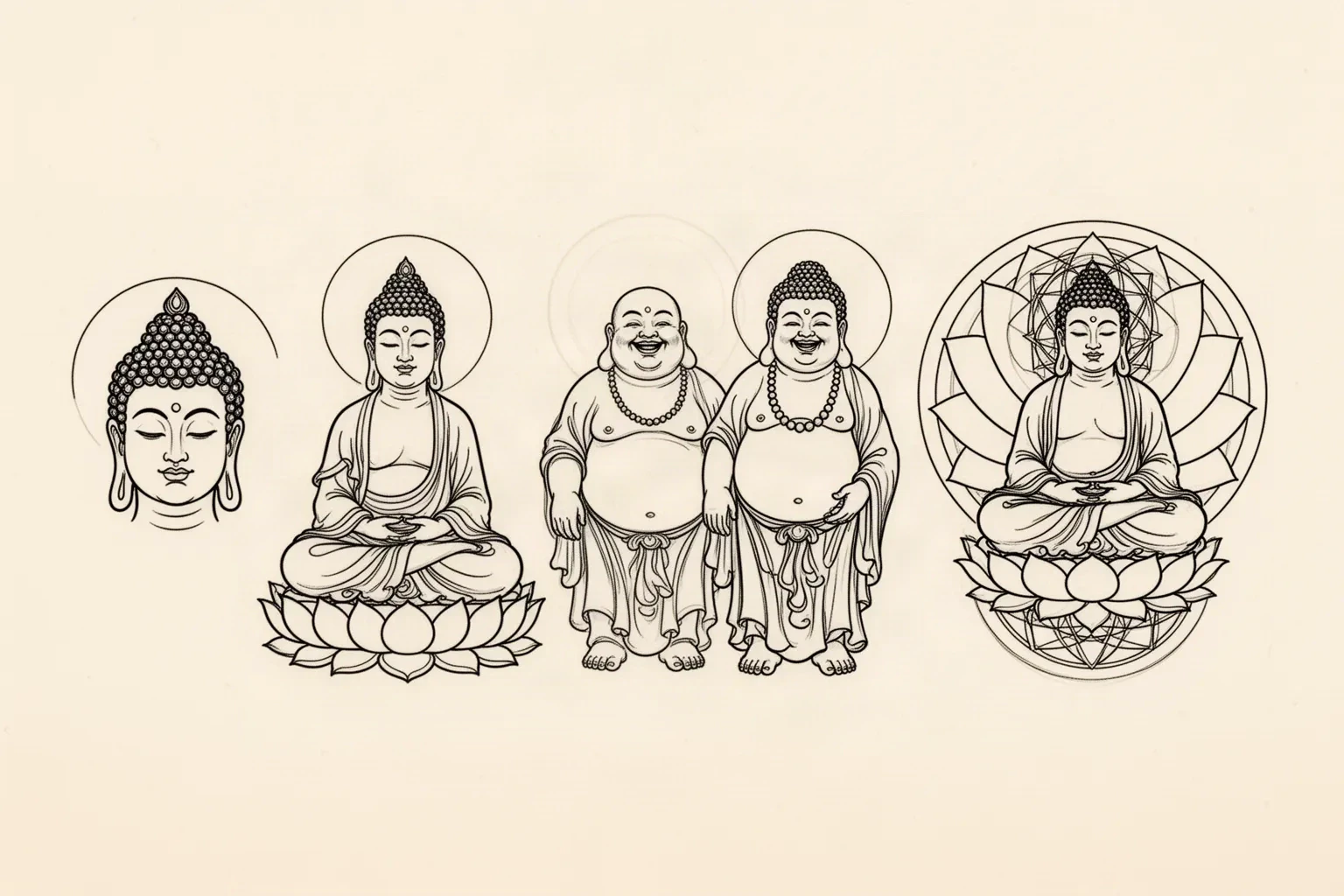
Synthetic ink line study of Buddha stencil construction families: a head-only portrait with detached halo arc, a seated meditating figure on a lotus base, laughing Hotei figures with bead necklace and exposed belly, and a seated figure inside a lotus petal and mandala ring, with open skin held between halo and head, fingers, robe folds, and petal tips.
Synthetic line-art study, not app output or client work. Compare construction families by silhouette mass, halo separation, finger and fold channels, and petal spacing before judging a real reference at its stated height.

HOLDS AT STATED SIZE

Meditating Buddha on lotus at 14 cm

Intended height 140 mm

Source
Full seated figure in meditation posture on a lotus base, hands in a resting gesture, closed eyes, ushnisha crown, elongated earlobes, and a plain halo ring. Calm on screen with layered lotus petals and several robe folds across the lap.
Protect
Serene face spacing with closed lids, ushnisha silhouette and urna position, earlobe drops clear of jaw, hand gesture with one clear separation, and the outer lotus silhouette.
Fix
Keep two or three long robe folds with open skin between them, merge the shortest inner lap folds first, and hold every lotus petal tip clear of its neighbor at 1:1. Do not thin the face to rescue petal crowding.
Candidate stencil
Same Buddha with serene face placement set, ushnisha and earlobe anchors held, halo separation kept, and protected contours held at transferable mass.
Final-size verdict
Holds at 14 cm once every finger, fold, and petal gap reads as open skin at true size. Serenity comes from the face, recognition from ushnisha and earlobes, and reverence from the upright seated posture on the lotus.

SIMPLIFY BELLY AND FOLDS FIRST

Laughing Hotei figure at 12 cm

Intended height 120 mm

Source
Rounded standing or seated Hotei with broad smile, large belly, exposed chest, bead necklace, and loose robe over the shoulders. Friendly on screen with many small fold breaks around belly, armpits, and sleeves.
Protect
Smile position with open skin around mouth, eye spacing above the cheeks, belly outline as one smooth mass, bead necklace path, and the two longest robe masses over the shoulders.
Fix
Merge short belly-side folds into one smooth curve first, keep one bead rhythm with open skin between beads, and hold sleeve folds clear of the hands at 1:1. Do not keep full wrinkle count plus fine bead detail at this height.
Candidate stencil
Same Buddha with serene face placement set, ushnisha and earlobe anchors held, halo separation kept, and protected contours held at transferable mass.
Final-size verdict
Not stencil-ready until fold count drops. Small creases around the belly and armpits merge first while the smile, belly mass, beads, and lead robe masses can stay.

HOLDS AT STATED SIZE

Head-only serene Buddha at 9 cm

Intended height 90 mm

Source
Head and upper neck only with closed eyes, calm mouth, urna mark, ushnisha crown, snail-curl hair rhythm, and elongated earlobes. Compact on screen with a thin halo arc close to the head edge.
Protect
Closed-lid spacing and brow line, nose hint with open skin on both sides, mouth position, urna dot clear of brows, earlobe drops, and the ushnisha silhouette.
Fix
Hold the halo arc clear of hair and ushnisha with one continuous open channel, merge the smallest inner curls into directional hair masses, and confirm the urna reads as its own dot at 1:1. Do not add rays, beads, or lettering at this height.
Candidate stencil
Same Buddha with serene face placement set, ushnisha and earlobe anchors held, halo separation kept, and protected contours held at transferable mass.
Final-size verdict
Holds at 9 cm as a tight head recrop once the halo gap and urna separation stay countable at true size. Recognition comes from lids, urna, earlobes, and ushnisha, not from added background.

ENLARGE OR RECROP

Lotus and mandala composition forced to 6 cm

Intended height 60 mm

Source
Seated Buddha centered inside layered lotus petals with a geometric mandala ring, dot bands, and fine petal repeats. Attractive symmetry on screen with hairline separations between figure, petals, and mandala geometry.
Protect
The seated axis with head position and the outer mandala circle that carries the composition.
Fix
Enlarge past the point where face gaps, halo separation, hand channels, and one petal rhythm each transfer as open skin, or recrop to the head with one lotus edge for this height. Do not keep the full mandala plus fine dot bands at 6 cm.
Candidate stencil
Same Buddha with serene face placement set, ushnisha and earlobe anchors held, halo separation kept, and protected contours held at transferable mass.
Final-size verdict
At 6 cm the mandala functions as one textured band and dot rows print as broken scratches. Enlarge, recrop to the head, or choose a simpler meditating or head-only construction for this height.

Broad subject browsing stays on the subjects owner. Generic portrait and figure recognition stays on the people owner. Photo conversion, board organization, quality checks, grid overlay, and session sheets stay on their tool owners, and Jesus beard, Sacred Heart, and crown construction stays on the Jesus owner. This framework exists to judge Buddha face, ushnisha, urna, earlobe, halo, mudra, and fold gaps at a stated height, not to replace those owners.

Face, anchors, hands, and base at final size

Judge the white space at the height you will print.

Screens forgive crowding that paper and skin do not. Set the height first, then inspect each feature below at true physical size with scaling off.

About 8 cm and below

Small upper-arm accents and compact shoulder pieces.

Carry one head-only recrop or one tight meditating head with plain hair masses. Keep one face cluster, one halo gap or none, and no hands, full lotus beds, mandala rings, or beads. If the urna dot or halo gap closes at 1:1, enlarge or reselect rather than forcing reduction.

About 10 to 15 cm

Common outer forearm, calf, shoulder, chest, and thigh Buddha pieces.

The most flexible band. A meditating figure on lotus, a simplified Hotei, or a head-only with halo can work when every face gap, halo separation, finger channel, and fold channel is verified at true size. Check mudra hands and robe folds before approving lotus or bead detail.

About 15 cm and above

Upper back, large thigh, chest, and full back devotional compositions.

Room for a meditating figure with full lotus base or a lotus and mandala composition, but only when open skin separates every finger, fold, petal, and mandala repeat from edge to edge. Larger height does not rescue a merged serene face, a touching halo, or filled finger channels.

Buddha feature checks by height band
FeatureAbout 8 cm and belowAbout 10 cm and above
Closed eyes, nose hint, and mouthCarry brows, closed lids, one nose hint, and mouth maximum, with visible skin between them. Shaded cheeks, deep wrinkles, and lip texture merge first at small heights.Soft modeling can work when each mark keeps its own spacing at 1:1. Check the full face with a squint test at true size.
Ushnisha, urna, earlobes, and haloKeep the ushnisha silhouette, one urna dot, and earlobe drops, with the halo simplified or omitted. Every kept gap must read as open skin at 1:1. If the halo touches hair or crown, widen the gap or remove the halo.A full hair rhythm plus a halo ring can work when each separation stays countable at 1:1. Keep the halo clear of the head, ushnisha, and shoulder edges.
Mudra hands and robe foldsKeep one hand gesture maximum with open finger channels, or omit hands in favor of the head. Small beads and cuff folds merge first.Full meditation or earth-witness hands and ranked robe folds can work when each finger and each fold keeps its own separation at true size.
Lotus base and mandala repeatsKeep one lotus edge or omit the base entirely. Mandala rings, dot bands, and petal repeats merge first and should wait for larger heights.A ranked lotus bed with one mandala ring can work when every petal tip and geometric repeat keeps open skin between neighbors at 1:1.

Reference to clean stencil

Build from the serene face outward, then protect the gaps.

Work in this order so one change at a time can be judged at the same height. Stop when the face, anchors, halo, hands, and base each read correctly.

  1. 01

    Lock height, placement, and intent first

    Set the intended physical height in millimeters, name the body area, and name the intent in one line: meditating calm, Hotei warmth, head-only serenity, or lotus/mandala devotion. A meditating figure that holds at 15 cm on an upper back can fail at 7 cm on a wrist with no line being wrong on its own. Discuss placement respectfully with the client before locking, keeping the figure above the waist and upright. Use the size calculator when target dimensions are still open.

  2. 02

    Verify variant and reverent composition

    Confirm the variant fits the intent and the available height, then rank the composition: serene face first, head anchors and halo second, hands and robe third, lotus and mandala last. Keep the head upright or gently inclined, the gaze lowered or closed, and the gesture readable. Confirm the client understands the respectful handling of the image, including orientation and coverability in temples and Buddhist countries.

  3. 03

    Set face-versus-halo-versus-hand roles

    Assign every mark a role: lead structure that carries recognition, support that shapes reverence, and texture that can be removed. Strengthen closed-lid placement, nose hint, ushnisha silhouette, and the outer head contour first, keep halo structure and mudra gesture second, and mark one removable fold group, inner petal row, or bead repeat that can go if gaps close.

  4. 04

    Simplify curls, petals, and fingers at 1:1

    Reduce curl count, petal and mandala repeats, and finger detail before thinning contours. Keep open skin between hair masses, between halo and head, between fingers, between robe folds, and between petals, then run a squint check: step back until fine marks disappear and confirm the face, crown, and gesture still read. The line-weight guide covers fine, normal and bold behavior on the same stencil.

  5. 05

    Verify print and transfer path

    Export a true-size PDF with no fit-to-page scaling, inspect the narrowest halo gap, the tightest finger channel, the urna separation, and the smallest petal gap on plain paper, then measure the physical print with a ruler. If the digital file passes and only paper fails, move to print-stage evidence instead of simplifying again.

Placement and composition decisions

Reverent figures want flat skin that preserves calm and symmetry

A Buddha piece is an upright devotional composition with a strict face axis and a placement boundary. Flat upper-body placements preserve it with little compensation, while narrow limbs demand a head-only recrop.

Upper back and shoulder blade

Broad flat field where a meditating figure on lotus or a head with halo can breathe. The spine centerline becomes part of the design, so any face asymmetry is immediately visible. A reverent and highly visible choice that keeps the figure upright and above the waist.

Check: Center the face and lotus base on the flattest span, hold the halo clear of the head edge, and verify finger and petal spacing at 1:1 before print.

Chest and upper arm

Large devotional panels with room for meditating and Hotei compositions. Clothing friction and the body midline affect symmetry on the chest, while the upper-arm curve suits a seated figure following the limb axis.

Check: Mirror lid placement and earlobe drops against the midline on the chest, align the seated axis with the limb on the arm, and confirm hand and fold clearance at true size.

Outer forearm and calf

Long narrow fields where a vertical meditating figure or head-only recrop follows the limb axis well. Wide mandala fans and broad lotus beds wrap fast and crowd separations here.

Check: Choose a head-only or a vertical meditating recrop for these fields, shorten cross-limb petal spreads, and verify halo and finger gaps at 1:1 while edits are still cheap.

Respectful placement boundary

Many Buddhists experience images below the waist, on the feet and ankles, or in positions that sit, press, or distort the figure as disrespectful, and travelers report real offense in Theravada countries. Placement below the waist is the most common failure point for an otherwise clean Buddha stencil.

Check: Keep the figure above the waist, upright rather than tilted or inverted, and coverable where temple visits matter. When a client requests a lower placement, pause and discuss a different motif or an upper-body alternative before preparing the transfer.

Stencil-ready checklist

Approve the Buddha only when every line passes

Run this short sequence with scaling off and a ruler in hand. One failed line means fix, enlarge, or reselect before transfer.

  • Confirm intended height in millimeters, the named placement above the waist, and the variant intent.
  • Confirm brows, closed lids, one nose hint, and mouth read as one serene face with open skin between marks.
  • Confirm ushnisha silhouette, urna dot, earlobe drops, and hair rhythm each read separately with no merged bands at 1:1.
  • Confirm the halo ring holds one continuous open channel clear of hair, crown, and shoulders, where a halo is present.
  • Confirm every finger channel, robe-fold channel, petal gap, and mandala separation reads as open skin at true size.
  • Export a true-size PDF with scaling off and measure the physical print.
Serene recognition first Verify gaps at 1:1 Reverent composition held

FAQ

Buddha stencil decisions, answered

Short answers for the variant, face, gap, and placement checks that recur when a Buddha reference moves toward transfer-ready output.

This page recommends matching the variant to intent and available height. A meditating seated figure on lotus suits calm and awakening pieces with room for posture, hands, and base. A laughing Hotei suits warmth and abundance pieces where the smile and belly carry the read. A head-only serene portrait suits compact placements where only lids, urna, earlobes, and ushnisha can survive. A lotus and mandala composition needs the largest height of all and should be recropped to the head when room is short.

Next steps

Use the neighboring owners for adjacent jobs.

This guide covers Buddha variant checks, height-tied face and anchor density plus halo, mudra, fold, and petal gap rules, reverent placement-size decisions, and reference-to-stencil preparation. Use the links below for related jobs such as sizing, print checks, paper, and placement.

Broad subject browsing, generic portrait and figure vetting, Jesus beard and crown construction, generic conversion, broad gallery browsing, paper manufacturing detail, and placement mechanics stay in their specialist owners. The links above hand off instead of repeating that detail.

From evaluated reference to working stencil

Turn the approved Buddha into a stencil draft.

Start from the Buddha that passed the face, anchor, and gap checks, then continue on iPhone for body fit, exact-size print, mirror and professional export.