

Tale stencil evaluation

Keep the tale readable, prove it transfers

Tale pieces live or die on variant choice and open gaps. Vet which beast, heroine, and enchanted-rose anchors actually read at size, resolve dome and falling-petal spacing, decide character-plus-rose dominance, then prepare a stencil that transfers as one clean composition at final size.

Built for working artists handling client-requested tale pieces. This page covers variant vetting and transfer preparation only, not tattoo application or healing advice. Work from an original stencil-safe interpretation or a properly licensed reference. No franchise artwork is reproduced on this page. Dome, pairing, and accent constructions are judged as different options inside one tale-first framework.

What makes a tale stencil viable

Anchors, dome separation, and dominance decide the result.

A tale reference tempts artists to keep every prop, castle line, and script banner. These three pillars predict whether that combination survives reduction, print, and transfer.

Variant recognition anchors

A tale piece reads through a small set of anchors, not through a full scene. Common variants include a horned beast profile, a book-reading heroine figure, an enchanted rose under a glass dome, a castle silhouette, and small prop marks such as a candlestick, a teacup, or falling petals. A stencil succeeds when one or two anchors carry the read and every other mark ranks as support. References that need five labeled props to explain themselves lose the tale read at transfer size.

Check: Cover all props, lettering, and background. If the remaining one or two shapes still suggest the tale from two meters, the anchors are sound. If the read disappears, strengthen the anchors before touching line weight.
Dome and petal separation

The enchanted rose fails first at the glass dome outline and at petal-to-petal gaps. Dome walls drawn as doubled hairlines bridge into one grey band on transfer, and falling petals parked too close to the dome base or to each other merge into a single blob. A transfer-ready construction keeps one continuous dome outline, open glass channels between the rose and the dome wall, and countable petals with open skin between each.

Check: Trace the dome rim from base to base without lifting focus, then count every petal inside and below the dome. Each shape needs its own open channel at the target size. If two petals or the rose and the dome wall share one edge at 1:1, reopen the gap, drop a petal, or enlarge before print.

Dominance and pairing discipline

Character-plus-rose compositions fail when the beast profile, the heroine figure, the rose dome, and the castle all compete at equal weight. The stencil needs one declared dominant, usually the rose dome for small placements or the character pairing for larger panels, with everything else stepped down in size and line mass. Castle outlines, candlesticks, teacups, and script banners work only as single subordinate accents with clear standoff.

Check: Name the dominant at the stated size and point to it first. Cover the dominant; the support should go quiet, not take over. If removing the supposed support changes the read more than removing the dominant, the hierarchy is inverted.

Tale evaluation framework

Score the reference in minutes, then act on the weakest check.

Four tale constructions at labeled sizes. Each one names the protected structure, the fix, and the go or no-go verdict at that exact size. Confirm with a measured 1:1 print.

HOLDS AT STATED SIZE

Rose-dome dominant piece at 10 cm

Intended height 100 mm

Source pattern: Upright rose under a simple bell-dome outline on a small base, three open inner petals, a short stem, and two falling petals parked below the dome. One sparse leaf pair maximum. Illustrative construction with continuous contours and open skin between the rose, the dome wall, and each falling petal.

Protect
The single dome outline and base line, the rose head position centered under the dome, open channels between every petal, and standoff between falling petals and the dome base.
Fix
Widen only the narrowest petal channel if it closes at 1:1. Keep petal count, dome shape, and falling-petal positions unchanged.
Candidate stencil
Same tale construction with the dominant locked, dome reduced to one wall, petals ranked to countable shapes, accents reduced to one subordinate mark, and protected contours held at transferable mass.
Final-size verdict
Holds at 10 cm once every channel and both falling-petal gaps verify open on a measured print. The strongest choice for small placements where the tale must read without any character face.

REOPEN DOME AND PETAL GAPS

Dome with crowded petals and doubled glass at 9 cm

Intended height 90 mm

Source pattern: Rose-dome reference with a doubled dome wall, five tightly packed inner petals, three falling petals touching the base line, and fine thorn ticks along the stem. Strong on screen, but the doubled glass and the petal-to-base contacts share edges at transfer size.

Protect
Dome position and base placement, rose head direction, and the two widest falling-petal gaps that set the composition rhythm.
Fix
Reduce the dome to one wall with one consistent outline weight, cut inner petals to three countable shapes with open skin between each, park falling petals clear of the base line, and remove thorn ticks that sit closer than one outline-width to the stem.
Candidate stencil
Same tale construction with the dominant locked, dome reduced to one wall, petals ranked to countable shapes, accents reduced to one subordinate mark, and protected contours held at transferable mass.
Final-size verdict
Holds at 9 cm once the dome is single-wall and every petal keeps daylight at 1:1. Doubled glass plus petal-to-base contact is the most common transfer failure for this motif.

SET DOMINANCE BEFORE PRINT

Character pairing with rose dome and castle at 14 cm

Intended height 140 mm

Source pattern: Horned profile beside a heroine figure with a book, a rose dome between them, a small castle silhouette above, plus a candlestick, a teacup, and a script banner. Convincing as illustration, but four masses compete at equal weight and the banner touches the dome wall on one side.

Protect
The two face directions and the dome position that anchor the tale read, plus the castle silhouette as the single background accent.
Fix
Declare one dominant: enlarge the pairing and shrink the dome plus castle to support, or invert and make the dome dominant with the pairing reduced. Keep one prop maximum, move the banner fully clear of the dome, and remove the second prop or merge it into open skin.
Candidate stencil
Same tale construction with the dominant locked, dome reduced to one wall, petals ranked to countable shapes, accents reduced to one subordinate mark, and protected contours held at transferable mass.
Final-size verdict
Not stencil-ready until one mass clearly leads and every accent stands off at 1:1. Equal-weight character, rose, castle, and prop bands merge into one pocket on transfer.

ENLARGE OR RECROP

Fine-line small dome with hairline glass at 5 cm

Intended height 50 mm

Source pattern: Delicate dome-only construction with hairline glass walls, fine inner-petal tracery, tiny falling-petal dots, and a thin base line, drawn with almost no line mass. Attractive on screen but built from hairlines with narrow separations throughout.

Protect
Dome position and the rose head placement that give the motif its direction.
Fix
Enlarge past the point where the dome wall, three inner petals, and one falling petal each transfer as open shapes, or recrop to a simplified rose emblem without the dome. Do not keep hairline glass plus petal tracery together at 5 cm.
Candidate stencil
Same tale construction with the dominant locked, dome reduced to one wall, petals ranked to countable shapes, accents reduced to one subordinate mark, and protected contours held at transferable mass.
Final-size verdict
At 5 cm the glass and petal tracery print as broken scratches and the petals read as one band. Enlarge, recrop to rose plus one falling petal, or choose a bolder emblem construction for this height.
Rose-dome dominant vs pairing vs pairing-with-accent decision
ChoiceChoose whenStrengthsCosts
Rose-dome dominantSmall to medium placements, first tale pieces, or symmetric panels where instant recognition matters without faces.Simplest construction, gaps are geometric and easy to verify, holds smallest, heals most predictably.Less character story than a pairing, needs clean dome spacing, weak glass reads as a generic flower cloche.
Character pairing dominantMedium to large placements where the client wants the figures, not only the symbol.Strong likeness context, supports book and horn anchors, scales into medium compositions.Needs more height, fails first at face-to-prop contacts, facial detail must convert to ranked outlines.
Pairing with dome plus one accentLarge placements where the full tale around the figures is the point and accents can spread.Strong panel anchor, room for one castle or one small prop, works as a thigh or back centerpiece.Needs the largest height, banner and prop edges fail first, every accent gap must be verified at 1:1.

Generic cartoon bold-outline conversion stays on the cartoon owner. Solid-fill rose execution stays on the black-rose page. Six-direction rose composition comparison stays on the rose collection. Generic paper, printer, and removal depth stays on the print and transfer guides. This framework exists to judge tale variant anchors, dome and petal separation, and character-plus-rose dominance at a stated size, not to replace those owners.

Dome, petals, and accents at final size

Judge the white space at the size you will print.

Screens forgive crowding that paper and skin do not. Set the size first, then inspect each feature below at true physical size with scaling off.

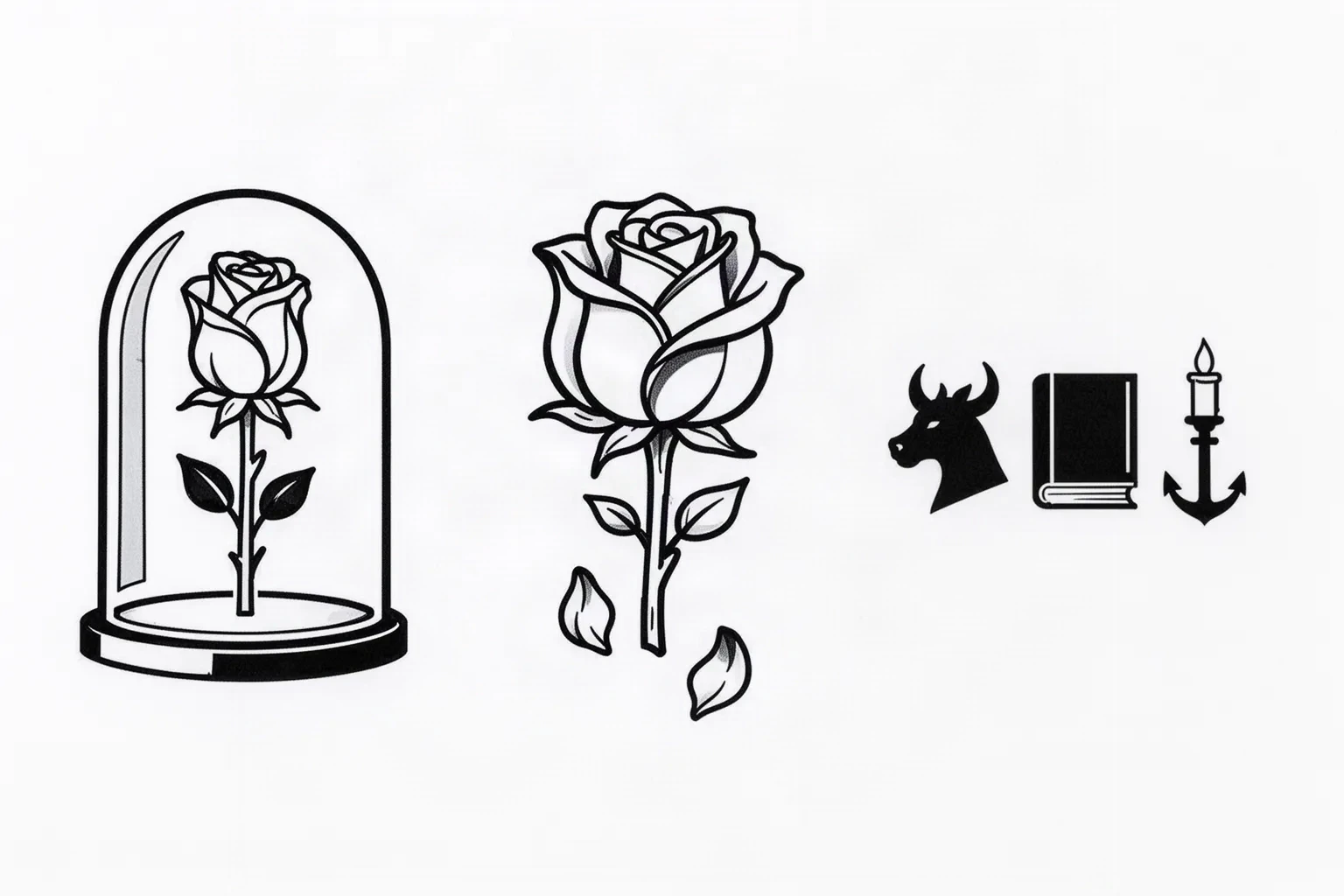
Black line-art construction plate showing a rose under a single bell dome outline with an open gap at the base, a compact rose with separated petals and two falling petals held clear below, and an anchor strip of a horned profile, a book, and a small prop mark at wide spacing.
Illustrative construction plate, not a measurement template and not app output. From left: a rose held inside one continuous dome contour with an open channel to the glass and an open base line; a compact rose with countable petals plus two falling petals parked clear of the base and of each other; and an anchor strip where a horned profile, a book, and a single prop mark stay countable with wide standoff. Use it to compare shapes, then verify the real gaps on your own measured 1:1 print.

About 6 cm and below

Wrist and ankle accents, behind-ear marks, finger panels, and small gap fillers.

Carry a rose emblem or a single-anchor recrop only: a simplified rose head with one falling petal, or one horn-and-book pairing without a dome. Keep one contour family and three countable shapes maximum. If a petal gap or a dome wall closes at 1:1, enlarge or reselect rather than forcing glass, tracery, or props.

About 8 to 12 cm

Common forearm, calf, shoulder, and collarbone tale pieces.

The most flexible band. A rose dome with two falling petals, or a compact character pairing with one dome accent, can work when every gap is verified at true size. Check dome-wall continuity, petal channels, falling-petal standoff, and prop clearance before approving castle or banner accents.

About 14 cm and above

Large thigh panels, back pieces, chest, and full sleeve sections.

Room for a character pairing with a rose dome and one castle or prop accent, but only when open skin separates the pairing, each dome edge, and every accent outline at 1:1. Larger height never rescues merged petal tracery, joined banner edges, or a doubled dome wall.

Tale feature checks by size band
FeatureAbout 6 cm and belowAbout 8 cm and above
Dome wall and baseKeep one continuous dome outline at transferable mass with an open base line. If the wall breaks or the base bridges to a petal, enlarge the piece rather than thinning the wall into a scratch.Same priority. Larger heights allow a slightly finer wall, but separability still beats uniform thinness. Confirm the dome wall holds unbroken on the physical print.
Rose petals and falling petalsCarry three countable inner petals maximum plus one falling petal with open skin on all sides. Remove petal tracery, extra buds, and thorn ticks at small widths.Up to five ranked petals plus two falling petals can work when each keeps open skin to its neighbors and to the dome wall at 1:1. Petal detail should never join the dome base or a neighboring petal.
Character anchors and propsKeep one anchor pair maximum, such as horns plus a book shape, with no castle, candlestick, teacup, or banner. A second prop at this width merges with the anchor field first.One castle silhouette or one small prop can join when its outlines stay lighter than the dominant and open skin separates every anchor edge to edge. Equal-weight prop bands need hierarchy work before print.
Lettering and bannersAvoid script banners and tale quotations. Letterforms close fastest and compete directly with petal gaps for the same room.One short banner can join a large panel when it stands fully clear of the dome wall and every letter keeps open counters at 1:1. If the banner touches glass, move it or drop it before changing petal detail.

Reference to clean stencil

Build from the dominant outward, then rank the accents.

Work in this order so one change at a time can be judged at the same size. Stop when variant, dome, dominance, and transfer path each read correctly.

  1. 01

    Lock variant, size, and placement first

    Name the construction (rose-dome dominant, character pairing, or pairing with one accent), set the intended physical height in millimeters, and name the body area before judging the reference. A dome that holds at 10 cm on a forearm and a pairing composition that needs 14 cm on a thigh are different decisions. Use the size calculator when target dimensions are still open.

  2. 02

    Assign the recognition carrier

    Decide which shape carries the read, then rank everything else as support. Protect the carrier geometry first: dome outline and petal channels for rose-led work, or horn and book placement for pairing-led work. Resolve dome-to-petal contacts, petal-to-base contacts, and prop-to-anchor contacts before touching line weight.

  3. 03

    Set dominant versus support roles

    Give every mark one role: dominant structure that carries the first read, support that shapes the silhouette, or accent that can be removed. Strengthen the dome wall or the pairing outlines first, keep castle and prop marks lighter, and mark one removable accent, banner segment, or petal that can go if gaps close.

  4. 04

    Simplify at 1:1 and run the gap checks

    Reduce petal tracery, doubled glass, banner detail, and extra props before thinning contours. Keep open skin between the rose and the dome wall, inside each petal channel, around each falling petal, and at both ends of any banner. Run a squint check: step back until fine detail disappears and confirm the dominant plus its gaps still read. The line-weight and density guides cover fine versus bold behavior on the same stencil.

  5. 05

    Verify print and transfer path

    Export a true-size PDF with no fit-to-page scaling, inspect the narrowest petal channel, the dome wall, and the smallest accent gap on plain paper, then measure the physical print with a ruler. If the digital file passes and only paper fails, move to print-stage evidence instead of simplifying again.

Placement and construction decisions

Domes want axis, pairings and accents want width

Rose domes want a clear vertical axis that survives curvature, while character pairings and castle accents want centered panels that preserve symmetry. Narrow limbs demand a vertical crop.

Thigh and back

Broad flat fields where a pairing with a dome and one accent can spread symmetrically. Width is the asset, so pairing-to-dome and accent spacing needs verification rather than compression.

Check: Center the dominant on the flattest span, mirror the support masses, and verify pairing-to-dome spacing at 1:1 before print.

Outer forearm and calf

Long narrow fields where the composition should follow the limb axis. Wide pairings and side-mounted castles wrap fast and crowd petal and anchor gaps.

Check: Choose a vertical dome or a slim pairing for these fields, align the dome axis with the limb, and shorten cross-limb accents while edits are still cheap.

Chest and shoulder

Large curved panels with room for a pairing or a dome with one accent. The curve compresses one side of wide compositions in photos and transfers.

Check: Center the dominant on the flattest span, let support fall toward the slope, and keep accents to one castle or one small prop maximum.

Wrist, ankle, hand, and behind ear

Small wrapped fields where only a recrop survives. Domes with tracery, pairings with props, castles, and banners forced into these bands merge first.

Check: Recrop to a simplified rose emblem or a single-anchor mark without a dome, then run the small-size checks at the exact height.

Stencil-ready checklist

Approve the tale piece only when every line passes

Run this short sequence with scaling off and a ruler in hand. One failed line means fix, enlarge, or reselect before transfer.

  • Confirm intended height in millimeters, the named placement, and the dome, pairing, or pairing-with-accent construction choice.
  • Confirm the dome wall stays continuous with open skin between the rose and the glass at 1:1.
  • Confirm every petal reads separately with open skin around it, including falling petals.
  • Confirm one dominant clearly leads with support and accents ranked below it.
  • Confirm props, castle, and banner shapes stay countable with no contact on the dominant.
  • Export a true-size PDF with scaling off and measure the physical print.
One dominant leads Verify gaps at 1:1 Accents stay subordinate

FAQ

Tale stencil decisions, answered

Short answers for the variant, dome, size, original-art, placement, and step checks that recur when a tale reference moves toward transfer-ready output.

Protect one or two anchors at the exact physical size: the rose-under-dome shape with open glass channels, or the horn-and-book pairing that signals the two figures. Cover the castle, candlestick, teacup, and lettering on your reference; if the remaining dominant still suggests the tale from two meters, the anchors hold. If the read becomes a generic rose or a generic couple, repair anchor placement and gap clearance before adding any accent back.

Next steps

Use the neighboring owners for adjacent jobs.

This guide covers tale variant checks, dome and petal gap rules, character-plus-rose dominance, and reference-to-stencil preparation. Use the links below for related jobs such as conversion, sizing, print checks, paper, and placement.

Generic cartoon conversion mechanics, solid-fill rose technique, realistic petal rendering, paper manufacturing detail, and placement mechanics stay in their specialist owners. The links above hand off instead of repeating that detail.

From evaluated reference to working stencil

Turn the approved tale piece into a stencil draft.

Start from the variant that passed the anchor, dome, and gap checks, then continue on iPhone for body fit, exact-size print, mirror and professional export.