

Tulip variant chooser

Pick the tulip variant that holds at your size

Bud sprigs, single partial-cup stems, open cup focals, paired tulips, triple clusters, and minimal sprigs fail in different places on skin. Compare the six variants below on cup stage, overlap gaps, and stem-leaf load, then prep one transfer-ready stencil.

Built for working artists choosing between tulip directions. This page compares the six variants with comparative final-size checks. Full single-reference scoring stays on the base tulip stencil page, and print execution stays with the transfer owners.

Tulip variant map

Six variants, six different size contracts.

Choose from variant construction and intent first. Each card names the build, where it fits, what to protect, and which failure to expect at true size.

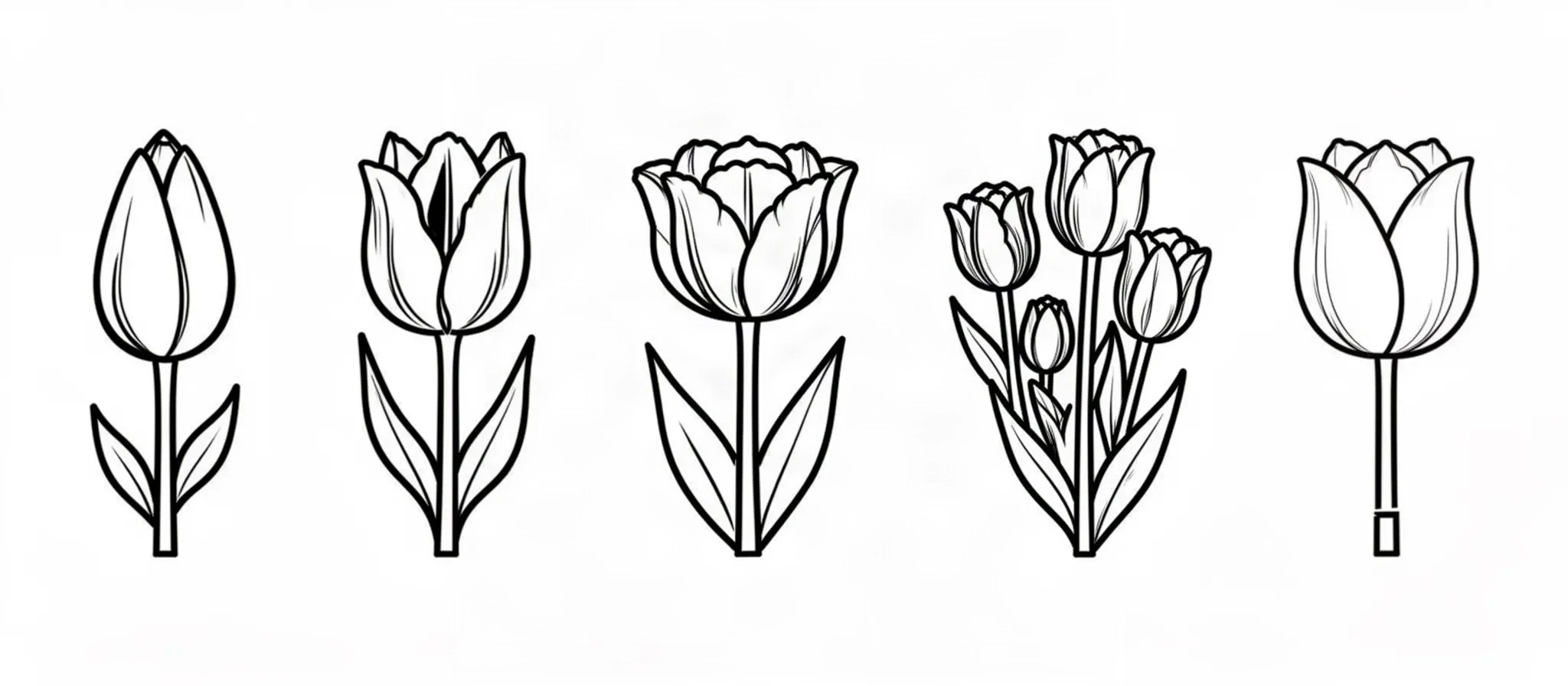
Original stencil linework strip of five tulip constructions in a row: a tight closed bud on a short stem with one small leaf, a single upright partial cup with two petal ranks and an open mouth, a full open cup with three staggered ranks and two leaves, a staggered multi-bloom group with blooms at different heights on separate stems, and a minimal single-contour cup recrop with a plain stem stub.
Five constructions in one linework strip: closed bud sprig, partial-cup stem, open-cup focal, a staggered multi-bloom group, and a minimal outline recrop. Paired tulips use the same height stagger with two stems, and the triple cluster uses the same discipline with three blooms and one base. Original illustration, not a specific tattoo result: confirm every overlap gap on your own 1:1 print.

Tight bud sprig

One closed teardrop bud on a short straight stem with at most one small leaf. The narrowest tulip construction and the only one built for small wrapped fields.

Best at 5 cm and below on wrist, ankle, behind ear, and finger-adjacent accents.

Keep: Keep the pointed tip, one sepal separation, and the stem centerline. The separation is the whole read.

Fails when: Fails when the bud closes into a solid almond at 1:1. Reopen one separation instead of adding interior detail.
Single partial-cup stem

One upright partial cup with two visible petal ranks and an open mouth, on a straight stem with one subordinate leaf. The classic tulip stencil and the most requested variant.

Best at 6 to 10 cm on forearm, collarbone dip, shoulder front, calf, and small sternum pieces.

Keep: Keep the cup mouth opening, the front-to-back rank assignment of every petal, and the stem path with its leaf attachment.

Fails when: Fails when the mouth closes and the partial cup collapses into a bud with extra lines. Protect the mouth before touching any other line.

Full open cup focal

One wide upright bowl with three staggered petal ranks spreading from a visible heart. The most demanding variant because every rank competes for the same skin.

Best at 10 cm and above on thigh, upper back, shoulder cap, and side-torso panels.

Keep: Keep the outer-rank silhouette, the heart position as rebuild anchor, and every inner-rank separation open at true size.

Fails when: Fails when inner-rank petals share edges near the heart and the center prints as one dark pocket. Remove or merge the weakest inner petal first.

Paired tulips

Two stems carrying two cups at clearly staggered heights, usually one partial cup with one bud or a smaller second cup. A composition variant, not a bigger single flower.

Best at 9 cm and above on forearm, calf, and shoulder panels where two vertical reads fit side by side.

Keep: Keep a clear height stagger between the two blooms, open skin between the cups, and two stem paths that never cross into one join.

Fails when: Fails when both blooms sit at equal height and touch, or when two leaves clasp both stems at the same point. Restagger or remove the weaker bloom first.

Triple cluster bouquet

Three blooms of mixed stages sharing one stem base with restrained leaves. The densest tulip variant and the hardest to keep transfer-readable.

Best at 12 cm and above on thigh, upper back, and side-torso panels with room for a lead cup plus two subordinates.

Keep: Keep one lead cup dominant, two subordinate blooms smaller and clearly separated, and a single readable stem mass at the base.

Fails when: Fails when three equal-weight blooms crowd one field and triple stem joins print as one blob. Demote two blooms before thinning any contour.

Minimal outline sprig

Fine-line single-contour recrop of one cup or bud with a stem stub and no fill, no vein nets, and no second leaf. Built for fields where a full variant cannot fit.

Best as a recrop at 5 cm and below, or as a gap filler beside larger work.

Keep: Keep one contour family, at most one mouth or sepal gap, and the stem direction. Hierarchy comes from what was removed.

Fails when: Fails when full rank detail is kept at a small height and every overlap prints as one filled cup. Recrop to fewer ranks rather than thinning lines further.

Tulip variant cup load, gap load, stem-leaf load, size, and placement trade-offs
VariantCup-stage loadGap loadStem-leaf loadMinimum heightPlacement
Tight bud sprigClosed bud, no interior ranks to separate.One sepal separation to protect.Stem stub plus at most one small leaf.Holds at 4 to 5 cm.Wrist, ankle, behind ear.
Single partial-cup stemTwo ranks with an open mouth.Mouth plus rank separations at true size.One stem plus one subordinate leaf.Needs 6 cm and above.Forearm, collarbone, calf.
Full open cup focalThree staggered ranks around a heart.Strictest: every inner separation must stay open.Full stem run with up to two leaves.Needs 10 cm and above.Thigh, upper back, shoulder cap.
Paired tulipsTwo stages chosen independently, then staggered.Bloom-to-bloom clearance plus each cup mouth.Two stem paths that never share one join.Needs 9 cm and above.Forearm, calf, shoulder panels.
Triple cluster bouquetLead cup plus two subordinate stages.Three mouths plus bloom-to-bloom skin.Single base mass, leaves subordinate to all blooms.Needs 12 cm and above.Thigh, upper back, side torso.
Minimal outline sprigRecropped single stage, fewest ranks.One protected gap only.Stem stub, second leaf removed.Recrop fits 5 cm and below.Gap filler, small accents.

Once the variant is set, run the full single-reference scoring on the base tulip stencil page. That sibling vets one chosen reference at a stated size, while the choice between variants happens here.

Bud-to-open cup decision

Choose the stage that fits the skin, not the prettiest picture.

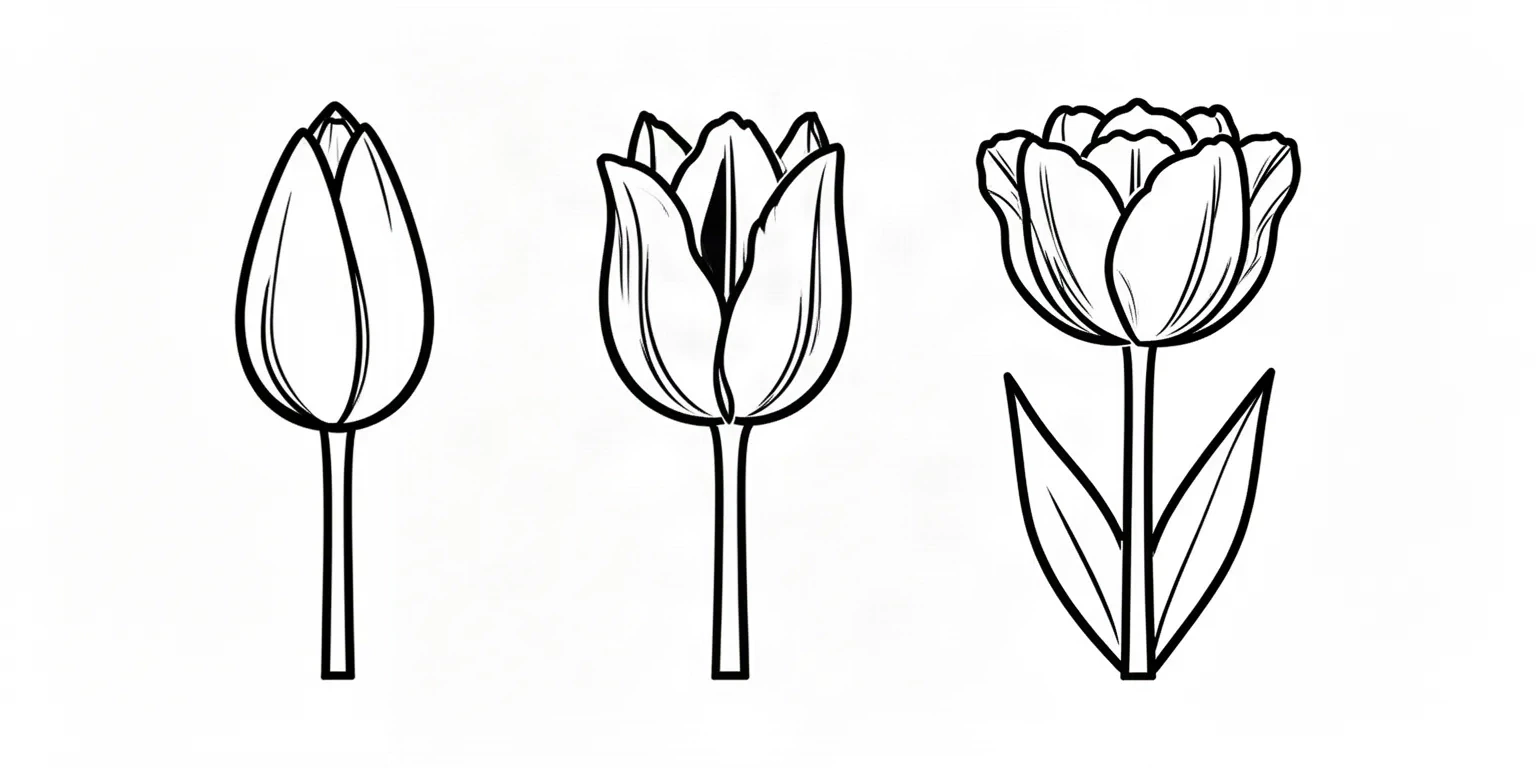
Three tulip stages with different footprints and different stencil costs. Match the stage to the placement height first, then pick the variant that carries it.

Original stencil linework illustration of three upright tulip stages in a row: a tall closed bud, a partial cup with two petal ranks and an open mouth, and a full open cup with staggered ranks above a straight stem and two lance leaves, with open gaps between neighboring petals.
Bud, partial cup, and full open cup drawn as clean stencil linework with open skin between neighboring petals, plus one simplified upright stem and two leaves. Original illustration, not a specific tattoo result: confirm every gap on your own 1:1 print.

Tight bud

Bud sprig and minimal outline sprig. Second bloom inside paired and cluster variants.

Lowest line count and narrowest footprint. Risk is blandness: a bud with no separation reads as a leaf or flame tip at transfer size.

Holds from about 4 cm with one sepal separation kept open.

Partial cup

Single partial-cup stem, and usually the lead bloom in paired and cluster variants.

Moderate. Two ranks must stay separable at final size, which sets a taller minimum than a bud but a narrower field than an open cup.

Needs about 6 cm before the mouth and both ranks hold open.

Full open cup

Open cup focal only, and only as a lead bloom in large cluster work.

Highest. Needs the tallest minimum, explicit front-to-back order, and the strictest gap discipline of any tulip construction.

Needs about 10 cm before inner-rank separations survive transfer.

Recurved spotted blooms with stamen sprays stay on the tiger lily owner, and symmetric radial bowls stay on the lotus owner. This framework judges upright tulip cups only: which stage, carried by which variant, at which minimum height.

Variant evaluation framework

Score the variant in minutes, then act on the weakest check.

Four tulip constructions at labeled heights. Each one names the protected structure, the fix, and the go or no-go verdict at that exact size. Confirm every verdict with a measured 1:1 print.

HOLDS AT STATED SIZE

Single partial-cup stem at 8 cm

Intended height 80 mm

Reference behavior
Upright partial cup with two cleanly separated ranks, an open mouth between the tallest inner petals, one straight stem, and one leaf fully clear of the lowest petal with open skin between every neighboring petal.
Protect
The cup mouth opening, the rank assignment of every petal, and the stem path with its leaf attachment point.
Fix
Shorten only the tallest inner petal tip if it touches the opposite rank at 1:1. Keep rank count, mouth, and stem direction unchanged.
Candidate stencil
Same tulip variant with the cup stage confirmed, overlaps separated, stem-leaf hierarchy set, and protected contours kept at transferable mass.
Final-size verdict
Holds at 8 cm. Overlap separations stay open at 1:1 and the variant reads as a partial tulip without guessing.

RESTAGGER FIRST

Paired tulips with blooms at equal height, 9 cm

Intended height 90 mm

Reference behavior
Two readable cups on two stems, but both blooms sit at the same height with less than a petal width between them, so the pair prints as one wide joined mass instead of two tulips.
Protect
The stronger cup with its mouth and rank order, plus both stem centerlines as rebuild anchors.
Fix
Drop the weaker bloom at least one cup height lower, or remove it and finish as a single partial-cup stem with a bud companion. Do not thin petal contours to rescue touching blooms.
Candidate stencil
Same tulip variant with the cup stage confirmed, overlaps separated, stem-leaf hierarchy set, and protected contours kept at transferable mass.
Final-size verdict
Not stencil-ready until the blooms stagger with open skin between them. Equal-height pairing doubles the gap work for no composition gain.

DEMOTE BEFORE DETAIL

Triple cluster with three equal blooms at 11 cm

Intended height 110 mm

Reference behavior
Three full cups of equal weight sharing one base, with inner-rank edges touching near two of the three hearts and three leaves clasping the base at the same point.
Protect
The best-drawn cup as the lead, and the single stem base direction.
Fix
Demote two blooms to a partial cup and a bud, remove at least one leaf, and stagger every bloom-to-bloom clearance open at 1:1. Enlarge past 12 cm if all three cups must stay full.
Candidate stencil
Same tulip variant with the cup stage confirmed, overlaps separated, stem-leaf hierarchy set, and protected contours kept at transferable mass.
Final-size verdict
Simplifies first. Equal-weight triples merge fastest, so hierarchy edits come before any line-mass work.

RECROP, DO NOT SHRINK

Open cup focal forced to 5 cm

Intended height 50 mm

Reference behavior
Full three-rank open cup with a long stem and two leaves compressed into a small wrist field, with the mouth drawn edge to edge and hairline inner overlaps.
Protect
The two strongest outer petal directions, the mouth position, and the upper stem segment.
Fix
Recrop to a tight bud sprig or a minimal outline sprig with a stem stub at this height, or enlarge past 10 cm to keep the open cup. Do not keep three ranks plus full leaves at 5 cm.
Candidate stencil
Same tulip variant with the cup stage confirmed, overlaps separated, stem-leaf hierarchy set, and protected contours kept at transferable mass.
Final-size verdict
At 5 cm the mouth and inner overlaps function as one filled cup. Reselect the variant before print.

Generic photo-to-stencil conversion stays out of this framework. Conversion turns pixels into linework, while this framework judges a tulip variant that already has linework: stage per bloom, mouth openness, variant gap load, and stem fit. Broad visual browsing stays on the stencils and subject hubs.

Stem and leaf simplification

Support marks stay subordinate on every variant.

Stems multiply on paired and cluster variants, so the join discipline changes with the variant. Apply the rule for the variant you locked before touching petal lines.

Bud sprig and minimal sprig

Stem stub plus at most one small leaf, every leaf tip fully clear of the bud. Any leaf-to-bud contact merges first at small heights, so the leaf is the first mark removed.

Single partial-cup stem

One straight or gently curved stem with one subordinate leaf. Keep the cup dominant, the stem second, and the leaf lightest, and stagger any second leaf far below the bloom instead of clasping near it.

Open cup focal

A full stem run with up to two leaves is allowed, but only when open skin separates every leaf from the lowest petal at true size. Two leaves must clasp the stem at different heights, never at the same join.

Paired and cluster variants

Stems multiply the join risk. Keep each stem path countable from base to bloom, never let two stems share one merged join, and subordinate every leaf to all blooms. One shared base mass beats three crossing stems.

Variant to clean stencil

Lock the variant, then build outward from the mouth.

Work in this order so one change at a time can be judged at the same height. Stop when variant, stages, overlaps, mouths, and stem fit each read correctly.

  1. 01

    Lock variant, height, and placement first

    Name one of the six variants above, set the intended physical height in millimeters, and name the body area before judging any line. A paired composition that holds at 12 cm on a thigh can fail at 8 cm on a forearm with no line being wrong on its own. Use the size calculator when target dimensions are still open.

  2. 02

    Confirm the stage each bloom carries

    Label every bloom bud, partial, or open from the cup mouth alone, then confirm the variant still matches its minimum height from the comparison table. A cluster holding two open cups below 12 cm needs a variant change, not finer lines.

  3. 03

    Reopen every variant gap at 1:1

    Trace each overlap from cup mouth to open air, confirm bloom-to-bloom clearance on paired and cluster variants, and pull every leaf tip clear of the lowest petal. Remove or merge the weakest petal or bloom before thinning any contour, then run a squint check: the stage of every bloom should still read when fine marks disappear.

  4. 04

    Verify print and transfer path

    Export a true-size PDF with no fit-to-page scaling, inspect the narrowest overlap gap, each cup mouth, and the smallest bloom-to-leaf clearance on plain paper, then measure the physical print with a ruler. If the digital file passes and only paper fails, move to print-stage evidence instead of simplifying again.

Stencil-ready checklist

Approve the variant only when every line passes

Run this short sequence with scaling off and a ruler in hand. One failed line means fix, enlarge, reselect, or recrop before transfer.

  • Confirm variant, intended height in millimeters, and the named placement.
  • Confirm every bloom carries one stage suited to the locked variant height.
  • Confirm every cup mouth stays open at true size with front-to-back order readable.
  • Confirm bloom-to-bloom and bloom-to-leaf clearances stay open as skin.
  • Confirm only subordinate support marks remain and one removable bloom or leaf is named.
  • Export a true-size PDF with scaling off and measure the physical print.
Variant fits placement Verify overlaps at 1:1 Stems and leaves stay subordinate

FAQ

Tulip variant decisions, answered

Short answers for the variant choice, cup stage, overlap, stem, transfer, and handoff checks that recur when a tulip direction moves toward transfer-ready output.

Match the variant to the available height first. Fields at 5 cm and below suit a tight bud sprig or a minimal outline sprig. Mid-size directional fields suit a single partial-cup stem from about 6 cm. Broad flat fields suit a full open cup focal from about 10 cm, paired tulips from about 9 cm, and triple clusters from about 12 cm. The comparison table on this page names the minimum height and placement of each variant so the choice happens before stencil prep.

Next steps

Use the neighboring owners for adjacent jobs.

This guide covers tulip variant choice, cup-stage trade-offs, overlap gaps, stem-leaf simplification, and transfer prep. Use the links below for related jobs such as scoring, sizing, print checks, photo scoring, boards, grids, libraries, and neighboring flower constructions.

Single-reference petal scoring stays on the base tulip owner, tiger lily spot and stamen logic stays on its owner, lotus flow examples stay on theirs, 2 to 5 cm exact-size method, true-size library printing, photo-quality scoring, board organization, and grid prep stay in their specialist owners. The links above hand off instead of repeating that detail.

From chosen variant to working stencil

Turn the approved tulip variant into a stencil draft.

Start from the variant that passed the stage, overlap, and stem checks, then continue on iPhone for body fit, exact-size print, mirror and professional export.