Small-snake stencil evaluation

Prove a small snake before it becomes a stencil

Small snakes live or die on gap retention at final size. Compare tight-coil, mini-extended, and minimal-line constructions at 2 to 5 cm, run the thickness and head hold test, then verify placement on finger, wrist, ankle, or behind the ear.

Built for working artists preparing small snake pieces from 2 to 5 cm. This page covers small-snake final-size vetting only, not tattoo application or healing advice. General silhouette choice at larger sizes belongs to the broad snake page linked below.

Hold limits at 2 to 5 cm

Fix the length first, then judge the construction.

Reduction shrinks the distance between neighboring marks. These three bands tell you which small-snake construction fits and which failure to look for first once the length is fixed.

About 2 cm

Finger side, ear edge, tiny wrist accents.

Minimal-line construction only: one short wave or single open bend, one head oval with one eye dot, no coils, no scale rows, no tongue. Body width must stay one clean band with open skin on both sides at 1:1. If the head and tail tips cannot be told apart at arm length, enlarge or reselect.

About 3 cm

Behind the ear, ankle front, wrist band gaps.

Minimal-line or one short mini-extended wave with a gentle S bend. At most one body pass near itself, with a visible skin gap between the pass and the head. Keep the head as one oval plus eye, drop tongue barbs and scale ticks. Check coil-adjacent bends with a squint test at true size.

About 4 to 5 cm

Inner wrist, outer ankle, forearm accents, collarbone line.

The most flexible small-snake band. A tight coil with one loop, a mini-extended wave with two bends, or a minimal-line runner can work when every body gap and the eye clearance stay open at 1:1. Spend extra length on separation first, not on extra loops, scales, or head detail.

General snake silhouette choice at 6 cm and above belongs to the broad snake stencil page. Generic photo conversion belongs to the from-photo owner. This framework judges only small-snake survivability at 2 to 5 cm.

Small-snake variant comparison

Pick the construction that survives your target length.

Three small-snake constructions at labeled lengths. Each one names the protected structure, the fix, the placement fit, and the go or no-go verdict at that exact size. Confirm every verdict with a measured 1:1 print.

MOST FORGIVING AT 2-3 CM

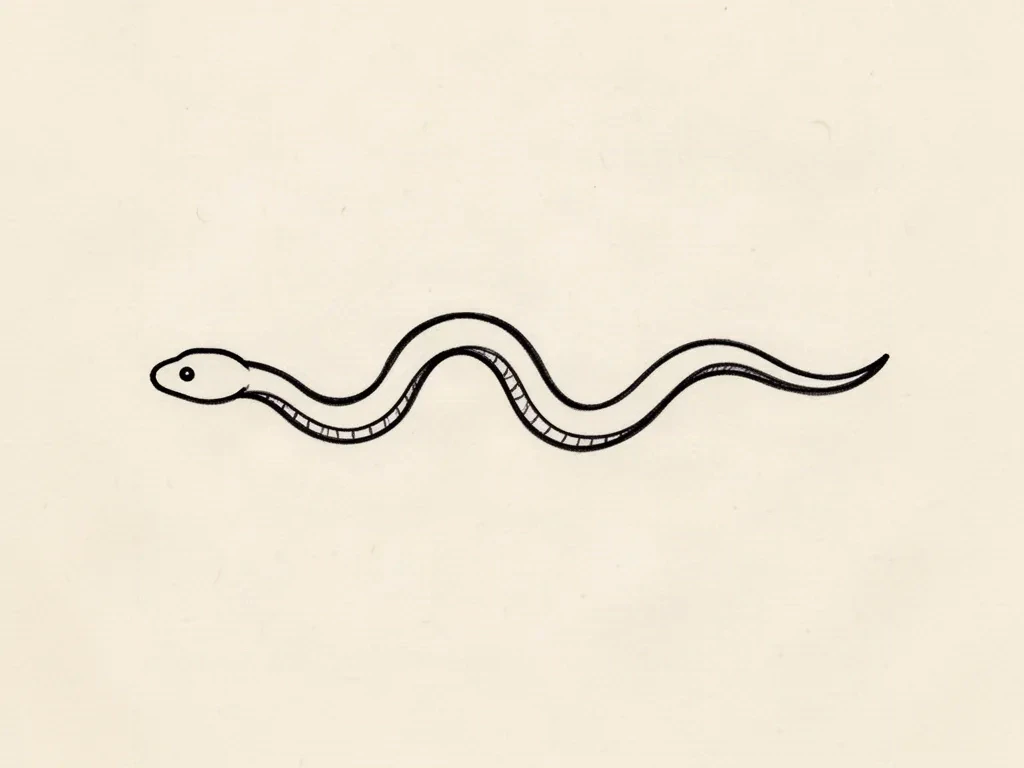
Minimal-line snake at 3 cm

Intended length 30 mm

Synthetic black line-art illustration of a small snake drawn as one open flowing body line with a simple head and a tapering tail.
Synthetic line-art construction reference, not a stencil file or app output. Judge the open body-to-skin gaps on your own 1:1 print.
Source
One short open wave with a single head oval, one eye mark, and a tapering tail. No loops, no scale rows, no tongue forks, no background. The whole read comes from one body centerline and head position.
Protect
The single body centerline from head to tail tip, the head oval with its eye clearance, and the tail taper direction.
Fix
Shorten the wave or straighten one bend if the body crowds the head at 1:1. Never add scales or a tongue to fill space at this length.
Best for
Finger, behind ear, tiny wrist accents where the field holds one body pass only.
Tradeoff
Less decorative than a coil. Gains survival by removing every merge risk: no loop contacts, no parallel texture, no small head cluster.
Final-size verdict
Holds at 2 to 3 cm when the body band and the head oval each keep open skin around them. The best choice for finger sides and ear edges where only one pass of body fits.

HOLDS AT 4-5 CM WITH GAP WORK

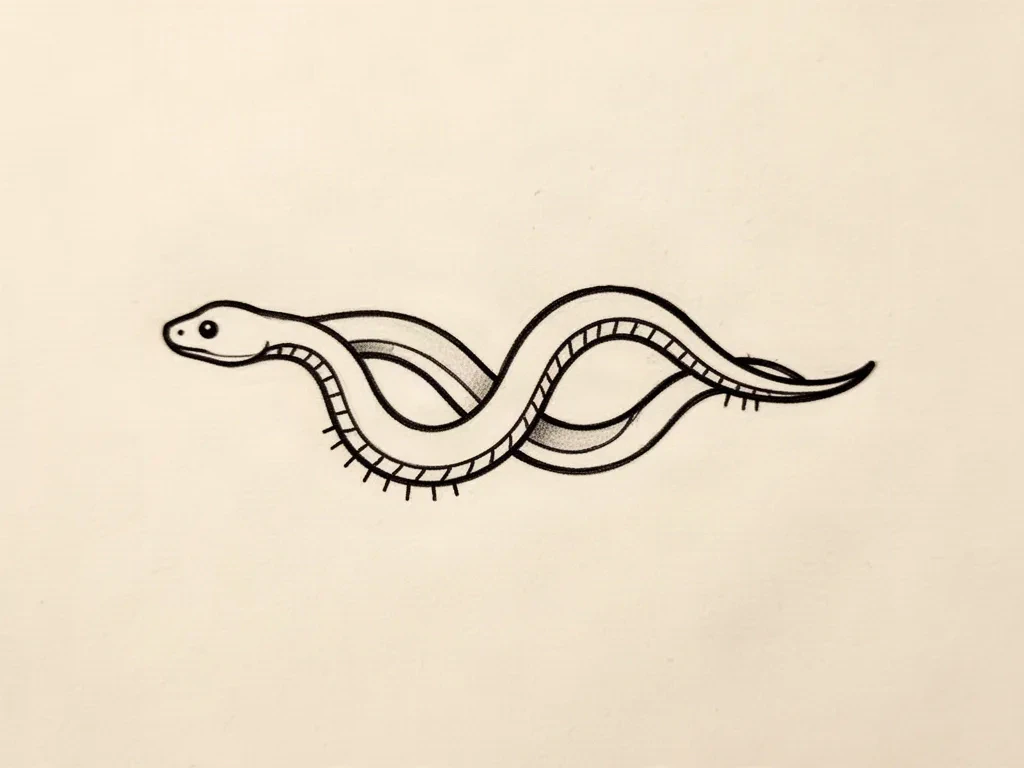
Mini-extended snake at 5 cm

Intended length 50 mm

Synthetic black line-art illustration of a small snake in a short extended shape with gentle bends and a simple head.
Synthetic line-art construction reference, not a stencil file or app output. Verify every bend gap and the eye clearance on your own 1:1 print.
Source
A short gliding snake with two gentle bends, a simple head in line with the body, and at most spaced single scale ticks on the outer bend. Suited to wrist and ankle lines where the body can run with the limb.
Protect
The head-to-tail direction that sets flow, the outer body contours on both bends, and the eye position with open skin around it.
Fix
Reduce scales to outer-bend ticks only or remove them entirely, then reopen the tightest bend gap until it runs as open skin at true size. Drop the tongue before touching head or body mass.
Best for
Wrist and ankle runs where the body can follow the limb axis in one direction.
Tradeoff
More motion than minimal-line, but every added bend is a new gap to verify. Keep two bends maximum at this length.
Final-size verdict
Holds at 4 to 5 cm once the tightest bend gap and the eye clearance stay open at 1:1. Fails below 4 cm because two bends plus a head cluster share too little room.

COIL ONLY AT 4-5 CM, ONE LOOP MAX

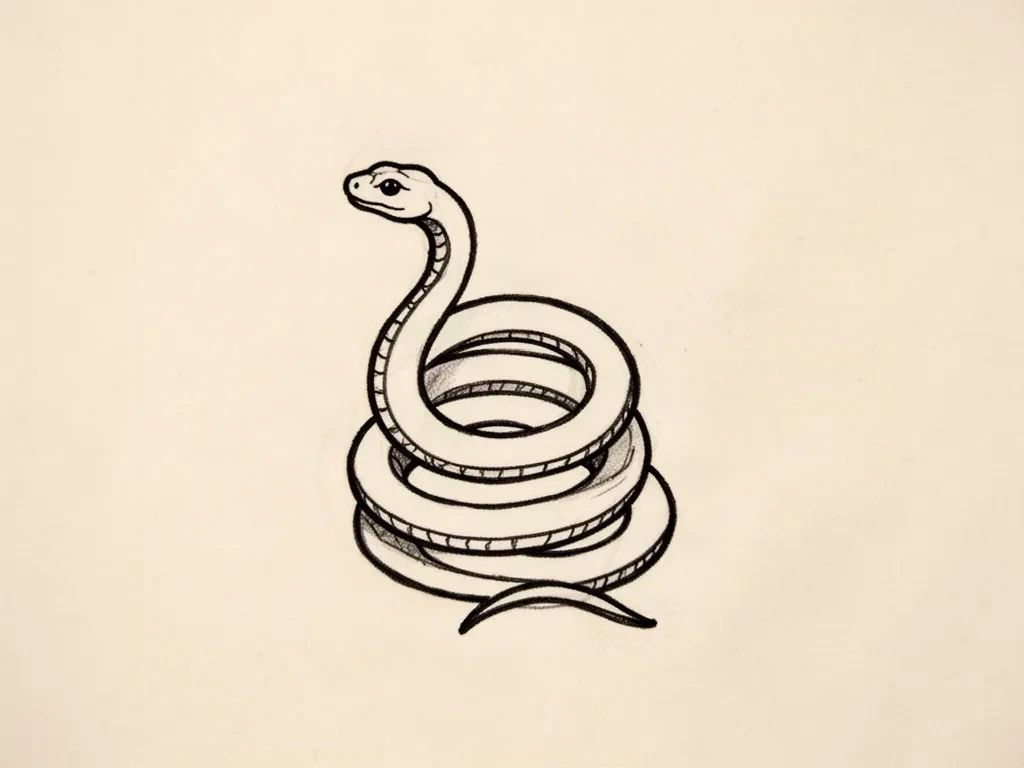
Tight-coil snake at 5 cm

Intended length 50 mm

Synthetic black line-art illustration of a snake coiled into a stacked multi-pass spiral with visible belly plating.
Overstacked reference, not a target: multiple loops plus belly plating are what this page removes at 2 to 5 cm. Synthetic illustration, not a stencil file or app output.
Source
A compact spiral with one full loop and the head raised or tucked beside the stack, plus a short tail exit. Decorative on screen, but loop stacking puts two body passes side by side with a thin skin channel between them.
Protect
The outer coil contour with a countable loop, the raised or offset head position with eye clearance, and the tail exit direction.
Fix
Keep one loop only, open the skin channel between passes until it reads at arm length, and remove all scale rows, tongue barbs, and jaw ticks. If two passes still share one edge at 1:1, switch to mini-extended or enlarge.
Best for
Inner wrist discs, outer ankle spots, and collarbone accents with a roughly square 4 to 5 cm field.
Tradeoff
Most compact motif, highest merge risk. One loop is the ceiling at this length, never two.
Final-size verdict
Holds at 4 to 5 cm with one loop and open inter-pass skin. Below 4 cm the loop stack functions as one band and the head merges into the coil, so recrop to head plus one bend instead.
Side-by-side variant comparison for tiny placements
CriterionMinimal-lineMini-extendedTight coil
Holds at 2 cmYes, best choice with one open bend and no texture.No, two bends plus head cluster share too little room.No, loop stack bridges into one band.
Holds at 5 cmYes, with room to spare for a slightly stronger head.Yes, once bend gaps and eye clearance stay open.Yes with one loop only and an open inter-pass channel.
Body thickness riskLowest, single pass with skin on both sides.Medium, bends narrow one channel that must be reopened.Highest, two passes share one channel along the contact.
Head readability riskLowest, head sits clear of the body with one eye mark.Medium, head sits near a bend and needs separation work.Highest, head sits beside the coil and can merge into it.

Cobra hood-flare and spectacle vetting stays on the cobra page. Snake-and-flower dominance and gap logic stays on the snake-and-flower page. This comparison judges only small-snake body thickness, coil tightness, and head readability at 2 to 5 cm.

2 to 5 cm hold test

Run three checks at the exact length you will print.

Screens forgive crowding that paper and skin do not. Print with scaling off, then inspect thickness, coil tightness, and head readability in this order.

Body thickness check

Print at the exact target length with scaling off. Measure the narrowest body band and the skin channel beside it with a ruler. Cover the head: the body alone should read as one flowing ribbon, not two edges joined into a solid bar.

2 cm failure: At 2 cm, any body band drawn with double outlines plus inner scale ticks merges into one dark strip. Fix by using one contour family and removing all scale rows.

5 cm failure: At 4 to 5 cm, a body band survives only when each pass keeps its own skin break. Fix by bolding the outer contour rather than thinning neighbors, then re-checking the gap.

Coil tightness check

Count the loops at 1:1 from a normal viewing distance. Each neighboring pass needs visible skin between the passes along the full contact length. Squint until fine detail disappears: countable loops should remain countable.

2 cm failure: At 2 cm, even one full loop usually closes. Fix by uncoiling to a single open bend or switching to the minimal-line variant rather than redrawing the same coil thinner.

5 cm failure: At 4 to 5 cm, one loop can hold when the channel stays open. Two loops at this length function as one band. Fix by removing the inner loop before changing line mass.

Head readability check

Name three marks at 1:1: the head oval, the eye, and the jaw line. Step back to arm length. The head should read as a separate shape from the nearest body pass, with the eye as a distinct mark inside it.

2 cm failure: At 2 cm, fangs, forked tongue barbs, and jaw-plate ticks merge the head into a blob. Fix by keeping one oval plus one eye mark and removing everything else in the head cluster.

5 cm failure: At 4 to 5 cm, one fang pair or one simple tongue fork is the ceiling, and only when the head keeps its own silhouette. Fix by reducing the head cluster before touching body mass.

Small-snake simplification and gap rules by length
FeatureAbout 2 to 3 cmAbout 4 to 5 cm
Body contours and thicknessOne contour family at transferable mass. No double outlines with filled centers, no parallel inner lines. If a pass looks weak, strengthen the outer contour rather than adding an inner line.Same priority. A slightly finer inner-pass line is allowed only when every gap stays open. Separability beats uniform thinness at every small length.
Coils and bendsNo closed loops. One open bend maximum. A bend that pinches two body edges together needs straightening or a longer run, not thinner lines.One loop maximum for coils, two bends maximum for mini-extended waves. Each contact length needs open skin along its full run.
Scales and belly platesNone. Remove all dorsal scale rows and belly-plate seams. Texture at this length prints as a scratchy band that erases the body read.Outer-bend single ticks only, or nothing. One restrained row is the ceiling, and it must never join two neighboring body passes or touch the outline.
Head, eye, tongueHead oval plus one eye mark, nothing else. No fangs, no tongue, no jaw ticks. The eye needs open skin around it at 1:1 or the head reads as a dot.Head oval plus separated eye, one fang pair or one simple fork maximum. Extra jaw plates and tongue barbs go before any head or body change.
Gaps that must stay openTwo gaps maximum to defend: body-to-skin on both sides of the single pass, plus eye clearance inside the head. Skip any design that depends on sub-millimeter channels.Three gaps maximum: inter-pass skin for coils, bend clearance for waves, and eye clearance in every variant. If any gap closes at true size, open it, simplify, or enlarge.

Final-size placement verification

Verify on the body area before print and transfer.

A small snake is a short body with one head that must land where the client expects it. Run these placement checks with the paper stencil cut to the exact length.

Finger side and top

Tight curved field with constant flex and a very short readable length. Coils wrap around the curve and crowd both passes, and small head clusters sit directly on the bend.

Check: Use the minimal-line variant at about 2 cm, run the body with the finger axis, and keep head plus tail on the same face. Preview wrap on the finger before print and confirm head and tail tips stay distinguishable when the finger bends.

Wrist

Narrow curved field where a short body should follow the limb line. Wide coils cross the wrist crease and crowd outer passes, while long waves overshoot the flat span.

Check: Align a mini-extended or minimal-line body with the limb axis at 4 to 5 cm, or recrop to a single bend at 2 to 3 cm. Dry-wrap the paper stencil and confirm the head lands clear of the crease at 1:1.

Ankle

Narrow field with footwear contact and a short flat span on the front and outer face. Coils wider than the flat span wrap fast and bridge the inter-pass gap.

Check: Fit a one-loop coil only at 4 to 5 cm on the squarest part of the span, otherwise use a mini-extended wave running with the leg line. Confirm the tail exit points away from shoe contact.

Behind the ear

Very small wrapped field with hair contact and a curved skin plane. Only a compact single-pass snake survives, and the head must sit where hair will not erase its clearance.

Check: Use the minimal-line variant at 2 to 3 cm, keep the head on the flattest skin with open eye clearance, and run the body away from the hairline. Verify at true size that the head still reads as a separate shape after placement tilt.

Stencil-ready checklist

Approve the small snake only when every line passes

Run this short sequence with scaling off and a ruler in hand. One failed line means fix, switch variants, enlarge, or reselect before transfer.

  • Confirm intended length in millimeters (2 to 5 cm), the named placement, and the chosen variant: tight-coil, mini-extended, or minimal-line.
  • Confirm body passes stay countable with open skin between neighbors at 1:1.
  • Confirm the head reads as one clean shape with a separated eye at arm length.
  • Confirm scale rows follow the small-snake ceiling: none at 2 to 3 cm, outer-bend ticks or none at 4 to 5 cm.
  • Confirm coil count respects the ceiling: no loops at 2 to 3 cm, one loop maximum at 4 to 5 cm.
  • Export a true-size PDF with scaling off, inspect the narrowest gap on plain paper, and measure the physical print.
Separated body passes first Verify gaps at 1:1 Clean head with open eye

FAQ

Small-snake stencil decisions, answered

Short answers for the variant, thickness, gap, placement, and print checks that recur when a small snake moves toward transfer-ready output.

At about 2 to 3 cm the minimal-line snake holds best: one short wave or open bend, one head oval with one eye mark, no coils and no scales. At 4 to 5 cm a mini-extended wave with two bends or a tight coil with one loop can hold when every body gap and the eye clearance stay open at 1:1. Below 4 cm a coil usually merges into one band, so the fix is switching variants rather than redrawing the same coil thinner.

Next steps

Use the neighboring owners for adjacent jobs.

This guide covers small-snake variant comparison, 2 to 5 cm hold limits, small-snake simplification, and final-size placement checks. Use the links below for related jobs such as general snake choice, sizing, print checks, and conversion.

Broad snake silhouette choice, cobra construction, snake-and-flower composition, generic conversion, generic size calculation, paper manufacturing detail, and placement mechanics stay in their specialist owners. The links above hand off instead of repeating that detail.

From evaluated reference to working stencil

Turn the approved small snake into a stencil draft.

Start from the small snake that passed the 2 to 5 cm checks, then continue on iPhone for body fit, exact-size print, mirror and professional export.