

Simplicity-first butterfly vetting

Choose a simple butterfly that still reads as a butterfly

Simple means clean contours, open gaps, and restrained veins by choice, not by shrinking. Compare simple-only variants against that bar, then run a thin-line readability check at your final size.

Built for working artists selecting a simple butterfly reference. This page covers simplicity vetting only, not tattoo application or healing advice. Exact-size print calibration, species choice, placement measurement, and pairing composition belong to the owners linked below.

What counts as simple

Three checks decide whether a butterfly is simple.

Run every candidate through these checks in order. A design that fails one check is not rescued by passing the other two. Simple is independent of size: a large butterfly can be simple and a tiny butterfly can still be crowded.

Clean outer contour

One continuous outer contour carries the butterfly, with mirrored upper and lower lobes and a plain body bar. No doubled outline echoes, no scalloped edge texture given equal weight to structure, and no antennae clubs fused to the wing edge. Trace each wing once around the form: a clean contour returns to its start without a parallel twin joining it for part of the route.

Pass when the butterfly reads from silhouette alone at working distance, left and right wings mirror through the body axis, and no second line chases the same edge on the true-size print.

Reject when one wing drifts or stretches without a matching partner, when texture reads as loudly as the contour, or when the hierarchy changes between screen zoom and the 1:1 print.
Open gaps

Every important separation stays visibly open at the intended width: each lobe-to-lobe notch, each wing-to-body channel, and each surviving vein channel. Judge the single tightest must-keep opening, not the average openness. Spacing is a structural decision for transfer, not decoration.

Pass when the narrowest lobe notch and both body side gaps stay open on a measured true-size print, read as background rather than a hairline, and survive a brief squint check.

Reject when one notch or body gap needs zoom to confirm, when two lobes touch at true size, or when the gap passes on screen but closes on paper.

Restrained veins

Keep only veins that change recognition or direction: at most a short fork family on the upper wings with plain lower lobes for most simple briefs. When in doubt, apply the remove-one-vein test: cover one vein fork, and if the butterfly still reads the same, that fork was competing for room the narrowest gap needs.

Pass when removing any remaining vein would change what the butterfly is, and when the narrowest gap still reads as background after the squint check.

Reject when cross veins, vein nets, border dots, or repeated ticks survive zoom but merge into one band on the 1:1 print, or when lower-lobe veins repeat a cue already carried by the outline.

Cross-subject simple-outline principles and broad detail-level education stay with their owners. Use the simple outline filter for clean-contour rules across subjects and the detail-level guide for background on density levels. This page applies those ideas to butterflies only: contour, gaps, and vein restraint on one motif.

Simple-only variant comparison

Compare simple constructions, including one collapse.

Four illustrative example constructions judged at a locked final width. Each one names the protected structure, the removed family, and the go or no-go verdict. Confirm every verdict with a measured 1:1 print.

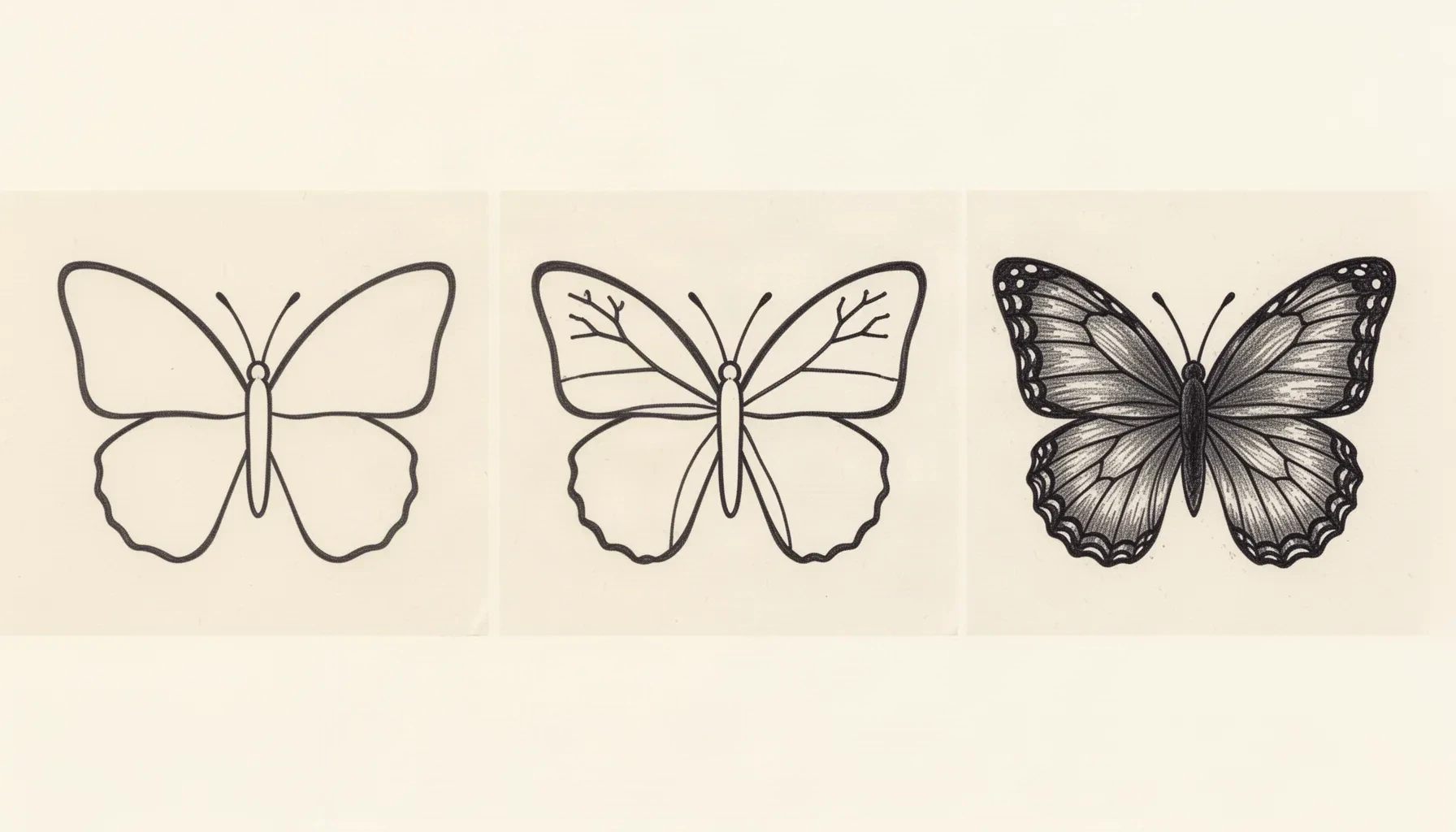
Three-panel ink study of one simple butterfly: a plain open four-lobe outline with clear body gaps, the same construction with two short vein forks per upper wing and plain lower lobes, and a collapsed fine-line version whose dense vein net and touching lobes read as one grey wing mass.
Synthetic editorial ink study, not app output. All three panels show the same butterfly construction at one comparable illustrated width so only the treatment changes. Left: clean open contour, no veins. Center: two short upper-wing forks per side, plain lower lobes, gaps still open. Right: dense vein net with touching lobes that fails simplicity even though the individual lines are thin.

PASSES AS SIMPLE

Open four-lobe outline with no veins

Illustrative example, judged at your locked final width

Source
One symmetric butterfly with four plain lobes, mirrored upper and lower wings, a simple body bar, and short antennae. Open skin separates every lobe and rings the full body.
Protect
The outer wing contours with their mirror relationship, the lobe separations, and the body bar with its side gaps.
Reduce
Nothing. This is the reference simple construction. Do not add vein ticks, dot rows, or border texture to fill empty skin.
Candidate stencil
Same butterfly with the removable family reduced, lobe and body gaps reopened, and protected outer contours kept at transferable mass.
Simplicity verdict
Passes as simple when every notch and body gap stays open at the locked width. The butterfly reads from silhouette alone with no vein detail needed.

PASSES AS SIMPLE

Upper-wing fork pair with plain lower lobes

Illustrative example, judged at your locked final width

Source
One symmetric spread with two short vein forks per upper wing and plain lower lobes. Forks stop well short of the wing edge and keep open channels along their full length.
Protect
The outer wing contours, the two strongest forks per upper wing, and the plain lower lobes with open body gaps.
Reduce
Any third fork family, cross veins near the lobe edges, and border dots. Keep plain lowers plain: lower-lobe veins add the least recognition for the most crowding.
Candidate stencil
Same butterfly with the removable family reduced, lobe and body gaps reopened, and protected outer contours kept at transferable mass.
Simplicity verdict
Passes as simple when each surviving fork keeps open skin along its full length at the locked width. If one fork pinches shut on paper, remove that fork before touching the contour.

PASSES AS SIMPLE

Narrow side-flight silhouette

Illustrative example, judged at your locked final width

Source
One resting-pose butterfly with wings folded toward each other, drawn as a compact side silhouette with a short body bar and minimal interior marks. Suited to narrow fields where a full spread would crowd the lobe tips.
Protect
The stacked wing edges with their separation, the body bar direction, and the small gap between the folded wings.
Reduce
Interior vein ticks inside the folded wings and antennae loops that touch the upper edge. If the two folded edges merge, widen their separation rather than thinning both lines.
Candidate stencil
Same butterfly with the removable family reduced, lobe and body gaps reopened, and protected outer contours kept at transferable mass.
Simplicity verdict
Passes as simple when the folded wings read as two stacked shapes with visible skin between them. This is a pose choice for narrow placements, not a smaller version of the spread above.

COLLAPSED, NOT SIMPLE

Fine-line butterfly with full vein net

Illustrative example, judged at your locked final width

Source
A delicate-looking butterfly with scalloped edges, full vein fans on all four wings, fine cross veins, and a dotted border. Attractive zoomed on screen, but several separations sit near or below reliable transfer width at final size.
Protect
The wing span direction and the strongest lobe rhythm, either the upper pair or the lower pair.
Reduce
Recrop to one clean silhouette with plain lobes, or keep at most two short upper forks and merge the lowers into open lobes. Remove cross veins, dots, and scallop texture before thinning any line.
Candidate stencil
Same butterfly with the removable family reduced, lobe and body gaps reopened, and protected outer contours kept at transferable mass.
Simplicity verdict
Fails simplicity even though the lines are thin. Thin lines do not make a crowded butterfly simple: the vein net reads as one mass on transfer. One open silhouette with gaps beats a fine net with closed gaps.

Species breadth and complexity comparison stay outside this set. Open-wing versus closed-wing monarch choice belongs to the monarch owner, and broad comparison across complexity levels belongs to the butterfly subject owner. This set judges only simple-only contour, gap, and vein treatment.

Thin simple-line readability at final size

Prove the thin lines on paper before trusting the screen.

Simple butterflies fail in predictable places: one gap closes, vein texture merges into one band, or the weakest thin mark disappears. This sequence finds the failure while it is still cheap to fix. Exact-size calibration method stays with the print owners linked below.

  1. 01

    Lock the final width first

    Write down the intended physical width in millimeters and the named body area before judging simplicity. A clean simple butterfly at one width can close the same gaps at a narrower width with no line being wrong on its own. When the target dimensions are still open, set them with the size calculator linked below, then return here to judge the design.

  2. 02

    Inspect one print at true size

    Review one true-size print with scaling off and a ruler beside it. Find the tightest must-keep separation: one lobe notch, one body side gap, or one vein channel. Inspect it at 1:1 without zoom, then at arm's length. If that opening closes on paper, it will not reopen on skin.

  3. 03

    Confirm contour leads at distance

    Hold the same print at working distance and run a brief squint check. The outer wing contours should read before interior veins, and interior veins should stay subordinate. If vein texture reads as loudly as the contour, remove one vein family before changing line mass. Screen zoom hides exactly the crowding this distance check is meant to catch.

  4. 04

    Thin lines need mass, not just delicacy

    Simple thin lines fail in two predictable ways: they vanish when drawn below transferable mass, or they bridge when crowded veins sit too close together. Keep the protected contour at transferable mass, reduce vein count before thinning veins, and reopen the narrowest gap after any mass change. The line-weight guide linked below shows how fine, normal, and bold behave on the same stencil without changing the design.

Collapse signals that disqualify a simple candidate

  • Vein net bridging: full vein fans with cross veins drawn edge to edge close into one grey wing on transfer.
  • Lobe contact: upper and lower lobes sharing one edge erase the butterfly read even when the lines are thin.
  • Body bridging: a body bar touching either wing turns two wings plus body into one solid insect mass.
  • Doubled contours: two near-parallel outlines chasing the same wing edge compete for the room the gaps need.
  • Antennae fusion: clubbed or looped antennae touching the upper lobes merge into the wing edge at final size.
  • Border texture crowding: dot rows, scallops, or ticks around the lobes close the only skin separating the wings.

Simplicity checklist

Approve the simple butterfly only when every line passes

Run this short sequence with scaling off and a ruler in hand. One failed line means reduce one vein family, widen local spacing, enlarge, or reselect before transfer.

  • Confirm the butterfly reads from silhouette alone before veins are judged.
  • Confirm wings mirror through the body axis at the locked width.
  • Confirm every lobe notch and both body side gaps stay open at 1:1.
  • Confirm surviving veins number two short forks per upper wing at most, with plain lower lobes.
  • Confirm the outer contour reads first on the squint check and veins stay subordinate.
  • Confirm the tightest opening is background, not a hairline, on the true-size print.
Contour first, veins second Judge gaps at 1:1 Reduce veins before thinning

FAQ

Simple butterfly decisions, answered

Short answers for the simplicity, thin-line, size, and routing questions that recur when a simple butterfly moves toward a working stencil.

Simple is a style choice, small is a size job. A simple butterfly carries clean contours, open gaps, and restrained veins at any width, and it reads from silhouette alone. A small butterfly is any butterfly judged at 2 to 5 cm, where symmetry, gap retention, and exact-size verification decide the outcome. Use this page to select and vet the simple construction, and use the small-butterfly owner when the main risk is holding detail at a micro width with exact-size print proof.

Next steps

Use the neighboring owners for adjacent jobs.

This guide covers simple-only variant choice, contour, gap, and vein vetting, and the thin-line readability check. Use the links below for related jobs such as sizing, species, placement, pairing, and maker depth.

Exact-size print calibration, species taxonomy, placement measurement, pairing composition, and maker-tool method stay in their specialist owners. The links above hand off instead of repeating that detail.

From vetted simple butterfly to working stencil

Turn the approved simple butterfly into a stencil draft.

Start from the butterfly that passed the contour, gap, and vein checks, then continue on iPhone for body fit, exact-size print, mirror and professional export.