Women's neck stencil vetting

Pick the side, nape, behind-ear, or throat motif that survives the neck

A women's neck request is four different placements sharing one name. Name the zone first, shortlist feminine motifs built for that flow, then prove fine-line readability at small visible scale and clear the hairline, jaw, and hair checks before the stencil reaches skin.

Built for working artists preparing women's neck stencils. This page covers stencil selection and visual review only, not tattoo application or healing advice. Neck work stays highly visible, so confirm the client understands the placement before prep continues.

Zone map for women's necks

Four zones, four different stencil jobs.

Match the motif to the zone before judging detail. Each zone below names its field, its constraint, and the check that gates the shortlist. Visibility runs throat highest, side high, behind-ear discreet, nape most coverable.

Side neck

Vertical strip from behind the ear to the collarbone

The most requested women's neck field and the most movement-sensitive. Long hair, necklaces, and collars all cross it, and head-turn stretches one side while compressing the other. Slim vertical compositions that read from the side view alone belong here.

Check: Run flow with the muscle cord, keep full width inside the side view, and test neutral, turned toward, and turned away before print.

Behind the ear

Small recess between ear back edge and hairline

The discreet women's entry point. Smallest field of the four, partly sheltered by hair and the ear, but bounded on three sides by cartilage, fold, and hair. Only compact motifs with no interior counters belong here.

Check: Hold clearance from the ear fold and hairline, judge the read from the side view alone, and check glasses, earrings, and strap lines.

Nape

Panel below the hairline, above the collar

The calmest women's neck field and the best holder of fine detail. Flatter and more stable than side or throat, easy to cover with hair, and centered on the spine line. Small symmetric florals and discs belong here.

Check: Center on the spine line, hold a clear margin below the hairline, and confirm with the head neutral and tilted forward.

Throat base

Low front panel above the collarbones, judged head-on

The highest-visibility women's neck field and the least forgiving. Skin moves with swallowing and chin position, symmetry is read straight-on in conversation, and coverage is nearly impossible. Only tiny centered pendants belong here, and only for clients who accept permanent visibility.

Check: Center on the midline with the chin neutral, keep the full motif inside the low front panel, and confirm the visibility decision before sizing.


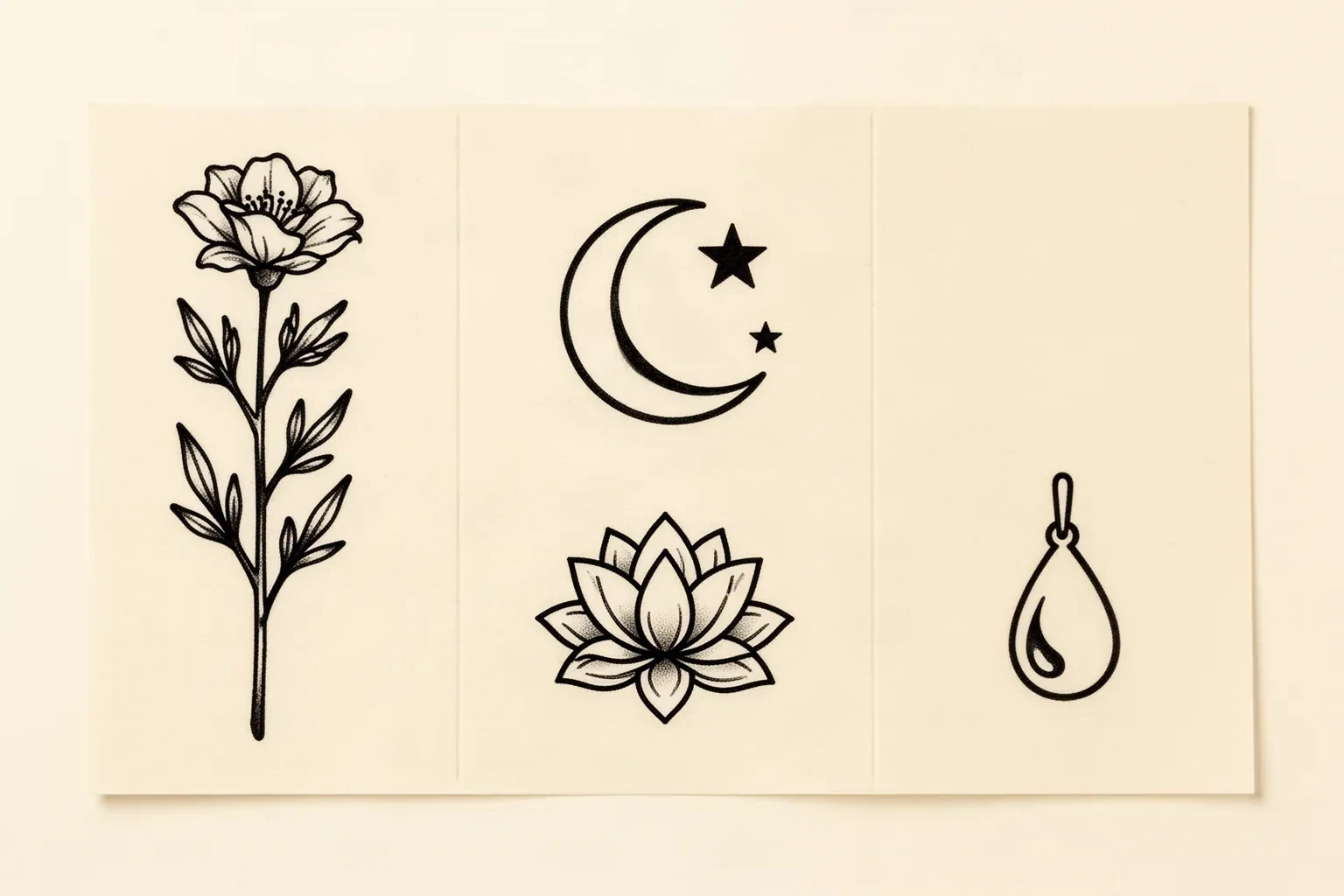
Four original feminine neck stencil motif directions drawn in black line art on cream paper: a slim flowering stem for the side neck, a crescent moon with stars for the behind-ear recess, an open floral disc for the nape, and a small teardrop pendant for the throat base.
Synthetic reference illustration of four motif directions, one per zone: a slim flowering stem for the side strip, a compact crescent for the behind-ear recess, an open floral disc for the nape, and a teardrop pendant for the throat base. It shows direction and line hierarchy only. It is not a measured stencil, app output, or client photo, so set the exact size and prove the narrowest gaps with the tools linked below before transfer.

Side shortlist

Slim vertical motifs that ride the muscle.

The side strip rewards length over width. Each construction below runs with the cord from behind the ear to the collarbone and names what to simplify when the strip narrows near the jaw.

Single-stem vine or wildflower sprig

One stem gives a natural flow line that rides the muscle cord from behind the ear toward the collarbone. Small leaves and one open bloom set the identity without needing width the strip does not have.

Line verdict: Mixed hierarchy wins: one confident stem outline with openly spaced leaves, fine-line petal veins only. If leaf gaps close at 1:1, remove a leaf pair before thickening anything.

Fit start: Start 50 to 90 mm long, 15 to 30 mm wide. Run the stem with the cord, keep bloom counters open at true size, and confirm no leaf crosses the jaw turn.

Short vertical script line

A single short word or date follows the cord naturally when kept to one line. The frequent women's request that fails only when lettering fights the stretch direction or shrinks below its counter limit.

Line verdict: Medium-weight script holds; hairline script pinches shut when the chin turns toward the piece. Keep counters in a, e, and o visibly open at true size and avoid all-caps micro lettering.

Fit start: Start 50 to 80 mm long with cap height sized so the smallest counter clears the 1:1 gap check. Baseline runs with the muscle, never across it.

Butterfly ascent or small flight cluster

Two small butterflies or a butterfly with two satellite dots create upward motion along the strip while staying narrow. Reads at conversational distance because the wing silhouette carries, not the wing pattern.

Line verdict: Bold-enough wing silhouette with one open body counter. Fine wing veins are support only; if veins bridge at 1:1, keep the silhouette and drop the veins.

Fit start: Start 50 to 80 mm long, 20 to 35 mm wide. Space the pair along the cord so head-turn compression never merges them, and keep wing tips clear of the ear fold and collar.

Behind-ear shortlist

Compact motifs for the small recess.

Behind the ear is the smallest and most bounded women's neck field. Shortlist from compact compositions with no interior counters, each with its line verdict and recess fit.

Crescent moon with one star

A compact two-element composition built for the recess. The crescent gives a bold-enough silhouette for a close-range read while the single star adds asymmetry without a second focal.

Line verdict: Medium-weight crescent outline with an open inner curve. Keep the star solid and separated from the crescent tips so the gap survives the fold at small size.

Fit start: Start 15 to 30 mm tall. Seat fully on post-auricular skin, hold clearance from the fold root, and judge from the side view alone.

Tiny single bloom or sprig

One small flower head with a short stem fits the recess without wrapping. Open petal separations give the read that micro shading cannot hold behind the ear.

Line verdict: Fine-line petals over one steady outline, maximum two petal depths. If petal separations bridge at 1:1, remove inner veins before enlarging.

Fit start: Start 15 to 30 mm tall. Keep the full bloom clear of the ear-edge setback and the hairline, and re-check with the ear gently folded forward and released.

Minimal symbol or three-dot constellation

A small heart outline, initial, or three-dot triangle uses the least skin and tolerates the recess best. No interior counters means nothing to close where the stencil bridges the fold.

Line verdict: Single-weight open outline or solid dots with generous spacing. Avoid enclosed micro counters; they fill first behind the ear.

Fit start: Start 10 to 25 mm. Center on the flattest part of the recess and confirm daily-wear lines from glasses, earrings, and straps stay clear.

Fold curvature, ear-setback, and daily-wear depth for this recess are covered in the behind-ear guide linked below. This page shortlists the women's motifs; that guide covers the recess fit in detail.

Nape shortlist

Centered pieces on the calm panel.

The nape tolerates the widest women's compositions and the most interior detail. Center on the spine line, hold the hairline margin, and spend the extra room on one focal rather than two.

Small lotus or open floral disc

Radial symmetry suits the stable nape field, where centering is judged with the head tilted forward. Open petal channels give a calm centered read that also hides cleanly under hair.

Line verdict: Medium outline with open channels between petals. Keep dotwork and inner veins off the hairline edge so regrowth never swallows the top row.

Fit start: Start 30 to 60 mm wide, centered on the spine line with a clear top margin below the hairline.

Nape script or short horizontal word

A short word set horizontally across the nape reads cleanly from behind and stays clear of the hairline when kept compact. Works best at slightly larger sizes than behind-ear script.

Line verdict: Medium-weight lettering with openly spaced counters. Hairline script at nape width loses to distance; choose one weight up from the reference.

Fit start: Start 40 to 70 mm wide, 12 to 25 mm tall. Keep the baseline level with the head neutral and hold the top margin below the hairline.

Small moth, butterfly, or ornamental pendant

A dense small focal that benefits from the nape hiding option: visible when the hair is up, covered otherwise. Symmetric wings or pendant drops center well on the spine line.

Line verdict: Steady body mass with open wing separations. Fine antennae and leg hairs close at nape scale, so keep only the separations that set the silhouette.

Fit start: Start 30 to 60 mm wide. Center body mass on the spine line and keep wing or drop tips clear of the hairline and collar boundaries.

Throat base, handled honestly

One tiny pendant, or a deliberate relocation.

The throat base is the least requested and least forgiving women's neck placement. Offer one honest pendant construction plus the relocation path most throat requests should take.

Tiny centered pendant or drop

A small gem outline, cross, or petal drop placed low at the throat base, where the panel is widest and movement is least severe. One focal only, judged head-on.

Line verdict: Medium outline with one open counter. No micro text and no flanking flourishes; width is the constraint and every extra element steals from the focal gap.

Fit start: Start 20 to 40 mm tall, centered on the midline with the chin neutral. Keep the full motif above the collarbones and inside the visible front panel.

When to refuse the throat and relocate

Most women's throat requests stencil better as a side or nape piece. Relocate when the motif needs width the front panel lacks, when the client wants coverage flexibility, or when script is the request.

Line verdict: Offer the relocation explicitly: the same motif at side-neck length or nape width usually gains readability and keeps a coverage option.

Fit start: Prepare two candidates: the requested throat pendant plus one side or nape alternate at its own zone size, and let the 1:1 gap check decide.

Fine-line versus bold at small feminine scale

Choose the weight the viewing distance requires.

Women's neck pieces are usually read close up, but side and throat placements still move through conversational distance. Use this comparison to set the line hierarchy before locking detail, then prove the narrowest gap at true size.

Line-weight comparison for small feminine neck scale
ChoiceWhen it winsStencil rule
Fine-line led, small feminine scaleChoose for behind-ear pieces, small nape florals, and close-range side sprigs where delicacy is the request and the client accepts a near read rather than a across-room read.One steady outline carries the silhouette, interior veins stay at two depths maximum, and the narrowest gap is proven open at a measured 1:1 print. Remove the weakest interior mark first when anything bridges.
Mixed hierarchy that holdsChoose for most women's side-neck and nape work: a confident silhouette plus restrained interior modeling, such as a vine with open leaf gaps or a butterfly with one vein depth.Rank every mark: structure, modeling, texture. If removing the texture leaves the motif unreadable, strengthen the contour before restoring detail.
Bold accents where distance demandsChoose when the motif must read at conversational distance while the head moves: side-neck statements, throat-base pendants, and first neck pieces.One heavier outer contour with one open focal void. Let open skin do the separation work instead of adding outline doubles that close at small scale.

Feminine fit

Start from zone sizes, then prove the gaps

These starting sizes are stencil-prep guides, not placement rules. Lock one size, judge the narrowest gap at true size, and let the working artist confirm the final call for the specific neck and skin.

Starting size and orientation by women's neck zone
ZoneStarting pointOrientation
Behind-ear motifHeight 10 to 30 mm, no interior countersSeated fully on post-auricular skin, judged from the side view alone with ear neutral.
Side vertical motifLength 50 to 90 mm, width 15 to 35 mmLong axis with the muscle cord from behind the ear to the collarbone. No horizontal bars across the muscle.
Nape emblemWidth 30 to 70 mm, height 25 to 50 mmCentered on the spine line with a clear top margin below the hairline. Confirm neutral and tilted forward.
Throat-base pendantHeight 20 to 40 mm, one focal onlyLong axis vertical on the midline low at the throat base, judged head-on with the chin neutral.

Hair, jaw, and interference checklist

Clear the transfer field before exact-size print

Women's neck transfers fail at the hairline, the jaw turn, and the jewelry line more than at the printer. Run this sequence with the client upright and the print at measured true size.

  • Map the hair first: clip or sweep hair fully clear, mark the hairline clearance line, and trim the stencil at that line before transfer.
  • Degrease twice on nape and behind-ear skin: hair product residue blocks transfer solution and lifts stencil edges.
  • Mark the jaw edge and ear fold as hard boundaries: keep enclosed counters and fine tails clear of both lines.
  • Run the head-turn test: neutral, fully left, fully right, plus chin lift for throat base and forward tilt for nape.
  • Check jewelry and accessory lines: earrings and ear backs at the top, necklaces and collars at the bottom, glasses arms and straps behind the ear.
  • Confirm visibility and coverage honestly: side and throat stay visible, behind-ear and nape hide under hair. Match the zone to the client's coverage need.
  • Seat the client upright with the chin neutral for the final read: necks vetted flat shift once standing.
  • Leave with 2 to 3 transfer-ready candidates: one primary plus one alternate zone or one alternate line weight.
Prove gaps at 1:1 Test the head-turn Measure the print

FAQ

Women's neck decisions, answered

Short answers for the zone, line-weight, hair and jaw, visibility, and handoff questions that recur on women's neck placements.

Use the side for a slim vertical composition such as a single-stem vine, one short script line, or a small butterfly ascent running with the muscle cord; behind the ear for a compact motif such as a crescent with one star, a tiny single bloom, or a minimal symbol with no interior counters; the nape for a wider centered piece such as a small lotus disc, short horizontal script, or a moth or pendant focal on the spine line; and the throat base only for a tiny centered pendant when the client accepts permanent visibility. When a motif needs more width than its zone allows, change the zone or the motif rather than squeezing the stencil.

From neck shortlist to working stencil

Turn the vetted women's neck reference into a stencil draft.

Start from the side, nape, behind-ear, or throat-base candidate that passed the readability and hairline checks, then continue on iPhone for body fit, exact-size print, mirror and professional export.