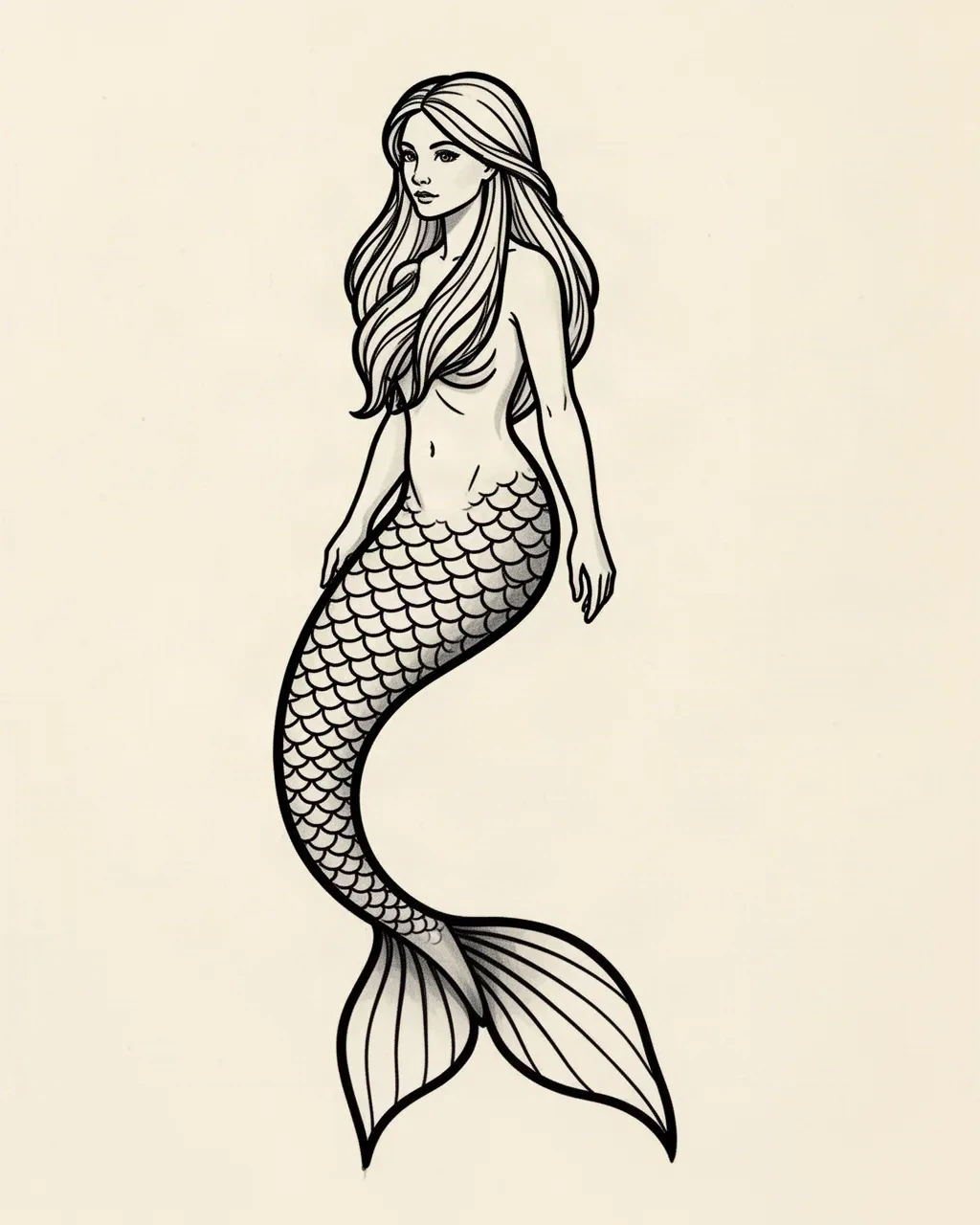

Mermaid stencil evaluation

Judge any mermaid reference before it becomes a stencil

Mermaids live or die on tail gaps. Check the variant fit, the scale and fin separations, the hair-to-water flow, and the torso-to-tail junction at your exact height, then prepare a clean stencil that transfers as one readable figure.

Built for working artists preparing mermaid pieces. This page covers mermaid evaluation and stencil preparation only, not tattoo application or healing advice. Upright, curled-tail, portrait, and small emblem options are judged here as different constructions inside one tail framework.

What makes a mermaid stencil-viable

Tail, hair, and junction decide the result.

A mermaid is a human torso joined to one readable tail with flowing underwater accents. These three pillars predict whether that figure survives reduction, print, and transfer.

Tail, fin, and scale hierarchy

A mermaid reads first as a human torso joined to one readable tail: a tail shaft with direction, paired fins with open separations, and a scale field that suggests texture without filling every gap. Reference art often draws every scale, fin ray, and highlight at once, but transfer needs ranked structure with plain skin between marks. When scales and rays share one merged patch, the tail reads as a plain fish shape and the mermaid signal is lost.

Check: Cover the hair and arms. If the torso-to-tail junction plus the tail outline and fin spread still read as a mermaid at a glance, the construction is sound. If removing tone leaves one smooth blob, protect the tail shaft, fin edges, and scale boundaries before touching texture.
Hair-to-water flow

Hair, water curls, bubbles, and drapery read through two or three long primary flows, not through every strand and ripple. Floating hair surrounds the face and shoulders exactly where fine lines crowd, and underwater curls wrap the tail where fin separations already need room. Stencil viability comes from one dominant hair mass with a single parting direction plus one water accent, because parallel strands and curls merge into a single dark pocket on transfer.

Check: Name the two longest flows that set the underwater motion. If removing a third flow changes nothing about the first read, that flow is support and can be shortened or removed before touching the tail or face.

Torso-to-tail proportion

The human half carries the pose through head size, arm direction, and the waist junction, not through shaded modeling. A long tail with a tiny torso reads as a sea creature, while a large torso with a short cramped tail reads as a portrait with a fin attached. The junction needs one clean contact with open skin around the waist so the two halves join without merging.

Check: Name the head, torso, and tail direction in one sentence each. If any part needs shading to be found, that part needs simplification or a larger height before fin or scale detail is touched.

Mermaid evaluation framework

Score the reference in minutes, then act on the weakest check.

Four mermaid constructions at labeled heights. Each one names the protected structure, the fix, and the go or no-go verdict at that exact size. Confirm with a measured 1:1 print.

Original black ink illustration of a full-body mermaid in an opaque top: one hair mass with a single parting direction, a clean torso-to-tail junction, spaced scale rows on the upper tail, and a single tail direction ending in two separated forked fin lobes.
Construction referenceRead the four marks that carry the figure: hair as one mass with a single parting, one tail direction, two forked lobes with their own separation, and scale rows that leave open paper between rows.Original editorial illustration generated for this guide, not app output and not a measured 1:1 print proof. Run the height checks below at your true physical size before approving the stencil.

HOLDS AT STATED SIZE

Classic upright mermaid with open tail at 15 cm

Intended height 150 mm

Source
Upright mermaid with a calm torso, long flowing hair mass, a straight tail shaft with a large forked fin, and a spaced scale field across the upper tail. Demanding on screen because scale rows and hair strands compete with the fin outline, but every scale boundary and fin separation stays open at this height.
Protect
Torso-to-tail junction with open skin around the waist, full tail outline with both fin lobes, the single hair mass direction, and the spaced scale rows across the upper tail.
Fix
Keep one scale boundary per row with open skin between rows, reduce hair to one mass with a single parting line, and keep both fin separations open at 1:1. Keep torso proportion, tail length, and fin spread unchanged.
Candidate stencil
Same mermaid with tail and fin hierarchy ranked, torso proportion held, scale rows spaced, hair merged to one mass, and protected contours held at transferable mass.
Final-size verdict
Holds at 15 cm after a strand-reduction check. Every scale keeps its own separation at 1:1, both fin lobes stay distinct, and the upright pose reads as a mermaid from a normal viewing distance.

SIMPLIFY SCALES FIRST

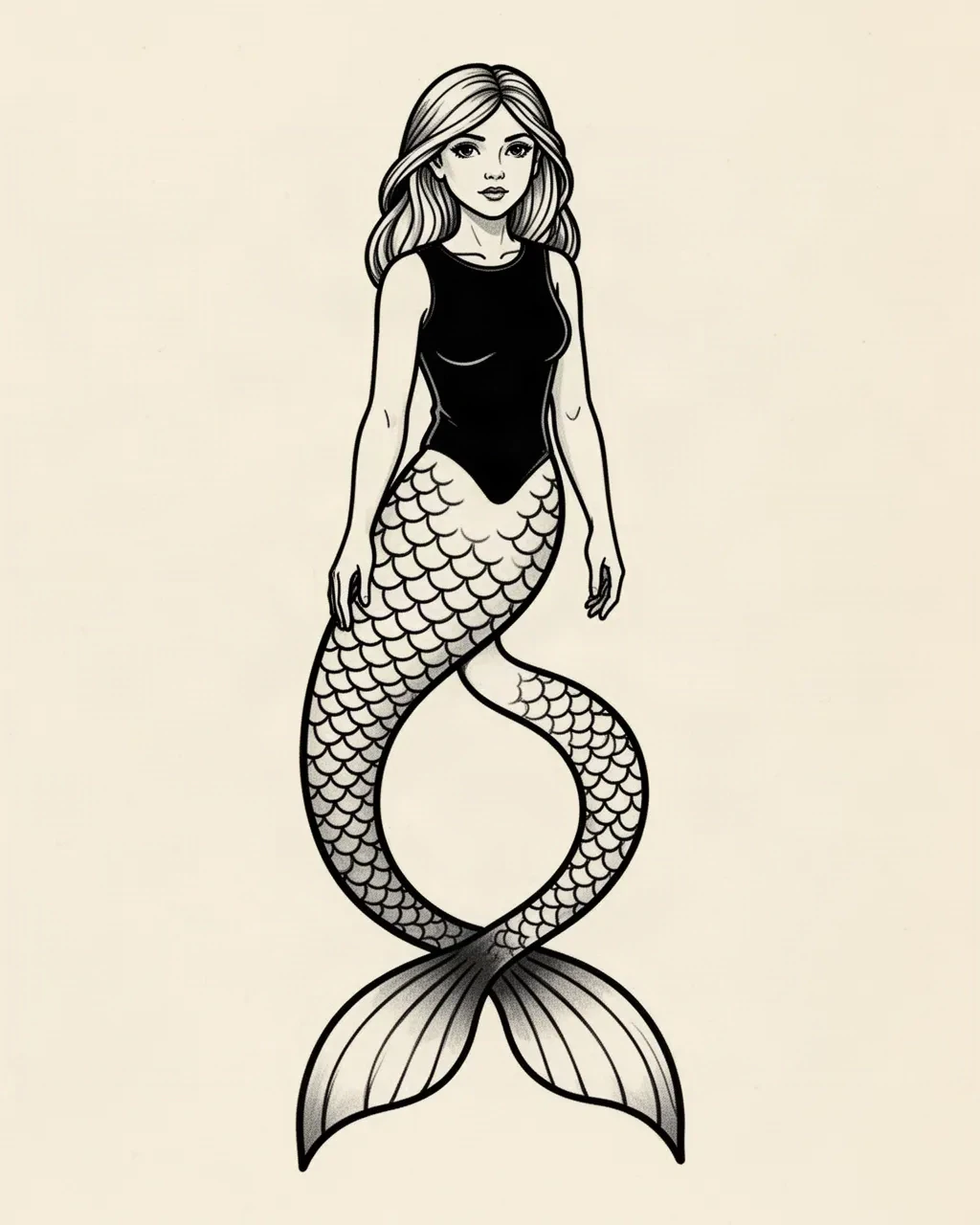
Traditional curled-tail mermaid with dense scales at 12 cm

Intended height 120 mm

Source
Mermaid with a curled tail wrapping back on itself, bold traditional outlines, dense overlapping scale rows down the full tail, fin rays inside both fin lobes, and wave accents around the curl. Strong on screen because the curl carries motion, but inner scale rows stack thin parallel lines that narrow every tail separation at this height.
Protect
Tail curl direction with the outer tail contour, both fin lobe outlines with the gap between them, torso axis with arm placement, and the top scale rows near the waist that carry the texture read.
Fix
Reduce scales to the upper tail only with open skin between rows, convert lower-tail scales into plain tone or one contour, and keep fin rays to three or four spaced rays per lobe. Do not keep full-length scale rows plus ray hatching plus wave texture together at 12 cm.
Candidate stencil
Same mermaid with tail and fin hierarchy ranked, torso proportion held, scale rows spaced, hair merged to one mass, and protected contours held at transferable mass.
Final-size verdict
Holds at 12 cm once scales are single-path construction on the upper tail at 1:1. The curl keeps its motion while the fins carry the underwater read around it.

REDUCE HAIR FIRST

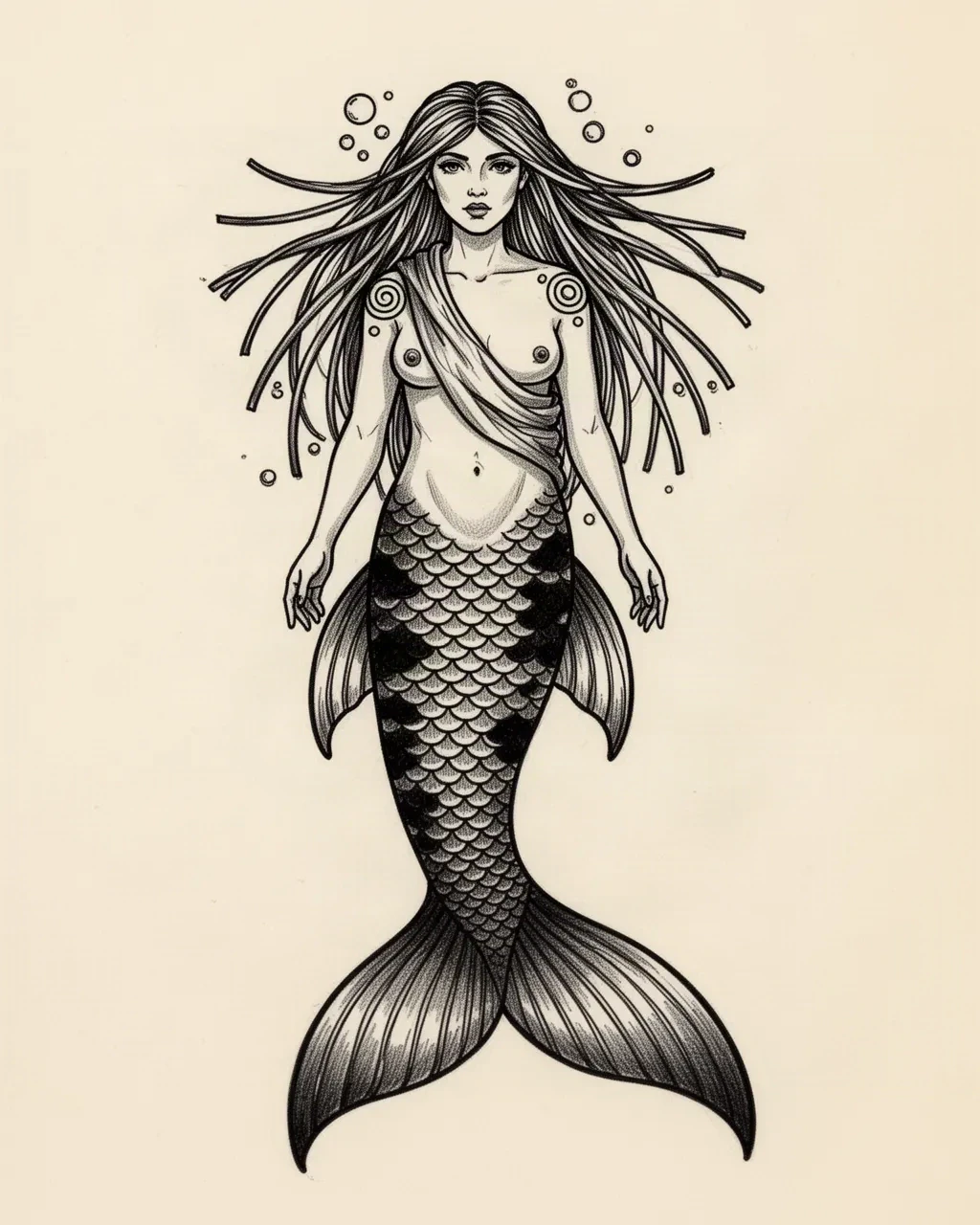
Fine-line portrait mermaid with floating hair at 13 cm

Intended height 130 mm

Source
Close mermaid portrait with a detailed face, jewelry, layered floating hair strands in every direction, a small tail curving below the torso, and bubble accents around the shoulders. Charming on screen, but the hair carries fine parallel strands and the small tail sits behind crossing hair lines.
Protect
Face oval with eye placement and spacing, outer hair mass direction, torso with the waist junction, and the tail outline with its fin spread below the torso.
Fix
Merge hair into one mass with a single parting direction and two outer flow lines, reduce the face to eyes, one nose hint, and mouth with open skin between them, and reopen the tail edge where hair crosses it. Do not keep layered strands, jewelry texture, and bubble rings together at 13 cm.
Candidate stencil
Same mermaid with tail and fin hierarchy ranked, torso proportion held, scale rows spaced, hair merged to one mass, and protected contours held at transferable mass.
Final-size verdict
Holds at 13 cm once the hair is one mass and the tail edge is separated from it. Detailed strand work merges first at this height while the tail can stay simple.

ENLARGE OR RECROP

Small tail-curl emblem with full fin detail at 5 cm

Intended height 50 mm

Source
Tiny curled-tail mermaid emblem with hairline scale rows, thin fin rays, small hands and face detail, and a water ripple cue sharing one small field. Attractive on screen with separations that read only when zoomed.
Protect
Tail curl gesture and the outer fin silhouette.
Fix
Enlarge past the point where every scale separation and fin gap transfers as open skin, or recrop to the tail plus fin alone without face, hands, or ripple cues. Do not keep full scales, thin rays, small digits, and ripple lines together at 5 cm.
Candidate stencil
Same mermaid with tail and fin hierarchy ranked, torso proportion held, scale rows spaced, hair merged to one mass, and protected contours held at transferable mass.
Final-size verdict
At 5 cm the scales function as one dark patch and fin rays print as a single scratch. Enlarge, recrop to the tail read alone, or choose a bolder minimal construction for this height.

Winged-figure comparison stays on the fairy stencil guide, broad creature-silhouette comparison stays on the fantasy collection, and sea-animal construction stays on the sea turtle stencil guide. Broad visual browsing stays on the stencils and subject hubs. This framework exists to judge mermaid tail scales, fin rays, hair flow, and the torso-to-tail junction at a stated height, not to replace those owners.

Scales, fins, and hair at final size

Judge the white space at the height you will print.

Screens forgive crowding that paper and skin do not. Set the height first, then inspect each feature below at true physical size with scaling off.

About 6 cm and below

Ankle accents, wrist marks, behind-ear pieces, and small gap fillers.

Carry a recrop only, such as a tail curl with one fin lobe or a small mermaid head with a hair hint. Keep one contour family and two separations maximum. If a scale channel, fin gap, or hair separation closes at 1:1, enlarge or reselect rather than forcing reduction.

About 8 to 15 cm

Common forearm, calf, shoulder, thigh, and side-torso mermaid pieces.

The most flexible band. An upright or curled mermaid with a ranked tail, separated fins, and one hair mass can work when every scale separation, fin outline, and hair gap is verified at true size. Check scale rows and floating strands before approving texture.

About 15 cm and above

Large thigh panels, back pieces, side-torso swim compositions, and full underwater scenes.

Room for a full figure with an extended tail plus one water accent, but only when open skin separates every scale row, every fin ray, and the hair mass from the tail. Larger height does not rescue merged scales, closed fin gaps, or hair-bridged tail edges.

Mermaid feature checks by height band
FeatureAbout 6 cm and belowAbout 8 cm and above
Scale separationsKeep scales on the upper tail only with one boundary per row. If a scale row disappears into tone, the tail loses texture and becomes a plain shape.Same priority. Larger height allows one extra scale band down the tail, but separability still beats uniform fineness.
Fin rays and fin spreadKeep the outer fin contour plus two or three spaced rays per lobe. Asymmetric lobe lengths read as mistakes at small heights.Full fin fans can work when each ray keeps its own spacing at 1:1. Check the full fin with a squint test at true size.
Hair strands and water curlsKeep one unbroken hair mass with a single parting line. Secondary strands and bubble rings compete with fin gaps for the same room and should be recropped away.Two flows plus one water curl can add motion when the longest flow clearly dominates. Equal-weight parallel strands need hierarchy work before print.
Face, hands, and junctionCarry eyes, one nose hint, and mouth maximum, with visible skin between them. The waist junction needs one open contact or torso and tail merge into one pocket.Soft facial modeling can work when each mark keeps its own spacing at 1:1. Keep fingers as simple separations and verify the junction gap before approving detail.

Reference to clean stencil

Build from the tail outward, then protect the figure.

Work in this order so one change at a time can be judged at the same height. Stop when tail, fins, torso, and flows each read correctly.

  1. 01

    Lock height, placement, and intent first

    Set the intended physical height in millimeters, name the body area, and name the intent in one line: calm upright figure, traditional curl, fine-line portrait, or small tail accent. A curled mermaid that holds at 15 cm on a thigh can fail at 5 cm on an ankle with no line being wrong on its own.

  2. 02

    Verify variant and pose hierarchy

    Confirm the variant fits the intent, then rank the composition: tail and fins first, torso proportion second, hair and water accents third. Resolve tail crossings, hair-over-fin contacts, and equal-weight flows before touching line weight. A mermaid with ranked fins and one clear tail direction is already halfway to stencil-ready.

  3. 03

    Set tail, torso, and flow roles

    Assign every mark a role: lead structure that carries the first read, support that shapes it, and texture that can be removed. Strengthen the tail outline and fin edges first, keep inner scale rows and hair strands lighter, and mark one removable scale band or strand that can go if gaps close.

  4. 04

    Simplify scales, hair, and curls at 1:1

    Reduce scale rows, hair strand count, and water-curl detail before thinning contours. Keep open skin between scale rows, around fin rays, and between hair flows, and run a squint check: step back until fine rays disappear and confirm the tail, fins, and pose still read. The line-weight guide covers fine, normal and bold behavior on the same stencil.

  5. 05

    Verify print and transfer path

    Export a true-size PDF with no fit-to-page scaling, inspect the narrowest scale gap, the smallest face cluster, and the tightest fin separation on plain paper, then measure the physical print with a ruler. If the digital file passes and only paper fails, move to print-stage evidence instead of simplifying again.

Original black ink illustration of a crowded mermaid construction: hair strands radiating in every direction around the face and shoulders, dense overlapping scale rows down the full tail, bubble accents, and both fin lobes filled with parallel rays.

Crowded constructionEvery strand, scale row, bubble, and fin ray competes for the same space. This is the state to simplify before any height check, because parallel hair lines and full-length scales merge first on transfer.

Original black ink illustration of a viable upright mermaid construction: one hair mass with a single flow direction, a clean torso-to-tail junction, spaced scale rows on the upper tail, and two separated forked fin lobes with a few open rays each.

Viable upright constructionOne hair mass, one tail direction, spaced scale rows, and open fin separations. The figure keeps its underwater read with far fewer marks, which is what the tail-first build order is aiming for.

Original editorial illustrations generated for this guide, not app output and not a measured 1:1 print proof. Judge both constructions at your true physical size before approving the stencil.

Placement and composition decisions

Tails want length, fins want width

A mermaid is a tall figure with a wide fin fan. Placements with length plus a flat span preserve both, while narrow limbs demand straight tails or a recrop.

Outer thigh and side torso

Tall fields where an upright or long curled mermaid can keep its full tail length. The tail gets length while fins get width, so this suits the most detailed mermaid variant.

Check: Align the torso axis with the body line, keep fin tips clear of creases, and verify every scale gap at 1:1 before print.

Shoulder blade and upper back

Broad flat fields where an open tail fan and spread hair can sit symmetrically. The spine centerline becomes part of the design, so any fin asymmetry is immediately visible.

Check: Center the figure on the flattest span, mirror fin lobe shapes, and verify ray spacing at 1:1 before print.

Outer forearm and calf

Long narrow fields where the tail should follow the limb axis. Wide fin fans wrap fast and crowd ray tips.

Check: Choose a straight or gently curled tail for these fields, align the tail shaft with the limb, and shorten cross-limb fin tips while edits are still cheap.

Wrist, ankle, and behind ear

Small wrapped fields where only a recrop survives. Full mermaids with detailed faces, small hands, and full scale rows forced into these bands merge first.

Check: Recrop to one tail curl with a single fin, or one small head with a hair hint, then run the small-size checks at the exact height.

Stencil-ready checklist

Approve the mermaid only when every line passes

Run this short sequence with scaling off and a ruler in hand. One failed line means fix, enlarge, or reselect before transfer.

  • Confirm intended height in millimeters, the named placement, and the variant intent.
  • Confirm scale rows stay separated with open skin between them at 1:1, limited to the upper tail at small heights.
  • Confirm both fin lobes hold their outer contour with two or three spaced rays each.
  • Confirm hair reads as one mass with a single parting direction and no merged parallel strands.
  • Confirm the torso-to-tail junction keeps one open contact and face plus hand marks stay countable.
  • Export a true-size PDF with scaling off and measure the physical print.
Ranked tail first Verify gaps at 1:1 Hair stays one mass

FAQ

Mermaid stencil decisions, answered

Short answers for the variant, tail, hair, flow, and placement checks that recur when a mermaid reference moves toward transfer-ready output.

It is usable when three checks pass at the exact physical height: tail scales stay separated with open skin at 1:1, fin lobes and rays keep their own gaps rather than merging into one band, and hair reads as one mass with a clear flow direction. If any check fails, the fix list on this page names what to simplify, reopen, or enlarge before print.

Next steps

Use the neighboring owners for adjacent jobs.

This guide covers mermaid variant checks, height-tied scale and fin density plus hair-flow rules, placement-size decisions, and reference-to-stencil preparation. Use the links below for related jobs such as sizing, print checks, paper, and placement.

Winged-figure depth, broad creature comparison, generic conversion, broad gallery browsing, paper manufacturing detail, and placement mechanics stay in their specialist owners. The links above hand off instead of repeating that detail.

From evaluated reference to working stencil

Turn the approved mermaid into a stencil draft.

Start from the mermaid that passed the tail, fin, and hair checks, then continue on iPhone for body fit, exact-size print, mirror and professional export.