

Maori stencil evaluation

Judge any Maori-direction reference before it becomes a stencil

Maori-direction work lives or dies on motif discipline and restraint. Identify the koru, unaunahi, puhoro, or manaia system in your reference, vet spiral symmetry and line closure at your exact size, apply the facial moko versus body kirituhi boundary, then prepare a transfer-ready stencil you can defend in consultation.

Built for working artists preparing Maori-direction body work. This page covers motif vetting, moko versus kirituhi restraint, and transfer-ready prep only, not tattoo application or healing advice. It never treats facial moko as flash: face and rank-linked requests decline and redirect to a moko practitioner.

The motif system

Name the motif family before judging any line.

Every Maori-direction reference on the stencil table belongs to one of four constructions below. Each one fails in a different place, so the family decision comes before symmetry, hierarchy, and gap checks.

Koru spiral

The unfurling fern-frond spiral that signals growth and new beginnings. In stencil terms it is a tapering curve that must widen smoothly from the outer arm into a clean inner eye with one open channel tracing the full turn. References fail when the inner eye pinches shut, when the taper steps instead of flowing, or when two paired spirals mirror badly.

Check: Trace the spiral channel from outer arm to inner eye at 1:1 and confirm it stays open the whole turn. Fold paired koru on their shared axis and compare both arms plus both eyes at the same scale.
Unaunahi rows

Overlapping fish-scale rows used for protection and layered order. In stencil terms unaunahi is a repeat unit: one scale shape, one spacing, one overlap depth, repeated in rank. References fail when one row drifts in spacing, when overlap depth varies across the run, or when scales touch tip to base and read as solid fill.

Check: Name the single scale unit, count repeats across the run, and confirm every tip keeps open skin from its neighbor at true size.

Puhoro sweep

The fast thigh-stroke pattern of angled parallel bands that carries speed and strength across large muscle. In stencil terms puhoro is rhythm on a curve: parallel bands of matched width separated by matched skin channels that must survive limb taper. References fail when bands widen toward the narrow end of the limb or when channels close exactly where the leg curves hardest.

Check: Measure every band and every channel at the narrow end of the taper, not only at the wide end, and confirm matched widths at 1:1.

Manaia figure

The profiled guardian figure with bird-like head, human torso, and fish tail. In stencil terms manaia is a small emblem with a silhouette that must read first and interior lines that rank strictly below it. References fail when interior feather or scale detail equals the silhouette in weight, or when the figure is shrunk until head, torso, and tail merge into one mark.

Check: Cover all interior detail. If the silhouette does not read alone at the stated size, simplify or enlarge before judging any inner line.

Broad Polynesian band and focal comparison across Samoan, Hawaiian, Marquesan, and Maori directions stays with the Polynesian owner. This section exists to route a Maori-direction reference to one motif family with its own vetting checks, not to repeat that cross-tradition comparison.

Moko versus kirituhi

Body kirituhi proceeds with care. Facial moko redirects.

This is the safety decision every Maori-direction reference must pass before stencil work begins. Ta moko carries whakapapa and identity for people of Maori descent with a Maori practitioner. Kirituhi is pattern work without genealogical content that a studio can prepare respectfully for body placement.

Ta moko (including mataora and moko kauae)

Moko carries whakapapa, rank, and identity, and is worn by people of Maori descent, created with a Maori practitioner who holds that practice. Facial moko forms belong to this category without exception.

Studio rule: A non-specialist studio does not stencil, copy, resize, or re-place facial moko as flash. When a client requests a face moko pattern, decline the stencil and refer to a moko practitioner. Record the referral on the consultation record.

Kirituhi body work (non-genealogical)

Pattern work inspired by Maori art that carries no whakapapa and can be worn more broadly when it is created respectfully, placed on the body rather than the face, and attributed honestly as kirituhi-inspired rather than as moko.

Studio rule: Proceed only with body placement, a respectful-use conversation, honest attribution on the record, and a design that avoids copying rank-linked or face-specific constructions onto other zones.

Placement restraint

Five lines that keep the studio defensible

Apply these before any stencil work. One failed line means decline or redirect, not redesign.

  • No facial placements from a Maori-direction reference in this workflow, including forehead, cheek, chin, lip, and nose zones. Face requests redirect to a moko practitioner.
  • No rank-linked constructions (facial moko layouts, pe-a style extents referenced as Maori, lineage panels) re-cut to fit a different body zone as decorative flash.
  • No invented meanings printed into the stencil record. Describe motif families in general terms (growth, protection, movement, guardianship) and leave specific story meanings to the client or a cultural practitioner.
  • When the reference origin is unknown, label the piece kirituhi-inspired on the record rather than assigning it a specific iwi or whanau meaning.
  • When doubt remains about identity-linked content, simplify toward neutral curvilinear geometry and seek guidance from a Maori artist before transfer prep.

Decline with a referral, not a lecture: explain briefly that facial and lineage-linked forms belong with a moko practitioner, offer a kirituhi-inspired body alternative only when the client welcomes one, and keep the Polynesian owner on hand for clients whose brief is genuinely pan-Polynesian rather than Maori-specific.

Final-size vetting framework

Score the reference in minutes, then act on the weakest check.

Four Maori-direction constructions at labeled sizes. Each one names the protected structure, the fix, and the go or no-go verdict at that exact size. Confirm every verdict with a measured 1:1 print.

HOLDS AT STATED SIZE

Paired koru panel with open spiral channels at 14 cm

Intended panel width 140 mm

Source
Mirrored koru pair with matched outer arms, even taper into two clean inner eyes, and one open channel tracing each full turn. Shared center axis holds across the pair.
Protect
The shared center axis, the taper rhythm of both arms, and every open millimeter of both spiral channels.
Fix
Adjust nothing structural. Confirm both channels at 1:1 with scaling off and keep contour mass unchanged.
Candidate stencil
Same motif family with the axis or repeat rebuilt, hierarchy set, and motif count adjusted for the stated size.
Final-size verdict
Holds at 14 cm. Both spiral eyes read open at true size and both halves match across the axis.

REBUILD THE MIRROR

Unaunahi band with drifting scale spacing at 12 cm

Intended band width 120 mm

Source
Layered fish-scale rows with a strong protection read on screen, but scale spacing widens across the run and one row overlaps deeper than its neighbors, so tips touch bases near the band end.
Protect
The cleanest single scale unit and the widest rows that already hold open skin between tips and bases.
Fix
Rebuild every row on the single scale unit with matched spacing and matched overlap depth, then recheck tip clearance at 1:1 before touching line mass. Do not thicken contours to hide the drift.
Candidate stencil
Same motif family with the axis or repeat rebuilt, hierarchy set, and motif count adjusted for the stated size.
Final-size verdict
Not stencil-ready until spacing and overlap match across the run. Rebuilt rows read as protection order, drifted rows read as fill.

REOPEN THE CHANNELS

Puhoro thigh sweep closing at the taper at 16 cm

Intended sweep length 160 mm

Source
Fast angled parallel bands with strong movement on the wide thigh, but bands widen toward the knee while skin channels narrow, and two channels close exactly where the leg curves hardest.
Protect
The sweep direction, the band entry angle at the wide end, and the widest channels that already survive.
Fix
Hold matched band widths and matched channel widths measured at the narrow end of the taper, remove or merge the weakest band, and recheck at 1:1. Do not keep full band count plus shared narrow channels together.
Candidate stencil
Same motif family with the axis or repeat rebuilt, hierarchy set, and motif count adjusted for the stated size.
Final-size verdict
Holds at 16 cm once every channel reads open at the narrow end. Sweep speed comes from matched rhythm, not band count.

ENLARGE OR RECROP

Manaia emblem with merged interior detail at 6 cm

Intended height 60 mm

Source
Detailed guardian figure with feather and scale interior work, attractive on screen but drawn with fine mass and nearly no silhouette clearance. At 6 cm the head, torso, and tail function as one pocket.
Protect
The outer silhouette and the single head profile that carries guardian identity.
Fix
Enlarge past the point where head, torso, and tail transfer as separate marks, or recrop to the silhouette with one interior family. Do not keep full interior detail at 6 cm with fine mass.
Candidate stencil
Same motif family with the axis or repeat rebuilt, hierarchy set, and motif count adjusted for the stated size.
Final-size verdict
At 6 cm the figure reads as one mark. Enlarge, recrop, or choose a koru or single unaunahi row for this size.

Tribal flow continuity, geometric direction comparison, and broad gallery browsing stay in their specialist owners. This framework exists to judge Maori motif choice, spiral and curvilinear symmetry, and gap retention at a stated size.

Spiral closure and gaps at final size

Judge the white space inside every curve at the size you will print.

Curvilinear Maori work fails as closed eyes, merged scales, and shut sweep channels, not as wrong lines. Set the dimensions first, then inspect each feature below at true physical size with scaling off.

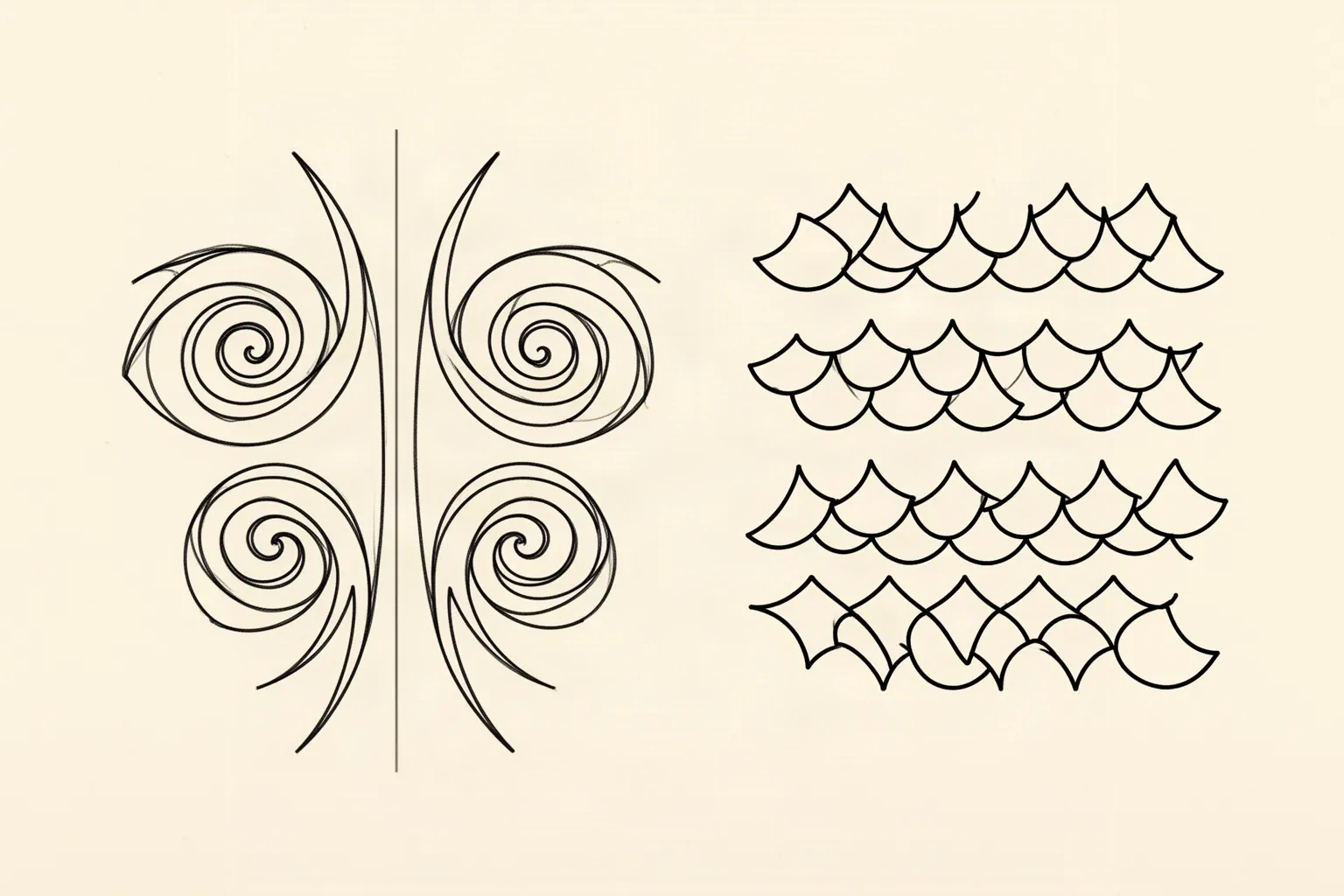
Synthetic line study on cream paper: a mirrored pair of tapered spiral forms split by a thin center axis, with repeated rows of overlapping scallop shapes beside them, drawn in a single black outline weight.
Synthetic instructional study, not app output and not a wearable flash design. Use it as a comparison surface, not a design to copy: on the left, trace each paired spiral from outer arm to inner eye and confirm one shared axis; on the right, follow each scale row and check whether a scale tip keeps clear of the neighboring base. The sketch is informal, so run the same two checks on your own reference at the measured 1:1 print, where tight eyes and crowded rows actually show up.

About 7 cm and below

Wrist accents, ankle bands, behind-ear marks, and small gap fillers.

Carry one simple koru or one unaunahi row maximum with a single contour family. If a spiral eye, scale tip, or sweep channel closes at 1:1, enlarge or reselect rather than forcing reduction. Manaia figures do not belong at this size with interior detail.

About 8 to 14 cm

Common forearm panels, calf work, shoulder caps, and chest emblems.

The most flexible band. A mirrored koru pair or a controlled unaunahi field can work when every spiral channel and scale gap is verified open at true size. Check mirror alignment and repeat consistency before approving motif density.

About 14 cm and above

Thigh puhoro sweeps, upper back panels, and large shoulder compositions.

Room for multi-family curvilinear work and real sweep rhythm, but only when open skin separates every mark from its neighbor. Larger size does not rescue a pinched spiral eye, a drifting scale row, or tapered channels that close at the curve.

Maori feature checks by size band
FeatureAbout 7 cm and belowAbout 8 cm and above
Koru spiral eyes and channelsKeep one spiral with a wide open eye. Inner eyes pinch shut first, so hold fewer turns with more channel room rather than tight double coils.Paired spirals can work when each channel is checked at true size with print scaling off. Mirror halves must match before density is judged.
Unaunahi scale tips and overlapKeep one scale row with open skin between every tip and base. Doubled fine rows merge first.Layered rows can work when tip clearance is verified at 1:1. Overlap depth must match across the run.
Puhoro band and channel rhythmAvoid sweep compositions. Short bands crowd and channels share hairline widths.Measure bands and channels at the narrow end of the taper. One fewer band with open channels beats a full count that closes on the curve.
Manaia silhouette and interior detailSilhouette only, no interior feather or scale work. Fine interiors drop out or merge at small sizes.One interior family maximum, ranked strictly below the silhouette. If covering the interior still leaves a weak read, the silhouette itself needs rebuild work.

Reference to clean stencil

Restraint first, then build from the motif outward.

Work in this order so one change at a time can be judged at the same size. Stop when restraint, symmetry, hierarchy, and gaps each read correctly.

  1. 01

    Lock size, placement, and motif family first

    Set the intended physical dimensions in millimeters, name the body area, and commit to one motif family (koru, unaunahi, puhoro, or manaia) before judging the reference. A koru pair that holds at 14 cm on a shoulder can fail at 6 cm on a wrist with no line being wrong on its own. Use the size calculator when target dimensions are still open.

  2. 02

    Run the moko versus kirituhi decision

    Confirm the design is body kirituhi work, not facial moko, rank-linked construction, or lineage content. Face requests and identity-linked forms decline and redirect to a moko practitioner before any stencil work begins. Record the decision and any referral on the consultation record.

  3. 03

    Verify symmetry, rhythm, and silhouette order

    Confirm one center or axis, count the repeat unit on rows and sweeps, compare opposite halves of koru and manaia work at the same scale, and cover interior detail to confirm the silhouette reads alone. Rebuild a drifted axis, a mismatched repeat, or a weak silhouette before touching line weight.

  4. 04

    Set curvilinear hierarchy and reopen gaps at 1:1

    Assign every mark a role: outer contours and spiral arms heaviest, secondary bands and scale bodies second, interior detail lightest or removable. Keep spiral channels, scale gaps, and sweep separations open at true size with scaling off, then run a squint check: step back until fine detail disappears and confirm the motif family still reads.

  5. 05

    Verify print and hand off to transfer depth

    Export a true-size PDF with no fit-to-page scaling, inspect the tightest spiral eye, scale tip, and sweep channel on plain paper, then measure the physical print with a ruler. After the file passes, use the transfer and body-fit owners for media and placement depth rather than repeating their procedures here.

Attribution and consultation

Sign the respect checklist before transfer prep

This checklist turns cultural care into a studio habit. Every line passes before the stencil is approved, and the record stays with the client file.

  • Ask what draws the client to this Maori direction and whether they have a connection to it or guidance from a Maori artist, and record the answer.
  • Name the tradition accurately on the record: kirituhi-inspired body work, with the motif family noted. Never label a studio adaptation as moko or as a specific whanau design.
  • Confirm the design carries no copied facial moko layout, rank-linked extent, or lineage panel lifted into decorative placement.
  • Confirm placement is a body zone the studio can defend in consultation, with face zones excluded from this workflow.
  • Confirm the client understands the piece is inspired pattern work, not a genealogical record, and note that understanding on the record.
  • When the client claims Maori heritage with a lineage-linked request, refer the design conversation to a moko practitioner rather than adapting it in-house.

Stencil-ready checklist

Approve the Maori piece only when every line passes

Run this short sequence with scaling off and a ruler in hand. One failed line means repair, enlarge, reselect, or decline before transfer.

  • Confirm intended dimensions in millimeters, the named body placement, and the chosen koru, unaunahi, puhoro, or manaia family.
  • Confirm the moko versus kirituhi decision with placement restraint applied and the outcome recorded.
  • Confirm one center or axis with matching opposite halves and consistent repeat rhythm.
  • Confirm the silhouette reads with interior detail covered and hierarchy ranked heaviest outward.
  • Confirm every spiral channel, scale gap, and sweep separation stays open at 1:1.
  • Confirm the respect and attribution checklist is signed off before transfer prep begins.
  • Export a true-size PDF with scaling off and measure the physical print.

Maori transfer prep

Transfer without closing the curves

Maori-direction transfers fail at four predictable points. Each one below names the early sign and the prevention that keeps the motif honest. Full transfer and placement procedures stay with their owners.

Spiral-eye fill-in

Early sign: A koru inner eye prints as a solid dot on paper or skin although the screen file looked open.

Prevention: Judge spiral eyes on the measured 1:1 paper print, not the screen. Widen the eye or remove an outer turn when the tightest must-keep eye closes, and re-check after any contour weight increase.

Scale-tip merger

Early sign: Unaunahi tips join their neighboring bases after transfer, so rows read as one banded mass.

Prevention: Hold open skin between every tip and base at true size, keep one fewer row than the reference shows when tips crowd, and lift to confirm separation before the second half of the stencil touches skin.

Sweep-channel closure on the curve

Early sign: Puhoro channels that looked open flat close where the stencil rounds the thigh or calf.

Prevention: Apply with the limb in a natural relaxed position, anchor the sweep center first, and smooth toward both free ends in short passes so the curve cannot drag the rhythm shut.

Manaia detail dropout

Early sign: Fine feather or scale interiors transfer as a broken gray pocket while the silhouette survives.

Prevention: Keep at most one interior family ranked below the silhouette, confirm it at 1:1 before committing transfer paper, and remove rather than thin interior work that closes.

Prerequisites before the transfer touches skin

Confirm the measured 1:1 paper print with a ruler, a clean dry placement area, and the planned anchor point (center for koru and manaia work, lead end for unaunahi and puhoro runs). Transfer in sections from the anchor so the free end cannot drag the rhythm shut. If the first contact looks faint or patchy, diagnose the layer with the transfer troubleshooter instead of pressing harder.

Open the transfer troubleshooter
Restraint before stencil work Verify channels at 1:1 Attribution on the record

FAQ

Maori stencil decisions, answered

Short answers for the motif, restraint, respect, and transfer checks that recur when a Maori-direction reference moves toward transfer-ready output.

It is viable when four checks pass at the exact physical size: the motif family is identified as koru, unaunahi, puhoro, or manaia with one stable center, axis, or repeat unit; opposite halves or neighboring repeats match; the silhouette reads with interior detail covered; and every spiral channel, scale gap, or sweep separation stays open at 1:1 with scaling off. If any check fails, the fix list on this page names what to rebuild, simplify, or enlarge before print, and the size calculator sets exact dimensions.

Next steps

Use the neighboring owners for adjacent jobs.

This guide covers Maori motif vetting, moko versus kirituhi restraint, respect sign-off, and transfer-ready handoff. Use the links below for related jobs such as sizing, print checks, paper, placement, and adjacent traditions.

Broad Polynesian comparison, tribal flow depth, geometric direction depth, board organization, grid overlays, photo-quality scoring, generic conversion, paper manufacturing detail, and placement mechanics stay in their specialist owners. The links above hand off instead of repeating that detail.

From evaluated reference to working stencil

Turn the approved Maori-direction piece into a stencil draft.

Start from the motif family that passed the symmetry, restraint, and gap checks, then continue on iPhone for body fit, exact-size print, mirror and professional export.