
Joker variant map

Pick the Joker variant that survives final size

Card emblems, grin-faces, smeared cinematic builds, cropped grins, minimal icons, and framed hybrids all fail in different ways. Compare the six options below, check grin and makeup at your exact size, then prep one clean transfer-ready stencil.

Built for working artists choosing between Joker directions. This page compares the six variants with comparative final-size vetting. Full single-reference scoring stays on the Joker stencil page, paired-mask comparison stays on the theater-masks subject, broad likeness depth stays on the portrait maker, and payasa plus lettering vetting stays on the chicano owner.

Variant map

Six Joker directions, six different size contracts.

Choose from silhouette and expression cues first. Each card names the visual contract: where it fits, what to protect, and which failure to expect at true size.

Card-icon emblem

Joker playing-card construction: pointed hood or jester hat, symmetric face, one suit mark, clean card border.

Best at 7 to 12 cm on symmetric panels, forearms, calves, and chests.

Keep: Keep hood tine separations, grin band with open corners, both eye marks, border plus one corner pip.

Fails when: Fails when the frame geometry goes sloppy. A weak border plus a plain face reads as generic card art, not Joker.
Classic grin-face portrait

Clean comics-style character face: wide extended grin, darkened eye framing, pale face field, styled hairline.

Best at 10 to 16 cm on thigh, back, chest, and shoulder.

Keep: Keep grin width, both eye positions with open rims, face oval, and the two longest hair spikes.

Fails when: Fails first at grin corners and eye rims. Merged corners turn the read into a generic clown oval.

Smeared cinematic face

Textured realism direction: smeared eye black, grin extensions into cheeks, crackle, modeled shading.

Best at 14 cm and above where smears can become bounded marks with clearance.

Keep: Keep face oval and hairline direction, grin placement, both eye positions, and the two longest spikes.

Fails when: Fails when tonal smears transfer as one pocket. Shading must convert to bounded marks or it merges.

Cropped grin close-up

Tight crop on mouth, nose, and partial eyes: grin band plus corner ticks, one nose hint, minimal surround.

Best at 8 to 14 cm on forearm, calf, and shoulder along the limb axis.

Keep: Keep the full grin band corner to corner, open pockets at both corners, and the nose axis hint.

Fails when: Fails when mouth corners share merged edges with fold shading. Corner closure is the top failure for this crop.

Minimal line icon

Recrop emblem: grin plus eyes only, one contour family, no teeth, no crackle, no border flourishes.

Best at 6 cm and below on wrist, ankle, hand, and behind ear.

Keep: Keep one continuous grin band, two separated eye marks, and one outer contour maximum.

Fails when: Fails as a full face with teeth or shading at this height. Enlarge or stay a recrop, never thin further.

Framed face hybrid

Character face set inside a card frame: grin and eyes carry expression, border plus ornament carry structure.

Best at 12 cm and above on thigh, back, and chest where frame and face both fit.

Keep: Keep grin plus eye clearance first, then border geometry, then one ornament maximum near the face.

Fails when: Fails when ornament joins the grin band or an eye. Frame detail must stay subordinate with open skin.

Variant, recognition carrier, and size trade-offs
VariantRecognition carrierMinimum sizePlacement
Card-icon emblemCard frame carries the read, face stays simple.About 7 cm for full emblem.Forearm, calf, chest, symmetric panels.
Classic grin-faceGrin plus eyes carry the read.About 10 cm for full face.Thigh, back, chest, shoulder.
Smeared cinematicGrin plus bounded eye marks after conversion.About 14 cm with converted smears.Thigh, back, large chest panels.
Cropped grinGrin band width carries the read.About 8 cm for the crop.Forearm, calf, shoulder.
Minimal iconGrin plus eyes as a recrop pair.Holds smallest, recrop only.Wrist, ankle, hand, behind ear.
Framed hybridFace plus frame share the read.About 12 cm with one ornament.Thigh, back, chest.

Card vs face decision tree

Answer four questions, then commit to a silhouette.

Work top to bottom and stop at the first match. Each answer protects a different recognition carrier, so one pass settles the card versus face call.

  1. 01

    Under about 7 cm? Stop at card or minimal

    Small heights carry only geometric reads. Choose the card-icon emblem when the client wants instant Joker recognition, or the minimal grin-plus-eyes recrop when they want a face cue. Full faces, smears, and framed hybrids are not candidates at this height.

  2. 02

    Symmetric panel or instant read? Choose the card

    When the placement is symmetric or the brief is recognition without likeness, the card frame carries the read and the face can stay simple. Protect hood, border, and suit-mark geometry first, since a weak frame is the failure mode here.

  3. 03

    Expression or likeness matters? Choose a face

    When acting, mood, or a supplied face reference drives the piece, choose classic grin-face at 10 cm and above, or smeared cinematic at 14 cm and above with smears converted to bounded marks. Protect grin width and eye clearance first, since corners and rims are the failure mode here.

  4. 04

    Want frame plus face? Earn the hybrid

    Choose the framed hybrid only at 12 cm and above, only after grin and eyes pass on their own, and only with one ornament near the face. If any ornament touches the grin band or an eye at 1:1, remove it before changing face mass.

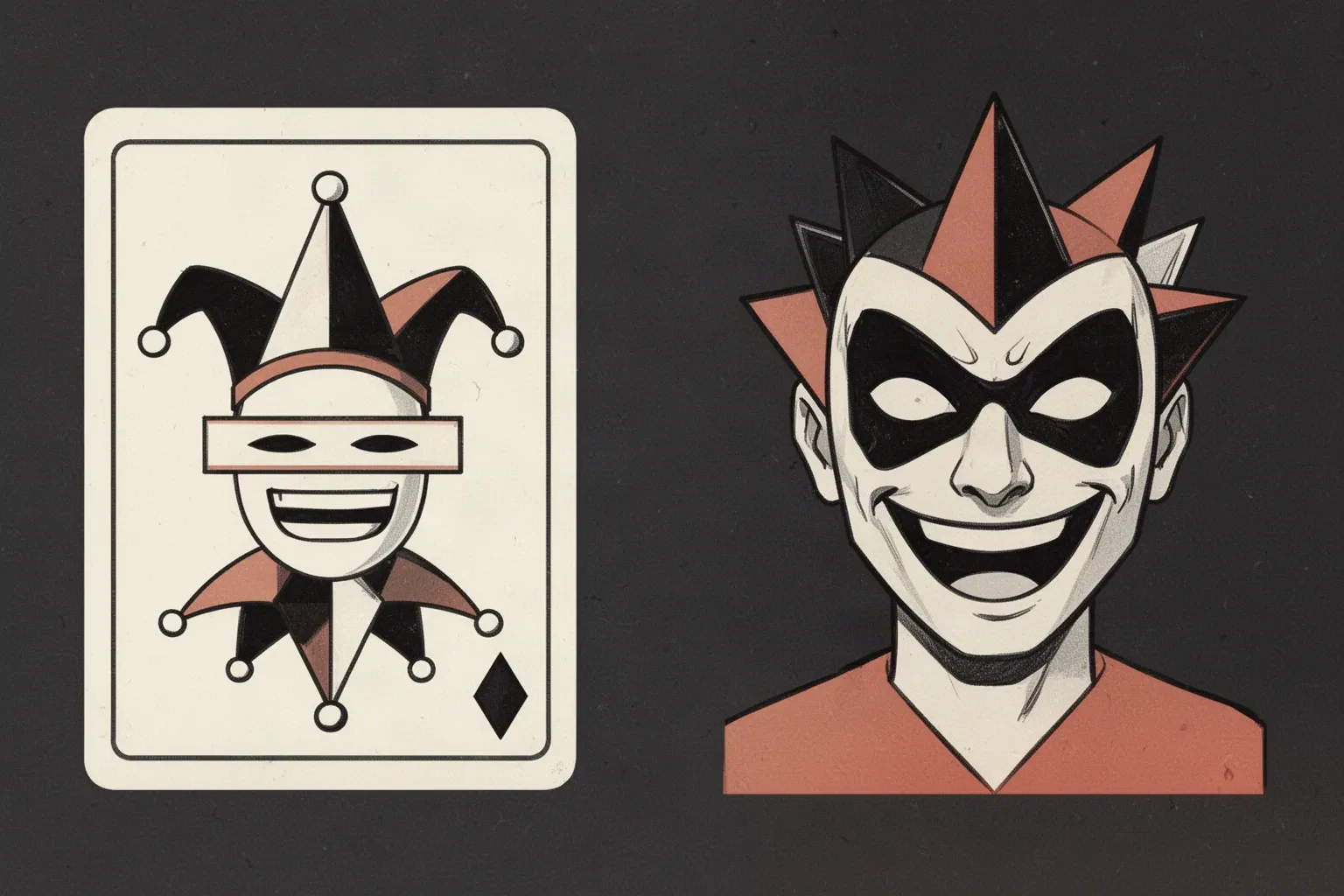
Side-by-side editorial illustration of two Joker recognition carriers: a playing-card emblem whose border and card geometry carry the read, next to a full character face whose grin band and eye marks carry the read
Card frame versus character face. Original editorial illustration, not app output. Left: the card border and card geometry carry recognition, so the face can stay simple and small. Right: the grin band and eye marks carry recognition, so the face needs height and open corners to survive transfer.

Comparative readability vetting

Vet the chosen variant at the size you will print.

Four labeled outcomes tied to variant choice. Each one names the protected structure, the fix, and the go or no-go verdict at that exact size. Confirm with a measured 1:1 print.

HOLDS AT STATED SIZE

Card-icon emblem at 10 cm holds

Intended height 100 mm

Source
Symmetric joker-card construction: pointed hood with three tines, simplified face with a wide grin band and two eye slits, one diamond suit mark, clean rectangular border with one corner pip. No shading, no flourishes.
Protect
Hood tine separations, grin band with open skin at both corners, both eye slits with open rims, border with one corner pip.
Fix
Shorten only the shortest hood tine if two tips touch at 1:1. Keep grin width, eye spacing, and border geometry unchanged.
Candidate stencil
Same variant with a continuous grin band, bounded eye marks with open rims, reopened hood or hair gaps, and protected grin and frame contours held at transferable mass.
Final-size verdict
Go at 10 cm after a tine-spacing check. The frame carries the read so the face stays simple, and every gap transfers as open skin at true size.

REOPEN GRIN CORNERS

Cropped grin at 12 cm needs corners reopened

Intended width 120 mm

Source
Tight crop on mouth and nose: wide grin with corner ticks, one nose hint, shaded folds, partial eye framing at the top edge. Both mouth corners share merged edges with fold shading at true size.
Protect
Full grin band corner to corner, open pockets at both corners, nose hint that sets the center axis.
Fix
Reopen both corner pockets until each runs from grin band to open skin at 1:1, then reduce fold shading to one short mark per side. Do not narrow the grin to save the shading.
Candidate stencil
Same variant with a continuous grin band, bounded eye marks with open rims, reopened hood or hair gaps, and protected grin and frame contours held at transferable mass.
Final-size verdict
Go at 12 cm once both corners stay open at true size. Grin width is the anchor for this variant, and corner closure is its most common transfer failure.

SIMPLIFY SMEARS FIRST

Smeared cinematic face at 15 cm needs conversion

Intended height 150 mm

Source
Character face with smeared eye black, grin extensions into cheeks, hair spikes, forehead crackle, shaded jaw. Convincing as illustration, but tonal smears and crackle rows carry no stencil separation.
Protect
Face oval and hairline direction, grin placement, both eye positions, two longest hair spikes.
Fix
Convert smeared eye black into two bounded marks with open rims, reduce crackle to at most three short strokes or remove it, keep one jaw line maximum. Verify every gap at 1:1 before print.
Candidate stencil
Same variant with a continuous grin band, bounded eye marks with open rims, reopened hood or hair gaps, and protected grin and frame contours held at transferable mass.
Final-size verdict
No-go until smears become bounded marks. Shaded modeling merges into one pocket at transfer while grin and eye positions can stay.

ENLARGE OR RECROP

Fine-line full face at 6 cm fails

Intended height 60 mm

Source
Delicate outline-only full face with tooth ticks, thin grin extensions, narrow eye framing, forehead crackle, collar detail. Built from hairline contours with narrow separations throughout.
Protect
Grin band position and the two eye positions that give the face its direction.
Fix
Enlarge past the point where grin, both eyes, and one outer contour each transfer as open shapes, or recrop to the minimal icon variant. Do not keep teeth and crackle together at 6 cm.
Candidate stencil
Same variant with a continuous grin band, bounded eye marks with open rims, reopened hood or hair gaps, and protected grin and frame contours held at transferable mass.
Final-size verdict
No-go at 6 cm as drawn. Teeth and crackle read as one band and eyes print as broken scratches. Enlarge, recrop, or switch to the card-icon variant for this height.

Paired comedy and tragedy mask comparison stays on the theater-masks subject. Broad portrait recognition comparison stays on the portrait maker and people collection. Payasa and lettering vetting stays on the chicano owner. Full single-reference scoring stays on the Joker stencil page. This vetting exists to compare Joker variants against each other at a stated size, not to replace those owners.

Variant to clean stencil

Simplify the variant, then lock transfer readiness.

Work in this order so one change at a time can be judged at the same size. Stop when grin, eyes, frame, and texture each read correctly.

  1. 01

    Pick variant from size and placement

    Set the physical height in millimeters and name the body area first, then choose from the map above. A grin-face that holds on a thigh fails on a wrist with no line at fault. Use the size calculator while dimensions are still open.

  2. 02

    Name the recognition carrier

    State whether the card frame, the grin plus eyes, or a shared hybrid carries the read, then rank everything else as support. Resolve grin corner contacts, eye smear contacts, and ornament contacts before touching line weight.

  3. 03

    Simplify variant detail at 1:1

    Reduce tooth ticks, crackle rows, smear modeling, and extra pips at true size. Keep open skin at both grin corners and around both eyes. Run a squint check: step back until fine texture disappears and confirm the variant still reads.

  4. 04

    Rank ornament last

    Confirm one ornament maximum near the face, drawn lighter than grin and eye structure, with open skin at every contact. Remove the ornament before touching grin or eye mass when density is the blocker.

  5. 05

    Print true size and measure

    Export a true-size PDF with scaling off, inspect the narrowest grin corner, both eye rims, and the smallest hood, hair, or ornament gap on plain paper, then measure with a ruler. If the file passes and only paper fails, move to print-stage evidence instead of simplifying again.

Stencil-ready checklist

Approve the variant only when every line passes

Run this short sequence with scaling off and a ruler in hand. One failed line means fix, enlarge, or reselect before transfer.

  • Confirm intended size in millimeters, named placement, and one variant from the map above.
  • Confirm the grin band stays continuous with open skin at both mouth corners at 1:1.
  • Confirm both eye marks read as separate shapes with open skin around each one.
  • Confirm hood tines or hair spikes stay countable with no merged tips.
  • Confirm ornament and texture total support only, with no contact on grin or eyes.
  • Export a true-size PDF with scaling off and measure the physical print.
Variant first, then size Verify gaps at 1:1 Frame or face, not both

FAQ

Joker variant decisions, answered

Short answers for the variant, card versus face, grin, makeup, size, and handoff checks that recur when a Joker direction moves toward transfer-ready output.

Match the silhouette to the available height. Card-icon emblems suit symmetric panels and small to mid placements around 7 cm and above. Classic grin-faces suit thigh, back, chest, and shoulder pieces around 10 cm and above. Smeared cinematic faces need about 14 cm and above with smears converted to bounded marks. Cropped grins suit forearm and calf flow around 8 cm and above. Minimal icons suit wrist, ankle, hand, and behind-ear fields as a recrop. Framed hybrids suit large panels around 12 cm and above.

Next steps

Use the neighboring owners for adjacent jobs.

This guide covers cross-variant choice, card versus face disambiguation, comparative grin and makeup vetting plus ornament gap rules, and variant-to-stencil preparation. Use the links below for related jobs such as full evaluation, sizing, print checks, and browsing.

Full single-reference scoring stays on the Joker stencil page, paired-mask and ribbon-framing depth stays on the theater-masks subject, broad likeness depth stays on the portrait maker and people collection, and payasa plus lettering workflows stay on the chicano owner. The links above hand off instead of repeating that detail.

From chosen variant to working stencil

Turn the approved Joker variant into a stencil draft.

Start from the variant that passed the grin, eye, and gap checks, then continue on iPhone for body fit, exact-size print, mirror and professional export.