
Jesus variant chooser

Pick the Jesus depiction that stays recognizable

Portrait, Sacred Heart, praying hands, and cross compositions fail in different ways on skin. Compare the four options below, run the facial and gap checks at your exact size, then leave with a chosen variant, a placement rule, and the right link for printing.

Built for working artists choosing between Jesus directions. This page compares the four depictions with comparative final-size checks. Full single-reference scoring stays on the Jesus stencil page, portrait likeness depth stays on the portrait maker, and print execution stays on the transfer guide.

Variant map

Four Jesus directions, four different size contracts.

Choose from depiction and intent first. Each card names the visual contract: where it fits, what to protect, and which failure to expect at true size.

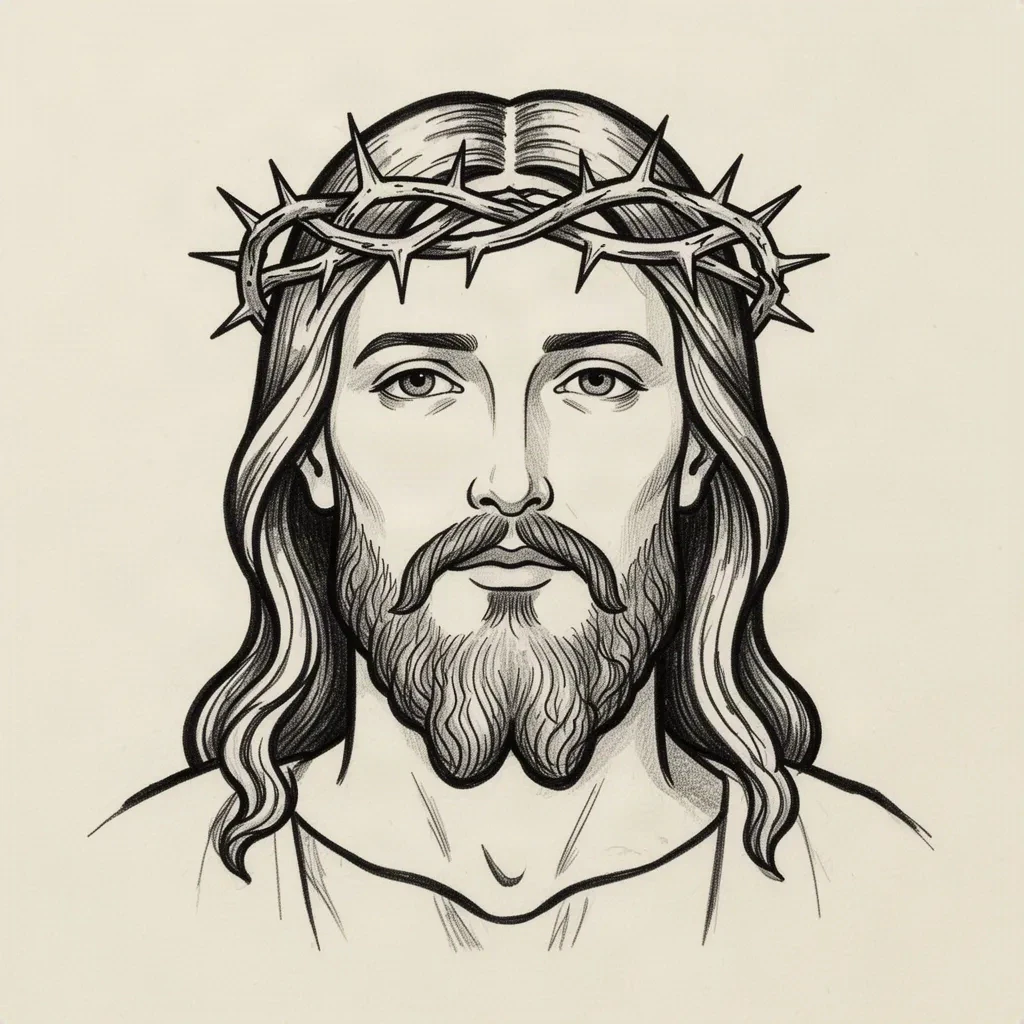
Synthetic black line illustration of a sorrowful Jesus portrait with a calm forward gaze, center-parted hair, full beard, and a crown of thorns band above the brow

Sorrowful portrait with crown of thorns

Head and shoulders, calm gaze, center-parted hair, full beard, thorn band above the brow.

Best at 10 to 15 cm on forearm, calf, shoulder, chest, and thigh.

Keep: Keep eye spacing, one nose hint, mouth position, the two longest hair masses, and the thorn band position.

Fails when: Fails when thorn points touch hair or brow, or when fine strand texture closes the gaps between hair masses.

At size: The thorn band is the first gap to test. At about 10 cm it must stay clear of hair and brow while eye spacing still reads.
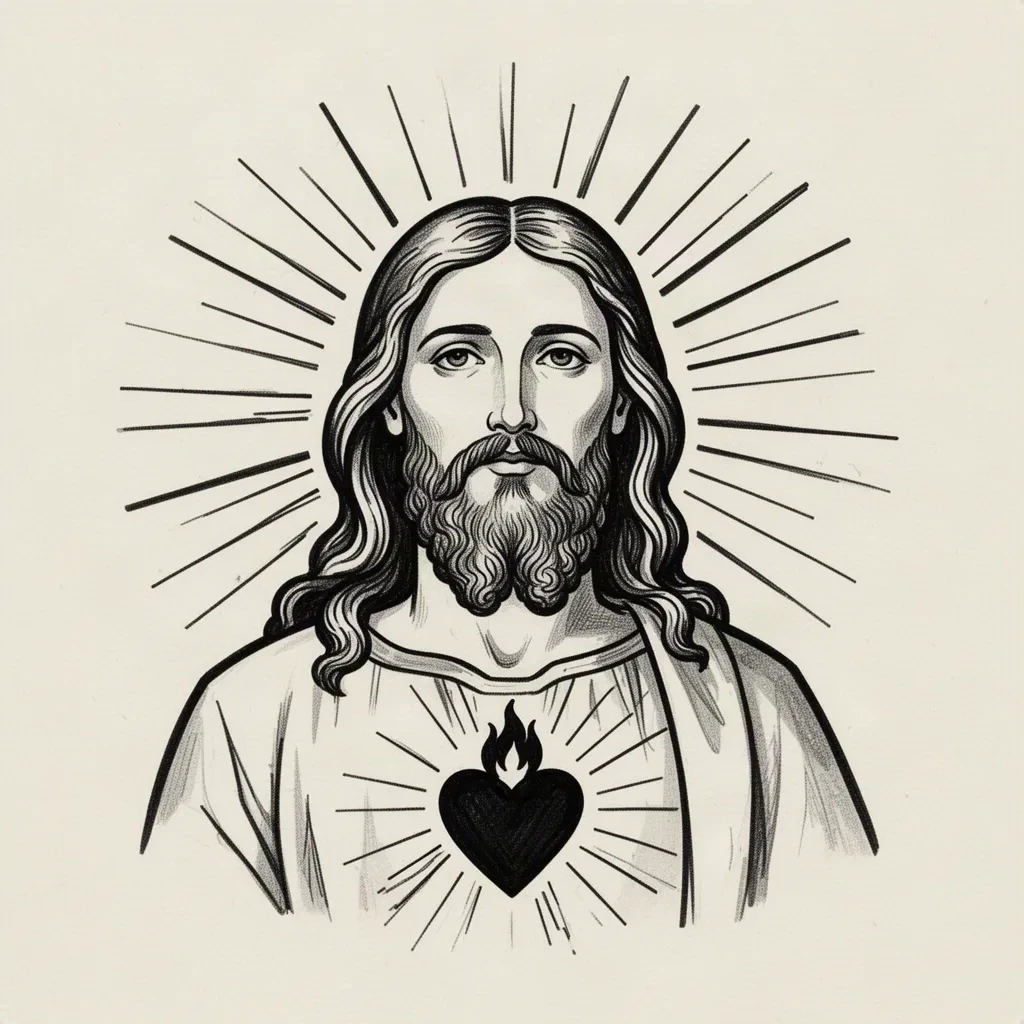
Synthetic black line illustration of a three-quarter Jesus figure with a Sacred Heart emblem, flame, and radiating rays behind the head and shoulders

Sacred Heart devotional composition

Three-quarter head with a visible heart emblem, flame, and radiating rays behind head and shoulders.

Best at 15 cm and above on upper back, chest, and large thigh panels with room for rays.

Keep: Keep face oval and eye placement, beard direction toward the chin point, heart outline, and the longest ray directions.

Fails when: Fails when thin rays share the same fine mass as hair strands, or when rays touch the head or shoulder edges.

At size: Ray spacing decides the read. Below about 15 cm the rays compete with hair strands and stop separating at 1:1.

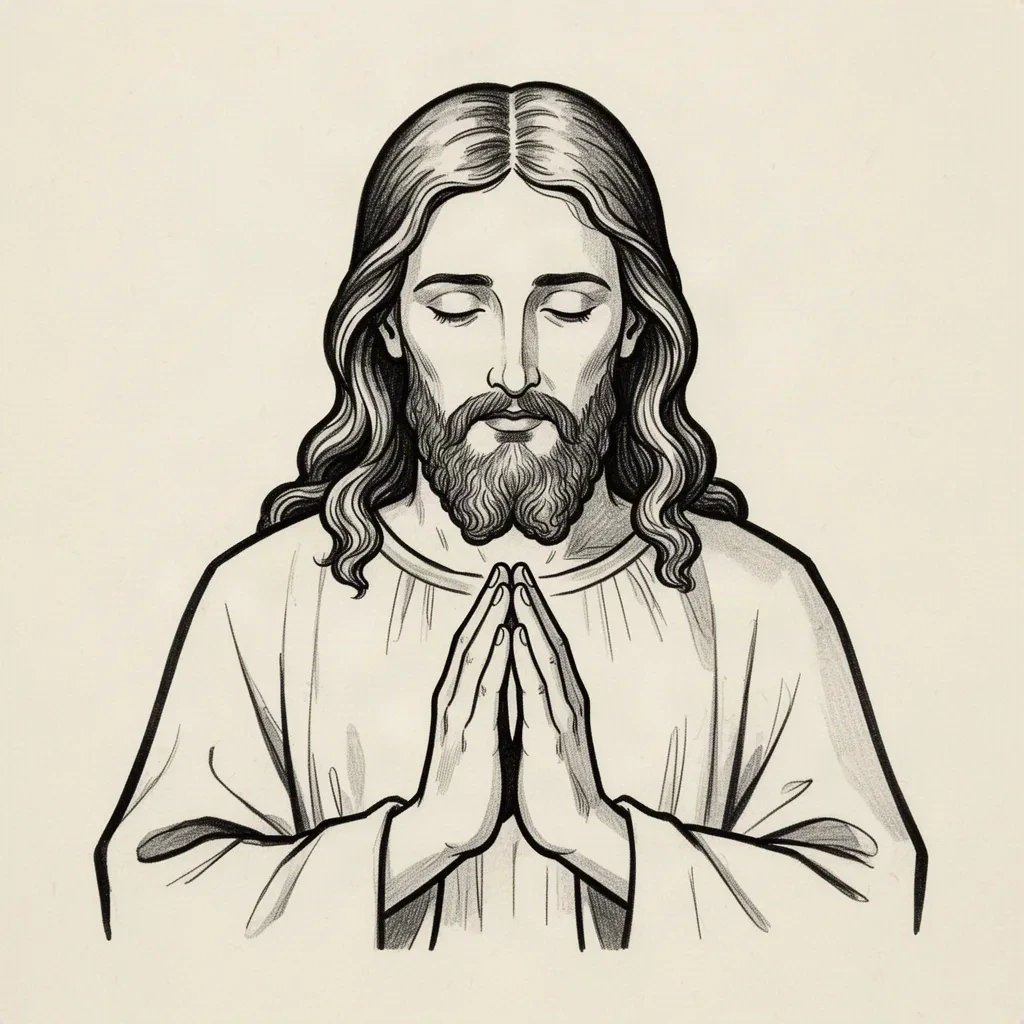
Synthetic black line illustration of a bowed Jesus half-figure with long hair over the shoulders and hands pressed together in prayer at the chest

Praying half-figure with folded hands

Bowed head, long hair over the shoulders, hands pressed together at the chest.

Best at 12 to 16 cm on upper arm, thigh, chest, and upper back where hands keep open channels.

Keep: Keep head bow angle, one clear separation between the palms, outer sleeve silhouette, and the two longest hair masses.

Fails when: Fails when finger separations narrow toward the fingertips and digits converge into one pocket.

At size: Finger channels decide the read. At about 12 cm every digit separation must stay open from palm to fingertip.

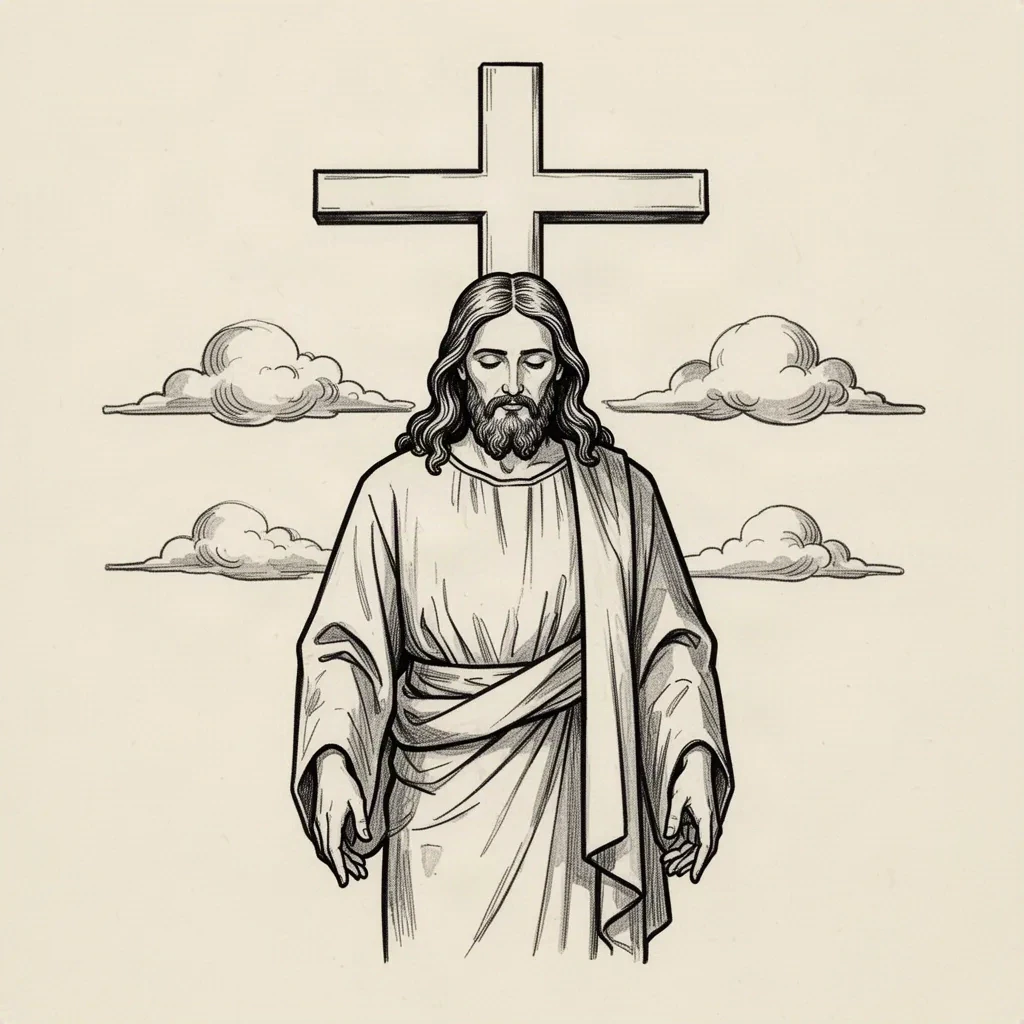
Synthetic black line illustration of a Jesus figure standing before a tall cross with drapery folds and low cloud bands behind the figure

Cross-composition scene

Jesus figure set against a cross with drapery, cloud bands, or small lettering.

Best as a large back or chest piece, or recropped to the portrait head for heights under about 12 cm.

Keep: Keep the figure axis with head position and the cross vertical that carries the composition.

Fails when: Fails at small heights when figure, cross edge, and background bands merge into one textured band.

At size: Figure, cross edge, and cloud bands merge first. Under about 12 cm, recrop to the head instead of thinning the scene.

Illustrations above are original synthetic linework drawn to compare composition. They are not StencilStudio app output, customer work, or a size-calibration reference. Confirm thorn, ray, and finger gaps against your own 1:1 print at the exact physical height.

Jesus variant recognition, risk, size, and placement trade-offs
VariantRecognitionDetail riskMinimum heightPlacement
Portrait with crownHighest: the face carries everything with no emblem needed.Thorn tips touching hair or brow; fine hair strands merging.About 10 cm for crown plus face.Forearm, calf, shoulder, chest, thigh.
Sacred HeartHigh: face plus heart emblem and ray rhythm name the devotion.Ray count competing with hair strands for the same gap room.About 15 cm with ranked rays.Upper back, chest, large thigh.
Praying half-figureHigh: bow plus hand gesture read even at distance.Finger channels closing toward fingertips; sleeve texture crowding hands.About 12 cm with open finger channels.Upper arm, thigh, chest, upper back.
Cross compositionNarrative: cross axis plus figure carry memorial meaning.Background bands and lettering merging with figure edges at small sizes.Large piece, or recrop to head under 12 cm.Back, chest, or recropped portrait fields.

Once the variant is set, run the full single-reference scoring on the Jesus stencil page. That sibling covers reference evaluation at a stated height, while the choice between depictions happens here.

Facial safeguards

Protect the face before decorating around it.

Recognition comes from proportion and flow, not from shading density. Run these four checks on every Jesus variant before judging thorns, rays, or hands.

Eye spacing and nose hint

Settled eye spacing with one nose hint and open skin on both sides carries calm recognition.

Avoid: Do not add shaded cheeks, deep wrinkles, or tear detail to rescue a weak eye placement. Fix the spacing first.

Beard and hair flow

Two or three long directional masses with one parting or chin point carry reverent character.

Avoid: Do not keep every strand. If removing a third strand group changes nothing about the first read, merge it before print.

Mouth and expression

A composed mouth inside the beard with a gently bowed or level gaze reads as reverent at any size.

Avoid: Do not use strained, exaggerated sorrow or a sideways glance that reads as distortion once simplified.

The covered-beard test

Cover beard and hair. If the bare eyes, nose hint, and mouth still read as one calm face, proportion is sound.

Avoid: Do not judge the face only with the beard visible. If the face needs the beard to make sense, fix eyes and nose first.

Broad portrait likeness comparison beyond Jesus construction stays on the portrait maker. This section judges Jesus face and beard-flow construction at final size only.

Gap-retention checklist

Thorns, rays, and fingers decide transfer success.

Print at the exact physical height with scaling off, then confirm every line below with a ruler in hand. One failed line means reopen, merge, enlarge, or reselect before transfer.

  • Trace every thorn gap from open skin to open skin at true size, with no thorn tip touching hair or brow.
  • Keep one ranked thorn rhythm: merge the shortest temple crossings first instead of thinning the face.
  • Keep one ranked ray family with open skin between neighboring rays, held clear of the head and shoulder edges.
  • Omit rays, or reduce them to a short plain band, at heights around 8 cm and below.
  • Widen every finger channel until it stays visibly open at 1:1, with one clear separation between the palms.
  • Merge cuff, sleeve, and drapery texture before touching finger or face mass when gaps close.
  • Treat small lettering as the first removal candidate: at small heights it prints as broken scratches.
  • Confirm the full piece with a squint check: when fine marks disappear, face, crown, and gesture must still read.

Placement and scale

Flat skin preserves reverent symmetry.

A Jesus piece is a vertical devotional composition with a strict face axis. Flat placements preserve it with little compensation, while narrow limbs demand a portrait recrop.

Upper back and shoulder blade

Sacred Heart with rays or a praying half-figure. Broad flat field where emblem and hands breathe.

Rule: Center face and heart emblem on the flattest span. The spine centerline exposes asymmetry, so mirror eye placement.

Chest

Portrait with crown or Sacred Heart emblem. Large devotional panel centered on the midline.

Rule: Preview on a body photo, keep emblem edges clear of the face, and confirm symmetry against the midline at true size.

Outer forearm and calf

Portrait head or vertical praying recrop aligned with the limb axis.

Rule: Shorten cross-limb ray fans before print. Wide compositions wrap fast and crowd separations on narrow limbs.

Thigh and upper arm

Half-figures with hands. Curved panels with room for vertical beard flow and gestures.

Rule: Spend extra room on finger channels and thorn gaps first, then decide whether inner rays earn their detail.

Wrist, ankle, and small fields

Tight head recrop only: one face cluster with plain hair masses, no rays, hands, or lettering.

Rule: If a thorn gap or eye spacing closes at 1:1, enlarge or reselect rather than forcing the reduction.

Reverent composition

Five rules that prevent disrespectful crops

Reverence here is a composition discipline: composed gaze, one gesture, intact face and hands, aligned axis, and legible or removed text.

  • Keep the head upright or gently bowed with a composed gaze; avoid strained expressions that simplify into distortion.
  • Keep one clear gesture per piece: a bow, folded hands, or blessing hand. Competing gestures crowd the composition.
  • Never crop through the eyes, mouth, or hands to fit a field. Recrop to the full head or choose a smaller emblem instead.
  • Keep the face axis aligned with the body area: follow the limb on forearms and calves, center on the midline on chest and back.
  • Keep text minimal and legible or remove it: fragmented lettering around sacred imagery reads as careless at small sizes.
Variant first, then size Verify gaps at 1:1 Reverent composition held

FAQ

Jesus variant decisions, answered

Short answers for the depiction, face, gap, size, reverence, and handoff checks that recur when a Jesus direction moves toward transfer-ready output.

Match the variant to intent and available height. A sorrowful portrait with a thorn crown suits memorial and intercession pieces where the face carries everything, and it is the most flexible choice from about 10 cm. A Sacred Heart suits devotional chest and back pieces with room for the heart emblem and ranked rays from about 15 cm. A praying half-figure suits intercession pieces where the bow and hand gesture carry the meaning, from about 12 cm with open finger channels. A cross-composition scene needs the largest height of all and should be recropped to the head when room is short.

Next steps

Use the neighboring owners for adjacent jobs.

This guide covers cross-variant choice, facial safeguards, thorn, ray, and hand gap rules, and placement and scale for reverent composition. Use the links below for related jobs such as scoring, sizing, print checks, and browsing.

Full single-reference scoring stays on the Jesus stencil page, broad portrait comparison stays on the portrait maker, generic conversion stays on the photo-to-stencil owner, print execution stays on the transfer guide, and broad gallery browsing stays on the stencils and subject hubs. The links above hand off instead of repeating that detail.

From chosen variant to working stencil

Turn the approved Jesus variant into a stencil draft.

Start from the depiction that passed the facial and gap checks, then continue on iPhone for body fit, exact-size print, mirror and professional export.