

Infinity loop stencil

Judge any infinity loop before it becomes a stencil

Infinity marks live or die on lobe symmetry and crossing continuity. Check the loop construction, the matched lobes with an open crossing, and the name and accent load at your exact width, then prepare a clean stencil that transfers as one readable loop.

Built for working artists preparing infinity pieces. This page covers infinity loop selection and stencil preparation only, not tattoo application or healing advice. Single-weight, outlined, name-carrying, and accented builds are judged here as different constructions inside one continuity framework.

What makes an infinity stencil-viable

Construction, continuity, and integration load decide the result.

An infinity is one loop with nowhere for asymmetry to hide. These three pillars predict whether that loop survives reduction, print, and transfer.

Loop construction choice

An infinity mark reads as one continuous loop with two matched lobes and one central crossing. Stencil viability comes from picking one construction that fits the size and integration need: a single-weight loop, an outlined double-line loop, a loop carrying one or two short names, or a loop with one small accent. A reference that mixes outline plus names plus dates plus a feather plus a heart is five jobs in one field, not one construction.

Check: Name the construction in one sentence before judging detail. If the reference needs more than one sentence to describe, pick one build first. Mixed constructions cannot be fixed with line weight.
Symmetry and continuity

Both lobes must mirror each other in size, curve, and tilt, and the central crossing must read as one deliberate overlap with open skin on both sides. When one lobe sits larger, the crossing touches a lobe wall, or a threaded name bridges both loop walls, the transfer prints one merged mass and the infinity read goes with it.

Check: Fold the reference through the crossing center and compare lobe outlines, then trace the loop channel from open skin around each lobe and through the crossing. If any segment dead-ends into a filled pocket, reopen that channel before touching texture.

Line weight, gaps, and integration load

The loop contour carries the first read, the crossing defines the construction, and names, dates, or accents only support. When threaded lettering shares equal weight with thin loop walls, small letterforms close first and the loop prints weakly at the same time.

Check: Cover all names, dates, and accents. If the loop still reads as a balanced infinity with an open crossing at true size, the hierarchy is sound. If it collapses into lettering or decoration, rank the lines before changing size.

Infinity evaluation framework

Score the reference in minutes, then act on the weakest check.

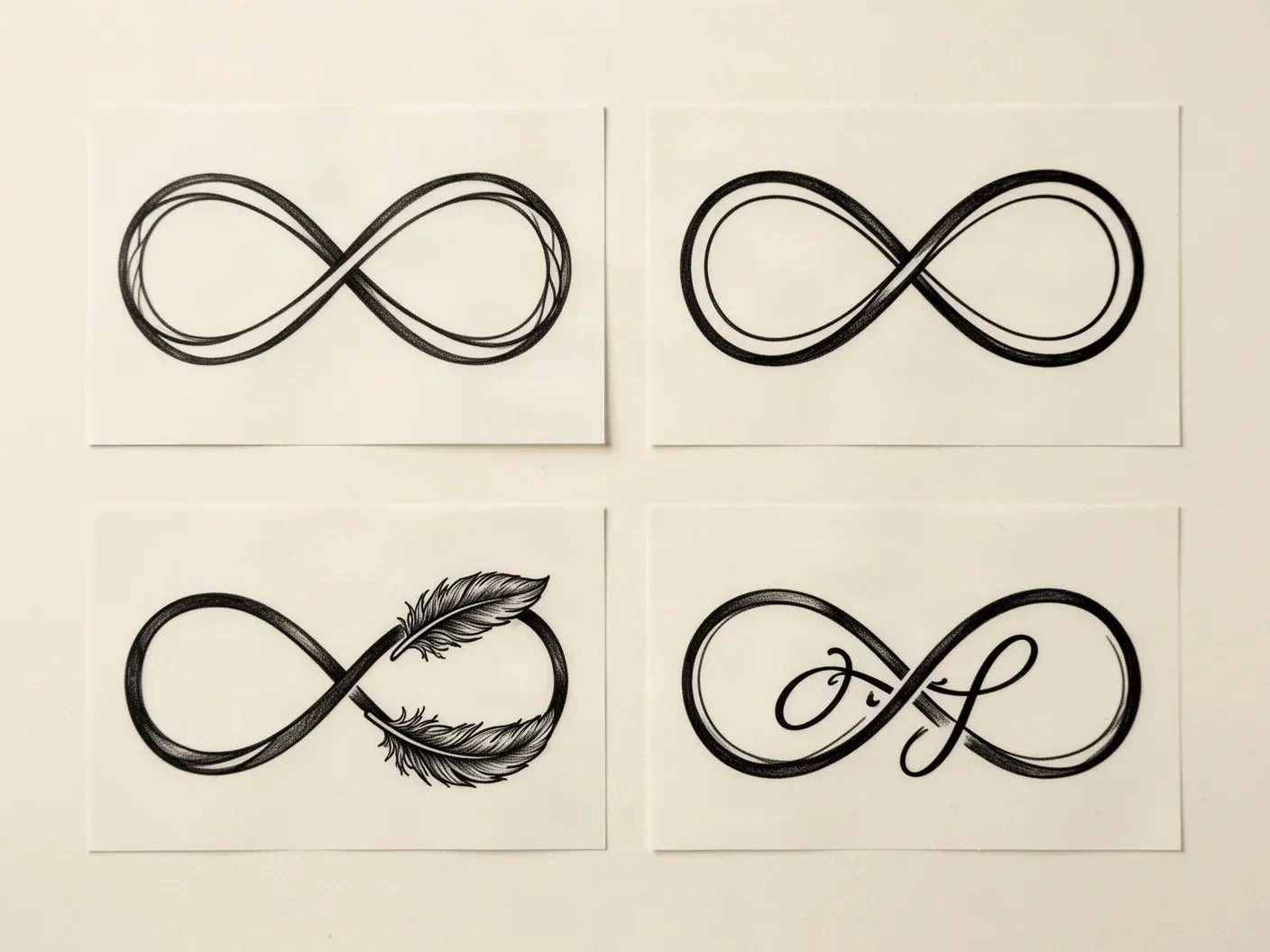
Four infinity constructions at labeled widths. Each one names the protected structure, the fix, and the go or no-go verdict at that exact width. Confirm every verdict with a measured 1:1 print.

Four ink infinity loop constructions: a plain single-weight loop, an outlined double-line loop with an open inner channel, a loop with a feather accent woven into the wall, and a loop with a threaded script flourish inside one lobe.
Original illustration of the four constructions this framework judges, in the same order as the examples below: single-weight loop, outlined loop with inner channel, loop with an accent woven into the loop wall, and loop with a threaded flourish inside one lobe. The two lower panels show the contact the integration checks exist to catch, and both are re-spacing or recrop jobs rather than line-weight jobs. This is synthetic editorial artwork, not StencilStudio app output and not a client stencil. It carries no measurements, so confirm every verdict on a measured 1:1 print.

HOLDS AT STATED SIZE

Single-weight loop with open crossing at 8 cm

Intended width 80 mm

Source
One even single-weight loop with matched lobes, a centered crossing with visible skin on both sides, and no names, dates, or accents inside the field. Quiet on screen, which is why it transfers well.
Protect
The even loop contour, the matched lobe pair with shared tilt, and the open crossing with skin on both sides.
Fix
Adjust only the crossing overlap if it crowds at 1:1. Keep loop weight, lobe size, and tilt unchanged.
Candidate stencil
Same infinity with the construction set, lobes matched, crossing opened, and names or accents ranked below the loop mass.
Final-size verdict
Holds at 8 cm after a crossing check. Both lobes stay distinct at 1:1 and the loop reads from a normal viewing distance.

REOPEN GAPS AND JOINS

Outlined loop with tight inner channel at 6 cm

Intended width 60 mm

Source
Double-line outlined loop where the inner channel narrows toward both lobe tips and nearly closes at the crossing. Decorative on screen with almost no open skin inside the outline.
Protect
The outer loop silhouette with matched lobes, the crossing position, and the widest correct inner channel segment as the spacing reference.
Fix
Widen the full inner channel until it reads as open skin edge to edge at true size, then re-check the crossing separation. Do not thicken the outer contour to hide the crowding.
Candidate stencil
Same infinity with the construction set, lobes matched, crossing opened, and names or accents ranked below the loop mass.
Final-size verdict
Not stencil-ready until the inner channel stays open. Outline loops need more room than single-weight loops at the same width.

RE-SPACE NAMES FIRST

Loop with two short names threaded at 10 cm

Intended width 100 mm

Source
Single-weight loop carrying one short name per lobe, but one name touches both loop walls near the crossing and the second name crowds a lobe tip. The loop silhouette is sound, so spacing is the only break.
Protect
The loop contour with matched lobes, the correctly spaced name as the tracking reference, and the open crossing.
Fix
Shorten or re-track the touching name until daylight separates every letterform from both loop walls, keep each name on its own lobe segment clear of the crossing, and re-check at 1:1. Do not thin the loop walls to fit longer names.
Candidate stencil
Same infinity with the construction set, lobes matched, crossing opened, and names or accents ranked below the loop mass.
Final-size verdict
Not stencil-ready until every letterform holds clearance. Threaded names fail by contact, and contact cannot be fixed with line mass.

ENLARGE OR RECROP

Loop with feather and heart pairing at 6 cm

Intended width 60 mm

Source
Appealing loop with a feather woven along one lobe and a small heart at the crossing, but feather barbs touch the loop wall in two places and the heart bridges the crossing overlap. Attractive on screen with almost no separation at this width.
Protect
The loop silhouette with matched lobes, the crossing position, and the single strongest accent as the pairing anchor.
Fix
Separate the surviving accent fully clear of the loop with visible skin on all sides and remove the second accent, or keep the pairing only after enlarging past the point where every contact stays open. Do not invent spacing from merged contact.
Candidate stencil
Same infinity with the construction set, lobes matched, crossing opened, and names or accents ranked below the loop mass.
Final-size verdict
At 6 cm the contacts function as bridges and the pairing reads as one mass. Enlarge, recrop to the loop alone, or choose one separated accent for this size.

Cross-symbol silhouette comparison stays on the symbols collection. Family archetype choice stays on the family stencil guide. This framework exists to judge loop construction, crossing continuity, and integration clearance at a stated width, not to replace those owners.

Line weight, gaps, and joins at final size

Judge the white space at the width you will print.

Screens forgive crowding that paper and skin do not. Set the width first, then inspect each feature below at true physical size with scaling off.

About 5 cm and below

Finger sides, behind-ear marks, wrist edge, and ankle accents.

Carry the single-weight loop alone. Keep one contour family, protect the crossing separation above all else, and carry no threaded names, dates, or pairings. If the crossing or any loop segment closes at 1:1, enlarge or reselect rather than forcing reduction.

About 6 to 10 cm

Common wrist, ankle, collarbone, and forearm infinity pieces.

The most flexible band. One loop with at most one short threaded name or one small separated accent can work when every gap is verified at true size. Check lobe symmetry, crossing clearance, and letterform separation before approving integration.

About 10 cm and above

Forearm panels, shoulder pieces, and infinity compositions with real integrations.

Room for two short names, a date, or one separated pairing, but only when open skin separates every letterform and every accent from the loop walls edge to edge. Larger width does not rescue touching names or bridging accents.

Infinity feature checks by width band
FeatureAbout 5 cm and belowAbout 6 cm and above
Loop contour and lobe symmetryKeep the loop contour as the heaviest mark. If one lobe drifts larger or the tilt shifts, the piece reads as a loose figure eight rather than an infinity.Same priority. Larger width allows slightly finer loop contours, but matched lobes still beat decorative weight changes.
Crossing, joins, and inner channelsThe crossing must keep open skin on both sides at 1:1. Outlined loops need the full inner channel open edge to edge, so prefer single-weight builds at micro widths.Crossings and joins can carry slightly tighter overlaps, but each separation must still survive print and transfer as its own opening.
Names, dates, and letterformsCarry no threaded lettering. Even short names bridge thin loop walls at micro widths and the loop silhouette collapses first.One short name per lobe segment can work when every letterform holds daylight to both loop walls and no name splits across the crossing. Size the whole piece around the smallest counter and join.
Accents and pairingsKeep the loop alone. Feathers, hearts, birds, and florals forced into micro fields bridge the loop walls first.One accent can add meaning when the loop clearly dominates and sits fully clear of the walls and crossing. Equal-weight doubles need hierarchy work before print.

Name and date integration

Thread wording through the loop without touching both walls.

Names fail inside infinity loops by contact, not by style. These six rules keep threaded wording subordinate to the loop silhouette at true size.

One name per lobe segment

Keep each name on its own straight-ish lobe run, fully clear of the crossing and the lobe tips. A name that splits across the overlap touches both walls at once and the join fills first.

Daylight on both walls

Every letterform needs visible skin between itself and each loop wall at true size. If one tall letter or flourish touches, shorten the name or re-track it rather than thinning the loop.

Size the smallest counter first

Small enclosed counters in threaded names fill faster than the loop does. Check the smallest counter and the tightest join at the exact width, and size the whole piece around that mark.

Dates stay subordinate

Birth dates and years sit small and secondary, either along one lobe interior or just outside the loop. A date that competes with a name for the same segment crowds both, so park it where it cannot bridge the walls.

Script joins need extra tracking

Joined script names spread as they heal, so tracking that looks elegant on screen can bridge on skin. Open tracking slightly on small threaded names and confirm neighboring letters never share one merged edge at 1:1.

Silhouette must survive cover-up

Cover all names, dates, and accents. If the bare loop no longer reads as a balanced infinity with an open crossing, the integration is carrying structure it should not carry. Fix the loop before re-adding wording.

Reference to clean stencil

Build from the loop outward, then set the wording.

Work in this order so one change at a time can be judged at the same width. Stop when loop, crossing, wording, and accents each read correctly.

  1. 01

    Lock width, placement, and integration intent first

    Set the intended physical width in millimeters, name the body area, and decide loop alone versus loop with names versus loop with one accent before judging the reference. A loop that holds at 10 cm on a forearm can fail at 5 cm on a finger with no line being wrong on its own. Use the size calculator when target dimensions are still open.

  2. 02

    Verify lobe symmetry and crossing state

    Fold the reference through the crossing center and compare lobe size, curve, and tilt on both sides, then confirm the crossing reads as one deliberate overlap with open skin. Resolve lobe mismatch and crossing contact before touching line weight. A loop with matched lobes and an open crossing is already halfway to stencil-ready.

  3. 03

    Set loop-versus-support roles

    Assign every mark a role: the loop that carries the first read, open skin that separates the crossing and any integration, and names, dates, or accents that may be removed without changing identity. Strengthen the loop contour first, keep integration compact, and mark one removable element that can go if gaps close.

  4. 04

    Simplify integration and reopen gaps at 1:1

    Shorten names, reduce accent count, and reopen the crossing and every letterform clearance before thinning contours. Keep daylight between each letter and the loop walls, and run a squint check: step back until fine detail disappears and confirm the loop still reads as an infinity. The line-weight guide covers fine, normal and bold behavior on the same stencil.

  5. 05

    Verify print and transfer path

    Export a true-size PDF with no fit-to-page scaling, inspect the narrowest crossing gap, the tightest name clearance, and the smallest accent separation on plain paper, then measure the physical print with a ruler. If the digital file passes and only paper fails, move to print-stage evidence instead of simplifying again.

Placement and width decisions

Infinity loops want flat runs that protect the crossing.

A loop is a wide, low construction with one critical overlap. Flat placements preserve the crossing with little compensation, while tight curves demand a plain loop verified on skin.

Wrist and ankle

Narrow wrapped bands where the loop runs along the limb axis well. Length is available but height is not, so stacked names and tall accents crowd the loop walls fast.

Check: Align the loop axis with the limb, keep threaded names on the flattest span with clearance on both walls, and confirm the crossing stays open after wrapping the preview.

Fingers and behind ear

Very small curved fields where only a plain loop survives. Threaded names, dates, and outline channels forced into these spots merge first.

Check: Recrop to the strongest single-weight loop at the exact width, then run the crossing and lobe checks with a ruler before approving anything else.

Forearm and collarbone

Flat runs with room for one short integration. The most forgiving small-to-mid field for a name-carrying loop when spacing is verified.

Check: Center the loop on the flattest span, keep each name on its own lobe clear of the crossing, and confirm every letterform clearance at 1:1 before print.

Shoulder, thigh, and upper back

Broad panels with room for two short names, a date, or one real separated pairing. The width is the asset, so loop-to-integration separation needs checks rather than compression.

Check: Spend the extra room on name and accent separation first, keep dates subordinate to the loop, and verify the crossing plus every clearance at true size.

Stencil-ready checklist

Approve the infinity only when every line passes

Run this short sequence with scaling off and a ruler in hand. One failed line means fix, enlarge, or reselect before transfer.

  • Confirm intended width in millimeters, the named placement, and the single loop construction.
  • Confirm matched lobes with shared tilt on a fold test through the crossing center.
  • Confirm the crossing keeps open skin on both sides at 1:1.
  • Confirm every threaded letterform holds daylight to both loop walls with no split across the crossing.
  • Confirm no accent bridges the loop walls or the crossing overlap.
  • Export a true-size PDF with scaling off and measure the physical print.
Matched lobes plus open crossing Verify gaps at 1:1 Wording stays clear of walls

FAQ

Infinity stencil decisions, answered

Short answers for the construction, continuity, integration, placement, and print checks that recur when an infinity reference moves toward transfer-ready output.

It is usable when three checks pass at the exact physical width: matched lobes with one deliberate open crossing, every loop channel and crossing separation open at 1:1, and any names, dates, or accents reading as separate marks with daylight to the loop walls. If any check fails, the fix list on this page names what to re-space, simplify, or enlarge before print.

Next steps

Use the neighboring owners for adjacent jobs.

This guide covers infinity loop construction choice, crossing and gap vetting, name and date integration, small-placement fit, and reference-to-stencil preparation. Use the links below for related jobs such as sizing, print checks, paper, and placement.

Family composition triage, broad symbol comparison, filigree scrollwork technique, lettering generator mechanics, generic small-stencil workflows, and paper manufacturing detail stay in their specialist owners. The links above hand off instead of repeating that detail.

From evaluated reference to working stencil

Turn the approved infinity into a stencil draft.

Start from the loop that passed the lobe, crossing, and clearance checks, then continue on iPhone for body fit, exact-size print, mirror and professional export.