Gods, columns, meander bands, myth scenes and lettering fail in different places on skin. Compare the five families below on silhouette, density and placement fit, run the final-size triage at your exact dimensions, then prep one transfer-ready stencil.
Built for working artists choosing between Greek directions. This page compares the five families with final-size triage and transfer prep. Snake-hair and gaze construction stays on the Medusa owner, helmet plus shield plus spear construction stays on the Spartan owner, and broad browsing stays on the stencils and subject hubs.
Choose from motif family and intent first. Each card names the construction, where it fits, what to protect, and which failure to expect at true size.
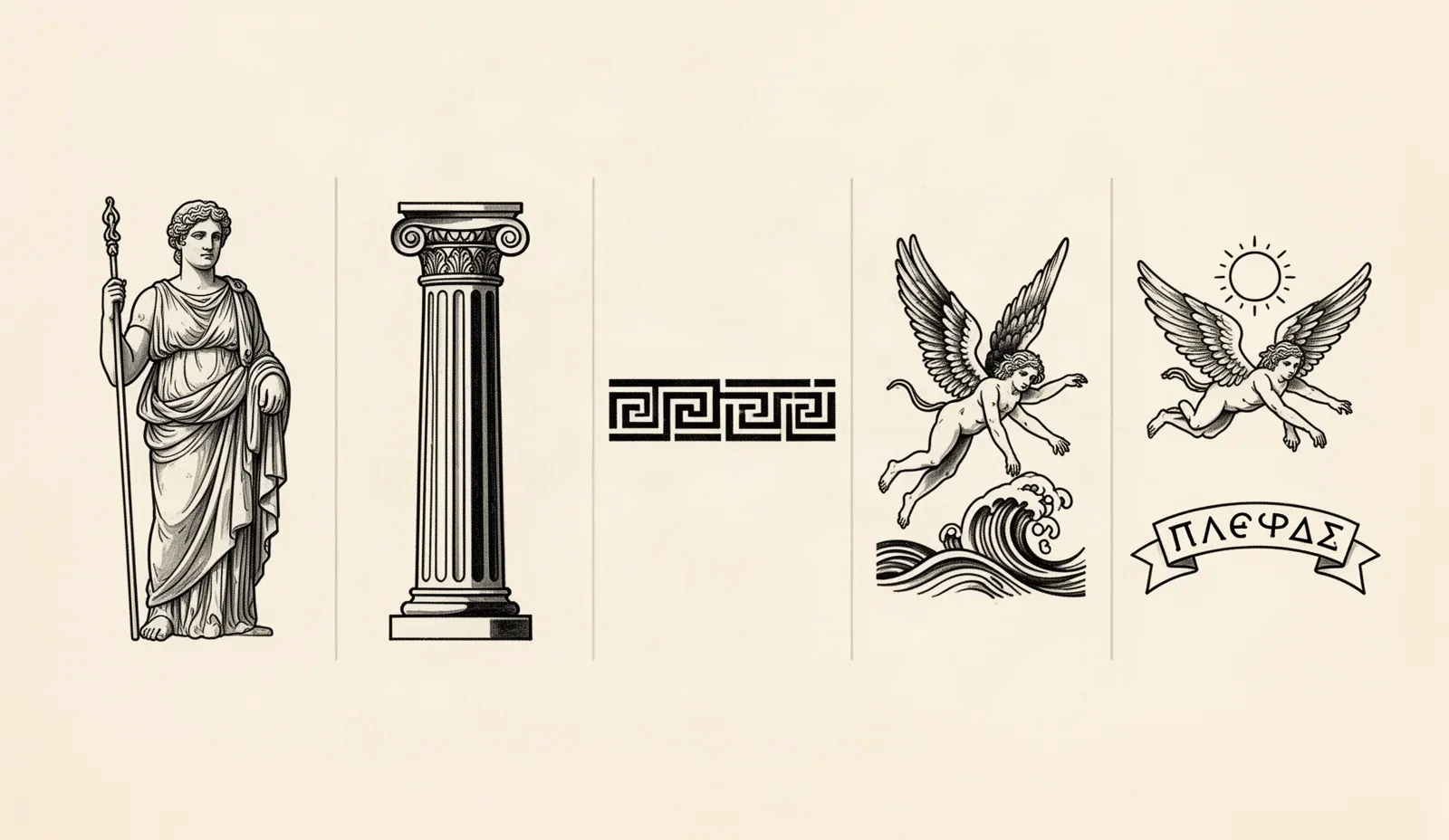
Editorial illustration by StencilStudio: draped figure, column, meander band, myth scene and banner linework shown side by side for silhouette contrast. Synthetic artwork, not generated app output, and not a size or measurement reference. Judge scale on a true-size print of your own file.
Gods and statue figures
Full or half figures such as Zeus, Athena, Apollo or Aphrodite rendered as marble statues: a stance axis, a composed face, ranked drapery folds, and one attribute such as a thunderbolt, helmet, lyre or shell.
Best at 14 cm and above on thighs, backs, calves and forearms where the figure axis runs along the limb.
Keep: Keep the stance axis, the face and eye positions, the two longest drapery masses, and one attribute maximum.
Fails when: Fails when drapery folds merge into one shaded block, small faces print as a single mark, or stone-crack texture competes with the figure for the same room.
Columns and temple architecture
A tall vertical build: Doric or Ionic shaft with capital and base, sometimes a pediment fragment or broken ruin edge. One center axis plus flute rhythm governs the full height.
Best at 12 cm and above on spines, forearms, calves and thighs where a narrow vertical field gives the shaft room to stand.
Keep: Keep the shaft edges straight and parallel, the capital position, one flute rhythm, and a single base line.
Fails when: Fails when flute lines touch along the shaft, capital volutes close into solid blobs, or ruin rubble adds a second density family beside the shaft.
Meander and border bands
The repeating Greek key fret plus laurel or wave borders run as straight bands, armband wraps, frames around a focal, or spine columns. One repeat unit governs the full run.
Best at 8 cm band widths and above on forearms, calves, armbands and frames where unit count can flex to fit.
Keep: Keep the repeat rhythm, the cleanest fret as the spacing reference, even wall thickness, and a planned closing joint on wraps.
A narrative moment such as Icarus falling, Atlas carrying the sky, a minotaur and labyrinth, or a trireme under sail: one lead figure plus one setting mark plus motion direction.
Best at 16 cm and above on backs, thighs and sleeves where figure, setting and motion each keep their own channel.
Keep: Keep the lead figure axis, the single strongest setting mark, and one motion direction with open skin between all three.
Fails when: Fails when two figures plus architecture plus sky texture merge into one band, wings or waves touch the lead figure, or small secondary faces close first.
Lettering and banners
Greek words, names in Greek script, or short phrases on a ribbon or laurel banner. One baseline plus letter spacing governs the full read.
Best at 8 cm widths and above on forearms, collarbones, ribs and calves where the baseline stays flat or follows one gentle curve.
Keep: Keep the baseline position, open counters inside each letter, even letter spacing, and one banner edge family maximum.
Fails when: Fails when small enclosed counters fill first, banner folds touch letter strokes, or laurel leaves crowd the baseline the words depend on.
Medusa branch
When the comparison above points to Medusa, stop here and continue on the Medusa stencil owner, which holds frontal, profile and bust choice with snake-hair, gaze and bust hierarchy checks.
When the comparison above points to a Spartan warrior, stop here and continue on the Spartan stencil owner, which holds helmet bust, guard and battle-stride choice with slit, shield and spear separation checks.
Greek family recognition, risk, size and placement trade-offs
Family
Recognition
Detail risk
Minimum size
Placement
Gods and statue figures
Highest narrative presence: a named god posture reads across a room.
Drapery folds and faces merging; crack texture crowding the figure.
About 14 cm height for face plus drapery.
Thigh, back, calf, forearm.
Columns and architecture
High: a straight shaft with capital reads as Greek at a glance.
Flute lines touching; capital detail closing into blobs.
About 12 cm height with one flute rhythm.
Spine, forearm, calf, thigh.
Meander and border bands
Pattern rhythm: separated frets read as Greek key, not texture.
Fret walls pinching; closing joints misaligning on wraps.
About 8 cm band width with even walls.
Forearm, calf, armband, frames.
Myth scenes
Story read: lead figure plus setting names the myth.
Figure, setting and sky merging; secondary faces closing.
About 16 cm height for three channels.
Back, thigh, sleeve.
Lettering and banners
Direct: spaced letters on a clean baseline read instantly.
Counters filling; banner folds touching strokes.
About 8 cm width with open counters.
Forearm, collarbone, ribs, calf.
Once a Medusa or Spartan direction wins, continue on the Medusa stencil page or the Spartan stencil page. Those siblings hold the single-figure construction detail, while the choice between Greek families happens here.
Final-size triage
Protect the read before decorating around it.
Readability comes from silhouette, axis and gap retention, not from carving density. Run these four checks on every Greek family before judging ornament.
Silhouette contract per family
Each family must read from its outer contour alone: striding figure axis, straight shaft with capital, repeating fret rhythm, lead figure plus setting, or a clean baseline of letters. Cover all inner detail and confirm the family still reads.
Avoid: Do not rescue a broken silhouette with heavier inner lines. Rebuild the contour or reselect the family first.
Tall, narrow and band geometry
Columns and statues need one true vertical axis; meander and lettering bands need one even rhythm with a planned closing joint on wraps; myth scenes need one motion direction. Judge the axis before judging ornament.
Avoid: Do not approve a leaning shaft, an uneven fret run, or a scene with two competing motion directions. One broken axis breaks the whole piece and no line-weight change repairs it.
Ornament density ceilings
Carry two or three ranked line families maximum with open skin between them: lead structure first, support second, one removable ornament band last. Stone shading, crack texture and background sky are support, never structure.
Avoid: Do not keep five drapery ranks plus crack rows plus sky texture plus small faces together at small heights. Remove one family or enlarge before print.
Line hierarchy at true size
Strengthen outer contours and focal anchors first, keep flute lines, fret walls and letter strokes even and lighter than the focal, and verify every must-keep separation at 1:1 with scaling off.
Avoid: Do not thin figure or shaft contours to rescue fret density. Thinning the lead structure weakens the read that carries the piece.
Medusa snake-hair and gaze construction stays on the Medusa stencil owner, and Spartan helmet plus shield plus spear construction stays on the Spartan stencil owner. This section judges pan-Greek silhouette, axis and hierarchy at final size only.
Simplification thresholds
Ornament density decides transfer success.
Print at the exact physical size with scaling off, then confirm every line below with a ruler in hand. One failed line means reopen, merge, enlarge or reselect before transfer.
Reduce statue drapery to two ranked fold masses with open skin between them before touching face or stance mass on god figures.
Reduce column flutes to one even rhythm, hold a single capital line family, and remove rubble or second base lines at heights near 12 cm.
Hold one fret wall family with even thickness on meander bands; remove double borders, inner echo lines or corner flourishes when fret channels narrow.
Reduce myth scenes to one lead figure plus one setting mark plus one motion direction, and remove or enlarge the two smallest enclosed faces first.
Hold one letter stroke family with open counters on lettering; remove banner folds, laurel overlap or shadow fills when counters or spacing close.
Run a squint check at true size: step back until fine carving disappears and confirm the motif still reads as its family.
Statues and columns are drawn vertical and worn along a limb, meander and lettering are drawn flat and worn curved, and myth scenes are drawn wide and worn flat. Each placement protects a different part of the construction.
Back, thigh and sleeves
Myth scenes, full god figures and wide pediment builds. Broad flat fields where figure, setting and motion each keep their own channel.
Rule: Center the lead figure axis on the flattest span, keep setting and motion marks inside the panel edges, and verify face, drapery and gap separation at 1:1.
Spine, forearm and calf
Columns, slim statues and vertical glyph-like runs that follow a long axis without symmetric spread.
Rule: Run the shaft or figure axis along the limb, hold one even flute or fold rhythm down the full run, and keep width inside the limb so edges stay clear of the curve.
Armband wraps and frames
Meander rows and laurel borders that rescale by adding or removing units, including frames that enclose a separate focal.
Rule: Count fret units around the full circumference at the exact limb measurement, mark registration ticks on the stencil margin, and confirm the closing joint on a body preview before print.
Collarbone, ribs and sternum
Lettering baselines, small meander accents and compact focals. Curved or breathing panels where flat baselines need care.
Rule: Keep the baseline to one gentle curve maximum, confirm every letter counter stays open at the exact width, and anchor the baseline center to the body landmark.
Wrist, ankle, hand and behind ear
One recropped fret unit, a single simplified letter group, or one small column capital only. Small wrapped fields where figures and scenes merge first.
Rule: Carry one contour family with two separations maximum. If a fret wall, letter counter or capital gap closes at 1:1, enlarge or reselect.
Adaptation to transfer
Approve the Greek piece only when every line passes
Run this short sequence with scaling off and a ruler in hand. One failed line means fix, enlarge or reselect before transfer.
Lock one Greek family, the intended dimensions in millimeters, and the named placement before judging the reference.
Confirm the outer silhouette reads as its family with inner detail covered, and the axis holds (vertical shaft, stance line, band rhythm or baseline).
Assign lead, support and removable roles to every mark, and name the one ornament band that goes first if gaps close.
Simplify density to two or three ranked line families and reopen every drapery channel, flute gap, fret separation, letter counter and scene gap at 1:1.
Confirm meander and lettering bands close cleanly on wraps and symmetric focals sit on their landmark.
Export a true-size PDF with scaling off and measure the physical print with a ruler.
Family first, then size Verify gaps at 1:1 Countable ornament only
FAQ
Greek stencil decisions, answered
Short answers for the family choice, size, column versus statue, meander, Medusa and Spartan handoff, and transfer checks that recur when a Greek direction moves toward transfer-ready output.
Match the family to the available size first. Fields under about 8 cm suit one recropped fret unit, a short letter group, or a small capital. Mid sizes suit columns, meander bands with a planned closing joint, and clean lettering baselines. Large fields suit full god figures with drapery and attributes, and the largest fields suit myth scenes with figure plus setting plus motion. The comparison table on this page names the structure, strengths, constraints and minimum band of each family so the choice happens before stencil prep.
Myth scenes break first because lead figures, setting marks and sky texture merge into one band. God figures break next at drapery folds and small faces. Columns break at flute lines and capital volutes. Meander bands break at fret walls and double borders, and lettering breaks at small enclosed counters. Single fret units and short letter groups hold smallest because each depends on one or two protected separations: the fret channel, and the letter counter plus spacing.
Choose a column when the brief centers on Greek order and the placement is a true vertical run such as a spine, forearm or calf, because one shaft with one flute rhythm vets cleanly at about 12 cm. Choose a statue figure when the client wants a named god, and confirm at least 14 cm of height so the face and drapery keep their own channels. Columns punish uneven flutes, statues punish merged drapery, so the deciding check is which single axis the placement protects best.
Size from the tightest fret channel, not the band length: print the repeat unit at the exact limb width with scaling off and confirm every fret wall keeps visible open skin at arm's length. Count units around the full circumference, plan the closing joint with registration ticks, and remove double borders or echo lines when channels narrow. If one channel closes, widen the fret rhythm or drop one border family before changing the band width.
Use the Medusa owner when the brief is already decided on Medusa and the job becomes frontal versus profile versus bust choice with snake-hair, gaze and bust hierarchy checks. Use the Spartan owner when the brief centers on the Corinthian helmet, aspis shield and dory spear with slit, rim and shaft separation checks. This page compares across Greek families to reach that decision; once Medusa or Spartan is chosen, those owners hold the construction detail and this page hands off instead of repeating it.
Lock family, dimensions and placement, verify silhouette and axis, set lead versus support versus removable roles, simplify density and reopen gaps at 1:1, then verify with a measured true-size print. The transfer checklist on this page runs that sequence with scaling off and a ruler in hand. One failed line means fix, enlarge or reselect before transfer.
Next steps
Use the neighboring owners for adjacent jobs.
This guide covers cross-family choice, readability and simplification thresholds, placement and scale, and the adaptation checklist. Use the links below for related jobs such as construction depth, sizing, print checks, conversion and browsing.
Medusa construction detail stays on the Medusa owner, Spartan construction detail stays on the Spartan owner, generic conversion stays on the photo-to-stencil owner, board organization stays on the board-maker, and broad gallery browsing stays on the stencils and subject hubs. The links above hand off instead of repeating that detail.
From chosen family to working stencil
Turn the approved Greek family into a stencil draft.
Start from the family that passed the silhouette, axis and gap checks, then continue on iPhone for body fit, exact-size print, mirror and professional export.