
Demon stencil evaluation

Judge any demon reference before it becomes a stencil

Demons live or die on horn symmetry and gaze clarity. Check the horn pair, the eye and fang spacing, the horned face versus mask/oni versus full-body construction and the blackwork density at your exact height, then prepare a clean stencil that transfers as one readable figure.

Built for working artists preparing demon pieces. This page covers demon evaluation and stencil preparation only, not tattoo application or healing advice. Horned face, mask/oni and full-body options are judged here as different constructions inside one horn-symmetry framework.

What makes a demon stencil-viable

Horns, gaze, and hierarchy decide the result.

A demon is a mirrored horned silhouette with a menacing face. These three pillars predict whether that figure survives reduction, print, and transfer.

Horn symmetry

A demon reads first as a balanced horned silhouette. Stencil viability comes from mirrored horn pairs with open skin along both sides of each horn, not from matching every tine, crack or texture mark a reference shows.

Check: Fold the design on its vertical axis at the target height. If both horns land within one line width of each other with open skin between horn and skull on each side, symmetry is sound. If one horn drifts, shortens or merges into the skull, the outer contour needs repair before anything else changes.
Gaze and fang readability

The eyes carry the menace, and the fangs carry the bite. When both eyes stay separated with open skin around them, and each fang keeps its own channel down to the jaw or lip line, the face survives reduction. Brow wrinkles, nostril hatching and lip texture close first and should be judged as removable.

Check: Count the marks inside the face at the target height. Eyes plus fangs plus one nose hint should total about eight or fewer at small heights. If a brow band touches an eye, or two fangs share one merged pocket, that contact needs reopening or removal.

Blackwork hierarchy

Dense demon shading reads through two or three ranked black masses, not through every flame lick, scale row or smoke wisp a reference shows. Secondary black competes with horn and fang separations for the same room, so it thins first.

Check: Name the horn pair, the eye pair and the fang pair that set the first read. If removing one flame band, one smoke wisp or one texture cluster changes nothing about that read, that mark is support and can go before touching horn, gaze or fang mass.

Demon evaluation framework

Score the reference in minutes, then act on the weakest check.

Four demon constructions at labeled heights. Each one names the protected structure, the fix, and the go or no-go verdict at that exact size. Confirm every verdict with a measured 1:1 print.

HOLDS AT STATED SIZE

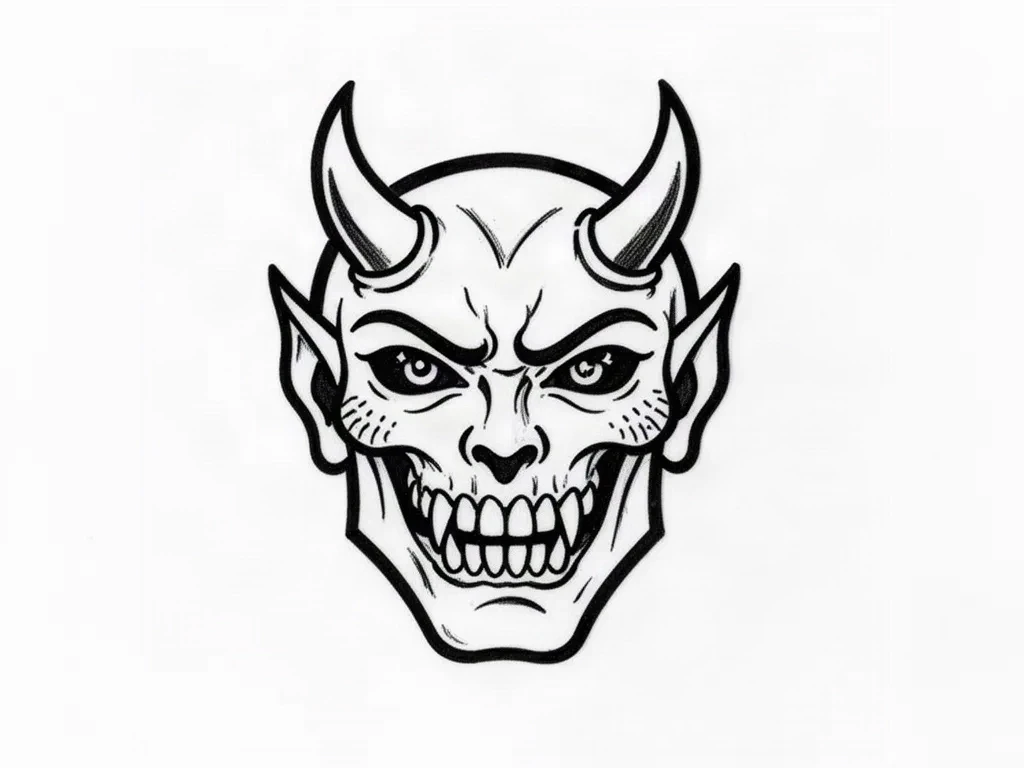
Frontal horned face at 14 cm

Intended height 140 mm

Construction: horned demon at intended height 140 mm. Judge horn mirroring, eye and fang gaps, and blackwork bands at true size with scaling off.

Illustrative stencil construction of a frontal horned demon face with a mirrored horn pair, two separated eyes with open skin around each, and four fangs with open channels between them.
Original synthetic construction illustration, not app output or customer work. Confirmed-size verdicts still come from your own measured 1:1 print.
Source
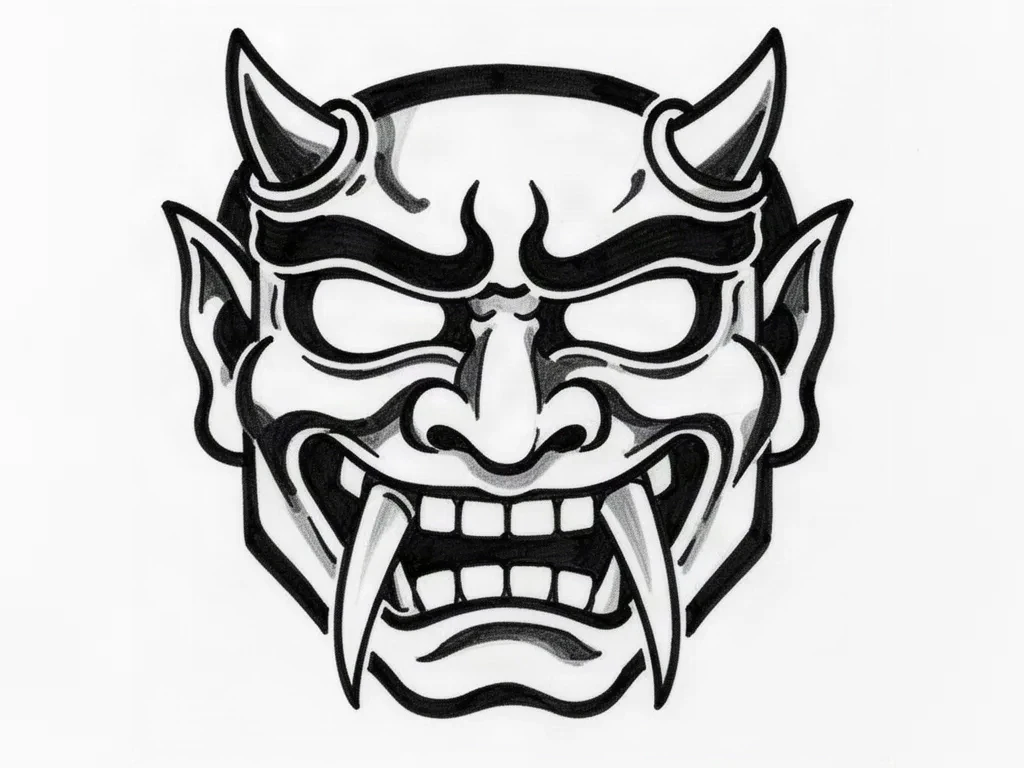
Direct-stare horned demon face with a mirrored horn pair, separated brow ridge, two eyes with open skin around each, a nose mass with one nostril hint, and four fangs with open channels between them. Illustrative construction with clean contours and open skin along both horns.
Protect
Outer horn contours on both sides, both eye positions with open skin between them, the four fang channels, and the outer jaw contour.
Fix
Shorten only the shorter outer horn tine if two tips touch at 1:1. Keep horn height, eye spacing and fang count unchanged.
Candidate stencil
Same demon with the horns mirrored, gaze separated, fang count set, separations reopened, and protected horns and face contours held at transferable mass.
Final-size verdict
Holds at 14 cm after a tine-spacing check. Both horns stay mirrored, every eye and fang keeps its own gap at 1:1, and the stare reads from a normal viewing distance.

REOPEN GAZE AND FANG GAPS

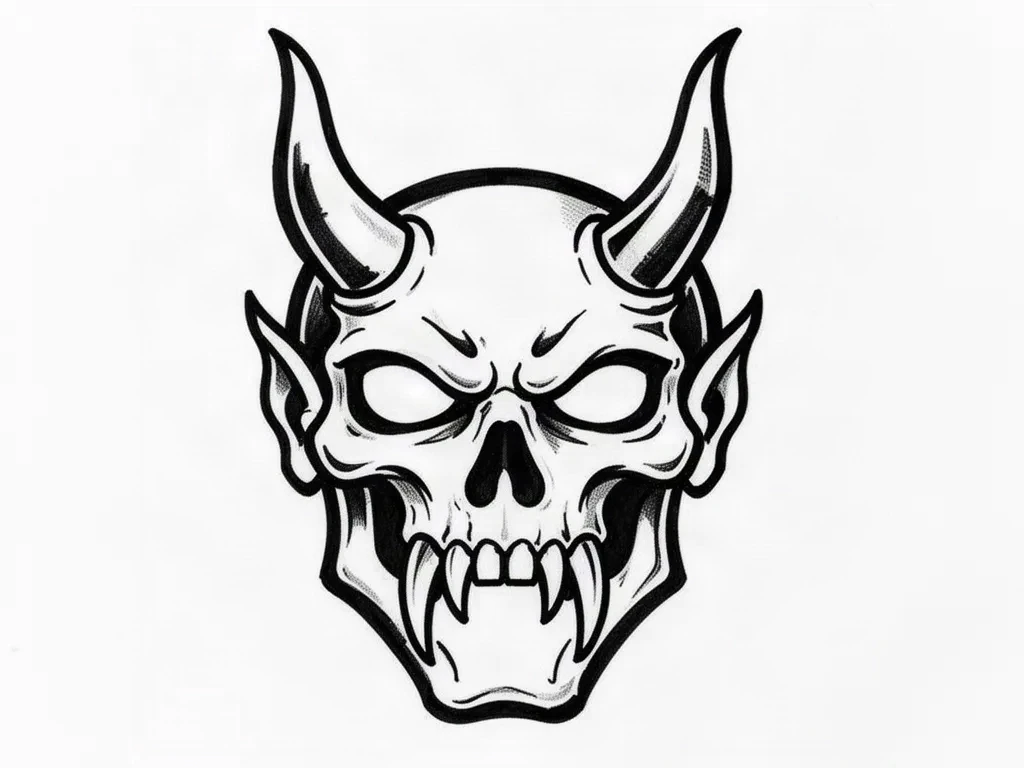
Mask/oni construction at 12 cm

Intended height 120 mm

Construction: mask demon at intended height 120 mm. Judge horn mirroring, eye and fang gaps, and blackwork bands at true size with scaling off.

Illustrative stencil construction of a symmetrical oni-style demon mask with a heavy brow band, wide grin, two long fangs and short horns at the upper corners.
Original synthetic construction illustration, not app output or customer work. Confirmed-size verdicts still come from your own measured 1:1 print.
Source
Broad symmetrical oni-style mask with a heavy brow ridge, flared nostrils, a wide grin with six teeth plus two long fangs, and short horns tucked at the upper corners. Strong presence, but one eye touches its brow band and two adjacent teeth share one merged edge.
Protect
Mask outer contour on both sides, the brow ridge position, the two long fangs, and the upper horn pair.
Fix
Reopen the eye-to-brow gap and the merged tooth channel until each runs as open skin at true size, then confirm symmetry still holds. Remove small teeth before changing fang or horn mass.
Candidate stencil
Same demon with the horns mirrored, gaze separated, fang count set, separations reopened, and protected horns and face contours held at transferable mass.
Final-size verdict
Holds at 12 cm once both gaps stay open at true size. Mask menace comes from the brow plus separated fangs, not from tooth count or nostril hatching.

RANK BLACKWORK LAST

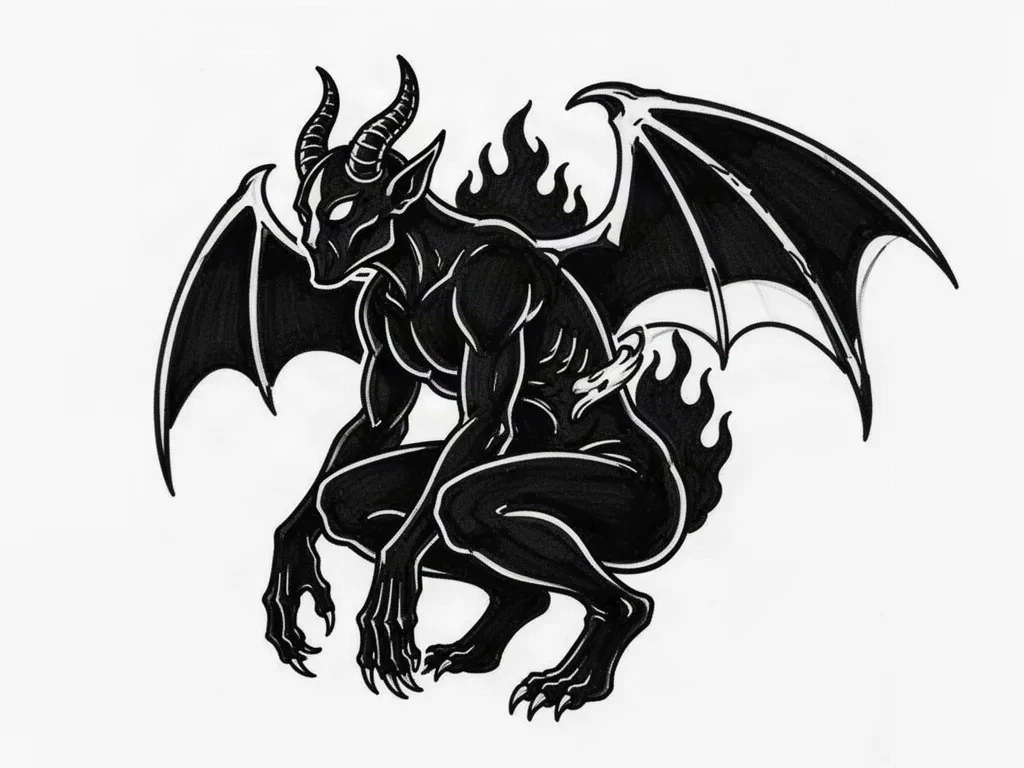
Full-body crouching demon at 15 cm

Intended height 150 mm

Construction: fullbody demon at intended height 150 mm. Judge horn mirroring, eye and fang gaps, and blackwork bands at true size with scaling off.

Illustrative stencil construction of a crouching horned demon with bat-style wings reduced to one outer band, clawed hands, bent legs and a single flame band behind the torso.
Original synthetic construction illustration, not app output or customer work. Confirmed-size verdicts still come from your own measured 1:1 print.
Source
Crouching horned figure with a profile head, clawed hands, digitigrade legs, bat-style wings, and a flame plus smoke field behind the torso. Convincing on screen, but wing fingers, flame licks and smoke wisps carry no stencil separation at this height.
Protect
Head direction set by horns plus eyes, torso and crouch leg axis, wing outer contour as one band, and the fang positions.
Fix
Reduce the background field to one flame band or remove it, keep two wing-finger separations maximum with open skin between them, and hold claws as single contours. Do not keep wing texture, flame rows and smoke wisps together at this height.
Candidate stencil
Same demon with the horns mirrored, gaze separated, fang count set, separations reopened, and protected horns and face contours held at transferable mass.
Final-size verdict
Holds at 15 cm once blackwork is ranked below figure mass. The crouch posture carries the demon read while wings, flames and smoke stay subordinate at 1:1.

ENLARGE OR RECROP

Fine-line dense demon head at 6 cm

Intended height 60 mm

Construction: fine demon at intended height 60 mm. Judge horn mirroring, eye and fang gaps, and blackwork bands at true size with scaling off.

Illustrative stencil construction of a fine-line demon head with hairline horn contours, doubled brow lines, small eyes with glints and a crowded row of narrow teeth.
Original synthetic construction illustration, not app output or customer work. Confirmed-size verdicts still come from your own measured 1:1 print.
Source
Delicate outline-only demon head with hairline horn contours, doubled brow lines, small eyes with inner glints, and eight fine teeth with narrow separations, attractive on screen but drawn with almost no line mass and six competing detail bands.
Protect
Horn directions and the eye positions that give the head its demon read.
Fix
Enlarge past the point where every horn channel, eye clearance and fang separation transfers as open skin, or recrop to the eyes plus fangs with the widest gaps. Do not keep eight fine teeth plus lid doubling plus horn texture together at 6 cm.
Candidate stencil
Same demon with the horns mirrored, gaze separated, fang count set, separations reopened, and protected horns and face contours held at transferable mass.
Final-size verdict
At 6 cm the horns, lids and teeth function as one band and the eyes print as broken scratches. Enlarge, recrop to eyes plus fangs, or choose a bolder construction for this height.

Cross-creature silhouette comparison stays on the stencils gallery hubs. Snake-crown and gaze depth for Medusa stays on the Medusa owner. This framework exists to judge demon horn symmetry, gaze and fang construction and blackwork hierarchy at a stated height, not to replace those owners. The four constructions above are original synthetic illustrations that show the stencil-read problems described in each card, not screenshots or customer pieces.

Horns, gaze, and blackwork at final size

Judge the white space at the height you will print.

Screens forgive crowding that paper and skin do not. Set the height first, then inspect each feature below at true physical size with scaling off.

About 6 cm and below

Wrist and ankle accents, behind-ear marks, finger panels and small gap fillers.

Carry a recrop only, such as eyes plus fangs or a single horn pair without a full face. Keep one contour family and two separations maximum. If a horn channel, eye clearance or fang gap closes at 1:1, enlarge or reselect rather than forcing reduction.

About 8 to 14 cm

Common forearm, calf, shoulder and thigh demon pieces.

The most flexible band. A horned face or mask/oni with ranked fangs can work when every gap is verified at true size. Check horn symmetry, eye count, fang channels and blackwork crossings before approving texture.

About 14 cm and above

Large thigh panels, back pieces, chest and full sleeve sections.

Room for a full-body figure with wings or a flame field, but only when open skin separates horns, eyes, fangs and each blackwork band. Larger height does not rescue merged horns, a touching gaze or a solid black cap.

Demon feature checks by height band
FeatureAbout 6 cm and belowAbout 8 cm and above
Horns and symmetry axisKeep the heaviest lines on the outer horn contours and the mirrored pair. If an outer horn edge disappears, the head loses its demon read and becomes a plain fierce face.Same priority. Larger height allows slightly finer inner horn ridges, but separability still beats uniform thinness.
Eyes, gaze and fang marksBoth eyes must read as separate marks with open skin around each one, and each fang needs its own channel. Merge means a bolder eye and fang pair or a larger height, not thinner lids.Brow bands and mouth corners can carry more modeling when each mark keeps its own spacing at 1:1. Check the full face with a squint test at true size.
Teeth, nostrils and textureCarry at most two long fangs with one jaw hint each, and only with visible skin around them. Repeated tooth rows and nostril hatching merge first at small heights.Additional teeth and light scale hints can work when each tooth keeps its own silhouette and open skin. Texture should never join two fangs or close an eye.
Wings, flames and background blackworkKeep no background field. Wing, flame and smoke lines compete with horn and fang gaps for the same room and should be recropped away.One wing band or one flame band can add weight when the horns, gaze and fangs clearly dominate. Equal-weight double bands need hierarchy work before print.

Reference to clean stencil

Build from the horns outward, then rank the black.

Work in this order so one change at a time can be judged at the same height. Stop when horns, gaze, fangs and blackwork each read correctly.

  1. 01

    Lock height, placement and variant first

    Set the intended physical height in millimeters, name the body area, and choose horned face, mask/oni or full-body before judging the reference. A horned face that holds at 15 cm on a thigh can fail at 6 cm on a wrist with no line being wrong on its own. Use the size calculator when target dimensions are still open.

  2. 02

    Verify horn symmetry and gaze hierarchy

    Confirm the horn pair mirrors across the vertical axis, then rank the composition: horns first, eyes and fangs second, texture and background last. Resolve horn drift, eye contacts and fang merges before touching line weight. A demon with mirrored horns and separated eyes plus fangs is already halfway to stencil-ready.

  3. 03

    Set lead-black versus texture roles

    Assign every mark a role: lead structure that carries the first read, support that shapes the horns and face, and texture that can be removed. Strengthen horn outers and jaw contours first, keep inner detail lighter, and mark one removable flame band or texture cluster that can go if gaps close.

  4. 04

    Simplify fangs, teeth and blackwork at 1:1

    Reduce fang count, tooth detail and black masses before thinning contours. Keep open skin along both horns, around both eyes and between fangs, and run a squint check: step back until fine texture disappears and confirm the horns, gaze and fangs still read. The line-weight guide covers fine, normal and bold behavior on the same stencil.

  5. 05

    Verify print and transfer path

    Export a true-size PDF with no fit-to-page scaling, inspect the narrowest horn channel, both eyes and the smallest fang cluster on plain paper, then measure the physical print with a ruler. If the digital file passes and only paper fails, move to print-stage evidence instead of simplifying again.

Placement and variant decisions

Horns want skin that gives them width

A demon is a mirrored horned figure with a dense face. Placements with a clear flat span preserve symmetry, while narrow limbs demand a slim face or a recrop.

Thigh and back

Broad flat fields where a frontal horned face or a wide mask can spread symmetrically. The width is the asset, so horn tips need spacing checks rather than compression.

Check: Center the face on the flattest span, mirror the horn pair, and verify tip and fang spacing at 1:1 before print.

Outer forearm and calf

Long narrow fields where the face should follow the limb axis. Wide symmetric horns and flared masks wrap fast and crowd outer horn tips.

Check: Choose a slim horned face with folded outer tines or a vertical mask for these fields, align the face axis with the limb, and shorten cross-limb tips while edits are still cheap.

Chest and shoulder

Large curved panels with room for a full-body figure or a mask with wings. The curve compresses one side of wide horns in photos and transfers.

Check: Center the lead eye pair on the flattest span, let support horns fall toward the slope, and keep background bands to one maximum.

Wrist, ankle, hand and behind ear

Small wrapped fields where only a recrop survives. Full horns with gaze, fangs and blackwork forced into these bands merge first.

Check: Recrop to eyes plus fangs, or one horn pair without a full face, then run the small-size checks at the exact height.

Stencil-ready checklist

Approve the demon only when every line passes

Run this short sequence with scaling off and a ruler in hand. One failed line means fix, enlarge, or reselect before transfer.

  • Confirm intended height in millimeters, the named placement, and the horned face, mask/oni or full-body choice.
  • Confirm a mirrored horn pair with open skin along both sides at 1:1.
  • Confirm both eyes read as separate marks with open skin around each one.
  • Confirm fangs stay countable with no merged tooth band.
  • Confirm wings, flames and background bands total one or zero with no merged parallel channels.
  • Export a true-size PDF with scaling off and measure the physical print.
Mirrored horns first Verify gaps at 1:1 Countable fangs only

FAQ

Demon stencil decisions, answered

Short answers for the horn, gaze, blackwork, and placement checks that recur when a demon reference moves toward transfer-ready output.

It is usable when three checks pass at the exact physical height: the horn pair stays mirrored with open skin along both sides at 1:1, both eyes read as separate marks with open skin around them, and fangs plus blackwork read as separate shapes rather than one merged band. If any check fails, the fix list on this page names what to simplify, reopen, or enlarge before print.

Next steps

Use the neighboring owners for adjacent jobs.

This guide covers demon variant choice, height-tied horn and gaze density plus fang gap rules, placement-size decisions, and reference-to-stencil preparation. Use the links below for related jobs such as sizing, print checks, paper, and placement.

Board organization, grid overlays, photo-quality scoring, generic conversion, broad gallery browsing, paper manufacturing detail, and placement mechanics stay in their specialist owners. The links above hand off instead of repeating that detail.

From evaluated reference to working stencil

Turn the approved demon into a stencil draft.

Start from the demon that passed the horn, gaze, and gap checks, then continue on iPhone for body fit, exact-size print, mirror and professional export.