
Chinese dragon stencil evaluation

Vet the dragon as Chinese, then make it transfer

Chinese dragons live or die on Eastern accuracy plus coil flow plus separation. Confirm the wingless serpentine markers, choose one coil construction that fits the placement, then separate whiskers, antlers, claws, and scales so the long body reads at final size.

Built for working artists preparing Chinese dragon pieces. This page covers Eastern vetting, serpentine coil choice, and transfer separation only, not tattoo application or healing advice. Full-body flow here means the long Chinese serpentine body; broad all-style dragon comparison stays with the dragon subject owner, 2 to 5 cm rules stay with the small-dragon page, head-only crops stay with the dragon-head page, and franchise motifs stay with the Dragon Ball page.

What makes a Chinese dragon stencil-viable

Accuracy, coil flow, and separation decide the result.

A Chinese dragon is one serpentine spine with an antlered head, trailing whiskers, and countable claws. These three pillars predict whether that construction survives reduction, print, and transfer.

Eastern accuracy first

A Chinese dragon reads as a long serpentine body with a deer-antlered head, flowing whiskers, carp-like scale rhythm, and clawed feet, with no wings and no heavy reptilian plates. Stencil viability starts by confirming those markers before judging line quality, because a winged or plated Western body with whiskers added on top still reads as confused at any size.

Check: Cover the whiskers and pearl. If the bare body still names an Eastern serpentine dragon through coil flow, antlered head, and clawed feet, accuracy holds. If the read depends on wings, dorsal armor, or a bulky lizard torso, repair the construction before touching stencil detail.
Coil flow carries the piece

A Chinese dragon is one continuous spine path with a head that leads and a tail that resolves. Stencil viability comes from choosing one coil construction, S-coil, C-coil, limb wrap, or resting panel coil, that fits the placement before approving head or claw detail. Coils that cross, pinch, or stack body segments against each other merge first, so coil-gap spacing is ranked before scale or whisker work.

Check: Trace the spine from head to tail with one finger. If the path never crosses itself without open skin between the passes and the head aims along the body flow, the coil holds. If two body passes share one edge or the tail disappears under the head, re-space the coil before changing detail.

Separation hierarchy at final size

Whiskers, antler tines, claws, and scale rows all compete for the same narrow channels. Transfer needs the spine and head to dominate, claws and antlers to stay countable, and whiskers plus scales to stay subordinate, because parallel whisker pairs, stacked scale arcs, and multi-toe feet bridge into solid pockets first.

Check: Name the spine, the head, and the claw set that carry the read. If removing a whisker strand, a scale row, or a claw toe changes nothing about that read, that mark is support and can go before touching spine or head mass.

Eastern versus Western vetting with correction actions
MarkerEastern / ChineseWestern confusionCorrection
Body and wingsLong serpentine body with no wings, flowing continuously through coils with a tapering tail.Stocky lizard torso with bat-like wings and a heavy tail, built for bulk rather than flow.Remove wings entirely and re-draw the torso as one even-width serpentine ribbon. Do not keep a Western torso with whiskers added.
Head: antlers and snoutDeer-like antlers with countable branches, a broad snout with nostrils, flowing mane or beard hints, and whiskers rooted at the snout.Swept-back horns or spikes, narrow reptilian snout with heavy brow plates, no whisker roots.Replace swept horns with a paired antler rhythm with open skin between branches, and root whiskers at the snout. If antler branches touch the skull edge at 1:1, respread or remove a branch before thinning the skull.
WhiskersOne to two long flowing lines per side, trailing with the coil direction and never crossing the body.Absent, or short barbs crowded against the jaw with no trailing flow.Hold whiskers to two lines per side maximum, route them into open skin away from coils and claws, and delete any strand that crosses a body pass or claw at final size.
Claws and feetDistinct feet with three to five claws each; four claws is the common tattoo convention and five carries imperial association worth discussing with the client.Heavy talons merged into the limb mass, or bird-like feet with no spacing between toes.Separate each toe with open skin at 1:1 and confirm the claw count with the client before print. If toes share one edge, remove a toe or enlarge the foot rather than thinning neighboring toes.
Scales and maneCarp-like scale rhythm along the back, often with a mane or beard fringe running with the spine; pearl or cloud accents sit in open skin, never touching the body.Armor plates, dorsal spikes, or shaded hide with no repeating scale rhythm.Reduce scales to spaced arc hints on the outer curves only, keep mane fringe to one band with open gaps, and float pearls and clouds in open skin with clearance on all sides.

Coil evaluation framework

Score the coil in minutes, then act on the weakest check.

Four Chinese-dragon coil constructions at labeled body lengths. Each one names the protected structure, the fix, and the go or no-go verdict at that exact size. Confirm with a measured 1:1 print.

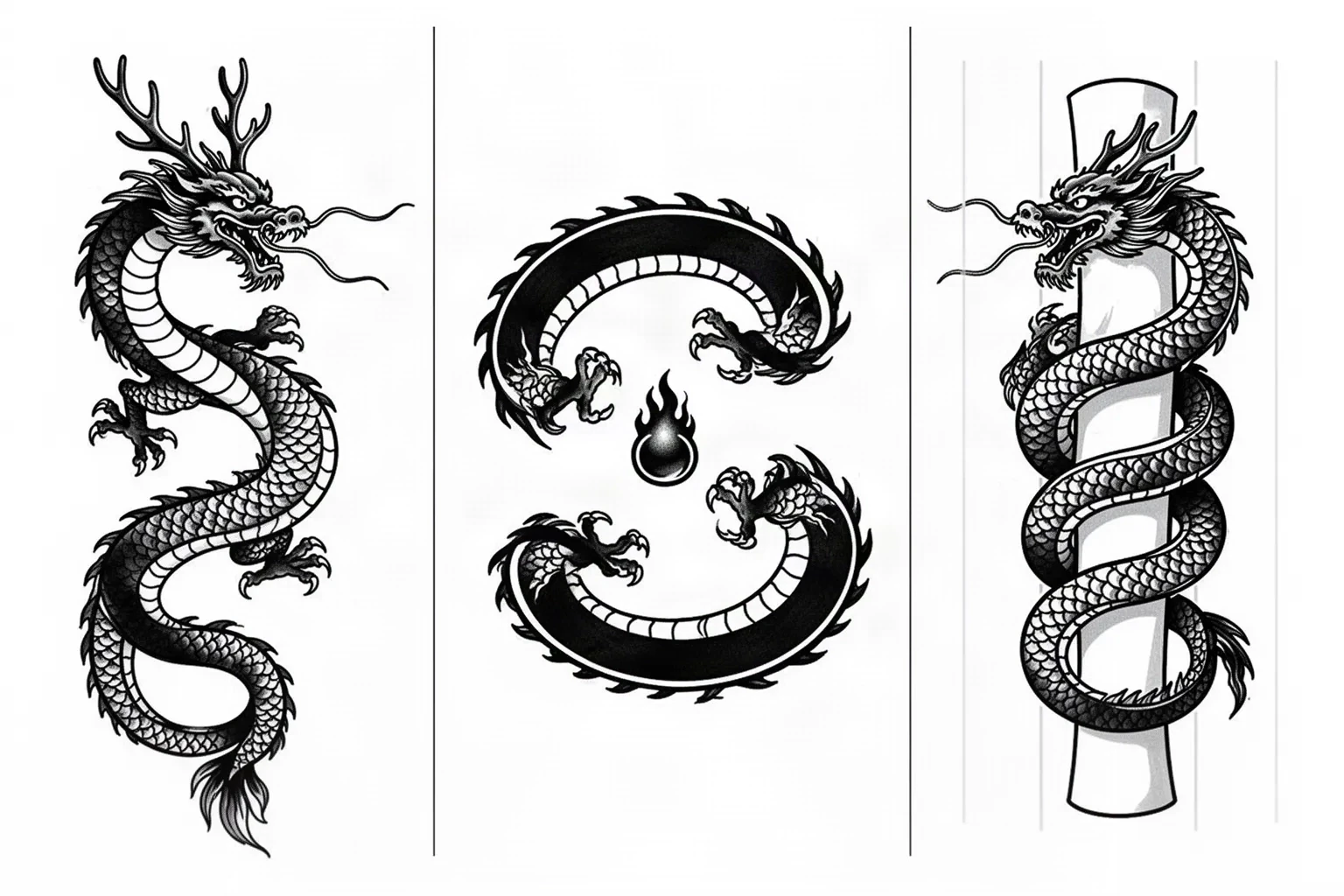
Three Chinese dragon coil constructions in black linework on white: an open S-coil running down a limb field, a C-coil with head and tail facing each other across a floating flaming pearl, and a dragon wrapping around a cylindrical limb.
Coil construction reference, original synthetic study. Left, open S-coil with two body passes. Center, C-coil with the head and tail facing each other across a floating pearl. Right, limb wrap with evenly spaced passes. Use the plate to choose spine direction and check coil gaps, then reduce interior detail to this page's separation rules before print. This study is denser than a transfer-ready stencil on purpose so the coil geometry stays visible.

MOST FORGIVING ON LIMBS

Open S-coil for forearms, calves, and ribs

Body length 15 to 25 cm along the limb axis

Source
One serpentine dragon running in a single open S-curve down the limb: head leading toward the hand or foot per client direction, two body passes with open skin between them, tail tapering into open skin, claws angled into the gaps. The most stencil-forgiving Chinese construction because every coil gap is verifiable and no body segment stacks on another.
Protect
The single S spine path, the head-to-first-pass direction, both open coil gaps, and the head clearance from the nearest body pass.
Fix
Widen the S until each coil gap shows daylight at 1:1, shorten the tail taper if it crowds the lowest claw, and route both whiskers into the widest gap. Keep the spine width even rather than thinning one pass to save another.
Candidate stencil
Same Chinese dragon with a verified serpentine spine, open coil gaps, an antlered head with clearance, countable claws, restrained whiskers, and spaced scale hints held at transferable mass.
Final-size verdict
Holds at 15 cm and above once both coil gaps stay open at true size and the head reads separately from the nearest pass. Spine flow and gap spacing carry the read, not scale rows or whisker length.

BEST FOR SHOULDERS AND THIGHS

C-coil panel for shoulder caps, chest sides, and thighs

Panel height 15 to 22 cm with balanced width

Source
One dragon curled in a C around a pearl or cloud accent: head and tail facing each other across open skin, body forming one even band, claws gripping toward the accent, belly line on the inner curve. Strong focal choice for curved panels where the accent gives the composition a center.
Protect
The even C band with open skin inside and outside it, the head-to-tail clearance across the accent, and the accent floating free of every body edge.
Fix
Enlarge the C opening until the head, tail, and accent each keep clearance at 1:1, reduce scales to outer-curve hints, and hold claws to one separation each. Never let the pearl touch the snout, a claw, or the tail.
Candidate stencil
Same Chinese dragon with a verified serpentine spine, open coil gaps, an antlered head with clearance, countable claws, restrained whiskers, and spaced scale hints held at transferable mass.
Final-size verdict
Holds at 15 cm panel height once the accent floats free and the head-to-tail gap stays open. The composition needs one clear center plus an even band, so verify both, not just one.

PLAN THE WRAP ON SKIN

Limb wrap for full forearms and full calves

Wrap length 20 to 30 cm around the limb

Source
One long dragon spiraling around the limb with the head placed on the flattest face, body passes spaced evenly around the curve, and the tail resolving on the opposite face. Dramatic in person because the dragon moves with the body, but wrap foreshortening hides one coil gap in photos and crowds claws against the far pass.
Protect
Even spacing between every wrap pass measured on skin, head placement on the flattest face, and claw clearance from the neighboring pass.
Fix
Reduce wrap turns until every pass keeps open skin at 1:1 on the body, not only on screen, simplify claws to separated nubs where passes stack, and keep whiskers routed along the limb axis. Verify with a body-fit preview before print.
Candidate stencil
Same Chinese dragon with a verified serpentine spine, open coil gaps, an antlered head with clearance, countable claws, restrained whiskers, and spaced scale hints held at transferable mass.
Final-size verdict
Holds at 20 cm wrap length and above once every pass separates on the curved surface. Wrap turns are the first thing to cut when gaps close; detail is never the fix for a crowded wrap.

ENLARGE OR RECROP

Dense coiled dragon with full scales and whisker fan at 10 cm

Body length 100 mm

Source
A long Chinese dragon with layered scale arcs across the full body, a multi-strand whisker fan, branched antlers, five-toe feet, mane fringe, clouds, and a pearl compressed into a 10 cm field, attractive on screen but built from a dozen sub-3 mm marks with almost no open skin between coils, whiskers, and claws.
Protect
The spine path and the head placement with its antler direction.
Fix
Enlarge past 18 cm so coils, whiskers, and claws each keep clearance, or recrop to head plus one coil pass or pearl plus one coil with no scale rows. Do not keep whiskers, scale grids, claws, and clouds together at 10 cm.
Candidate stencil
Same Chinese dragon with a verified serpentine spine, open coil gaps, an antlered head with clearance, countable claws, restrained whiskers, and spaced scale hints held at transferable mass.
Final-size verdict
At 10 cm the scales and whisker roots function as one band and the claws print as filled nubs. Enlarge, recrop, or choose a single-coil direction for this length.

Broad all-style dragon direction choice stays with the dragon subject owner. Head-only symmetry and fang workflow stays with the dragon-head page. This framework exists to judge Chinese serpentine coil flow and Eastern marker accuracy at a stated body length, not to replace those owners.

Whiskers, antlers, claws, and scales at final size

Judge the white space at the body length you will print.

Screens forgive crowding that paper and skin do not. Set the body length first, then inspect each feature below at true physical size with scaling off.

Body length about 10 cm and below

Small accents, wrists, ankles, behind-ear fields.

Carry a recrop only: head plus one coil pass, or pearl plus one coil, with a plain body and no scale rows. Keep one flowing line family and two separations maximum. If a whisker root or claw toe closes at 1:1, enlarge or reselect rather than forcing a full Chinese dragon into this length.

Body length about 12 to 18 cm

Common forearm, calf, shoulder, and rib Chinese dragon pieces.

The decision band. A single S-coil or C-coil with simplified claws, one antler pair, and restrained whiskers can work when every coil gap and toe separation verifies open at true size. Check whisker routing, antler channels, and claw gaps before approving scales.

Body length about 18 cm and above

Thigh panels, back sections, chest wraps, and full sleeves.

Room for a full serpentine dragon with spaced scale hints, branched antlers, full claws, and one pearl or cloud accent, but only when open skin separates every coil pass, whisker, tine, toe, and accent at 1:1. Greater length does not rescue coils that touch or whiskers that cross the body.

Chinese dragon separation checks by body-length band
FeatureAbout 12 cm and belowAbout 18 cm and above
WhiskersOne line per side maximum, or none below 12 cm body length. Route into the widest coil gap with clearance from every claw and body edge.Two lines per side maximum, trailing with the coil direction. Delete any strand that crosses a body pass, claw, or pearl at 1:1.
Antlers and hornsOne short antler pair with no branches. If a tine gap closes toward the skull, open the spread or remove the branch rather than thinning neighbors.Countable branches with open skin between every tine and to the skull edge. Verify by folding the head on its midline at true size.
Claws and feetSimplified feet with one or two separated toes each. Toes that share one edge become one nub or the foot enlarges; never thin toes to save a crowded foot.Full toe count with open skin between every toe at 1:1. Confirm three, four, or five claws with the client before print, since the count carries cultural meaning.
Scales, mane, and accentsNo scale rows, no mane fringe, no clouds. One small pearl accent only if it floats fully clear of the body at 1:1.Spaced scale-arc hints on outer curves only, one mane band with open gaps, pearls and clouds floating in open skin with clearance on all sides.

Reference to clean stencil

Vet, coil, separate, then verify at true size.

Work in this order so one change at a time can be judged at the same body length. Stop when markers, coil, and separations each read correctly.

  1. 01

    Vet Eastern markers before judging the stencil

    Confirm serpentine wingless body, antlered head, whisker roots at the snout, countable claws, and carp-like scale rhythm. Repair wings, plated torsos, or swept-horn Western heads first. A confused dragon that is perfectly separated still fails the brief.

  2. 02

    Lock body length, placement, and one coil construction

    Set the intended body length in millimeters, name the body area, and choose one coil: open S-coil, C-coil panel, or limb wrap. A dragon that holds as an S-coil at 20 cm on a forearm can fail as a stacked coil on a shoulder with no line being wrong on its own. Use the size calculator when target dimensions are still open.

  3. 03

    Set lead versus support roles

    Assign every mark a role: lead structure that carries the first read (spine path, head, coil gaps), support that shapes direction (claws, antlers), and texture that can be removed (scale rows, extra whiskers, clouds). Strengthen the spine band and head first, keep claws and antlers countable, and mark one removable texture row that goes if channels close.

  4. 04

    Separate whiskers, antlers, claws, and scales at 1:1

    Reduce whisker strands, antler branches, claw toes, and scale rows before thinning contours. Keep open skin between coil passes, around each whisker, between antler tines, between toes, and around pearls and clouds. Run a squint check: step back until fine ticks disappear and confirm the spine and head still read as Chinese.

  5. 05

    Verify print and transfer path

    Export a true-size PDF with no fit-to-page scaling, inspect the narrowest coil gap, the tightest whisker channel, the smallest claw separation, and the pearl clearance on plain paper, then measure the physical print with a ruler. If the digital file passes and only paper fails, move to print-stage evidence instead of simplifying again.

Placement and coil decisions

Long bodies want axis or centered panels

A Chinese dragon is one long spine that must land where the client expects flow. Narrow limbs preserve S-coil spacing along the axis, while broad panels preserve accent centering and head-to-tail clearance.

Outer forearm and calf

Long narrow fields where an open S-coil running along the limb axis reads best. Width is the constraint, so coil passes must stay inside the limb with open skin on both edges.

Check: Align the spine with the limb axis, point the head toward the hand or foot per client direction, and measure coil-gap width against the limb before locking whisker length.

Thigh, back, and chest side

Broad fields where a C-coil panel with a pearl accent or a long S-coil can spread. The area is the asset, so the accent needs centering checks and coil loops need spacing checks rather than compression.

Check: Center the accent on the flattest span, keep the head and tail clear of it, and verify head-to-tail clearance plus every coil gap at 1:1 before print.

Full forearm and full calf wraps

Curved wrap fields where passes hide behind the limb in photos. Foreshortening crowds claw and whisker channels that look open on screen.

Check: Preview the wrap on the body before print, reduce turns until every pass separates on skin, and route whiskers along the limb axis rather than across passes.

Wrist, ankle, and behind ear

Small wrapped fields where only a recrop survives. Full serpentine bodies with whiskers, antlers, claws, and scales forced into these bands merge first.

Check: Recrop to head plus one coil pass or pearl plus one coil with a plain body, then run the small-length checks at the exact body length.

Stencil-ready checklist

Approve the Chinese dragon only when every line passes

Run this short sequence with scaling off and a ruler in hand. One failed line means fix, enlarge, or reselect before transfer.

  • Confirm the reference reads Eastern: wingless serpentine body, antlered head, whiskers, countable claws.
  • Confirm intended body length in millimeters, the named placement, and the single coil construction.
  • Confirm every coil pass keeps open skin with no shared edges at 1:1.
  • Confirm whiskers, antler tines, claw toes, and pearls each keep their own clearance.
  • Confirm scales and mane stay subordinate hints, never equal-weight texture bands.
  • Export a true-size PDF with scaling off and measure the physical print.
Eastern markers first One coil with open gaps Countable claws, clear whiskers

FAQ

Chinese dragon stencil decisions, answered

Short answers for the vetting, coil, separation, size, and transfer checks that recur when a Chinese dragon reference moves toward transfer-ready output.

It reads Eastern when the body is a long wingless serpentine ribbon, the head carries deer-like antlers with whiskers rooted at the snout, the feet show countable claws, and scales follow a carp-like rhythm rather than armor plates. Change wings into open skin with a re-drawn serpentine torso, swap swept-back horns for a paired antler rhythm, and convert plating into spaced scale hints. Verify the bare construction without whiskers and pearls first, since added accents cannot rescue a Western body.

Next steps

Use the neighboring owners for adjacent jobs.

This guide covers Chinese-dragon vetting, serpentine coil choice, whisker plus antler plus claw plus scale separation, body-length placement decisions, and transfer preflight. Use the links below for related jobs such as sizing, print checks, paper, and placement.

Broad all-style comparison, 2 to 5 cm construction detail, head-only symmetry method, franchise landmark detail, photo conversion mechanics, paper manufacturing detail, and placement mechanics stay in their specialist owners. The links above hand off instead of repeating that detail.

From evaluated reference to working stencil

Turn the approved Chinese dragon into a stencil draft.

Start from the dragon that passed the Eastern vetting, coil, and separation checks, then continue on iPhone for body fit, exact-size print, mirror and professional export.