

Cactus stencil reference

Pick a cactus that still reads at final size

Cactus work lives or dies on construction choice and gap discipline. Pick the silhouette that fits the placement, verify ribs, arms, pads, and spine gaps at your exact width, then protect joints and channels for a clean transfer-ready stencil.

Built for working artists preparing cactus pieces. This page covers saguaro, prickly-pear, and barrel variant choice, rib, arm, pad, and spine simplification with gap preservation, and transfer-ready contour-hold prep only, not tattoo application or healing advice. Broad gallery browsing and tool workflows need their own owners.

What makes a cactus stencil-viable

Construction, joints, and spine gaps decide the result.

A cactus is a ribbed or jointed plant with almost no interior shading to fall back on. These three pillars predict whether that construction survives reduction, print, and transfer.

Column and arm construction

A saguaro is a ribbed column with arms that branch at visible joints, and the stencil holds only when each arm owns a complete contour separated from the trunk by open skin. When an arm shares a long merged edge with the column, the silhouette reads as one lumpy mass instead of a branching plant.

Check: Cover each arm and confirm the trunk still reads as a cactus on its own, then cover the trunk and confirm each arm still reads as an arm. If either shape needs the other to be recognizable, re-space the joint before print.
Pad chains and joint order

A prickly-pear reads as stacked oval pads joined at narrow nodes, and the stencil holds only when that stacking order is explicit. Each pad needs one closed contour plus a short node where it meets the next pad. When pads merge along a shared edge, the cluster reads as a leafy blob instead of a jointed cactus.

Check: Number the pads from base to tip with a finger. If two neighboring pads cannot be assigned separate outlines without sharing an edge, re-space or remove the weaker pad before touching spine detail.

Rib fields and spine gaps

Ribs are parallel verticals that give the column or barrel its roundness, and spines are short marks seated on those ribs. The stencil survives reduction only when the white space between ribs and around each spine mark stays open at the printed width. Crowded spine rows close first, ribs second, outer contours last.

Check: Trace every rib channel and every spine gap to open air at 1:1. If a gap dead-ends into a neighboring mark, that mark is a bridge and needs removal or re-spacing before transfer.

Saguaro, prickly-pear, and barrel decision

Choose the silhouette that fits the skin, not the prettiest picture.

Three cactus constructions with different footprints and different stencil costs. Match the silhouette to the placement shape first, then judge the reference against that variant.

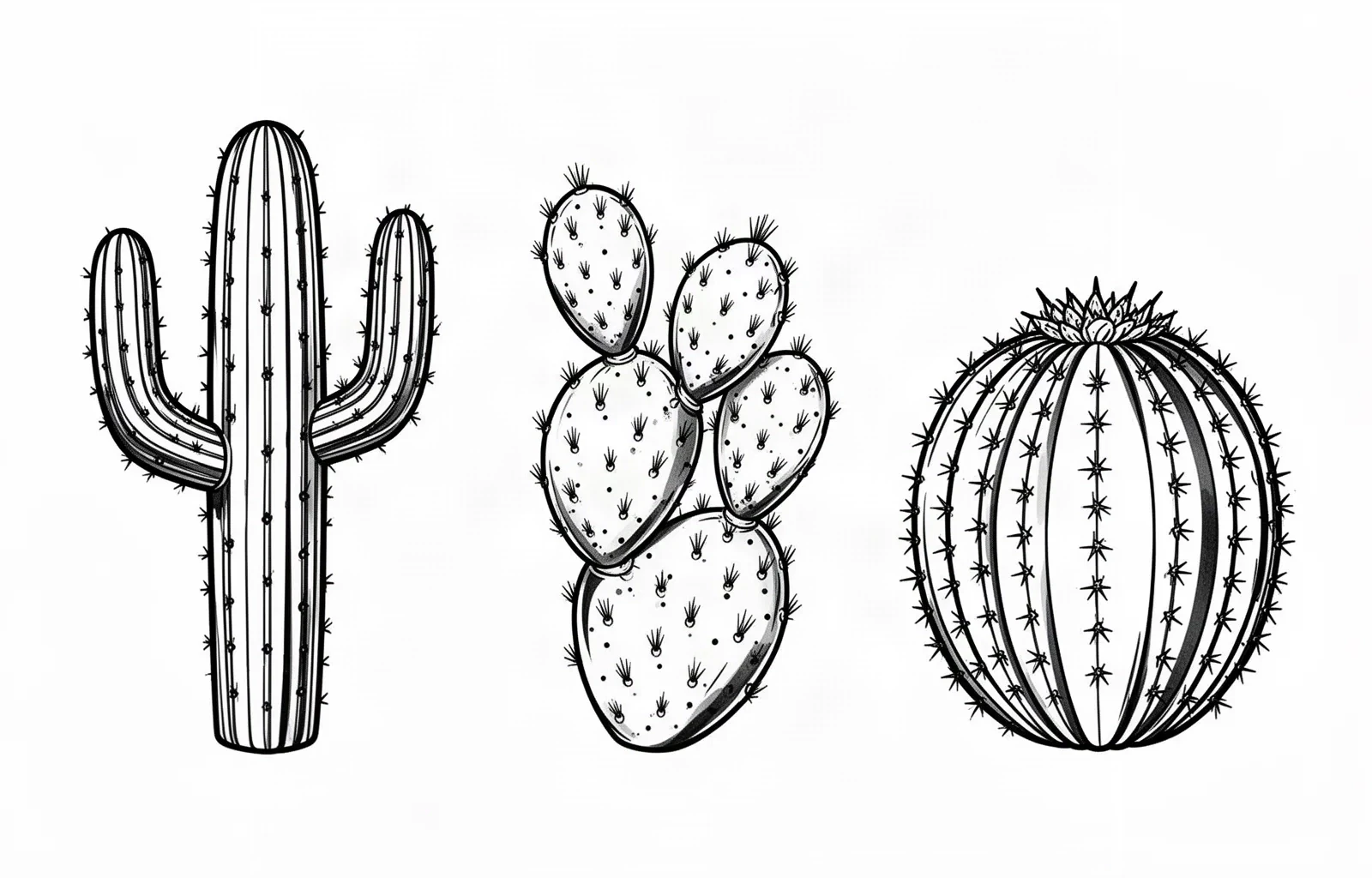
Original black line-art comparison of three cactus stencil constructions side by side: a ribbed saguaro column with two arms meeting the trunk at open joint wedges, a prickly-pear cluster of stacked oval pads joined at narrow pinched nodes, and a round barrel cactus with vertical ribs and even rows of short spine marks, each drawn with open white channels between ribs and around every spine.
Saguaro, prickly-pear, and barrel constructions side by side at equal height. Read the open wedges at each arm joint, the pinched nodes between pads, and the white channels between ribs: those are the separations that decide whether a cactus stencil survives print and transfer at final size. Original illustration drawn for this guide, not a screenshot of app output.
Cactus variants compared for stencil work
VariantReads asStencil costSuits
SaguaroTall ribbed column with one or two upward arms, short spine ticks in vertical rows, sometimes a single flower or knob at the crown. Reads as desert landmark and vertical accent.Moderate. Ribs plus arm joints plus spine rows compete for the same column width, so the minimum width is set by spine-gap survival, not by the outline.Forearm, outer calf, and spine-adjacent back runs where a tall vertical fits the limb or torso axis without wrapping.
Prickly-pearCluster of flat oval pads stacked at slight angles, joined at narrow nodes, dotted with areole marks and small spine tufts, sometimes with round fruit on the top pads. Reads as a spreading, friendly desert plant.Moderate to high. Every pad needs its own closed contour and every node needs open skin, so pad count sets the minimum width more than any single pad.Thigh, shoulder cap, and upper arm where a spreading cluster can sit flat with room for each pad to separate.
BarrelRound ribbed globe with evenly spaced vertical ribs and regular spine rows radiating from areole points, sometimes ringed with small flowers at the crown. Reads as a compact symmetric ornament.Highest per centimeter. The globe is small but rib count is high, so crowding arrives fast; small barrels need aggressive rib and spine reduction to stay readable.Shoulder cap, calf, and flat gap-filler fields where a compact round form anchors a composition without demanding vertical span.
  • Saguaro watch-out: Protect the arm joints: the open skin wedge where each arm meets the trunk. If that wedge closes, the arm fuses into the column and the saguaro becomes a plain post.
  • Prickly-pear watch-out: Protect the nodes: the pinched joints between pads. If two pads share an edge instead of meeting at a node, remove or re-angle the weaker pad rather than thinning all contours.
  • Barrel watch-out: Protect rib-channel rhythm: evenly spaced separations from crown to base. If neighboring ribs touch anywhere at 1:1, remove whole ribs evenly instead of thinning every rib.

Crown flowers, pad fruit, and ground lines are accents, not structure. Once a cactus reference includes blooms, buds, fruit, or scenery, vet the plant construction first with this page, then keep each accent only if it sits fully clear of the plant at true size. Drop accents before redrawing the cactus itself.

Reference evaluation framework

Score the reference in minutes, then act on the weakest check.

Four cactus constructions at labeled widths. Each one names the protected structure, the fix, and the go or no-go verdict at that exact size. Confirm every verdict with a measured 1:1 print.

HOLDS AT STATED SIZE

Saguaro column with two arms at 10 cm

Intended width 100 mm

Source
Upright ribbed column with two arms branching at clear joints, open skin wedges at both arm junctions, evenly spaced ribs, and short spine ticks with visible gaps between marks at true size.
Protect
The arm-joint wedges, the outer column contour, the rib rhythm, and the gap around each spine tick.
Fix
Shorten only the longest spine ticks if a single tick touches a rib line at 1:1. Keep arm count, rib count, and joint wedges unchanged.
Candidate stencil
Same cactus construction with the variant confirmed, joints separated, hierarchy set, and protected contours kept at transferable mass.
Final-size verdict
Holds at 10 cm. Joints stay open at 1:1 and the plant reads as a saguaro without guessing.

RE-SPACE SPINES FIRST

Barrel cactus with crowded spine rows at 7 cm

Intended width 70 mm

Source
Appealing round globe with correct rib structure, but spine rows sit so tight that neighboring spine marks share edges near the crown while ribs stay well spaced, closing the top third into one textured band.
Protect
The outer globe contour and the rib rhythm as rebuild anchors.
Fix
Remove whole spine marks evenly, keeping every remaining mark fully clear of its neighbors, then re-check with a squint test at 1:1. Do not thin rib lines to compensate for spine crowding.
Candidate stencil
Same cactus construction with the variant confirmed, joints separated, hierarchy set, and protected contours kept at transferable mass.
Final-size verdict
Not stencil-ready until spine gaps open. Correct ribs cannot rescue merged spine rows.

SIMPLIFY PADS FIRST

Prickly-pear cluster with photo-detailed texture at 8 cm

Intended width 80 mm

Source
Good pad stacking and clear nodes, but each pad carries fine inner texture, dense areole dots, and long spine tufts that read on screen and close into bands at true transfer size.
Protect
Pad outlines, node positions, and the stacking order from base to tip.
Fix
Drop inner-pad texture to at most one short mark or dot pair per pad, shorten tufts to ticks, and re-check with a squint test at 1:1. Reduce marks before thinning pad contours.
Candidate stencil
Same cactus construction with the variant confirmed, joints separated, hierarchy set, and protected contours kept at transferable mass.
Final-size verdict
Simplify first. If pad separations still close at 8 cm, run this reference with fewer pads or enlarge the width.

ENLARGE OR RECROP

Flowering saguaro scene with buds and ground line at 5 cm

Intended width 50 mm

Source
Tall column with arms plus crown flowers, side buds, and a ground line compressed into a narrow ankle band, so flowers touch the crown, one bud bridges into an arm, and the ground line merges with the column base.
Protect
The column contour and the best arm joint as the recrop anchor.
Fix
Recrop to the column and arms alone for this width, or move the full flowering scene to a wider flat field. Do not keep flowers, buds, or ground marks that touch the cactus.
Candidate stencil
Same cactus construction with the variant confirmed, joints separated, hierarchy set, and protected contours kept at transferable mass.
Final-size verdict
At 5 cm the plant and its accents function as one merged mass. Enlarge, recrop, or drop the scene elements before print.

Desert scenes with suns, skulls, or lettering stay out of this framework. A scene judges compositional balance across unrelated elements, while this framework judges one plant: construction order, joint and node clearance, rib rhythm, and spine-gap retention. Broad visual browsing stays on the stencils and subject hubs.

Spine gaps and readability at final size

Judge the white space at the width you will print.

Screens forgive crowding that paper and skin do not. Set the width first, run the four checks below, then inspect each feature in the table at true physical size with scaling off.

Rib counting

Count the ribs on the reference and confirm each rib runs crown to base (or pad edge to pad edge) without touching its neighbors at the printed width.

Fail signal: A rib that merges into its neighbor anywhere along its run, or a rib count that changes between the top and the base, means ribs need removal or re-spacing before judging spines.

Spine-gap tracing

Trace the white space around every spine mark to open air with a finger. Each spine should sit in its own pocket of skin between rib lines.

Fail signal: A spine whose gap dead-ends into a neighboring spine or a rib line is a bridge. Remove the weaker mark rather than shrinking all spines at once.

Joint and node clearance

Confirm open skin at every arm joint and every pad node at 1:1. The wedge where an arm meets the trunk and the pinch where two pads meet must both read as background.

Fail signal: A joint or node that reads as a shared edge instead of a gap means the two shapes will fuse on skin. Re-space the shapes before simplifying any detail.

Squint read

Step back or blur the reference until fine marks disappear. The cactus variant and its construction, column with arms, stacked pads, or ribbed globe, should still read.

Fail signal: A saguaro that squints down to a plain post, a prickly-pear that squints down to a leaf cluster, or a barrel that squints down to a plain ball needs stronger separations, not finer lines.

About 6 cm and below

Wrist, ankle, behind-ear accents, and small gap fillers.

Single simple silhouettes only. One column with at most one arm, a two-pad cluster, or a reduced-rib barrel with tick spines and no flowers, fruit, or ground lines. If any rib channel or spine gap closes at 1:1, remove a mark rather than forcing reduction.

About 6 to 10 cm

Forearm, calf, shoulder front, and small thigh pieces.

The most flexible band for cactus work. Full saguaro arms, three-to-five pad clusters, and ribbed barrels with regular spine rows can work when every joint, node, and spine gap is verified at true size. Flowering crowns and fruit need the upper half of this band.

About 10 cm and above

Thigh, upper back, and full forearm or calf runs.

Room for multi-arm saguaros, large pad clusters with fruit, and full rib counts, but only when arm joints, nodes, and spine gaps stay open at 1:1. Larger width does not rescue fused joints, shared pad edges, or merged spine rows.

Cactus feature checks by width band
FeatureAbout 6 cm and belowAbout 10 cm and above
Outer contoursKeep the heaviest lines here. If a column edge, pad outline, or globe rim disappears, the cactus loses its silhouette and becomes an unreadable texture patch.Same priority. Larger width allows slightly finer outer contours, but separability still beats uniform thinness.
Ribs and pad seamsCarry the roundness cue with fewer, wider-spaced ribs. Fewer ribs with open channels beats a full botanical rib count that merges.A fuller rib count can work when each channel keeps open skin at 1:1. If neighboring ribs touch anywhere, remove whole ribs evenly.
Spines and areole marksReduce to short ticks or sparse dot pairs with a clear pocket of skin around each mark. Spine rows close fastest at small widths, so they simplify first.Longer spines and denser areole rows can add character when the rib channels dominate. Equal-weight spine texture needs hierarchy work before print.
Flowers, fruit, and ground accentsDrop scene accents entirely below the width where they sit fully clear of the plant. Any flower, bud, fruit, or ground mark that touches the cactus merges first.A flowering crown, pad fruit, or short ground line can work when open skin separates every accent from the plant at true size.

Reference to clean stencil

Lock the variant first, then build outward from the joints.

Work in this order so one change at a time can be judged at the same width. Stop when variant, joints, gaps, and accents each read correctly.

  1. 01

    Lock variant, width, and placement first

    Name the cactus variant, set the intended physical width in millimeters, and name the body area before judging the reference. A barrel that holds at 9 cm on a flat shoulder cap can fail at 5 cm on a curved ankle with no line being wrong on its own. Use the size calculator when target dimensions are still open.

  2. 02

    Verify construction and joints

    Count ribs, number pads from base to tip or arms from trunk outward, then confirm every joint wedge and node pinch stays open at 1:1. Resolve fused arms, shared pad edges, and touching ribs before touching spines, dots, or flower detail. A cactus with countable, separated construction is already halfway to stencil-ready.

  3. 03

    Set plant-versus-accent roles

    Assign every mark a role: plant construction that carries the first read, spine rows that texture it, and flower, fruit, or ground accents that support it. Strengthen outer contours first, keep support marks lighter, and mark one removable accent family that can go if gaps close.

  4. 04

    Simplify spines and reopen gaps at 1:1

    Remove spine marks and inner texture before thinning contours. Keep open skin between ribs, around each spine, inside every joint wedge, and between the plant and every accent, then run a squint check: step back until fine marks disappear and confirm the variant still reads. The line-weight guide covers fine, normal and bold behavior on the same stencil.

  5. 05

    Verify print and transfer path

    Export a true-size PDF with no fit-to-page scaling, inspect the narrowest rib channel, the tightest spine gap, and the smallest joint or node clearance on plain paper, then measure the physical print with a ruler. If the digital file passes and only paper fails, move to print-stage evidence instead of simplifying again.

Placement and size decisions

Tall plants want vertical skin, round plants want flat skin

A cactus has a strong axis or none at all depending on the variant. Vertical fields preserve columns with little compensation, while round and spreading forms demand flat panels.

Forearm and outer calf

Long, gently curved vertical fields that suit saguaro columns best. Arms can extend sideways only where the flatter face of the limb gives them room.

Check: Align the column with the limb axis, keep arm tips clear of the wrap edge, and confirm both joint wedges stay open at 1:1 before print.

Shoulder cap and thigh

Broad, softly rounded panels that suit spreading prickly-pear clusters and round barrels with room for every pad and rib to separate.

Check: Seat the cluster or globe on the flattest skin, spread pads or ribs evenly across the panel, and confirm node pinches and rib channels stay open at true size.

Wrist, ankle, and behind ear

Small wrapped fields where only narrow single silhouettes survive. Multi-arm columns, pad clusters, and flowering scenes forced into these bands merge first.

Check: Recrop to a single column, a two-pad sprig, or a reduced-rib barrel with tick spines and no accents, then run the small-size checks at the exact width.

Upper back and shoulder blade

Large flat panels with a strong vertical axis. Tall saguaros with symmetric arms and generous spine rows sit well here when joints stay open.

Check: Center the column on the flattest span, balance arm lengths on both sides, and confirm rib rhythm and spine gaps at 1:1 before print.

Stencil-ready checklist

Approve the cactus only when every line passes

Run this short sequence with scaling off and a ruler in hand. One failed line means fix, enlarge, or reselect before transfer.

  • Confirm cactus variant, intended width in millimeters, and the named placement.
  • Confirm every arm, pad, and rib is separated with no shared edges at 1:1.
  • Confirm all joint wedges, node pinches, and spine gaps trace to open air.
  • Confirm the squint read still names the variant with fine marks gone.
  • Confirm flowers, fruit, and ground accents sit fully clear of the plant.
  • Export a true-size PDF with scaling off and measure the physical print.
Variant fits placement Verify gaps at 1:1 Joints stay open

FAQ

Cactus stencil decisions, answered

Short answers for the variant, simplification, gap, and placement checks that recur when a cactus reference moves toward transfer-ready output.

It is usable when three checks pass at the exact physical width: the variant construction fits the available width with every arm, pad, and rib separated, all joint wedges, node pinches, and spine gaps stay open at 1:1, and every flower, fruit, or ground accent sits fully clear of the plant. If any check fails, the fix list on this page names what to re-space, simplify, or enlarge before print.

From evaluated reference to working stencil

Turn the approved cactus into a stencil draft.

Start from the cactus that passed the variant and gap checks, then continue on iPhone for body fit, exact-size print, mirror and professional export.