

Hybrid fusion vetting

Vet the angel butterfly fusion before it shares one stencil

An angel figure and butterfly wings compete for the same skin. Pick one dominant side, prove the vein to drapery and halo gaps at your exact height, then prep a symmetric layout that transfers as one readable fusion.

Built for working artists preparing fused angel butterfly requests. This page covers hybrid dominance choice, gap retention, and transfer prep only, not standalone angel or butterfly construction.

Dominance first

One side leads, the other supports.

Hybrids fail when figure mass and wing pattern share equal weight and drapery fills whatever is left. These three dominance options decide the hierarchy before a single gap is measured.

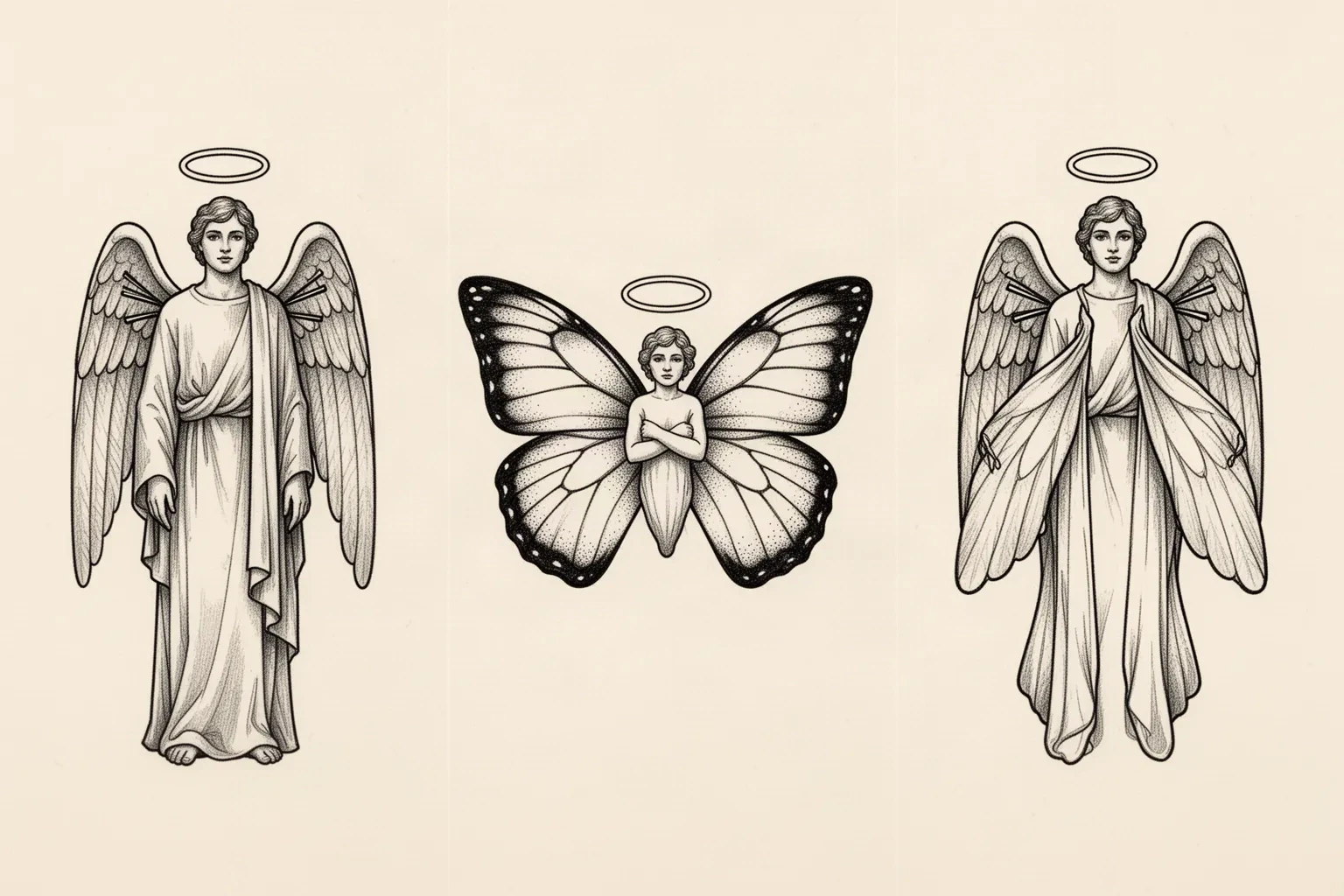
Three-panel ink study comparing angel butterfly dominance: a robed angel figure leading with wings behind the shoulders and open paper between robe and wing, a large butterfly spread leading with a small angel torso at its center and a halo clear of both upper wings, and a fused build where drapery flows down into the lower wings with blank channels between the fold and vein lines.
Left, figure-led: the angel reads first while wing pattern stays support texture. Center, wing-led: the wing spread leads and a small angel torso acts as the meaning anchor. Right, fused morph: drapery and wings share one silhouette, so the bridge channels decide whether the fusion survives. Synthetic editorial illustration of hierarchy only, not a to-scale stencil, not app output, and not a measurement reference. Verify every vein, fold, and halo gap on your own 1:1 print.

Figure-led

A recognizable angel figure carries the first read at roughly sixty percent of the visual mass, with butterfly wings used as patterned wing replacements rather than the subject. This build suits memorial and guardian briefs where the face, halo, and drapery must read first, and it survives reduction best when the figure silhouette stays simple because butterfly veins are support texture, not the focal detail.

Check: Cover the wing pattern. If the angel still reads as a complete figure with halo position and drapery direction intact at 1:1, the dominance is sound. If covering the pattern leaves only a generic robed shape, strengthen the figure pose before adding more vein work.

Wing-led

Butterfly wings carry the first read, with a small angel figure nested in the body zone or seated below the wings as the anchor. This build suits clients who want lightness and wing symmetry first with the angel as meaning rather than mass, but it fails fastest when drapery folds touch vein forks or when the halo ring bridges into the upper wing edge and turns two outlines into one pocket.

Check: Trace the full wing outline without lifting a finger. If the path stays clear of the halo, face, and every drapery fold at true size, the mass works. If any fold or halo edge shares a channel with a vein fork, separate or simplify before print.

Fused morph

Figure and wings share comparable mass on one vertical axis, usually a torso that dissolves into lower wings with drapery folds flowing into vein forks. This build suits larger flat fields such as the back and thigh, but it needs the strictest gap discipline because drapery and vein textures merge into one grey band on curves when no single hierarchy leads.

Check: Fold the composition through its vertical axis. If wing lobes mirror, the halo and face sit centered, and a continuous skin channel separates every vein fork from every fold edge at true size, the fusion holds. If one side crowds the halo or a fold dead-ends into a vein, recenter before judging line weight.

Hybrid evaluation framework

Score the fusion in minutes, then act on the weakest check.

Four fused constructions at labeled heights. Each one names the protected structure, the fix, and the go or no-go verdict at that exact size. Confirm every verdict with a measured 1:1 print.

HOLDS AT STATED SIZE

Figure-led guardian with patterned wings at 12 cm

Intended height 120 mm

Source
Standing angel figure with calm face, one thin halo ring, a robe with two long primary folds, and butterfly-patterned wings with three short vein forks per upper wing. Figure and wings sit in distinct zones with open skin between the outermost fold and the nearest vein.
Protect
The full figure silhouette with halo position, both primary robe folds, the outer wing contours with the mirror axis, and the clear bridge channel between drapery and wing zones.
Fix
Shorten only the vein fork nearest the robe if the bridge narrows at 1:1. Keep figure height, halo separation, fold count, and wingspan unchanged.
Candidate stencil
Same hybrid with dominant side set, axis centered, fold and vein count thinned to surviving bridges, and outer contours kept at transferable mass.
Final-size verdict
Holds at 12 cm after a bridge-channel check. Separate figure mass and wing texture mean the eye reads angel first, butterfly second, with no shared pocket.

SEPARATE FIRST

Wing-led spread with halo touching the upper wing at 9 cm

Intended height 90 mm

Source
Large symmetric butterfly wings with full vein fans, a small angel torso nested in the body zone, a thin halo that touches the left upper wing edge, and one drapery fold that crosses a lower vein fork.
Protect
One wing outer contour with the mirror axis and the small figure placement as the meaning anchor.
Fix
Move the halo fully clear of both upper wings until visible skin rings it, pull the crossing fold out of the vein zone or shorten it, and recheck at 1:1 before any shading work.
Candidate stencil
Same hybrid with dominant side set, axis centered, fold and vein count thinned to surviving bridges, and outer contours kept at transferable mass.
Final-size verdict
Not stencil-ready at 9 cm. A halo or fold that touches a vein turns the crown of the design into one dark mass, so separate first, then recheck before detail.

THIN FOLDS FIRST

Fused morph with folds flowing into veins at 11 cm

Intended height 110 mm

Source
Torso dissolving into lower wings with four parallel drapery folds flowing toward vein forks, plus a halo seated close to the upper wings. Several fold-to-vein separations sit under one millimeter on screen.
Protect
The outer fused silhouette with the mirror axis, the halo ring position, and the two longest folds that set the torso direction.
Fix
Keep two primary folds maximum with open skin between them, merge the remaining folds into open wing lobes, and recheck each surviving fold-to-vein gap for open skin at 1:1. Reduce fold and vein count before thinning any contour.
Candidate stencil
Same hybrid with dominant side set, axis centered, fold and vein count thinned to surviving bridges, and outer contours kept at transferable mass.
Final-size verdict
Simplify first. If the fusion zone still reads as one textured band at true size, the hybrid needs fewer folds and forks, not finer lines.

ENLARGE OR RECROP

Detailed hybrid with full fans and layered folds at 6 cm

Intended height 60 mm

Source
Small hybrid with full fine vein fans on all four wing lobes, a shaded cherub face, a hairline halo, and layered drapery folds sharing the same fine weight as the veins.
Protect
The hybrid silhouette direction and one texture anchor, either the upper vein fan or the primary fold pair, not both at full density.
Fix
Keep the upper vein fan, merge lower veins into open lobes, reduce the face to eyes plus one nose hint, drop inner folds, and recheck with a squint test. Below about 7 cm, fused fine detail plus a modeled face merges into one pocket.
Candidate stencil
Same hybrid with dominant side set, axis centered, fold and vein count thinned to surviving bridges, and outer contours kept at transferable mass.
Final-size verdict
At 6 cm the shared fine weight flattens the read order. Enlarge past 10 cm, recrop to wings plus a simplified figure, or cut the lower vein and fold density for this height.

Standalone angel variant choice and wing, halo, and drapery simplification stay with the angel owner, and standalone small-butterfly symmetry and vein holds stay with the small-butterfly owner. This framework judges only the fused job: dominance, vein-to-fold and halo bridges, and hybrid symmetry at a stated height.

Vein, fold, and halo gaps at final size

Judge the bridge zones at the height you will print.

Screens forgive fusions that paper and skin do not. Set the hybrid height first, then inspect each feature below at true physical size with scaling off.

About 6 cm and below

Wrist edge, ankle, behind-ear, and small gap fillers.

Carry one read only at micro size: open-lobe wings plus a simplified figure hint, or a small figure with plain wing lobes and veins removed. Treat vein fans, inner folds, halo thinness, and face modeling as removable. If any vein-to-fold or halo-to-wing gap closes at 1:1, remove that vein or fold rather than shrinking it further.

About 7 to 12 cm

Common forearm, calf, shoulder blade, and collarbone hybrid pieces.

The most flexible band for a true fused read. One clear dominant side, simplified veins, two primary folds, and a separated halo can work when every gap is verified at true size. Check vein fork channels, fold separations, and halo clearance before approving face modeling or extra forks.

About 12 cm and above

Thigh, upper back, and rib panels with room for fans, folds, and halo modeling.

Room for fuller vein fans and a real robe run, but only when open skin separates every vein edge from every fold edge and the halo. Larger height does not rescue veins fused to folds, a halo touching a wing edge, or a shaded face merged into one pocket.

Hybrid feature checks by height band
FeatureAbout 6 cm and belowAbout 12 cm and above
Wing veins and fork channelsKeep three short forks per upper wing maximum with channels wider than the vein mass. Merge lower fans into open lobes. Cross veins and border dots are removal candidates at hybrid sizes.Fuller fans can work when each fork keeps open skin along its full length and stays clear of every fold. Judge channel continuity, not count: one fork touching a fold fails the fusion even when the rest looks airy.
Drapery folds and robe directionKeep two primary folds maximum as open channels with no ripple folds, sleeve texture, or fold-to-vein contact. Drop inner folds and keep the robe as one clean directional read.Two or three folds can add weight when the longest fold clearly dominates and each keeps open skin from the nearest vein. Equal-weight parallel folds that meet veins need hierarchy work before print.
Halo ring, face, and figure clearanceKeep the halo as one closed ring fully clear of both upper wings, and reduce the face to eyes plus one nose hint with visible skin between marks. A halo that touches a wing or a shaded face merges first.Softer face modeling can work when each mark keeps its own spacing at 1:1 and the full halo keeps open skin on all sides. Check the crown zone with a squint test at true size.
Vein-to-fold and hybrid bridge zonesEvery vein-to-fold, vein-to-halo, and fold-to-wing gap must read as open skin at 1:1. Merge means fewer veins or folds, or a wider layout, not thinner lines.Gaps can sit closer relative to height, but each bridge must still survive print and transfer as a separate opening. Fused morph builds need the widest bridge check.

Reference to clean stencil

Set dominance first, then thin the bridge.

Work in this order so one change at a time can be judged at the same height. Stop when dominance, axis, gaps, and hierarchy each read correctly.

  1. 01

    Name the dominant side, height, and placement

    State the build in one sentence, figure-led, wing-led, or fused morph, then set the intended physical height in millimeters and the named body area. A fused hybrid that holds at 12 cm on a flat back can fail at 6 cm on a wrist with no line being wrong on its own. Use the size calculator when target dimensions are still open.

  2. 02

    Set the axis and open every vein-to-fold gap

    Center the halo and figure, mirror the wing tips, and confirm a continuous skin channel separates every vein fork from every fold edge and the halo at true size. Resolve halo contacts, fold crossings, and nested crowding before touching line weight. A hybrid with a stable axis and open bridges is already halfway to stencil-ready.

  3. 03

    Rank three line levels

    Assign heaviest mass to outer wing contours and the figure silhouette plus halo ring, middle mass to one vein family or one primary fold pair, and lightest removable mass to extra forks, ripple folds, and face modeling. Mark at least two details that can be removed without changing identity. Strengthen the dominant contour first and never promote texture to contour weight to fill empty skin.

  4. 04

    Simplify folds, veins, and face, then recheck at 1:1

    Reduce fold and vein count and face marks before thinning contours. Keep open skin between forks, between folds, inside the halo, and along the full bridge channel, then run a squint check: step back until texture disappears and confirm the hybrid still reads as figure plus wings. The line-weight guide covers fine, normal, and bold behavior on the same stencil.

  5. 05

    Verify symmetry, print, and transfer path

    Fold-check the wings through the figure axis, export a true-size PDF with no fit-to-page scaling, inspect the narrowest vein fork, the tightest fold gap, and the halo clearance on plain paper, then measure the physical print with a ruler. If the digital file passes and only paper fails, move to print-stage evidence instead of simplifying again.

Placement and size decisions

Hybrids want flat skin that preserves their separations

An angel butterfly hybrid is a two-texture symmetry composition. Flat placements preserve vein, fold, and halo separations with little compensation, while tight curves demand a recrop to one dominant read.

Upper back and shoulder blade

Broad flat field where both fused and wing-led builds spread well. The spine centerline becomes part of the symmetry check, so any wing or halo drift shows fast.

Check: Center the halo and face on the flattest span, mirror primary vein forks and folds, and verify tip spacing at 1:1 before print.

Outer forearm and calf

Long narrow fields where the hybrid should follow the limb axis. Wide-spread wings wrap fast and crowd vein tips, while long robes compress folds together.

Check: Choose figure-led or a vertical fused build for these fields, align the figure axis with the limb, and shorten cross-limb tips while edits are still cheap.

Thigh, chest, and ribs

Large panels with room for a full figure plus wing fans and a robe run. Breathing and curvature still foreshorten lower wings and lower folds first.

Check: Spend the extra room on vein-to-fold separation first, then decide whether inner veins or folds earn their detail. Preview on a body photo before locking the file.

Wrist, ankle, and behind ear

Small wrapped fields where only a recrop survives. A full halo, modeled face, and layered folds forced into these bands merge first.

Check: Recrop to open-lobe wings plus a simplified figure hint, carry at most one halo ring and two folds, and run the small-height checks at the exact size.

Stencil-ready checklist

Approve the hybrid only when every line passes

Run this short sequence with scaling off and a ruler in hand. One failed line means keep, simplify, rescale, or relocate before transfer.

  • Confirm dominant build, intended height in millimeters, and named placement in one sentence.
  • Confirm wing tips mirror through the figure axis and the halo and face sit centered.
  • Confirm every vein fork keeps open skin along its full length with no fold contact.
  • Confirm two or three primary folds maximum with open channels between them.
  • Confirm the halo reads as one closed ring with open skin on all sides.
  • Export a true-size PDF with scaling off and measure the physical print.
One side leads Verify vein-to-fold gaps at 1:1 Keep, simplify, rescale, or relocate

FAQ

Hybrid stencil decisions, answered

Short answers for the dominance, gap retention, symmetry, small-size, placement, and transfer checks that recur when an angel butterfly fusion moves toward transfer-ready output.

Give roughly sixty percent of the visual mass to one side. Choose figure-led when the brief is memorial or guardian and the face, halo, and drapery must carry the meaning. Choose wing-led when the client wants wing symmetry and movement first with the angel as a small anchor. Choose fused morph only on larger flat fields where folds can flow into veins with a proven skin channel. If both sides share equal mass at a small height, shrink or lighten one side before changing the overall size.

Next steps

Use the neighboring owners for adjacent jobs.

This guide covers fused dominance choice, size-tied vein, fold, and halo rules, hybrid symmetry proof, and reference-to-stencil preparation. Use the links below for related single-subject and pairing depth.

Standalone angel construction, standalone butterfly symmetry, floral and skull pairing scales, broad gallery browsing, and paper manufacturing detail stay in their specialist owners. The links above hand off instead of repeating that detail.

From evaluated fusion to working stencil

Turn the approved hybrid into a stencil draft.

Start from the hybrid that passed the dominance and gap checks, then continue on iPhone for body fit, exact-size print, mirror and professional export.