
Morning glory variant chooser

Pick the morning glory variant that holds at your size

Single trumpets, bud pairs, staggered runs, long wraps, bud trails, and minimal recrops fail in different places on skin. Compare the six variants below on trumpet load, star-center gaps, and trailing continuity, then prep one transfer-ready stencil.

Built for working artists choosing between morning glory directions. This page compares the six variants with comparative final-size checks. Full single-reference scoring stays on the base morning glory stencil page, and generic vine mechanics stay with the vine owner.

Morning glory variant map

Six variants, six different size contracts.

Choose from variant construction and intent first. Each card names the build, where it fits, what to protect, and which failure to expect at true size.

Single trumpet focal

One fused trumpet with a creased star center and one heart-shaped leaf on a short stem stub. The lowest morning glory load and the only variant built for small flat or gently curved fields.

Best at 5 to 7 cm on wrist, collarbone dip, ankle, and behind-ear accents.

Keep: Keep the unbroken rim loop, the open star points, and the heart leaf silhouette with open skin between leaf and rim.

Fails when: Fails when the star closes into one dark pocket at 1:1. Shorten the pleat feeding the closed point instead of adding throat detail.
Trumpet-plus-bud pair

One open trumpet with one closed bud and one heart leaf sharing a short stem. Adds trailing intent without the spacing cost of a second open bloom.

Best at 7 to 10 cm on forearm, calf, and collarbone-to-shoulder spans.

Keep: Keep the trumpet dominant, the bud clearly smaller with its own stalk, and open skin between all three marks.

Fails when: Fails when the bud sits against the trumpet rim and the pair prints as one joined mass. Shift the bud one bud-width along the stem first.

Two-bloom staggered run

Two trumpets at different openings with two heart leaves along one stem direction. The classic trailing morning glory composition and the most requested variant.

Best at 12 to 14 cm on forearm, shoulder front, calf, and thigh panels.

Keep: Keep a clear height stagger between the blooms, each star center open, and two leaf stalks that never touch a rim.

Fails when: Fails when both blooms sit at equal height and share an edge, or when two leaves clasp the stem at one join. Restagger or remove the weaker bloom first.

Long multi-bloom trailing wrap

Three or more blooms of ranked openings with buds at leaf joints along a long stem that turns with the limb. The densest morning glory variant and the hardest to keep transfer-readable on a curve.

Best at 14 cm and above on thigh, upper back, side torso, and full forearm wraps.

Keep: Keep one lead trumpet dominant, every subordinate bloom smaller with open skin on all sides, and one readable stem path through every turn.

Fails when: Fails when two rims share an edge after the run wraps, or when an inner-curve pinch closes a star. Demote or remove a bloom before thinning any contour.

Bud-and-tendril trail

Closed buds, curling tendrils, and heart leaves on a slim traveling stem with no open trumpet. Carries the morning glory habit into fields where no full bloom can fit.

Best at 4 to 6 cm on fingers-adjacent accents, behind ear, ankle bands, and narrow wrist wraps.

Keep: Keep one stem direction, each bud on its own short stalk, and every leaf tip fully clear of the nearest bud.

Fails when: Fails when buds cluster into a beaded chain with no skin between them. Thin to fewer buds with wider spacing rather than shrinking the whole trail.

Minimal outline recrop

Fine-line single-contour recrop of one trumpet or bud with a stem stub and no throat tone, no vein nets, and no second leaf. Built for fields where a full variant cannot fit.

Best as a recrop at 4 cm and below, or as a gap filler beside larger work.

Keep: Keep the rim loop, the star position as a small open mark, and the stem direction. Hierarchy comes from what was removed.

Fails when: Fails when full pleat and leaf detail is kept at a tiny width and every gap prints as one filled trumpet. Recrop to fewer marks rather than thinning lines further.

Morning glory variant trumpet load, gap load, stem-leaf load, size, and placement trade-offs
VariantTrumpet loadStar and gap loadStem-leaf loadMinimum sizePlacement
Single trumpet focalOne fused cone with five soft pleats.One star center to protect.Stem stub plus one heart leaf.Holds from about 5 cm.Wrist, collarbone, ankle.
Trumpet-plus-bud pairOne open cone plus one closed bud.Star plus bud-to-rim clearance.Short stem with one leaf stalk.Needs about 7 cm.Forearm, calf, collarbone span.
Two-bloom staggered runTwo cones at different openings.Two stars plus bloom-to-bloom skin.One direction with two leaf stalks.Needs about 12 cm of run.Forearm, shoulder, calf, thigh.
Long multi-bloom wrapThree or more ranked cones.Strictest: every star plus every rim edge.Long turning stem, leaves subordinate.Needs about 14 cm of run.Thigh, upper back, side torso, wraps.
Bud-and-tendril trailNo open cone, buds only.Bud-to-bud and bud-to-leaf skin.Slim stem with tendrils and leaves.Fits 4 to 6 cm fields.Behind ear, ankle, narrow wrist.
Minimal outline recropRecropped single stage, fewest pleats.One protected star or rim gap.Stem stub, second leaf removed.Recrop fits 4 cm and below.Gap filler, small accents.

Once the variant is set, run the full single-reference scoring on the base morning glory stencil page. That sibling vets one chosen reference at a stated size, while the choice between variants happens here.

Bud-to-trumpet decision

Choose the stage that fits the skin, not the prettiest picture.

Three morning glory stages with different footprints and different stencil costs. Match the stage to the placement size first, then pick the variant that carries it.

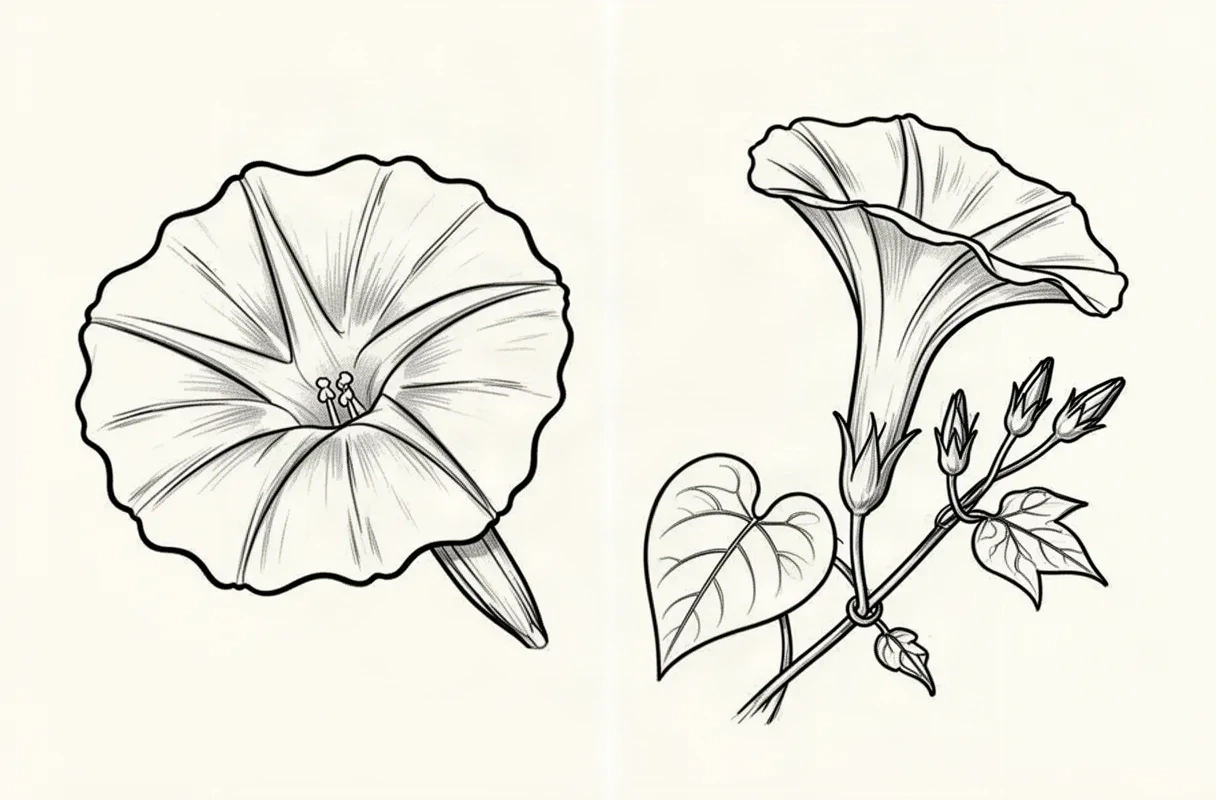
Line-art reference plate of a morning glory bloom in face-on and side profile, showing fused funnel pleats, a creased star at the throat, and foliage on a slender twining stem
Fused cone, five soft pleats, and a creased star at the throat with open skin between the points. Use this plate to label each bloom bud, half-open, or full open before assigning it to a variant. Original illustrative artwork, not a specific tattoo result: confirm every gap on your own 1:1 print.

Closed bud

Bud-and-tendril trails, second mark inside trumpet-plus-bud pairs, and minimal recrops.

Lowest line count and narrowest footprint. Risk is blandness: a bud with no stalk separation reads as a leaf tip at transfer size.

Holds from about 4 cm with open skin around every bud.

Half-open trumpet

Usually the subordinate bloom in two-bloom runs and the lead mark in trumpet-plus-bud pairs.

Moderate. A partial funnel still needs a readable rim arc and at least three separable pleats at final size.

Needs about 7 cm before rim and pleat separations hold open.

Full open trumpet

Single focals and the lead bloom in staggered runs and long wraps.

Highest. Needs the widest footprint, all five pleats separable, and a star with light between every point.

Needs about 5 cm as a lone focal, about 12 cm of run when paired or wrapped.

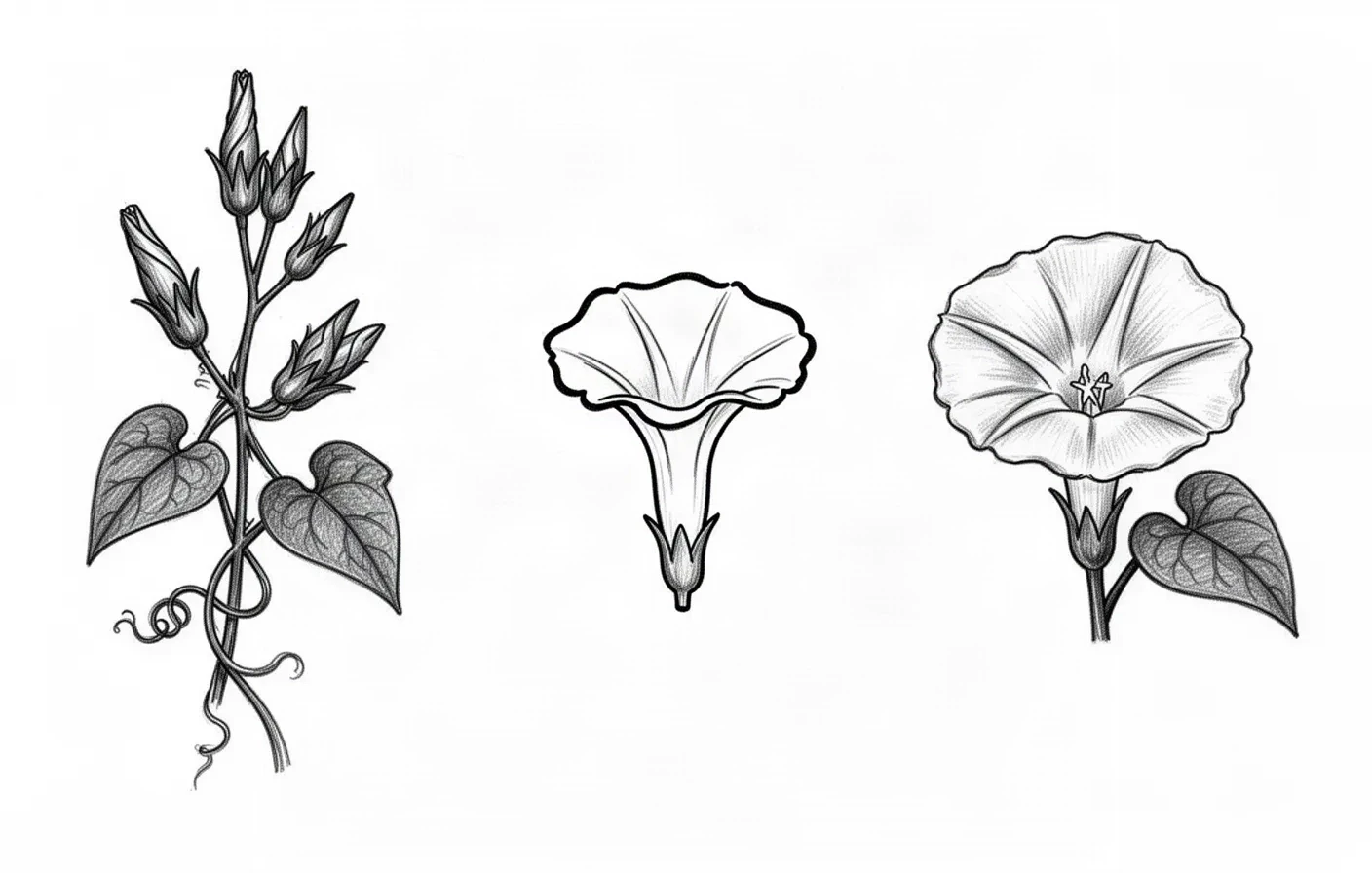
Line-art reference showing three small-field morning glory constructions: a bud-and-tendril trail with heart leaves, a minimal single-contour trumpet recrop, and a lone open trumpet with an open star center and one heart leaf
Three narrow-field constructions: a bud-and-tendril trail with heart leaves, a minimal single-contour recrop with throat tone and the second leaf removed, and a lone open trumpet with an open star center and one heart leaf. Small fields are handled by carrying fewer marks, not by thinning the same marks. Original illustrative artwork, not a specific tattoo result: confirm every gap on your own 1:1 print.

Variant evaluation framework

Score the variant in minutes, then act on the weakest check.

Four morning glory constructions at labeled sizes. Each one names the protected structure, the fix, and the go or no-go verdict at that exact size. Confirm every verdict with a measured 1:1 print.

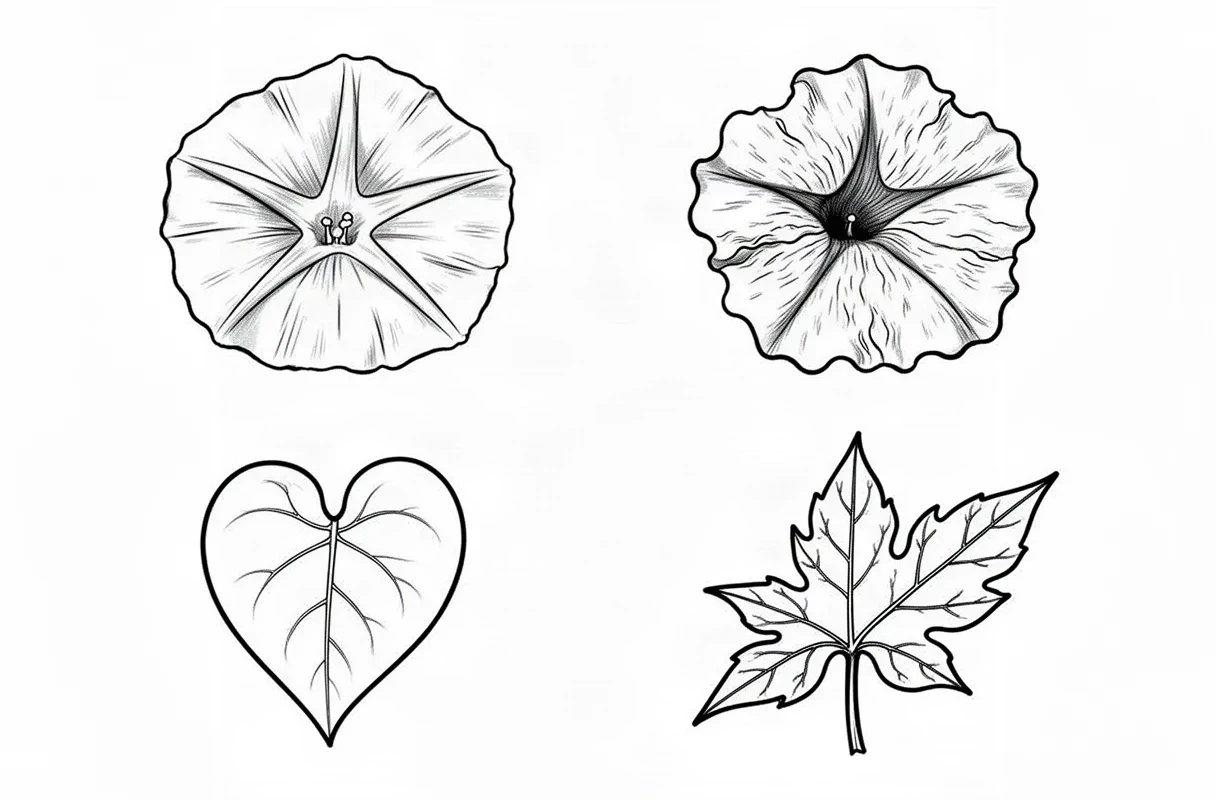
Recognition plate comparing an open morning glory star center and heart-shaped leaf against a trumpet center filled into one dark pocket and a lobed leaf that is not morning glory

Plate: recognize before you score

Top left shows the open star with light between the points and bottom left the heart-shaped leaf with pinnate veins. Top right shows a center that has closed into one dark pocket, and bottom right a lobed leaf that reads as ivy or maple rather than morning glory. Label the variant against this key first, then judge your own star and leaf on a measured 1:1 print. Original illustrative artwork, not a specific tattoo result.

HOLDS AT STATED SIZE

Trumpet-plus-bud pair at 8 cm

Intended width 80 mm

Reference behavior
One fused trumpet with five readable pleats and an open star, one closed bud on its own stalk, and one heart-shaped leaf with open skin between all three marks.
Protect
The rim loop, the open star points, the bud stalk separation, and the heart leaf silhouette.
Fix
Shorten only the pleat feeding a tight star point at 1:1. Keep bloom count, star gaps, and leaf shape unchanged.
Candidate stencil
Same morning glory variant with the bloom stages confirmed, trumpet gaps separated, trailing habit set, and protected contours kept at transferable mass.
Final-size verdict
Holds at 8 cm. The trumpet leads, the bud supports, and every gap stays open at true size.

RESTAGGER FIRST

Two-bloom run with trumpets at equal height, 12 cm

Intended length 120 mm

Reference behavior
Two readable trumpets on one stem direction, but both blooms sit at the same height with less than a rim width between them, so the pair prints as one wide joined flower instead of a trailing run.
Protect
The stronger trumpet with its star and pleat order, plus the stem centerline as rebuild anchor.
Fix
Drop the weaker bloom at least one trumpet width lower along the stem, or demote it to a bud and finish as a trumpet-plus-bud pair. Do not thin trumpet contours to rescue touching rims.
Candidate stencil
Same morning glory variant with the bloom stages confirmed, trumpet gaps separated, trailing habit set, and protected contours kept at transferable mass.
Final-size verdict
Not stencil-ready until the blooms stagger with open skin between them. Equal-height pairing doubles the gap work for no trailing gain.

DEMOTE BEFORE DETAIL

Long wrap with three equal trumpets at 13 cm

Intended length 130 mm

Reference behavior
Three full trumpets of equal weight sharing one turning stem, with rim edges touching near two blooms and one star merged into a dark pocket where the run bends.
Protect
The best-drawn trumpet as the lead, and the single stem direction through the turn.
Fix
Demote one trumpet to a bud, remove at least one leaf, and stagger every rim-to-rim clearance open at 1:1. Enlarge past 14 cm if all three trumpets must stay open.
Candidate stencil
Same morning glory variant with the bloom stages confirmed, trumpet gaps separated, trailing habit set, and protected contours kept at transferable mass.
Final-size verdict
Simplify first. Equal-weight triples merge fastest on a curve, so hierarchy edits come before any line-mass work.

RECROP, DO NOT SHRINK

Full trumpet focal forced to 4 cm

Intended width 40 mm

Reference behavior
Full five-pleat open trumpet with a star, a heart leaf, and a stem segment compressed into a tiny behind-ear field, with pleat separations drawn as hairlines.
Protect
The two strongest rim directions, the star position, and the upper stem segment.
Fix
Recrop to a bud-and-tendril trail or a minimal outline recrop at this width, or enlarge past 5 cm to keep the open trumpet. Do not keep five pleats plus a leaf at 4 cm.
Candidate stencil
Same morning glory variant with the bloom stages confirmed, trumpet gaps separated, trailing habit set, and protected contours kept at transferable mass.
Final-size verdict
At 4 cm the pleats and star function as one filled trumpet. Reselect the variant before print.

Generic photo-to-stencil conversion stays out of this framework. Conversion turns pixels into linework, while this framework judges a morning glory variant that already has linework: stage per bloom, star openness, variant gap load, and trail fit. Broad visual browsing stays on the stencils and subject hubs.

Trailing continuity and wrap vetting

Keep the trail readable where the limb curves.

A morning glory is a trailing composition with spaced blooms, so the wrap decides which variant survives. Apply the rule for the placement you named before touching trumpet lines.

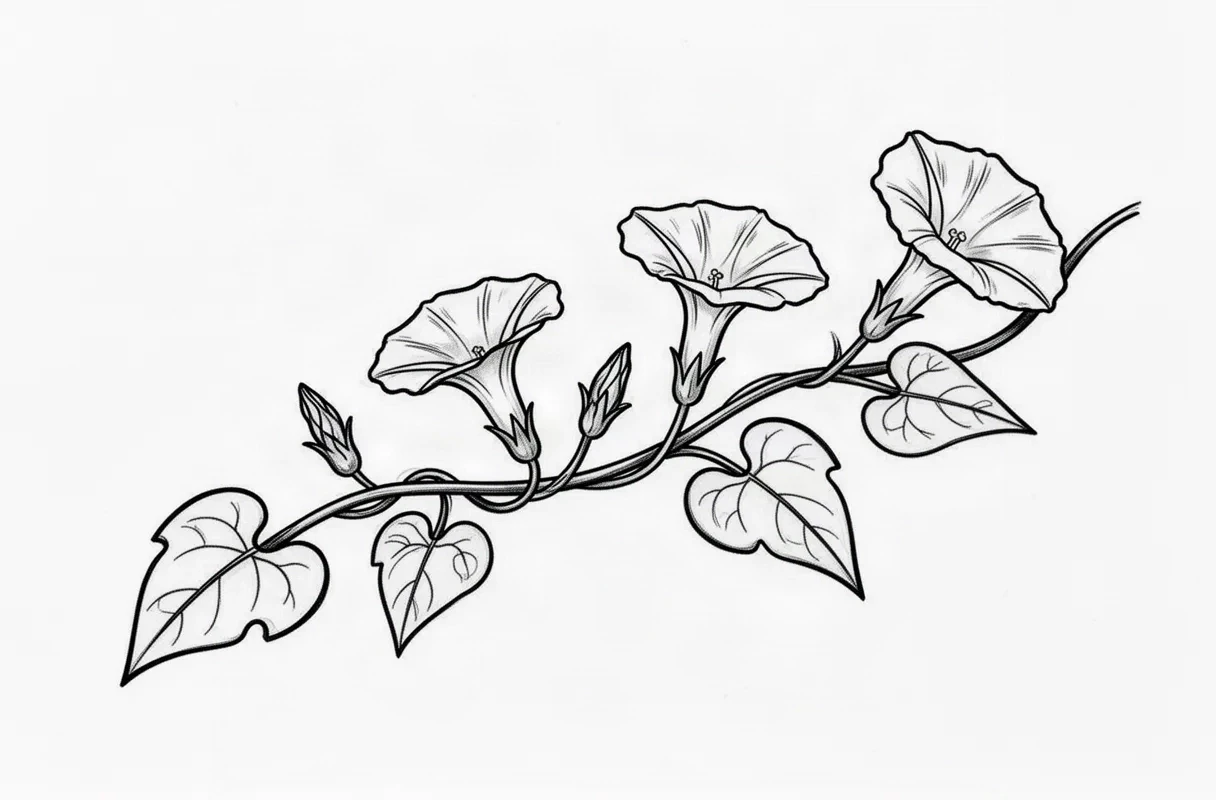
Line-art reference of a morning glory trailing run along a gentle curve, with three spaced trumpet blooms, heart-shaped leaves and buds on one continuous stem and open skin between every element

Plate: staggered run on a curve

One stem direction, spaced trumpets at different openings, heart leaves, and buds at leaf joints, with open skin between every element. This is the arrangement to protect when the run crosses a curved limb. Wrap the 1:1 print before approving any rim contact or closed star. Original illustrative artwork: confirm every decision on a measured 1:1 print.

Flat spans: thigh and upper back

The most forgiving fields for staggered runs and long wraps. Keep open skin between every trumpet and confirm the full run at 1:1 before print. Enlarge here when a smaller field forces crowding.

Limb lines: forearm and calf

Run the stem with the limb axis and keep the lead trumpet on the flattest span. Two-bloom runs fit; long wraps need the full limb length or they pinch one side of the run.

Curved spans: collarbone and shoulder

Suit a single focal or a trumpet-plus-bud pair following the available span. A slim two-bloom trail can work when the stem follows the curve instead of crossing it.

Tight wraps: wrist, ankle, behind ear

Only bud-and-tendril trails or minimal recrops survive here. Wrap the 1:1 print on the limb: if inner-curve pinching closes any gap, recrop to a smaller variant instead of resizing the same file.

Re-flow, resize, or recrop: the wrap decision order

When a wrap check fails, re-flow the stem along a longer limb path first, since a longer path restores open skin without changing the variant. Resize second, but only upward and only when the field allows it. Recrop to a smaller variant when neither saves the gaps: a staggered run that pinches on a wrist becomes a trumpet-plus-bud pair, and a pair that pinches becomes a bud-and-tendril trail. Generic wrap mechanics behind this order stay with the vine owner linked below; this page covers only the trumpet and leaf spacing the wrap must preserve.

Variant to clean stencil

Lock the variant, then build outward from the lead trumpet.

Work in this order so one change at a time can be judged at the same size. Stop when variant, stages, gaps, trail fit, and print each read correctly.

  1. 01

    Lock variant, size, and placement first

    Name one of the six variants above, set the intended physical width or run length in millimeters, and name the body area before judging any line. A staggered run that holds at 14 cm on a thigh can fail at 10 cm on a forearm with no line being wrong on its own. Use the size calculator when target dimensions are still open.

  2. 02

    Confirm the bloom stage each mark carries

    Label every bloom bud, half-open, or full open from the rim alone, then confirm the variant still matches its minimum size from the comparison table. A wrap holding three open trumpets below 14 cm needs a variant change, not finer lines.

  3. 03

    Reopen every variant gap at 1:1

    Trace each pleat separation from rim to open air, confirm the star holds light between every point, and pull every leaf tip and bud stalk clear of the nearest rim. Remove or demote the weakest bloom before thinning any contour, then run a squint check: trumpet read and trailing habit should both survive when fine marks disappear.

  4. 04

    Verify print and transfer path

    Export a true-size PDF with no fit-to-page scaling, inspect the narrowest pleat gap and the smallest star on plain paper, then measure the physical print with a ruler. On wraps, wrap the print on the limb before transfer. If the digital file passes and only paper fails, move to print-stage evidence instead of simplifying again.

Stencil-ready checklist

Approve the variant only when every line passes

Run this short sequence with scaling off and a ruler in hand. One failed line means fix, enlarge, reselect, or recrop before transfer.

  • Confirm variant, intended width or run length in millimeters, and the named placement.
  • Confirm every bloom carries one stage suited to the locked variant size.
  • Confirm every star center stays open at true size with light between the points.
  • Confirm trumpet-to-trumpet, bud-to-rim, and leaf-to-rim clearances stay open as skin.
  • Confirm only subordinate support marks remain and one removable bloom or leaf is named.
  • Export a true-size PDF with scaling off, measure the physical print, and wrap it on the limb for wraps.
Variant fits placement Verify star gaps at 1:1 Trail reads on the wrap

FAQ

Morning glory variant decisions, answered

Short answers for the variant choice, bloom stage, star gap, wrap, transfer, and handoff checks that recur when a morning glory direction moves toward transfer-ready output.

Match the variant to the available size first. Fields at 4 to 6 cm suit a bud-and-tendril trail or a minimal outline recrop. Single focals suit 5 to 7 cm fields. Trumpet-plus-bud pairs suit 7 to 10 cm spans. Staggered two-bloom runs need about 12 cm, and long multi-bloom wraps need about 14 cm of run. The comparison table on this page names the minimum size and placement of each variant so the choice happens before stencil prep.

Next steps

Use the neighboring owners for adjacent jobs.

This guide covers morning glory variant choice, bud-to-trumpet stage trade-offs, star-center gaps, trailing continuity, wrap vetting, and transfer prep. Use the links below for related jobs such as scoring, sizing, print checks, paper, placement, and neighboring constructions.

Single-reference trumpet scoring stays on the base morning glory owner, motif-agnostic stem hierarchy stays on the vine owner, broad floral browsing stays on the collections and subject hubs, and violet, water-lily, and lavender recognition stays on their own owners. The links above hand off instead of repeating that detail.

From chosen variant to working stencil

Turn the approved morning glory variant into a stencil draft.

Start from the variant that passed the trumpet, star, and trail checks, then continue on iPhone for body fit, exact-size print, mirror and professional export.