
Morning glory stencil evaluation

Judge any morning glory reference before it becomes a stencil

Morning glory lives or dies on the trumpet and the gaps inside it. Confirm the fused cone, the star center, and the heart-leaf trailing habit, then protect pleat separations and star points at your exact size for a clean transfer-ready stencil.

Built for working artists preparing morning glory pieces. This page covers trumpet recognition, star-center gap checks, trailing continuity and wrap placement, and transfer prep only, not tattoo application or healing advice. Generic vine paths and broad floral browsing stay with their owners below.

What makes a morning glory stencil-viable

Four anchors decide whether the bloom reads as morning glory.

A morning glory piece is a fused trumpet with a star center, carried on heart-shaped leaves along a trailing stem. These four anchors predict whether that construction survives reduction, print, and transfer.

Fused trumpet cone

A morning glory bloom is one continuous funnel, not separate overlapping petals. Petal edges show as five soft pleats running from rim to throat, with no deep splits between lobes. Stencil viability comes from keeping that single-cone read, so the flower never breaks into a generic five-petal rosette at reduction.

Check: Trace the rim in one loop without lifting a finger. If the loop forces a jump across a deep petal split, the reference is drawn as separate petals and needs a fused-trumpet redraw before judging anything else.
Star center and throat gap

The five pleats converge into a pale star where the folds crease toward the throat. A stencil-ready bloom keeps open skin between the star points so the center reads as a star, not one dark pocket. This star is the fastest morning glory signal at small sizes, ahead of rim detail.

Check: Cover the rim and judge the center alone. If the star reads as a star with light between the points at the target width, the bloom is close. If it reads as one filled dot, simplify the throat first.

Heart-shaped leaves

Morning glory leaves grow heart-shaped with a rounded base and a pointed tip, carried on slender stalks along a twining stem. A stencil-ready leaf keeps the heart silhouette and suggests texture with at most one center vein, since full veining and lobed edging merge first at small widths.

Check: Cover every bloom and judge one leaf alone. If it reads as a heart with a clear base notch and tip, keep it. If it reads as an oval or a pointed generic leaf, reshape it before touching bloom detail.

Trailing twining habit

Morning glory grows as a climbing vine with blooms spaced along the run and buds tucked near leaf joints, never as one upright stalk with a single terminal flower. Stencil viability comes from spaced blooms with open skin between each flower and leaf, so the piece reads as a trailing run at final size.

Check: Name the lead stem direction and count the blooms along it. If two blooms share an edge or a bud sits directly against a trumpet rim at 1:1, thin or respace the run before print.

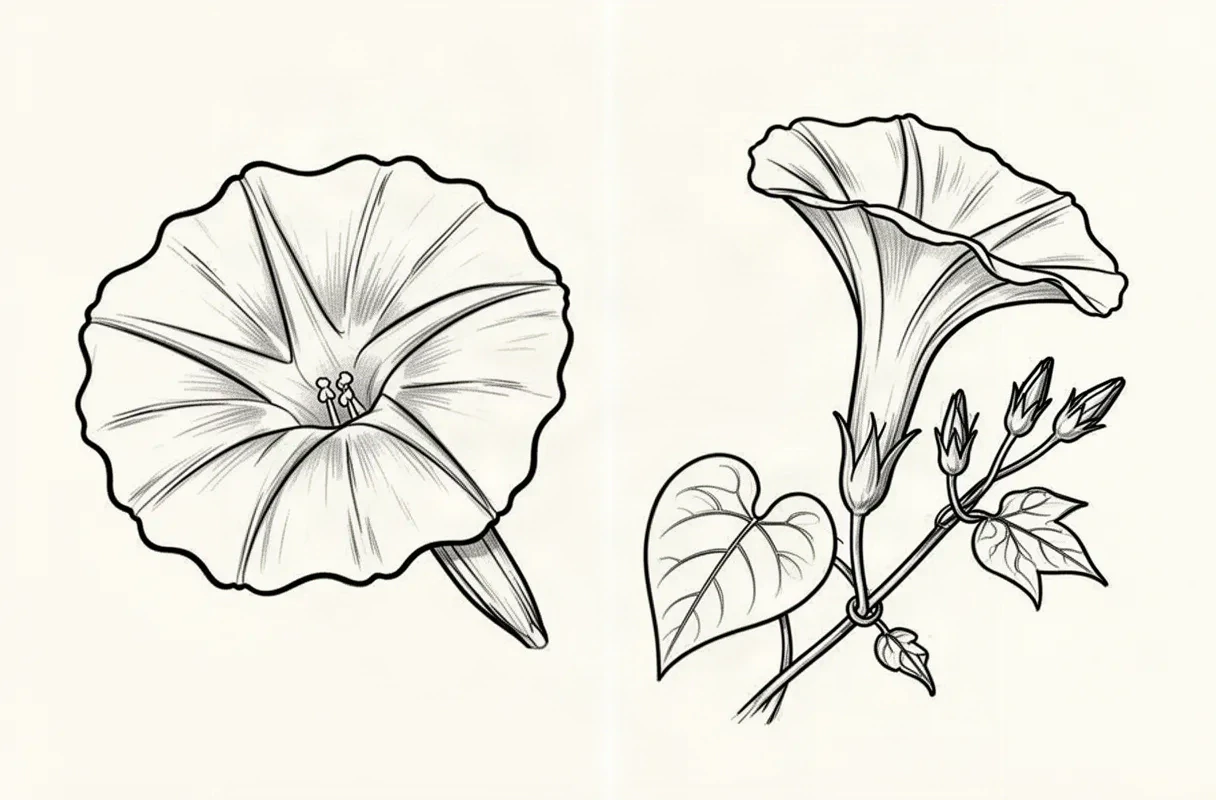
Line-art reference plate of a morning glory bloom in face-on and side profile, showing fused funnel pleats, a creased star at the throat, and foliage on a slender twining stem

Plate 01: bloom construction

Read the bloom only here: one continuous cone, five soft pleats, and a creased star at the throat with open skin between the points. Judge leaf shape on the comparison plate below, where the heart leaf and a divided lookalike leaf sit side by side.

All plates on this page are original AI-generated illustrative reference artwork, not verified app output, healed tattoos, or measured transfer proofs. Confirm every decision on a measured 1:1 print.

Morning glory versus lookalike safeguards

Rule out the wrong flower before judging stencil quality.

Trumpet-shaped stock gets mislabeled often, and a misfiled bloom fails the stencil brief no matter how clean its lines are. Run these three contrasts first.

Morning glory versus lookalike contrasts for stencil vetting
SignalTrue morning gloryLookalike warning
Bloom constructionOne fused funnel with five soft pleats and a creased star center, rim wider than the throat.Petunia shows a similar trumpet but with a broader flared rim and heavier ruffle; hibiscus carries protruding stamens past the rim. Either signal means a different construction.
Leaf shapeSimple heart shape with a rounded base notch and a pointed tip on slender stalks.Bindweed and generic vine stock often carry arrow-shaped or deeply lobed leaves that read pointed at both ends with no heart base.
Growth habitTwining trailing run with spaced blooms and small buds at leaf joints along one stem direction.Upright garden stems with one terminal bloom, or dense rosette clusters with no traveling stem, belong to other flower stock filed under a vine name.
  • Bloom construction: A bloom with stamens past the rim is hibiscus stock, not morning glory. A deeply ruffled flared face belongs to petunia references. Reselect or redraw before committing to a morning glory stencil.
  • Leaf shape: Arrow or strap leaves with no base notch break the morning glory read at any size. Reshape the leaves to hearts or reselect the reference.
  • Growth habit: One upright bloom with no trailing stem is not a morning glory composition. Recrop onto a run with stem direction or reselect before locking width.
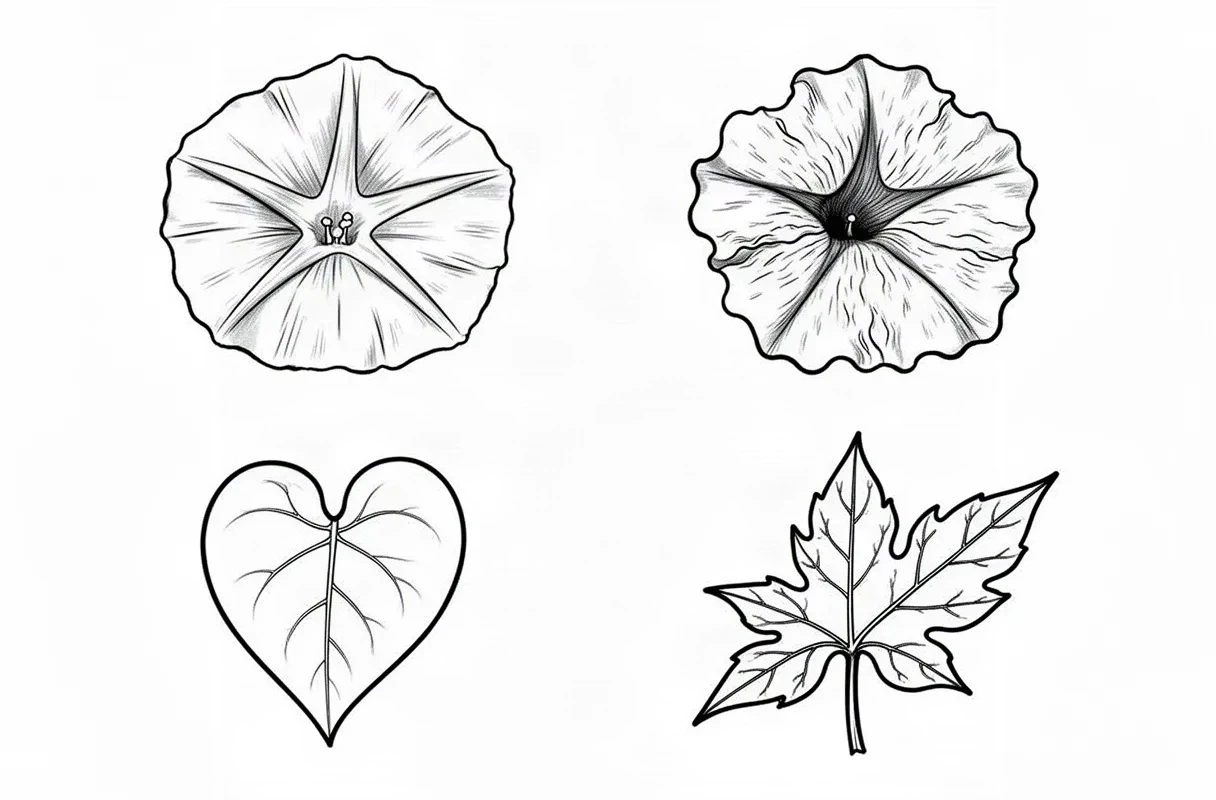
Comparison plate with a fused morning glory trumpet at top left, a ruffled flared lookalike trumpet at top right, a heart-shaped leaf at bottom left and a deeply divided lookalike leaf at bottom right

Plate 02: true bloom versus lookalikes

Top left: fused cone, five pleats, creased star at the throat. Top right: a broader ruffled face with a dark throat and no star structure, typical of petunia-type stock. Bottom left: heart leaf with a rounded base notch and single vein. Bottom right: a deeply divided leaf with no heart base. Use the pairings, not the drawing style, to accept or reject a reference.

Reference evaluation framework

Score the reference in minutes, then act on the weakest check.

Four morning glory constructions at labeled sizes. Each one names the protected structure, the fix, and the go or no-go verdict at that exact size. Confirm every verdict with a measured 1:1 print.

HOLDS AT STATED SIZE

Single trumpet with one leaf at 7 cm

Intended width 70 mm

Source
One fused trumpet with five readable pleats and an open star center, plus one heart-shaped leaf on its own stalk with open skin between leaf and rim.
Protect
The unbroken rim loop, the open star points, the heart leaf silhouette, and the gap separating bloom from leaf.
Fix
Shorten the deepest pleat line if it touches the throat at 1:1. Keep bloom count, star gaps, and leaf shape unchanged.
Candidate stencil
Same morning glory construction with identity confirmed, bloom count adjusted, and protected trumpet contours kept at transferable mass.
Final-size verdict
Holds at 7 cm. Pleat separations stay open at 1:1 and the leaf reads as morning glory without vein detail.

HOLDS WITH SPACING WORK

Two-bloom trailing run at 14 cm

Intended length 140 mm

Source
A short twining stem running one direction with two trumpets at different openings and two heart-shaped leaves, but one leaf tip touches a trumpet rim at this length.
Protect
The stem direction, the stronger trumpet with the clearer star, the better heart-shaped leaf, and the bud spacing at the leaf joint.
Fix
Shorten the touching leaf tip or shift the weaker bloom one bloom-width along the stem so every flower and leaf keeps open skin at 1:1. Re-check with a squint test at true size.
Candidate stencil
Same morning glory construction with identity confirmed, bloom count adjusted, and protected trumpet contours kept at transferable mass.
Final-size verdict
Holds at 14 cm after the contact is cleared. Confirm the star centers of both blooms stay open at true size before transfer.

RESELECT OR REDRAW

Stamen bloom filed as morning glory at 9 cm

Intended width 90 mm

Source
An attractive trumpet with a flared rim and long stamens protruding past the opening, filed under a morning glory name by the stock source.
Protect
Nothing morning-glory-specific survives here. Protruding stamens are hibiscus construction, and the flared ruffled rim points away from a fused morning glory cone.
Fix
Either accept a hibiscus stencil with the client or reselect a true morning glory reference with a fused cone and a creased star center. Do not file stamen linework as morning glory.
Candidate stencil
Same morning glory construction with identity confirmed, bloom count adjusted, and protected trumpet contours kept at transferable mass.
Final-size verdict
Not a morning glory stencil at any size until the bloom is redrawn. Size cannot fix a species mismatch.

THIN THE RUN FIRST

Crowded vine with touching trumpets at 10 cm

Intended length 100 mm

Source
Three trumpets and four leaves packed along a short run, with two rims sharing an edge and one star center merged into a dark pocket at this length.
Protect
The strongest trumpet with the clearest star, the best heart-shaped leaf pair, and the stem direction that separates the group.
Fix
Remove the weakest bloom so every remaining flower keeps open skin edge to edge, then reopen the star points of the focal trumpet. Re-check with a squint test at 1:1.
Candidate stencil
Same morning glory construction with identity confirmed, bloom count adjusted, and protected trumpet contours kept at transferable mass.
Final-size verdict
Simplify first. If two rims still share an edge at true size, run it as a two-bloom trail with fewer leaves or enlarge the length.

Generic vine-path vetting stays out of this framework. The vine owner judges stem hierarchy, overlap bridges, and filler roles on motif-agnostic runs, while this framework judges trumpet construction, star retention, and heart-leaf spacing on morning glory stock. Broad visual browsing stays on the stencils and subject hubs.

Trumpet gaps and line weight at final size

Judge the white space at the size you will print.

Screens forgive crowding that paper and skin do not. Set the size first, then inspect each feature below at true physical size with scaling off.

About 7 cm and below

Wrist, ankle, behind-ear accents, and small gap fillers.

Carry one trumpet with one leaf at most. Protect the star points above all else; drop leaf veins and pleat length first. If a star point closes at 1:1, shorten the pleat feeding it or remove one pleat mark rather than forcing reduction.

About 7 to 14 cm

Common forearm, shoulder, calf, and collarbone placements.

The most flexible band. A single full trumpet with a heart-shaped leaf, or a spaced two-bloom trail with open skin between every element, can work when each pleat gap and star point stays open at true size. Check stem spacing before approving a second bloom.

About 14 cm and above

Thigh, upper back, shoulder cap, and side-torso trails.

Room for a real trailing run with ranked blooms and buds, but only when each trumpet keeps its own star and separations. Larger length does not rescue touching rims or a merged star, so verify the full run at 1:1.

Morning glory feature checks by size band
FeatureAbout 7 cm and belowAbout 14 cm and above
Trumpet rim and pleatsKeep the rim loop and three to four short pleat marks with visible skin between them. If the rim breaks, the bloom loses its funnel read and becomes a plain cup.A fuller five-pleat fan can work when each mark stays separate at 1:1. If the throat end reads as one dark wedge, reopen it.
Star center and throatKeep the star as small open points with light between them. Merge means fewer pleat marks reaching the center, not thinner ones.A fuller star can work when each point stays separate at 1:1. If the center reads as one dark pocket, reopen it before print.
Leaves and budsSuggest the heart shape with a clean edge and at most one center vein. Full veining and extra buds merge first at small widths.Light veining and small buds at leaf joints can work when each separation stays open. Check the full run with a squint test at true size.
Stem run and spacingKeep one clean stem direction with open skin on both sides. A second stem competes with the trumpet for the same room and should be recropped away.A longer run with ranked blooms can work when the focal trumpet clearly leads. Equal-weight blooms need ranking work before print.

Grey-wash simplification for small trumpet work

When pleat shading or leaf veins threaten to close at final size, convert tone to light grey wash instead of adding lines: keep the rim loop, the star points, and the heart leaf edge as linework, and let wash carry interior throat softness. Wash holds open the separations that dense line texture would merge, which matters most below 7 cm where every extra mark competes with the star.

Reference to clean stencil

Confirm identity first, then build outward from the focal trumpet.

Work in this order so one change at a time can be judged at the same size. Stop when identity, hierarchy, gaps, and spacing each read correctly.

  1. 01

    Lock size and placement first

    Set the intended physical width or length in millimeters and name the body area before judging the reference. A trail that holds at 16 cm on a flat thigh can fail at 7 cm on a curved wrist with no line being wrong on its own. Use the size calculator when target dimensions are still open.

  2. 02

    Confirm true morning glory identity

    Trace one unbroken rim loop, name the star center, and confirm heart-shaped leaves on a trailing stem. Run the lookalike safeguards on this page before anything else: a stamen bloom or an arrow-leaf vine needs a reselect or an honest rename, not a size fix.

  3. 03

    Rank blooms and set leaf roles

    Name the focal trumpet and rank every other bloom as secondary or removable. Assign each leaf a supporting role with open skin between leaf and rim. Strengthen focal rim and star first, keep secondary blooms compact, and mark one removable element that can go if gaps close.

  4. 04

    Reopen gaps and simplify for final size

    Reduce bloom count before thinning trumpet lines. Confirm each pleat separation and star point stays open at 1:1, soften dense leaf detail into a short vein or light grey-wash tone, and run a squint check: step back until pleat lines disappear and confirm the trumpet and leaf habit still read. The line-weight guide covers fine, normal and bold behavior on the same stencil.

  5. 05

    Verify print and transfer path

    Export a true-size PDF with no fit-to-page scaling, inspect the smallest star cluster and narrowest rim gap on plain paper, then measure the physical print with a ruler. On wraps, wrap the print on the limb before transfer. If the digital file passes and only paper fails, move to print-stage evidence instead of simplifying again.

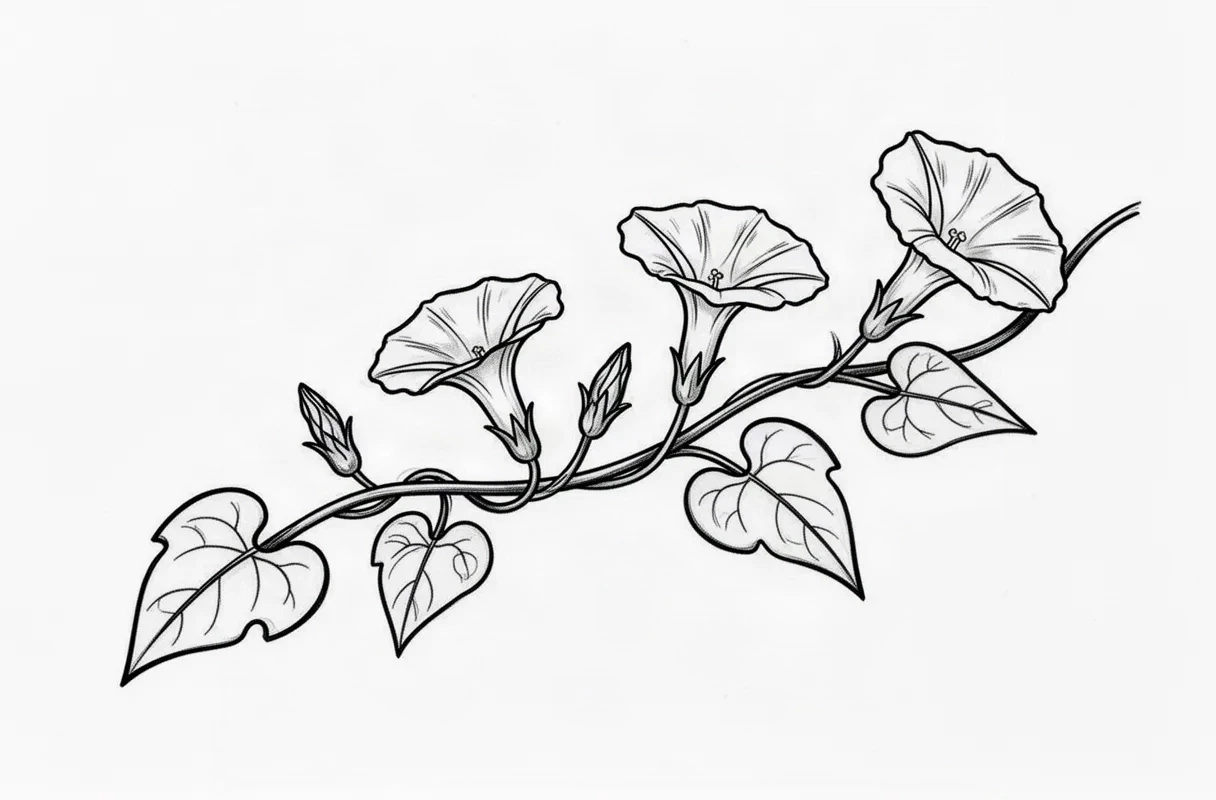
Line-art reference of a morning glory trailing run along a gentle curve, with three spaced trumpet blooms, heart-shaped leaves and buds on one continuous stem and open skin between every element

Plate 03: trailing run and wrap read

One stem direction, spaced blooms at different openings, heart leaves, and buds tucked at leaf joints, with open skin between every element. This is the arrangement to protect when the run crosses a curved limb. Wrap the 1:1 print before approving any rim contact or closed star.

Placement and wrap decisions

Trailing trumpets want skin that keeps them separated

A morning glory is a trailing composition with spaced blooms. Placements with a clear span preserve stem direction with little compensation, while small wrapped placements demand a recrop to one trumpet.

Collarbone and shoulder

Gently curved fields that suit a single trumpet with one leaf or a slim two-bloom trail. The long axis preserves stem direction with little compensation.

Check: Lay the stem along the available span, then confirm every pleat gap and star point stays open at 1:1 before print.

Outer forearm and calf

Narrow fields where the trail should follow the limb line. Wide multi-bloom runs wrap fast and crowd trumpet rims on the curve.

Check: Align the stem with the limb axis and keep the focal trumpet on the flattest span while edits are still cheap.

Thigh and upper back

Broad flat fields with room for a real ranked trail. The most forgiving areas for multi-bloom morning glory runs.

Check: Keep open skin between every trumpet and preview the stencil at exact size before locking the file.

Wrist, ankle, and wraps

Small wrapped fields where only one trumpet with a clear star survives. Trails forced into these bands merge first, and wraps pinch one side of the run.

Check: Recrop to the single strongest trumpet with at most one leaf, wrap the 1:1 print on the limb, then run the small-size checks at the exact size.

Stencil-ready checklist

Approve the morning glory only when every line passes

Run this short sequence with scaling off and a ruler in hand. One failed line means fix, enlarge, or reselect before transfer.

  • Confirm intended width or length in millimeters and the named placement.
  • Confirm one fused trumpet rim with a readable star center, not separate petals.
  • Confirm lookalike safeguards pass: no stamens past the rim, no arrow leaves filed as morning glory.
  • Confirm every pleat separation and star point stays open at 1:1.
  • Confirm heart-shaped leaves with open skin between each leaf and bloom.
  • Export a true-size PDF with scaling off and measure the physical print, wrapped on the limb for wraps.
Fused trumpet, open star Verify gaps at 1:1 Lookalikes ruled out

FAQ

Morning glory stencil decisions, answered

Short answers for the identity, lookalike, size, wrap, and transfer checks that recur when a morning glory reference moves toward transfer-ready output.

It is usable when three checks pass at the exact physical size: the bloom reads as one fused trumpet with a star center, every pleat separation and star point stays open at 1:1, and heart-shaped leaves sit on a trailing stem with open skin between elements. If any check fails, the fix list on this page names what to simplify, thin, or enlarge before print.

Next steps

Use the neighboring owners for adjacent jobs.

This guide covers morning glory trumpet recognition, star-center gap rules, trailing continuity and wrap vetting, and transfer prep. Use the links below for related jobs such as sizing, print checks, paper, placement, and neighboring constructions.

Board organization, grid overlays, photo-quality scoring, generic conversion, broad gallery browsing, paper manufacturing detail, and placement mechanics stay in their specialist owners. The links above hand off instead of repeating that detail.

From evaluated reference to working stencil

Turn the approved morning glory into a stencil draft.

Start from the morning glory that passed the trumpet and gap checks, then continue on iPhone for body fit, exact-size print, mirror and professional export.