

Larkspur stencil evaluation

Judge any larkspur spike before it becomes a stencil

Larkspur lives or dies on the spur and the gaps around it. Confirm the backward spur, the stacked-floret order, and airy spacing at your exact height for a clean transfer-ready stencil, including vertical bouquet use.

Built for working artists preparing larkspur pieces. This page covers spike recognition, delphinium and lavender safeguards, density relief, vertical placement, and transfer prep only, not tattoo application or healing advice. Sprig-band decisions and mixed-bouquet triage stay with their owners below.

Visual reference plates

See the spur, the spike order, and the bouquet lane.

Three original editorial illustrations for the decisions this page asks you to make. They show structure and composition only: not app output, a specific product, or a measured scale.

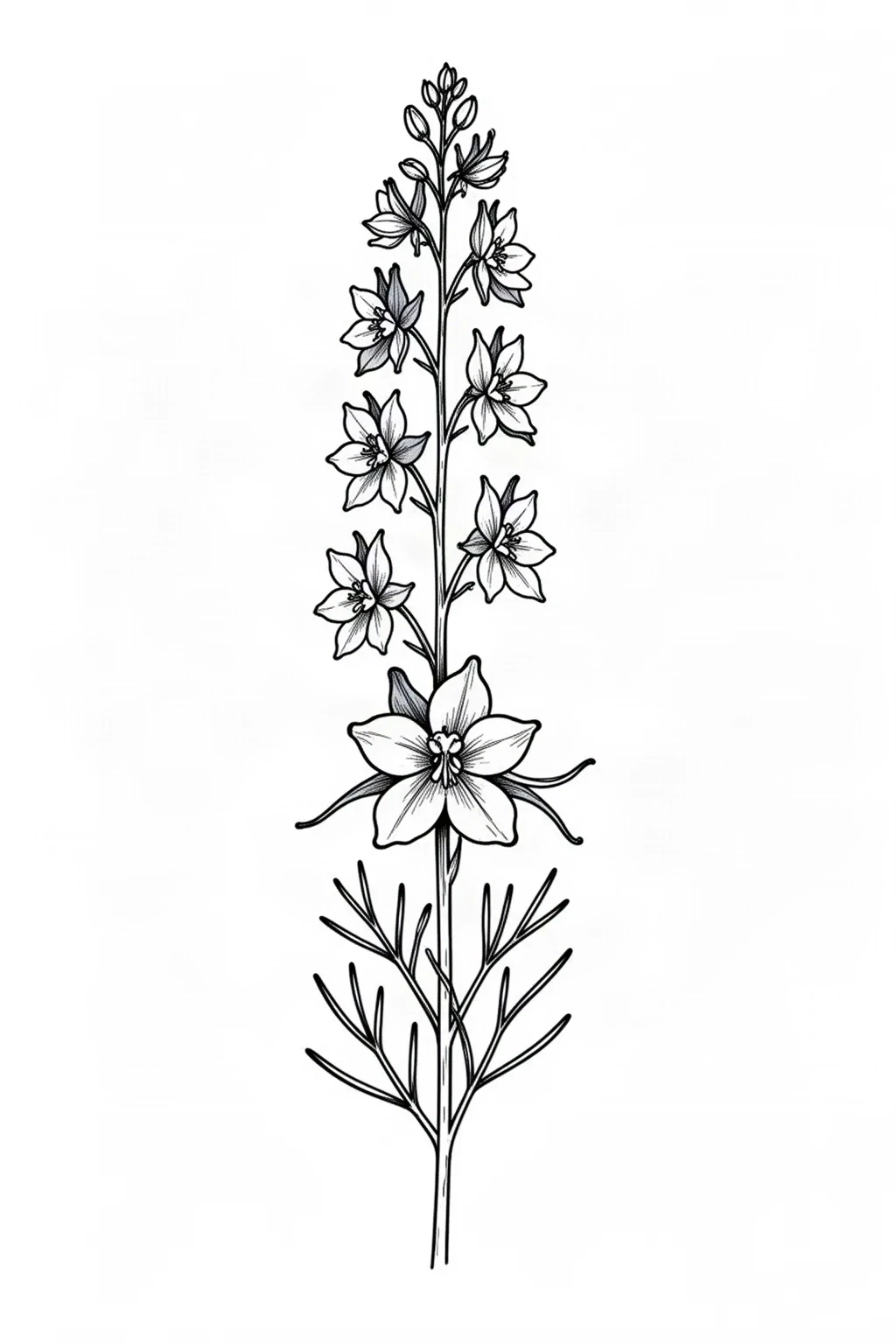
Editorial line illustration of a larkspur spike: small five-petaled blooms spaced along a slim upright stalk, a long backward spur behind the large focal bloom, and fine thread-like leaves held low.

Plate 01 / Spike anatomy

Spur, spaced florets, low fine foliage

Read one bloom before the whole spike: the spur tail behind the petals, the open stem between florets, then the fine foliage kept low. The focal bloom is drawn large so the spur is visible; judge spur and gap survival on your own exact-size print instead of copying this drawing.

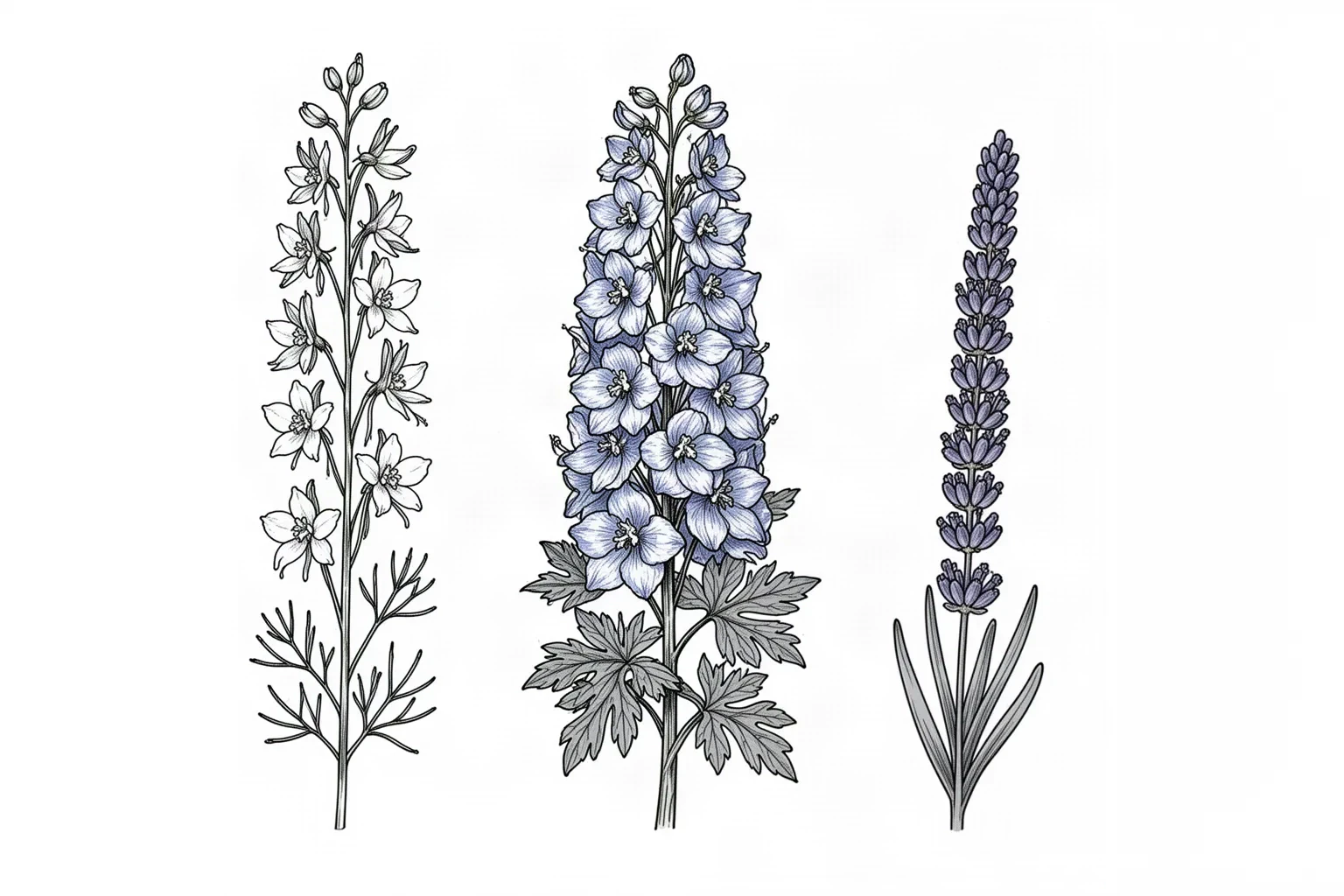
Editorial comparison illustration of three flower spikes: an airy larkspur spike with spurred five-petaled blooms on the left, a dense delphinium cluster with broad foliage in the middle, and a narrow lavender bud spike with no open petal faces on the right.

Plate 02 / Lookalike line-up

Larkspur, delphinium, lavender

Left to right: airy larkspur with spurred open faces and open gaps, dense delphinium with blooms touching along a broad-leaved stem, and a spur-less lavender bud spike. Match your reference to the correct column before you evaluate density.

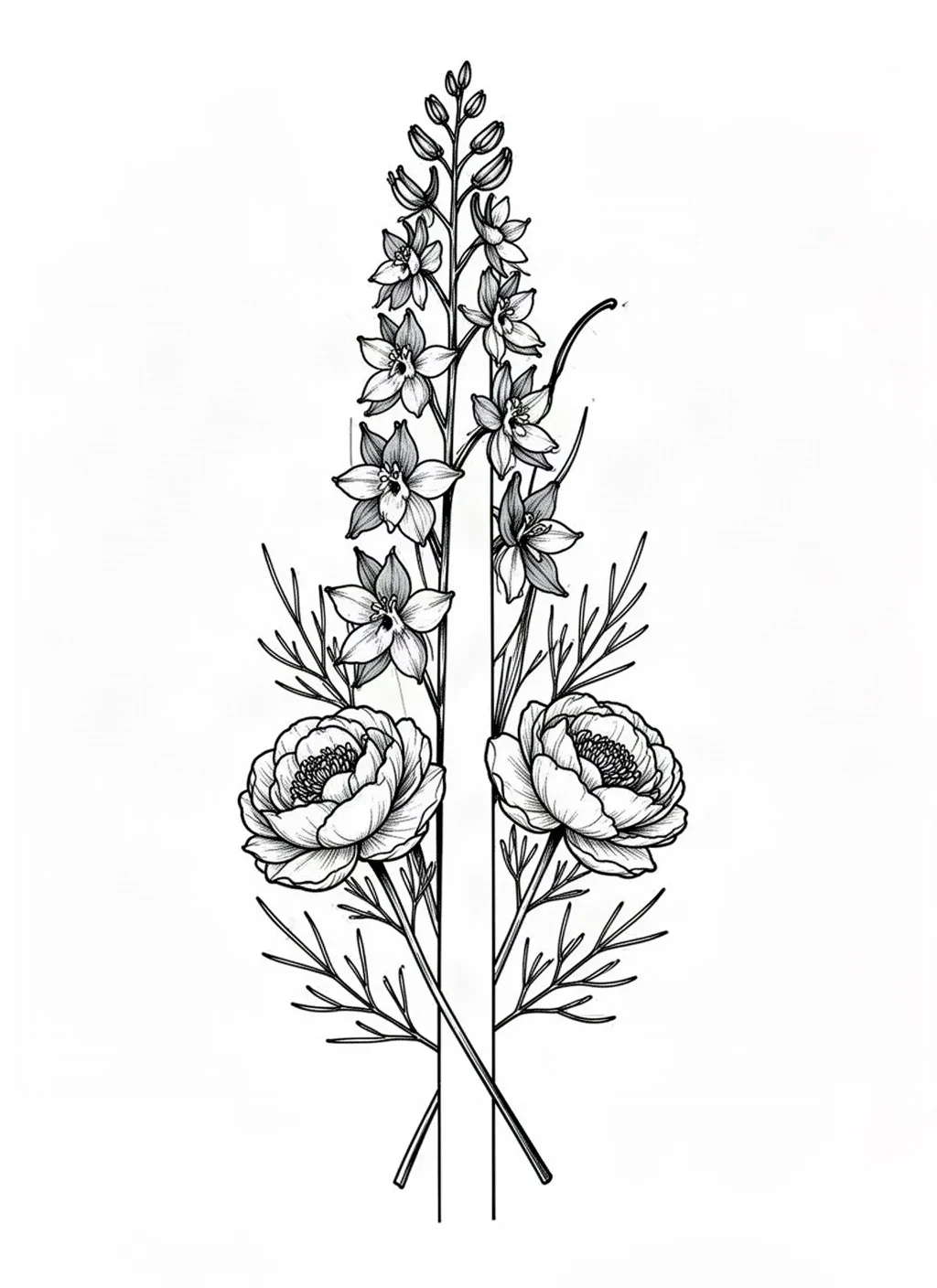
Editorial illustration of a vertical bouquet with a tall larkspur spike rising between two round layered blooms, fine accent stems, and one crossing stem near the base.

Plate 03 / Bouquet vertical

One open lane beside rounder blooms

The larkspur carries the vertical lead and keeps an open lane beside the round focal blooms. Where the crossing accent stem meets the lower stalk, re-space the contact before transfer so the spike does not bridge into its neighbour.

What makes a larkspur stencil-viable

Spur shape, stacked order, and airy spacing decide the result.

A larkspur piece is a tall slim spike of small spurred florets with fine low foliage. These four anchors predict whether that construction survives reduction, print, and transfer.

Backward spur on each bloom

Every true larkspur bloom carries a backward-pointing spur behind the flower, a slim tail-like extension that gives the plant its lark-claw name. In stencil linework this spur is the fastest identity signal, because neither lavender buds nor generic five-petal blossoms carry one. Keep at least the focal spurs open with skin on both sides so they survive reduction.

Check: Cover the stem and judge one bloom alone. If a slim spur reads behind the petals at the target width, the bloom carries larkspur identity. If no spur reads at 1:1, reselect before judging anything else.

Stacked-floret order up a slim stalk

Larkspur blooms stack loosely along a tall slim stalk, smaller and tighter toward the tip and opener lower down, with visible stem showing between florets. Stencil viability comes from preserving that airy stacked order, not from packing the spike edge to edge the way dense delphinium clusters pack.

Check: Trace the stalk from base to tip. If each floret keeps open skin to its neighbors and the tip order clearly leads, the spike is close. If florets share edges along the run at 1:1, thin the count before touching line weight.

Five-petaled open faces

Each larkspur floret opens as a small five-petaled face with light between the petal points, wilder and more scattered than a delphinium trumpet. A stencil-ready floret keeps petal separations open so the face reads as a face, not one filled dot, at final size.

Check: Cover the stalk and judge the focal floret alone. If petal points separate with light between them at the target width, keep it. If the face fills into one blob, simplify to fewer interior marks rather than thinner ones.

Fine thread-like foliage

Larkspur leaves grow fine and thread-like, low on the stem and well clear of the blooms, unlike the broad foliage of delphinium stock. A stencil-ready piece keeps foliage light and low so leaves never compete with the spike for the same room at small heights.

Check: Follow the stem from base to the first floret. If fine leaves sit low with clear stem gaps and none touches the lowest bloom at 1:1, keep them. If foliage climbs into the spike, remove or respace it before print.

Larkspur versus lookalike safeguards

Rule out the wrong flower before judging stencil quality.

Tall spike stock gets mislabeled often, and a misfiled bloom fails the stencil brief no matter how clean its lines are. Run these three contrasts first.

Larkspur versus lookalike contrasts for stencil vetting
SignalTrue larkspurLookalike warning
Bloom constructionSmall five-petaled open faces with a slim backward spur behind each bloom, spaced loosely along the stalk.Delphinium carries larger, denser stacked blooms in tight clusters with heavier presence and broader foliage. Lavender carries tiny stacked buds with no open petal faces and no spur at all.
Spike densityAiry run with visible stem between florets, tighter at the tip and opener low on the spike.Delphinium spikes read full and showy with blooms touching along the run. Some growers sell tall delphinium stems under the larkspur name, which is the most common stencil misfile.
Foliage and habitFine thread-like leaves low on a slender stem, carrying an upright vertical spike that suits tall narrow placements.Broad lobed foliage or a branching multi-stem posy with mixed head shapes belongs to delphinium or mixed wildflower stock, not a single larkspur spike.
  • Bloom construction: A dense packed cluster with no spur spacing is delphinium stock, not larkspur. A narrow bud spike with no petal faces is lavender stock. Reselect or vet under the true construction.
  • Spike density: Blooms sharing edges along the whole run point to delphinium. Either accept a delphinium stencil or reselect an airier larkspur spike with open floret gaps.
  • Foliage and habit: Broad leaves climbing into the blooms break the larkspur read at any size. Simplify foliage to low thread-like marks or route a mixed posy to the wildflower page.

Reference evaluation framework

Score the reference in minutes, then act on the weakest check.

Four larkspur constructions at labeled sizes. Each one names the protected structure, the fix, and the go or no-go verdict at that exact size. Confirm every verdict with a measured 1:1 print.

HOLDS AT STATED SIZE

Single airy spike with open spurs at 12 cm

Intended height 120 mm

Source
One slender upright stalk with small five-petaled florets spaced loosely upward, slim spurs reading behind the focal blooms, and fine thread-like leaves kept low with clear stem gaps.
Protect
The spur shapes on the focal blooms, the open floret separations along the stalk, and the low foliage clearance below the first floret.
Fix
Shorten only the deepest petal mark if one focal face threatens to fill at 1:1. Keep floret count, spur shapes, and stalk direction unchanged.
Candidate stencil
Same larkspur spike with identity confirmed, floret count adjusted, and protected spur contours kept at transferable mass.
Final-size verdict
Holds at 12 cm. Spurs read as spurs and floret gaps stay open at 1:1, so the spike reads as larkspur from structure, not shading.

SIMPLIFY FLORAL COUNT FIRST

Packed spike with touching florets at 10 cm

Intended height 100 mm

Source
An attractive full spike where stacked florets sit edge to edge along the stalk and two focal faces share one merged edge, leaving almost no stem showing between blooms.
Protect
The stalk direction, the two clearest spurred blooms, and the lowest foliage gap that carries the upright habit.
Fix
Remove the weakest florets so every remaining bloom keeps open skin edge to edge, then reopen the focal petal separations. Re-check with a squint test at true size.
Candidate stencil
Same larkspur spike with identity confirmed, floret count adjusted, and protected spur contours kept at transferable mass.
Final-size verdict
Simplify first. If florets still share edges at true size, enlarge the height or recrop to a shorter spike segment.

RESELECT OR REDRAW

Dense delphinium cluster filed as larkspur at 14 cm

Intended height 140 mm

Source
A showy tight cluster of large blooms with heavy presence and broad foliage, filed under a larkspur name by the stock source, with no airy spacing or readable spur along the run.
Protect
Nothing larkspur-specific survives here. Dense clustered blooms with broad foliage are delphinium construction, and size cannot convert them.
Fix
Either accept a delphinium stencil with the client or reselect a true larkspur spike with spaced spurred florets and fine low foliage. Do not file cluster linework as larkspur.
Candidate stencil
Same larkspur spike with identity confirmed, floret count adjusted, and protected spur contours kept at transferable mass.
Final-size verdict
Not a larkspur stencil at any size until the spike is reselected. Size fixes never resolve a species mismatch.

REOPEN GAPS FIRST

Vertical bouquet spike with foliage crowding at 16 cm

Intended height 160 mm

Source
A tall bouquet-ready spike where fine leaves rise beside the lower florets and one leaf tip touches the lowest bloom, with a second accent stem crossing near the base.
Protect
The stalk direction through the bouquet, the focal spurred blooms, and the open spacing of the upper spike.
Fix
Remove the touching leaf and re-space the crossing stem so the larkspur keeps its own skin channel through the bouquet. Confirm the lowest bloom gap stays open at 1:1 before transfer.
Candidate stencil
Same larkspur spike with identity confirmed, floret count adjusted, and protected spur contours kept at transferable mass.
Final-size verdict
At 16 cm the leaf-to-bloom contact prints as one mass. Clear it first, then verify the full vertical run holds gaps before treating the file as bouquet-ready.

Sprig-band and mixed-posy vetting stay out of this framework. The lavender page judges single sprig versus bundle versus band logic, and the wildflower page judges mixed-stem triage, while this framework judges spurred stacked florets, spur gaps, and vertical spike spacing on larkspur stock. Broad visual browsing stays on the stencils and subject hubs.

Stacked-bud density and gap retention at final size

Judge the white space at the height you will print.

Screens forgive crowding that paper and skin do not. Set the height first, then inspect each feature below at true physical size with scaling off.

About 8 cm and below

Wrist, ankle, behind-ear accents, and small gap fillers.

Carry a shortened spike segment with few florets and one clear spur signal, with foliage reduced to a stub or none. Keep plain floret outlines with no inner spur doubling. If a spur or petal separation closes at 1:1, enlarge or reselect rather than forcing reduction.

About 8 to 15 cm

Common forearm, shoulder, collarbone, and calf placements.

The most requested band. A single full spike with spaced spurred florets and low thread-like foliage can work when every separation stays open at true size. Check spur readability on the focal blooms before approving side detail.

About 15 cm and above

Spine, thigh, side torso, and vertical bouquet compositions.

Room for a tall spike with ranked florets and a full stem run, but only when each bloom keeps its spur and separations. Larger height does not rescue touching florets, buried spurs, or foliage climbing into the spike.

Larkspur feature checks by height band
FeatureAbout 8 cm and belowAbout 15 cm and above
Spurs and petal facesKeep the spur silhouette and three to four short petal marks with visible skin between them. If the spur disappears, the bloom loses its larkspur signal and becomes a generic blossom.A fuller five-petal face can work when each mark stays separate at 1:1. If the throat end reads as one dark wedge, reopen it.
Floret spacing along the stalkKeep open stem showing between every floret. A second bloom competing for the same span should be removed first.A longer spike can carry more florets when the tip-to-base order clearly leads. Packed runs need thinning work before print.
Foliage and secondary stemsSuggest fine foliage with a clean edge and no veining. Full leaf texture merges first at small heights.Light foliage low on the stem can work when each separation stays open. Check the full run with a squint test at true size.
Stalk line and bouquet fitKeep one clean stalk direction with open skin on both sides. A second stem competes with the spike for the same room and should be recropped away.A bouquet vertical can work when the larkspur keeps its own skin channel beside accent stems. Equal-weight stems need ranking work before print.

Reference to clean stencil

Confirm identity first, then build outward from the focal spur.

Work in this order so one change at a time can be judged at the same height. Stop when identity, hierarchy, gaps, and spacing each read correctly.

  1. 01

    Lock height, spike, and placement first

    Set the intended physical height in millimeters, choose one spike construction, and name the body area before judging the reference. A spike that holds at 16 cm on a flat thigh can fail at 7 cm on a curved wrist with no line being wrong on its own. Use the size calculator when target dimensions are still open.

  2. 02

    Confirm true larkspur identity

    Name the spur on a focal bloom, count the spaced florets along the stalk, and confirm fine low foliage. Run the delphinium and lavender safeguards on this page before anything else: a dense cluster or a spur-less bud spike needs a reselect or an honest rename, not a size fix.

  3. 03

    Rank florets and set foliage roles

    Name the focal spurred blooms and rank every other floret as secondary or removable. Assign each leaf a supporting role low on the stem. Strengthen focal spurs and petal separations first, keep secondary florets compact, and mark one removable element that can go if gaps close.

  4. 04

    Reopen gaps and simplify for final size

    Reduce floret count before thinning spur lines. Confirm each spur separation and petal gap stays open at 1:1, then run a squint check: step back until petal lines disappear and confirm the spike and spur habit still read. The line-weight guide covers fine, normal and bold behavior on the same stencil.

  5. 05

    Verify print and transfer path

    Export a true-size PDF with no fit-to-page scaling, inspect the smallest spur cluster and narrowest floret gap on plain paper, then measure the physical print with a ruler. For bouquet verticals, tape the print upright beside the accent stems before transfer. If the digital file passes and only paper fails, move to print-stage evidence instead of simplifying again.

Placement and vertical bouquet decisions

Tall spikes want straight skin that keeps florets separated

A larkspur is one tall vertical read on a slender stalk. Placements with a clear straight span preserve the stacked order with little compensation, while small wrapped placements demand a recrop to one spurred segment.

Inner and outer forearm

Long narrow fields that suit the natural vertical run of a larkspur spike with little compensation.

Check: Align the stalk with the limb axis, keep the focal spurred blooms on the flattest span, and confirm every floret gap stays open at 1:1.

Spine and sternum line

Long centered fields that suit a tall single spike with a full stem run, and the most requested vertical bouquet path.

Check: Keep the composition slim and vertical, center on the flattest span, and tape the 1:1 print upright to confirm the spike holds its own channel beside accent stems.

Thigh and calf

Broad flat fields with room for taller spikes and small bouquet groupings. The most forgiving areas for full-length larkspur runs.

Check: Keep open skin between every floret and preview the stencil at exact size before locking the file.

Shoulder and collarbone

Gently curved fields that suit a medium spike or a slim bouquet vertical. Wide multi-stem groups wrap fast and crowd floret edges on the curve.

Check: Lay the stalk along the available span, rank the larkspur above accent stems, and verify the skin channel at 1:1 before print.

Wrist, ankle, and small accents

Small wrapped fields where only a shortened spike segment with a clear spur survives. Full spikes forced into these bands merge first.

Check: Recrop to the strongest spurred segment with foliage reduced to a stub, then run the small-size checks at the exact height.

Vertical bouquet use

Larkspur frames bouquets as the tall vertical accent beside rounder focal blooms. The spike must keep its own channel so it does not bridge into neighbors.

Check: Tape the 1:1 larkspur print upright beside the accent blooms, confirm spur and floret gaps hold at the shared height, and trim or respace any contact before transfer. Mixed-stem rhythm stays with the wildflower page.

Stencil-ready checklist

Approve the larkspur only when every line passes

Run this short sequence with scaling off and a ruler in hand. One failed line means fix, enlarge, or reselect before transfer.

  • Confirm intended height in millimeters, the spike construction, and the named placement.
  • Confirm backward spurs read on the focal blooms, not just generic petal faces.
  • Confirm delphinium and lavender safeguards pass: airy spacing, true spurs, fine low foliage.
  • Confirm every floret separation and spur gap stays open at 1:1.
  • Confirm foliage sits low with open stem gaps and no bloom contact.
  • Confirm bouquet verticals keep their own skin channel beside accent stems.
  • Export a true-size PDF with scaling off and measure the physical print.
Spur reads, gaps open Verify gaps at 1:1 Lookalikes ruled out

FAQ

Larkspur stencil decisions, answered

Short answers for the identity, gap, size, bouquet, and transfer checks that recur when a larkspur reference moves toward transfer-ready output.

Check three signals at the target size: a slim backward spur behind the focal blooms, small five-petaled faces spaced loosely along a slim stalk, and fine thread-like foliage kept low. Dense packed clusters with broad foliage point to delphinium, while a narrow bud spike with no petal faces and no spur points to lavender. If the spur does not read at 1:1, reselect before judging density or size.

Next steps

Use the neighboring owners for adjacent jobs.

This guide covers larkspur spike recognition, spur safeguards, density relief, vertical placement, and transfer prep. Use the links below for related jobs such as sizing, print checks, conversion, and browsing.

Board organization, grid overlays, photo-quality scoring, generic conversion, broad gallery browsing, paper manufacturing detail, and placement mechanics stay in their specialist owners. The links above hand off instead of repeating that detail.

From evaluated reference to working stencil

Turn the approved larkspur into a stencil draft.

Start from the spike that passed the spur and gap checks, then continue on iPhone for body fit, exact-size print, mirror and professional export.