

Bluebonnet stencil evaluation

Judge any bluebonnet raceme before it becomes a stencil

Bluebonnets live or die on raceme discipline. Choose side vs front view, verify stacked pea-shaped buds keep open gaps, and hold stalk order with palmate-leaf clearance at your exact height for a clean transfer-ready stencil.

Built for working artists preparing bluebonnet pieces. This page covers lupine raceme vetting, view and stem-flow choice, placement fit, and transfer-ready prep only, not tattoo application or healing advice. Mixed bouquets and generic small-flower jobs use different vetting logic linked below.

What makes a bluebonnet stencil-viable

Raceme relief, stalk order, and leaf flow decide the result.

A bluebonnet piece is one dense upright raceme of small pea-shaped buds on a stalk above branching stems with palmate leaf stars. These three pillars predict whether that construction survives reduction, print, and transfer.

Reading a bluebonnet raceme

  • Buds: Count only the separations that stay open at your height. Merged stacked buds fail before thin lines do.
  • Stalk: Treat the raceme as one upright line with the tip leading. Buds seated off a kinked stalk read as scattered seed, not lupine.
  • Stem and leaf stars: Follow one direction from base to the first bud, then confirm leaflet tips never touch the lowest buds at 1:1.

Stacked-bud raceme relief

A bluebonnet head is a dense upright raceme of many small pea-shaped blossoms stacked along one stalk, tight at the tip and slightly opener low on the spike. Stencil viability comes from keeping open skin between neighboring buds along the raceme, not from drawing every blossom a photo shows.

Check: Count the readable buds at the target height, then trace one bud outline without crossing a neighbor. If two stacked buds share one merged edge at 1:1, that raceme needs fewer buds or wider spacing first.
Raceme axis and tip order

A bluebonnet reads as one upright terminal plume with the tip leading and buds seated in tight order down the stalk. One clear axis with buds climbing it transfers cleanly, while a kinked, forked, or tip-crowded raceme reads as a plain pod once reduced.

Check: Sight along the stalk from tip to base at 1:1. If the axis kinks, forks, or the tip buds compress into one cap with no separations, straighten or thin the tip before judging bud detail.

Stem and palmate-leaf flow

Below the raceme, bluebonnets carry branching stems with palmate leaves whose five to seven leaflets radiate from one point like fingers on a hand. One stem direction with well-spaced leaf stars supports the plume, while leaflets that climb into the raceme or cross the stem read as clutter at final size.

Check: Follow the stem from base to the first bud with a finger. If a leaflet tip touches the lowest buds or two leaf stars overlap with no skin between them at 1:1, re-space or remove one before judging the raceme.

Side profile versus front facing versus leaf star

Choose the view that fits the skin, not the prettiest photo.

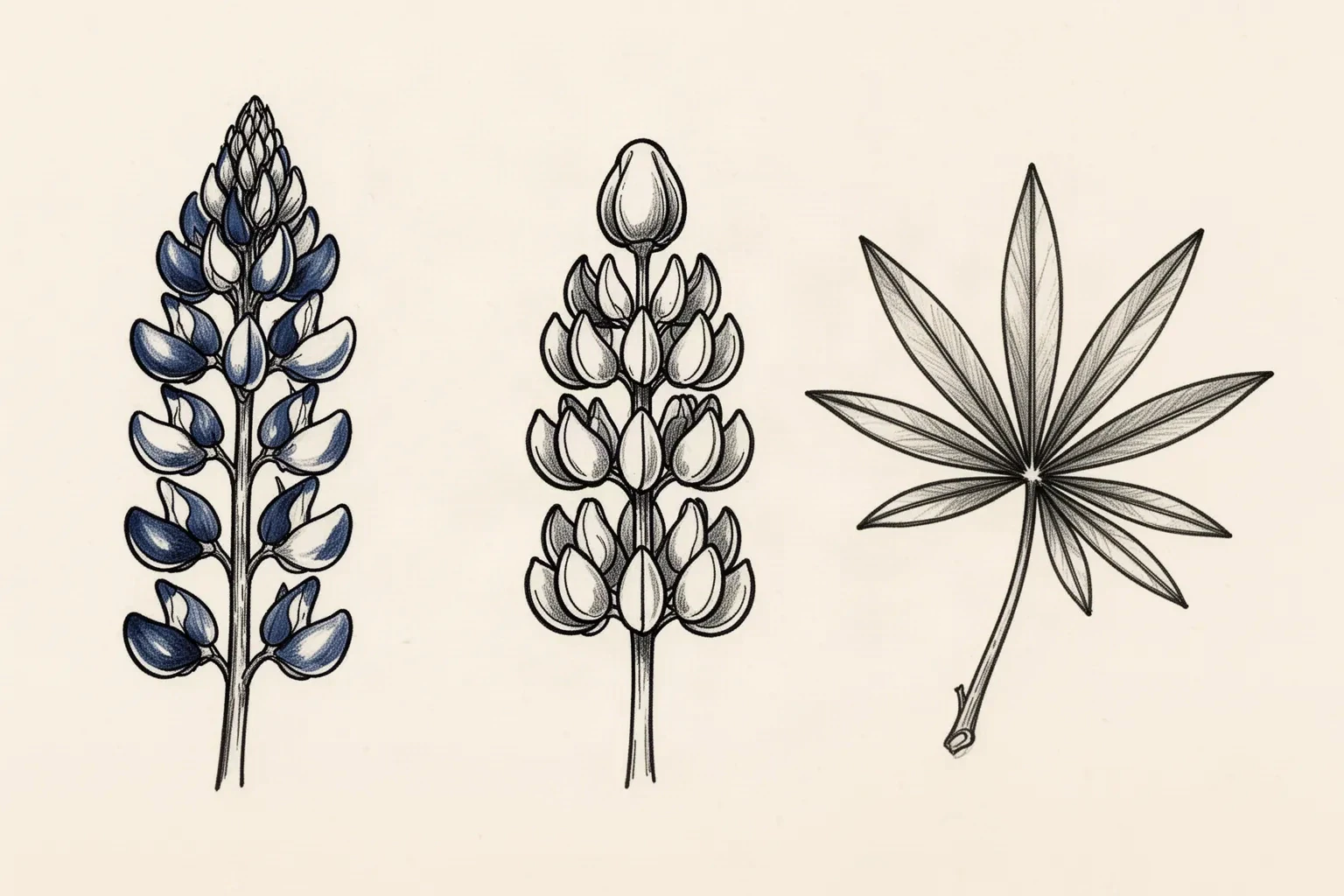
Three bluebonnet constructions with different footprints and different stencil costs. Match the view to the placement height first, then judge the reference against that view.

Synthetic ink illustration of three bluebonnet lupine constructions: a side-profile raceme with stacked pea-shaped buds along one upright stalk, a front-facing raceme with concentric bud rings and a contained tip, and a palmate leaf star whose leaflets radiate from one point.
Synthetic editorial illustration, not to scale and not a print proof. Left: side-profile raceme with stacked pea-shaped buds stepping down one stalk. Centre: front-facing raceme with concentric bud rings and a contained tip. Right: palmate leaf star with leaflets radiating from a single point. Use it to name the construction, then confirm every gap on a measured 1:1 print.
Bluebonnet views compared for stencil work
ViewReads asStencil costSuits
Side profileThe raceme seen edge-on with stacked pea-shaped banners stepping down one stalk, each bud showing a keel and banner profile. The classic lupine read and the most transfer-forgiving construction.Lowest. Gap discipline is limited to bud separations along one stalk plus leaf-star clearance below the raceme.Ankle, forearm, spine accents, and small calf pieces where one upright plume read must hold alone.
Front facingThe raceme seen head-on with concentric bud rings around the stalk and a contained tip cap. Fuller and showier, but every ring must keep its own separation or the head reads as one rosette.Higher. Each ring needs open skin between neighbors plus a contained tip that stays separate from the uppermost ring.Shoulder, thigh, and upper-back pieces from about 10 cm up, where a wider head has room to hold its rings on flatter skin.
Raceme with leaf starA side or front raceme carried on a stem run with one palmate leaf star, leaflets radiating from a single point. Movement comes from the stem and the star, not from extra buds.Composition risk joins density risk. The stem must stay smooth and every leaflet gap must hold while the raceme keeps its bud gaps.Forearm, calf, and collarbone lines where a longer stem run follows the body line and one star accents the base.
  • Side profile watch-out: Protect the stalk axis and every bud-to-bud separation. If buds merge into one ribbed pod at 1:1, remove buds rather than thinning all lines.
  • Front facing watch-out: Protect the tip cap and the ring-to-ring channels first. If rings share one merged edge anywhere at 1:1, recrop to a side profile or enlarge.
  • Raceme with leaf star watch-out: Protect stem smoothness and leaflet-to-leaflet gaps plus the lowest-bud clearance. If a leaflet touches the raceme base at 1:1, shorten the stem run or remove the star.

Mixed-bouquet construction stays out of this framework. A wildflower bouquet stencil judges mixed stems, anchor blooms, and wrap flow, while this page judges one lupine raceme so bud gaps, stalk order, and leaflet clearance can each be verified at true size. If the brief mixes several species, route it to the wildflower stencil guide. Broad visual browsing stays on the stencils and subject hubs.

Bluebonnet evaluation framework

Score the reference in minutes, then act on the weakest check.

Four bluebonnet constructions at labeled heights: spaced side profile, dense packed tip, compressed front rings, and leaf-crowded small plume. Each one names the protected structure, the fix, and the go or no-go verdict at that exact size. Confirm every verdict with a measured 1:1 print.

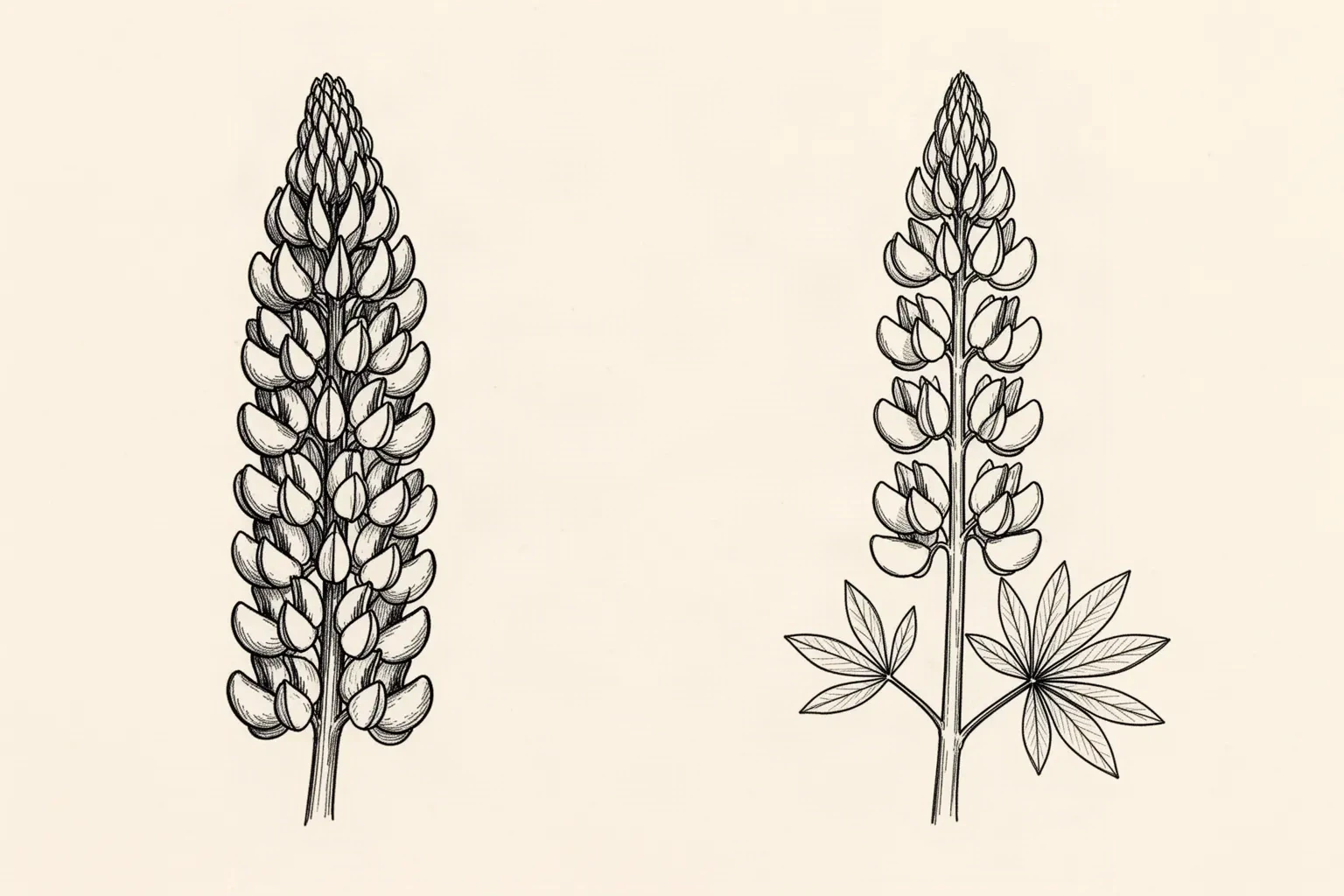
Synthetic ink illustration comparing two bluebonnet racemes: a dense raceme whose stacked buds touch edge to edge and read as one ribbed mass, beside a raceme with open paper between stacked buds, a distinct tip bud, and palmate leaf stars held clear of the lowest buds.
Synthetic editorial illustration, not to scale and not a print proof. Left: stacked buds drawn edge to edge collapse into one ribbed mass. Right: open skin between buds, a distinct tip, and leaf stars held clear of the lowest buds. The verdict still depends on your measured print at the intended height.

HOLDS AT STATED SIZE

Single side-profile raceme with spaced buds at 9 cm

Intended height 90 mm

Source
One upright side-profile raceme with clearly separated pea-shaped buds stepping down a straight stalk, open skin between neighbors, a readable tip, and one stem with a single low palmate leaf star held clear of the lowest buds.
Protect
Each bud separation from tip to base, the straight stalk, and the leaf-star clearance below the raceme.
Fix
Shorten only the longest leaflet if it crowds the lowest bud at 1:1. Keep bud count, axis, and stem direction unchanged.
Candidate stencil
Same bluebonnet with the view locked, bud spacing and stalk set, and protected contours kept at transferable mass.
Final-size verdict
Holds at 9 cm. Bud separations stay open at 1:1 and the plume reads as bluebonnet from raceme plus palmate leaf, not shading.

THIN THE TIP FIRST

Dense raceme with packed tip buds at 9 cm

Intended height 90 mm

Source
An attractive full plume where stacked buds sit edge to edge near the tip and two mid-raceme buds touch along the stalk, leaving almost no skin between neighbors in the upper third.
Protect
The stalk axis, the two strongest mid-raceme buds, and the stem direction that carries the upright habit.
Fix
Remove two or three tip buds to reopen the cap, restore a visible separation between the touching mid-raceme pair, and keep the leaf star low. Re-check with a squint test at 1:1.
Candidate stencil
Same bluebonnet with the view locked, bud spacing and stalk set, and protected contours kept at transferable mass.
Final-size verdict
Simplify first. If tip buds still share one merged cap at true size, enlarge the height or recrop to a shorter raceme.

REOPEN THE RINGS FIRST

Front-facing raceme with compressed rings at 11 cm

Intended height 110 mm

Source
A showy head-on plume where concentric bud rings compress around the stalk and the tip cap touches the uppermost ring, with one leaflet crossing the stem at the base.
Protect
The outer bud rhythm, the stalk direction, and the stem path through the base.
Fix
Remove one ring to reopen the compressed side, redraw the tip as a contained cap with open skin below it, and re-space the crossing leaflet off the stem. Do not invent spacing from merged rings.
Candidate stencil
Same bluebonnet with the view locked, bud spacing and stalk set, and protected contours kept at transferable mass.
Final-size verdict
At 11 cm the compressed rings function as one mass. Reopen rings first; a wider head is the only rescue for a fully packed front view.

RESTRUCTURE OR RECROP

Small raceme with leaf star crowding the base at 5 cm

Intended height 50 mm

Source
One sweet small plume where a palmate leaf star rises beside the stem and one leaflet tip touches the lowest buds, leaving a small enclosed separation at true size.
Protect
The raceme with its stalk, and the stem direction that gives the upright habit.
Fix
Keep one short leaflet star with a clear stem gap and remove the touching leaflet, or recrop to the raceme with a short stem stub. Do not invent spacing from a merged leaflet-to-bud contact.
Candidate stencil
Same bluebonnet with the view locked, bud spacing and stalk set, and protected contours kept at transferable mass.
Final-size verdict
At 5 cm the contact functions as one mass. Separate, recrop to the raceme, or enlarge before print.

Buds, stalk, and gaps at final size

Judge the white space at the height you will print.

Screens forgive crowding that paper and skin do not. Set the height first, then inspect each feature below at true physical size with scaling off.

About 5 cm and below

Behind ear, finger side, and tiny ankle accents.

Carry one short side-profile raceme with few buds and no leaf star or one short stub at most. Keep plain bud outlines with no inner keel texture. If a bud separation or the stalk closes at 1:1, enlarge or reselect rather than forcing reduction.

About 6 to 10 cm

Common ankle, wrist, collarbone, and small forearm bluebonnet pieces.

The most requested band. One side-profile raceme with spaced buds and a single low leaf star can work, or a front-facing head at the upper end, when every separation is verified at true size. Tip buds need a verified gap here or they read as one cap.

About 10 cm and above

Forearm, calf, shoulder, thigh, and spine compositions.

Room for a front-facing raceme or a side raceme with a full stem run and one leaf star, but only when open skin separates every bud and every leaflet. Larger height never rescues merged tip buds, kinked stalks, or touching leaflet-to-bud contacts.

Bluebonnet feature checks by height band
FeatureAbout 5 cm and belowAbout 10 cm and above
Bud separations along the racemeKeep the heaviest bud lines here. If a bud edge disappears, the plume loses its lupine read and becomes a plain pod.Same priority. Larger height allows slightly finer buds, but separability still beats uniform thinness.
Stalk axis, tip, and bud rhythmKeep one unbroken stalk segment with open skin on both sides and a readable tip. Extra buds compete for the same room and should be removed first.A longer raceme can work when the tip-to-base order clearly leads. Kinked stalks or packed tip caps need straightening work before print.
Stem line and palmate leaf contactKeep one unbroken stem segment with open skin on both sides. A leaf star competes with buds for the same room and should be recropped away.One leaf star can add movement when the raceme clearly dominates. Equal-weight stems or leaflets climbing into the raceme need hierarchy work before print.
Front-view rings and leaf starsCarry none. Small heights suit one side profile; rings or a star forced into these bands merge first.Rings or a leaf star can work when each keeps its own skin channel and open bud gaps. Check the full group with a squint test at true size.

Fine-detail fallout risk checklist: buds, stalk, and leaf stars

  • Bud bridging: stacked pea-shaped buds drawn edge to edge with no skin between them merge into one ribbed pod on transfer.
  • Tip capping: tip buds packed with no separations print as one solid cap and erase the raceme lead.
  • Axis wobble: a kinked or forked stalk collapses the lupine read once reduced, even when buds are spaced.
  • Leaflet-to-bud contact: a palmate leaflet tip touching the lowest buds bridges first at small heights.
  • Leaf-star overlap: two palmate stars touching with no skin between them print as one blotch beside the stem.
  • Keel over-texture: tiny inner banner and keel marks drawn edge to edge with no separation print as one dark collar.

When the job is small size without a species example, use the small-flower stencil guide for generic 2 to 5 cm readability rules. When the brief mixes bluebonnets with other species, use the wildflower stencil guide for mixed-bouquet triage and wrap-flow planning.

Reference to clean stencil

Lock the view, then build outward along the stem.

Work in this order so one change at a time can be judged at the same height. Stop when view, raceme, gaps, and stem flow each read correctly.

  1. 01

    Lock height, view, and placement first

    Set the intended physical height in millimeters, choose one construction (side profile, front facing, or raceme with leaf star), and name the body area before judging the reference. A plume that holds at 12 cm on a flat thigh can fail at 5 cm on a curved ankle with no line being wrong on its own. Use the size calculator when target dimensions are still open.

  2. 02

    Rank raceme, buds, and stem

    Name the stalk, count its readable buds, and assign every mark a role: buds that carry the first read, the stalk that orders them, and the stem that directs them. Strengthen outer bud contours and the stalk first, keep leaf stars compact, and mark one removable bud or leaflet that can go if gaps close.

  3. 03

    Simplify buds and leaflets for final size

    Reduce bud count and leaflet mass before thinning stalk lines. Keep open skin between buds, between leaflets, and between the lowest buds and every leaf star, then run a squint check: step back until inner detail disappears and confirm the raceme and stem still read. The line-weight guide covers fine, normal and bold behavior on the same stencil.

  4. 04

    Verify print and transfer path

    Export a true-size PDF with no fit-to-page scaling, inspect the narrowest bud gap, the tip separation, and the smallest leaflet clearance on plain paper, then measure the physical print with a ruler. If the digital file passes and only paper fails, move to print-stage evidence instead of simplifying again.

Placement and size decisions

Upright plumes want straight skin that keeps buds separated

A bluebonnet is one upright raceme on a stem run with palmate leaf stars. Placements with a clear straight span preserve the buds with little compensation, while small wrapped placements demand a recrop to one short side profile.

Ankle

Small curved field with footwear friction near the transfer, and the most requested bluebonnet placement. Slim upright side profiles survive; wide front heads wrap and bridge.

Check: Keep the composition slim and vertical, hold one stalk with clear leaf gaps, and verify the stencil survives the shoe line before locking height.

Forearm and calf

Narrow fields where the stem should follow the limb line. Wide front-facing heads set across the limb wrap fast and crowd bud edges.

Check: Align stems with the limb axis, tilt the raceme to the flattest spot, and shorten cross-limb leaflets while edits are still cheap.

Shoulder and upper back

Broad, gently curved fields with room for a front-facing raceme or a side plume with a real stem run and one leaf star.

Check: Seat the raceme on the flattest span, run the stem along the longest available line, then confirm every bud gap and leaflet clearance stays open at 1:1.

Spine and sternum line

Long centered fields that suit a tall side-profile plume with room for a full stem run, but symmetry pressure tempts heavy mirrored leaf stars.

Check: Keep the composition slim and vertical with one leaf star at most, center on the flattest span, and preview on a torso photo before print.

Wrist and behind ear

Small wrapped fields where only one short side-profile raceme survives. Front heads or leaf stars forced into these bands merge first.

Check: Recrop to the single strongest raceme with at most a short stem stub, then run the small-size checks at the exact height.

Thigh

Large panel with room for a front-facing raceme plus a leaf star, but the curve compresses one side of wide heads in photos and transfers.

Check: Spend the extra room on raceme-to-leaf separation first, center the head on the flattest span, and let the stem fall toward the slope.

Bluebonnet versus similar briefs

Route the flower to the right vetting logic

Bluebonnets share stacked-bud density with lavender and a bouquet habit with wildflowers, and clients sometimes mean a generic tiny bloom. Use this table to confirm the job before judging it as a lupine raceme.

Bluebonnet versus similar briefs for stencil vetting
FlowerConstructionStencil call
Bluebonnet raceme (this page)One dense upright raceme of small stacked pea-shaped buds on a stalk above branching stems with palmate leaf stars. Stencil work is bud-gap retention plus stalk order plus leaflet clearance.Vet view choice, raceme density, stalk order, and leaf-star clearance at final size using the framework on this page.
Lavender sprigOne slender stem with a narrow spike of small stacked buds over short calyx cups and low narrow linear leaves.Judge sprig versus bundle versus band on the lavender page. Link there when the brief is a narrow herbal spike, not a lupine plume.
Wildflower bouquetMixed stems, varied head shapes, and looser rhythm across several species in one composition.Judge mixed-stem rhythm and anchor-bloom triage on the wildflower page. Stay here when the brief is one bluebonnet raceme with a single stalk logic.
Small flower at 2 to 5 cmGeneric tiny bloom construction judged on readability rules without a species example.Follow generic small-size readability on the small-flower page. Stay here when the brief needs lupine construction, view choice, and palmate-leaf checks.

Stencil-ready checklist

Approve the bluebonnet only when every line passes

Run this short sequence with scaling off and a ruler in hand. One failed line means fix, enlarge, or reselect before transfer.

  • Confirm intended height in millimeters, the chosen view, and the named placement.
  • Confirm every bud separation stays open along the raceme at 1:1.
  • Confirm the stalk reads as one straight or smoothly arcing line with a readable tip, not a kink or cap.
  • Confirm lowest-bud to leaflet gaps and leaflet-to-leaflet gaps stay open at true size.
  • Confirm no crossing stem or equal-weight second element competes with the lead stem.
  • Export a true-size PDF with scaling off and measure the physical print.
Stacked buds, open skin Verify gaps at 1:1 One stalk, clean stem

FAQ

Bluebonnet stencil decisions, answered

Short answers for the view, bud-gap, size, placement, and handoff checks that recur when a bluebonnet reference moves toward transfer-ready output.

A bluebonnet is stencil-ready when three checks pass at the exact physical height: every stacked-bud separation stays open along the raceme at 1:1, the stalk reads as one straight line with a readable tip rather than a kink or a packed cap, and every palmate leaflet keeps open skin with no contact touching the lowest buds. Photos show dozens of blossoms with shading doing the separation work, while a stencil keeps only the buds that hold gaps. If any check fails, remove buds or leaflets, re-space, enlarge, or reselect before print.

Next steps

Use the neighboring owners for adjacent jobs.

This guide covers bluebonnet view choice, raceme density vetting, stalk order and leaf-star flow, placement fit, and transfer-ready prep. Use the links below for related jobs such as sizing, print checks, conversion, and neighboring flower constructions.

Board organization, grid overlays, photo-quality scoring, generic conversion, broad gallery browsing, paper manufacturing detail, and placement mechanics stay in their specialist owners. The links above hand off instead of repeating that detail.

From evaluated reference to working stencil

Turn the approved bluebonnet into a stencil draft.

Start from the raceme that passed the bud, stalk, and leaf-star checks, then continue on iPhone for body fit, exact-size print, mirror and professional export.