

Round emblem stencil reference

Vet an 8-ball that holds as a stencil

An 8-ball lives or dies on three relationships: solid disc, white window, and a legible 8. Check circle solidity, window contrast, and 8-counters at your exact width, then prep one transfer-ready emblem.

Built for working artists prepping 8-ball transfers. This guide covers 8-ball circle, window, 8, edge, highlight, and small-size prep only. Triple-numeral construction, moon phases, and joker faces stay with their owners below.

What makes an 8-ball stencil-viable

Disc, window, and 8 decide the result.

A plain black dot is easy. An 8-ball needs a solid disc plus a reversed window plus a readable digit in the same small emblem, so these three checks predict the transfer before ink is involved.

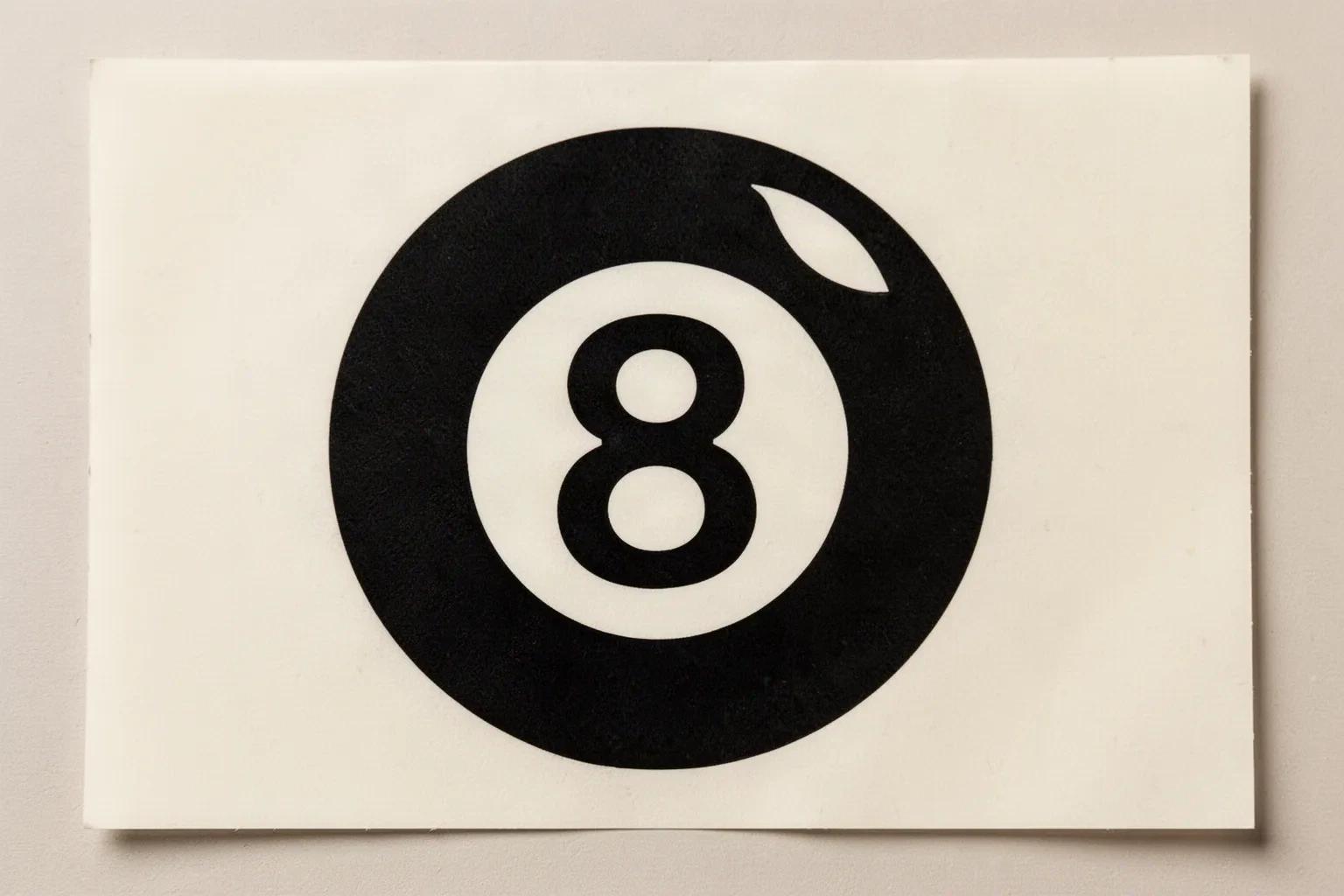
Original illustration of a transfer-ready 8-ball stencil emblem on plain paper: one solid black disc with a smooth closed edge, a centered reversed white window with an even black rim all around, a bold 8 with two open counters, and one short crescent highlight sitting fully outside the window.
Original illustration, not app output. The reference anatomy this page checks: solid disc fill with a smooth closed edge, a centered reversed window with an even black rim, a bold 8 whose counters stay open at true size, and at most one short crescent highlight outside the window. Compare your own emblem against those four parts at the width you will print, not at screen size.

Circle solidity and edge weight

An 8-ball reads first as one solid black disc with a clean round edge, not as patchy fill or a wobbling outline. Stencil viability comes from even black mass across the ball plus an outer contour heavy enough to survive thermal transfer without feathering. Sketched texture, broken fill, and thin ring-only edges fail first on curved skin.

Check: Squint at a 1:1 print at arm's length. If the disc reads as one even black ball with a smooth edge, the base is sound. If fill looks grey, streaky, or the edge wavers, rebuild mass before judging the window or the 8.

White window contrast

The small white circle on the ball carries the entire 8-ball read. It must sit as one bounded reversed shape with open separation from the outer edge on all sides. Windows that touch the ball edge, merge into highlight streaks, or carry thin bridging lines close at transfer and turn the emblem into a plain black dot.

Check: Cover the 8 inside the window. If the white circle still reads as a centered disc with a clear black rim around it, contrast is sound. If the window touches the edge or narrows into a slit, recenter and enlarge it before print.

8-legibility and highlight retention

The 8 inside the window is the smallest working part of the emblem. It needs two stacked counters that stay open at the target width plus stroke mass that survives transfer. Gloss highlights, shine streaks, and reflection ticks compete for the same white room and should be treated as removable unless the 8 already holds.

Check: Judge the 8 alone at true size with scaling off. If both counters stay open and the digit reads as 8 rather than 0, 6, or a blob, legibility holds. If counters close, simplify the 8 or enlarge the window before keeping any highlight.

8-ball evaluation framework

Score the emblem in minutes, then fix the weakest check.

Four common 8-ball constructions at labeled widths. Each one names the protected structure, the fix, and the go or no-go verdict at that exact size. Confirm with a measured 1:1 print.

HOLDS AT STATED SIZE

Solid blackball emblem at 4 cm

Intended width 40 mm

Source pattern: Flat solid black disc with a smooth round edge, one centered white window circle, and a bold grotesque 8 with two open counters. No shine streaks, no outline doubling, no background ring.

Protect
Even disc fill, the full window diameter with its black rim, and both 8 counters with open white around every stroke.
Fix
None structural. Confirm the window rim stays even on all sides at 1:1 and that the 8 strokes keep clearance from the window edge before print.
Candidate stencil
Same 8-ball with the disc rebuilt solid, the window centered with an even rim, the 8 simplified to open counters, and gloss reduced to one optional crescent outside the window.
Final-size verdict
Holds at 4 cm. The disc carries the read, the window supplies contrast, and the 8 keeps both counters open at true size.

REOPEN THE WINDOW

Outline ring ball with tight window at 3 cm

Intended width 30 mm

Source pattern: Ball drawn as a bold outline ring with partial inner fill, a small off-center window, and a condensed 8 whose lower counter nearly touches the window edge. Attractive on screen but the window rim is uneven and the 8 crowds one side.

Protect
The outer ring mass that sets the ball silhouette and the window position that gives the emblem its identity.
Fix
Enlarge the window until its black rim measures even on all sides, recenter it, and rebuild the 8 with lighter stroke mass or a simpler skeleton so both counters clear the window edge at 1:1.
Candidate stencil
Same 8-ball with the disc rebuilt solid, the window centered with an even rim, the 8 simplified to open counters, and gloss reduced to one optional crescent outside the window.
Final-size verdict
Holds at 3 cm once the window rim is even and both 8 counters clear the edge. Window-to-edge contact is the most common transfer failure for ring-built 8-balls.

CONVERT SHINE TO ONE MARK

Glossy shaded ball with highlight streaks at 5 cm

Intended width 50 mm

Source pattern: Shaded blackball with gradient tones, two curved gloss streaks crossing the window zone, plus a thin serif 8 with narrow counters. Convincing as illustration, but gradients carry no stencil separation and streaks cut through the window the 8 needs.

Protect
Ball silhouette and center axis, window placement, and the 8 position that sets the emblem read.
Fix
Convert the shaded ball to flat solid fill, reduce gloss to at most one short crescent fully outside the window, and replace the thin serif 8 with a bolder skeleton whose counters stay open at 1:1.
Candidate stencil
Same 8-ball with the disc rebuilt solid, the window centered with an even rim, the 8 simplified to open counters, and gloss reduced to one optional crescent outside the window.
Final-size verdict
Not stencil-ready until shading becomes solid fill and streaks leave the window. Verify the 8 counters and the crescent clearance on plain paper before transfer.

ENLARGE OR RECROP

Micro 8-ball with full detail at 2 cm

Intended width 20 mm

Source pattern: Complete emblem shrunk to finger scale: thin outer ring, small window, full 8 with serif ticks, plus a highlight dot and a short underline flourish. Every separation is sub-millimeter and the window plus 8 function as one grey pocket.

Protect
Disc silhouette and the window-plus-8 relationship that makes it an 8-ball rather than a black dot.
Fix
Enlarge past the point where the window and both 8 counters each transfer as open shapes, or recrop to a solid disc with one bold window and a simplified 8 without serif ticks, dots, or flourishes.
Candidate stencil
Same 8-ball with the disc rebuilt solid, the window centered with an even rim, the 8 simplified to open counters, and gloss reduced to one optional crescent outside the window.
Final-size verdict
At 2 cm the window and 8 merge into one pocket and the ring prints as a broken scratch. Enlarge, simplify to a bold window 8, or choose a plain disc treatment for this width.

Triple-numeral spacing and counter-fill depth stays with the 777 and 999 owners, circular phase-row specifics stay with the moon owner, and card-icon versus grin-face choice stays with the joker owner. This framework exists to judge solid-disc hold, reversed-window contrast, 8-legibility, and highlight control at a stated size, not to replace those pages.

Small-emblem hold at 2 to 5 cm

Judge the white room at the width you will print.

Reduction steals white first: the window rim thins, then the 8 counters close, then gloss turns to dirt. Set the width first, then apply the band rule and the highlight rules below.

About 4 to 5 cm

Forearm, calf, and shoulder emblem work with room for a full window 8.

Carry the complete emblem: solid disc, centered window, bold 8 with two open counters. One small highlight crescent outside the window is the maximum extra. Check the window rim and both 8 counters at 1:1.

About 3 cm

Wrist, ankle, and compact gap-filler placements.

Keep the disc, the window, and a simplified 8 only. Drop shine streaks, serif ticks, and outline doubling. If either 8 counter closes at true size, enlarge the window or the whole emblem before print.

About 2 cm and below

Finger, behind-ear, and tiny filler fields.

Only dominant structure survives: round disc plus one bold window 8 with heavy counters. No highlight, no flourish, no thin ring. If the window and 8 read as one pocket, enlarge or reselect rather than forcing detail.

Highlight retention rules for 8-balls

  • Keep the window first: no gloss mark may touch, cross, or narrow the white window at true size.
  • Allow at most one short crescent highlight, placed fully inside black fill and clear of the window rim.
  • Remove reflection dots, double streaks, and shine ticks at 3 cm and below; they read as stencil dirt at transfer scale.
  • Confirm the 8 still reads as 8 after any highlight is added, using an arm's-length squint check on the 1:1 proof.

Generic 2 to 5 cm simplification logic, including landmark protection and texture reduction across subjects, stays with the small-stencil owner. The rules above cover only 8-ball window and highlight decisions that the generic guide does not own.

Placement for round emblems

Circles show curvature fast

A round disc has no axis to hide distortion, so placement decides whether the ball stays round and the 8 stays level. Choose the band for the area first, then verify on the body preview.

Outer forearm and calf

Long, relatively flat fields that suit the full emblem at 4 to 5 cm. The round shape holds symmetry well when aligned with the limb axis.

Check: Center the window on the flattest span, keep the 8 upright to the limb axis, and verify the disc stays round on the body preview before print.

Wrist and ankle

Narrow wrapped fields where a full-size disc crowds fast. Curvature compresses one side of the circle and narrows the near window rim.

Check: Use the 3 cm treatment with a simplified 8, align the emblem center with the limb, and check the near rim for closure on the curve.

Finger and behind the ear

Very small fields with flex and contact. Only the micro treatment survives, and thin rings plus serif 8s merge first here.

Check: Carry a solid disc with one bold window 8 only. Skip highlights and flourishes, and confirm both counters on a measured 1:1 proof.

Chest, shoulder, and thigh

Broad panels with room for the emblem alone or paired with lettering or small flash. The curve can tilt the 8 if the stencil is placed off axis.

Check: Level the 8 against the body axis on the preview, keep companion marks clear of the disc edge, and confirm window contrast before locking the file.

Exact-size transfer prep

Leave print-ready only when every line passes

Run this sequence with scaling off and a ruler in hand. One failed line means fix, enlarge, or reselect before the session.

  • Lock the exact emblem width in millimeters and the simplified treatment before generating the final file.
  • Confirm the disc edge is one smooth closed contour with even fill and no broken segments.
  • Confirm the white window sits centered with an even black rim on all sides at 1:1.
  • Confirm both 8 counters stay open with white clearance around every stroke at true size.
  • Export mirrored at the exact millimeter width with scaling off and proof on plain paper.
  • Measure the physical proof with a ruler, confirm window and 8 on skin preview, then transfer.
Solid disc first Window rim even Both 8 counters open

FAQ

8-ball stencil decisions, answered

Short answers for the disc, window, 8, highlight, placement, and print checks that recur when an 8-ball idea moves toward a clean transfer.

It holds when three checks pass at the exact millimeter width: the disc prints as one even black ball with a smooth edge, the white window reads as a centered disc with a clear black rim, and the 8 keeps both counters open at 1:1. If any check fails, the fix list on this page names what to rebuild, recentre, simplify, or enlarge before print.

From vetted emblem to working stencil

Turn the approved 8-ball into a stencil draft.

Start from the emblem that passed the disc, window, and 8 checks, then continue on iPhone for body fit, exact-size print, mirror, and professional export.