

Hand-placed Medusa reference

Fit the Medusa to the hand zone before print

A Medusa brings a facing gaze and a radiating snake crown to the smallest, most mobile placement on the body. Name the hand zone first, choose a Medusa construction that survives that zone curvature and movement, then prove size with an exact print before transfer.

Built for working artists preparing client-ready hand Medusas. This page covers Medusa-to-hand-zone fit, snake and gaze simplification, and exact-size verification only, not tattoo application or healing advice. General Medusa vetting and generic hand mechanics live in the neighboring owners linked below.

Hand-zone fit framework

One hand, three different Medusa problems.

A hand Medusa fails when a placement-independent Medusa is copied onto a zone it was never drawn for. Pick the zone row below before judging any Medusa reference.

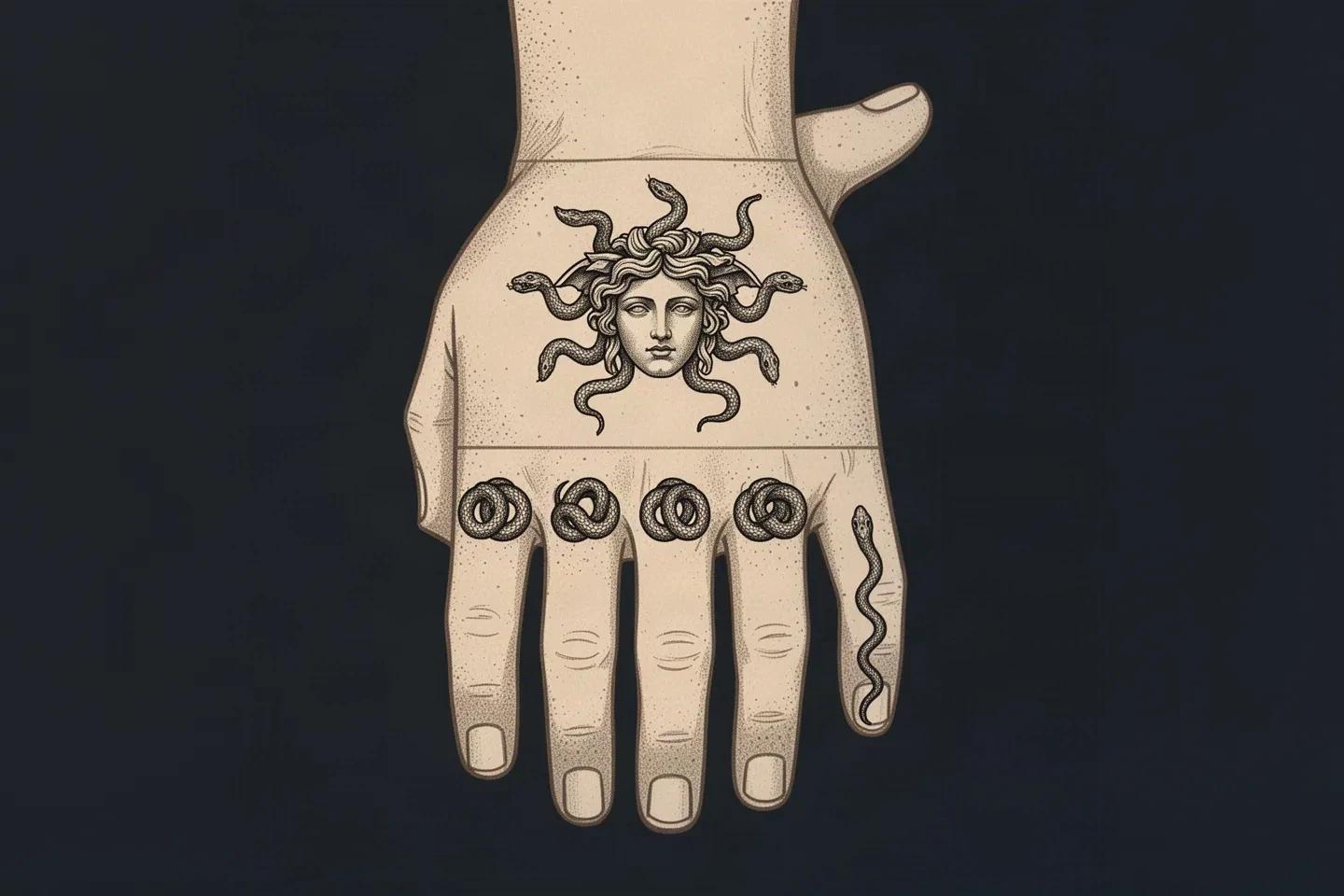
Editorial illustration of a dorsal hand: a compact Medusa face with ranked snake stems sits on the flat dorsal panel, four separate coiled snake segments sit one per knuckle with open skin at the creases, and one narrow snake coil runs along a single finger toward the tip.
Editorial illustration, not app output or client work. The gaze stays on the dorsal panel, the knuckle band carries separate coil segments with open skin at every crease, and the finger keeps one tapered coil with no face. Use the zone cards below to judge a real reference against each zone, then confirm it with a measured 1:1 print.

Dorsal panel

Back of hand between wrist and knuckles

The only hand field that accepts a recognizable Medusa face. A compact frontal face with three to five ranked snakes fits the gentle dome when the face sits on the flattest middle span and outer coils fold toward the wrist instead of reaching for the knuckles.

Check: Center the eye pair on the flat middle panel. Keep total width inside the wrist-to-knuckle span with open skin at both ends before print.

Knuckle band

Across the four knuckles, one row

Four joint high points with a crease valley between each one. A Medusa gaze cannot straddle this band because any eye or mouth line centered on a crease folds and closes on transfer. The workable Medusa answer here drops the face entirely: one self-contained snake-coil segment per knuckle, with open skin at every joint.

Check: Split the crown into per-knuckle coil units. Confirm no eye, mouth, or snake head crosses a crease center at transfer size.

Finger length

One finger, top or side face

A narrow tapering field in constant flex. A full Medusa face with a radiating crown cannot survive here, so the construction recrops to a single snake coil with at most one small head, stacked on one finger face and narrowing toward the tip. The gaze is deliberately sacrificed to keep one readable snake form.

Check: Keep the full construction inside one finger face, taper toward the tip, and judge every snake gap with the finger slightly bent.

Side edge and thumb slope

Lateral hand edge, read from one side angle

Not a Medusa zone. A Medusa reads through a facing gaze and a radiating crown, and both depend on a front view this edge never gives. A snake coil redrawn as a slim profile stem can survive here, but it will read as a snake, not as Medusa. Place the Medusa on the dorsal panel instead.

Check: Do not shrink a frontal Medusa onto the edge. Either move the face to the dorsal panel or accept a snake-only construction with no gaze claim.

Zone-fitted Medusa reference set

Four Medusa constructions, judged at hand size.

Each card below is a transfer-oriented Medusa construction at a stated width: what to protect, what to remove, and the go or no-go verdict at that exact size. The last card names the classic failure, a dense or fine-line crown forced to hand size. Confirm every verdict with a measured 1:1 print.

HOLDS AT STATED SIZE

Compact dorsal Medusa at 52 mm

Intended width about 50 to 55 mm | Dorsal panel

Source
Compact frontal Medusa face with separated eye pair, calm mouth, and four ranked snakes with distinct heads folded toward the wrist side. No bust, no pedestal, no scale texture.
Protect
Eye-pair position with open skin between the eyes, mouth placement, the three longest snake paths, and the outer crown contour on both sides.
Reduce
Fourth-snake inner coil detail, repeated scale rows, brow bands, nostril modeling, and any bust or base line that competes with snake separations.
Candidate stencil
Same Medusa with zone compensation applied: gaze kept only on the dorsal panel, snake count set, separations reopened, and protected face and coil contours held at transferable mass.
Final-size verdict
Holds at 50 to 55 mm after texture reduction. Both eyes stay separate at 1:1, every lead-snake gap stays open, and the stare reads from a normal viewing distance.

DROP THE GAZE HERE

Four knuckle coil segments at 12 mm each

One coil segment per knuckle, about 10 to 14 mm each | Knuckle band

Source
Four self-contained snake-coil segments in one row, each drawn as one coiled body with at most one simple head, with open skin planned at every joint crease and no face anywhere in the row.
Protect
Each coil body contour, the open gap at every crease, and the per-knuckle head direction that lets each segment read alone.
Reduce
Connecting snake bodies across creases, shared heads between knuckles, second heads on one segment, and scale texture inside any coil.
Candidate stencil
Same Medusa with zone compensation applied: gaze kept only on the dorsal panel, snake count set, separations reopened, and protected face and coil contours held at transferable mass.
Final-size verdict
Stencil-ready when each coil holds on its own knuckle face and every crease gap stays open at 1:1 in both a relaxed and a lightly closed check. A full Medusa face stretched across this band is the documented failure: gaze lines centered on creases close first.

RECROP, DO NOT SHRINK

Single-coil finger Medusa at 30 mm

Column about 8 to 12 mm wide, 28 to 34 mm long | One finger face

Source
One snake coil with a single small head, stacked on one finger face along a single center axis and narrowing toward the tip. No face, no second coil, no crown.
Protect
Center axis, coil body continuity, the single head silhouette, and the separation between coil turns.
Reduce
Second coil, second head, scale rows, and any face fragment squeezed above the coil at this width.
Candidate stencil
Same Medusa with zone compensation applied: gaze kept only on the dorsal panel, snake count set, separations reopened, and protected face and coil contours held at transferable mass.
Final-size verdict
Holds when the column narrows toward the tip, coil-turn separations read at 1:1 with the finger slightly bent, and nothing wraps around the finger side unintentionally.

ENLARGE OR RECROP

Dense bust or fine-line crown at hand size

Full bust or seven-coil crown forced under 60 mm | Any hand zone

Source
Stone-statue bust with shaded cheeks and textured snake scales, or a delicate outline-only crown with hairline contours and seven competing coils, copied to hand size without reconstruction.
Protect
Eye positions and the two strongest snake directions that give the crown its movement.
Reduce
Shaded cheek modeling, repeated scale rows, pedestal and shoulder lines, hairline coils, and small competing heads. Convert shading to line hierarchy first or abandon the bust.
Candidate stencil
Same Medusa with zone compensation applied: gaze kept only on the dorsal panel, snake count set, separations reopened, and protected face and coil contours held at transferable mass.
Final-size verdict
Not stencil-ready at hand size. Enlarge past the point where every snake gap transfers as open skin, or recrop to a dorsal face with three snakes, a knuckle coil row, or a finger single coil. Do not keep a bust base or seven hairline coils under 60 mm.

Placement-independent Medusa comparison, frontal versus profile versus bust vetting, and broad visual browsing stay in the Medusa owner and the stencil hubs linked below. This set exists only to judge Medusa-on-hand fit, not to replace those pages.

Curvature and movement simplification

Simplify the snakes and gaze for the curve they sit on.

Flat Medusa drawings hide the failure until transfer. Match the compensation to the row below before changing line weight or density.

Medusa-on-hand distortion behavior and stencil compensation
Medusa shapeWhat happens on the handStencil compensation
Full face centered on the knuckle bandEye, brow, and mouth lines bridge joint valleys on the flat stencil, then fold into the creases on transfer and close first.Never center a gaze on the knuckle band. Split into one coil segment per knuckle with open skin at every crease, or move the face to the dorsal panel.
Wide radiating crown on a fingerOuter snake bodies fall past the finger face edges and disappear around the sides, so the crown reads as a clipped band rather than living hair.Recrop to a single coil with at most one head, about 8 to 12 mm wide on one face, tapered toward the tip.
Gaze detail at dorsal widthBrow bands, tear lines, and nostril marks crowd the eye pair at 50 mm, and the stare merges into one pocket while the snakes still have room.Reduce the face to eyes, one nose hint, and mouth with open skin between each mark. Remove brow and tear detail before touching snake count.
Flat dorsal Medusa with long outer coilsThe dorsal dome lifts stencil corners at transfer, so coil tips reaching toward the knuckles or wrist edge lift and print patchy.Keep the face on the central flat span, fold outer coils back toward the wrist side, and preview on a hand photo before print.

Hand-Medusa sizing

Start from zone widths, then prove the gaze and gaps

These starting widths are stencil-prep guides for hand Medusas, not placement rules. Lock one width, judge the eye pair and the narrowest snake gap at true size, and let the working artist confirm the final call for the specific hand.

Starting widths for hand-placed Medusas
ZoneStarting pointDecision rule
Dorsal faceFace with three to five ranked snakes, about 50 to 55 mm wideJudge the eye pair first, then the narrowest snake gap. If either closes at 1:1, remove one coil or one face mark before enlarging past the wrist-to-knuckle span.
Knuckle coilsOne coil segment per knuckle, about 10 to 14 mm eachSize by single-coil width, not total row length. At most one simple head per segment and no shared bodies across creases.
Finger coilSingle coil column about 8 to 12 mm wide, 28 to 34 mm longOne coil and at most one head. When coil-turn separations merge, remove the head or shorten the coil rather than thinning every line.
Side edgeNot a Medusa constructionDo not place Medusa here. Move the face to the dorsal panel or accept a snake-only construction with no gaze claim.

Exact-size print verification

Prove the hand Medusa on paper before skin

Small hand tolerances leave no room for silent scaling. Run this short sequence with scaling off and a ruler in hand.

  • Lock the millimeter width for the chosen hand zone: dorsal face, per-knuckle coil width, or finger column.
  • Export a true-size PDF with scaling set to 100 percent, never fit-to-page or shrink-to-fit.
  • Include or draw a 50 mm calibration line and measure it with a ruler on the physical print.
  • Inspect the narrowest snake gap, eye separation, and crease gap at 1:1 on plain paper.
  • Compare the print against a photo of the actual hand in a relaxed position, plus a lightly closed check for knuckle work and a slightly bent check for finger work.
  • Confirm the narrowest line transfers as one continuous mark at true size before cutting the transfer.
Separated gaze first Verify gaps at 1:1 Measure the print

FAQ

Hand-Medusa decisions, answered

Short answers for the zone, layout, simplification, and verification questions that recur when a Medusa request meets the hand.

Match the construction to the zone, not the reference to the zone. Use a compact frontal face with three to five snakes at about 50 to 55 mm on the dorsal panel, one coil segment per knuckle at about 10 to 14 mm each with no face on the knuckle band, or a single coil with at most one head on one finger face. Dense busts and seven-coil fine-line crowns do not survive under 60 mm and must be enlarged or recropped first.

Next steps

Use the neighboring owners for adjacent jobs.

This guide covers Medusa-to-hand-zone fit, snake and gaze simplification for curvature and movement, and exact-size hand verification. Use the links below for related jobs held elsewhere.

General Medusa composition, generic hand sizing steps, copier-free transfer method depth, and broad gallery browsing stay in their specialist owners. The links above hand off instead of repeating that detail.

From zone-correct Medusa to working stencil

Turn the approved hand Medusa into a stencil draft.

Start from the Medusa construction that passed the zone, gaze, and gap checks, then continue on iPhone for body fit, exact-size print, mirror and professional export.