

Lotus-mandala pairing evaluation

Vet the lotus heart and the mandala ring as one stencil

A lotus-mandala piece fails where the two systems meet. Choose the center stage that fits the ring construction, prove both share one center, then protect every petal to dotwork channel at your exact diameter for a clean transfer-ready stencil.

Built for working artists preparing lotus-mandala pairings. This page covers integrated center plus ring choice, shared-center alignment, petal to dotwork transition with gap retention, and the combined transfer checklist only, not tattoo application or healing advice. Standalone lotus catalogs, pure mandala primers, and generic ornament guidance live with their own owners linked below.

Center plus ring decision

Pick the pairing build before judging any line.

A lotus-mandala stencil is one construction with two jobs: the heart must read as a flower stage and the rings must hold radial order around the same center. These three builds set which system leads.

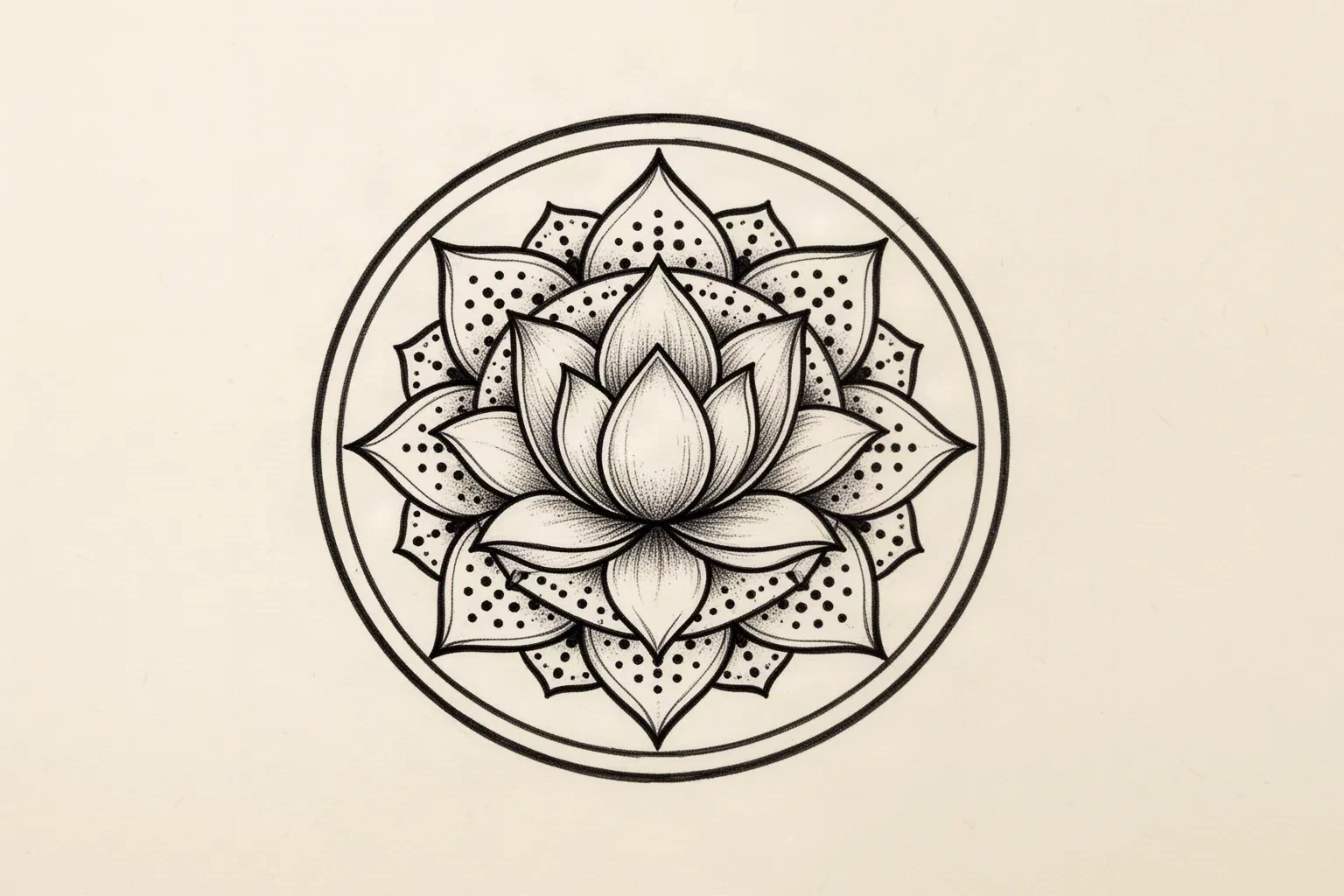
Synthetic ink illustration of a lotus-centered mandala construction with ranked bloom petals, an isolated dotwork transition band, and a single structural outer ring.
Illustrative construction only: this is synthetic artwork, not app output and not a vetted stencil. It marks the three zones this page judges, the lotus heart, the dotwork transition band, and the structural outer ring. Symmetry and gap retention are certified by the fold, quarter-turn, and 1:1 printing checks below, not by this drawing.

Lotus-dominant medallion

A botanical lotus carries the first read at roughly two thirds of the diameter, with one restrained mandala ring (a single petal repeat or a narrow dot band) framing it. This build suits clients who want the flower to stay recognizable, and it survives reduction best because the center has real petal layering rather than geometry alone.

Check: Cover the outer ring. If the lotus still names its own bloom stage with separated ranks, the dominance is sound. If the center reads as a plain rosette without the ring, the lotus needs stronger rank separation before the ring is judged.

Ring-dominant rosette

The mandala ring system carries the first read, with a simplified lotus heart (a bud or a single-rank cup) seated exactly on the shared center. This build suits sternum and upper-back centerpieces where radial ornament matters more than botany, but it fails fastest when the lotus heart drifts off center or when a heavy heart crowds the first ring channel.

Check: Cover the lotus heart. If the rings still hold one center with even quarter turns, the ring system is sound. Then uncover the heart and confirm open skin rings it on all sides at 1:1 before print.

Balanced fusion

A half or full bloom transitions directly into the mandala rings: outer petal ranks become the first ring segments, and dotwork bands carry the tone between them. This build suits larger flat fields (about 12 cm and above) where both systems have room, but it needs the strictest transition discipline because petal edges and dot bands compete for the same channels.

Check: Trace one channel from the lotus heart to the outer ring edge. If every bridge between petal layer and dot band stays open skin at true size, the fusion holds. If any bridge closes, simplify the dot band or remove one petal rank before touching line weight.

Pairing evaluation framework

Score the combination in minutes, then act on the weakest check.

Four lotus-mandala constructions at labeled diameters. Each one names the protected structure, the fix, and the go or no-go verdict at that exact size. Confirm every verdict with a measured 1:1 print.

HOLDS AT STATED SIZE

Half-bloom heart with single dot band at 12 cm

Intended diameter 120 mm

Source
Upright half-bloom cup with two separated petal ranks seated on the ring center, one narrow dot band with visible skin between dots, and a single structural outer ring with open channels from heart to rim.
Protect
The shared center point, the cup mouth opening, every petal-to-ring channel, and the outer ring contour.
Fix
Thin only dot spacing if isolated dots touch at 1:1. Keep petal ranks, channel positions, and ring mass unchanged.
Candidate stencil
Same pairing construction with one shared center, assigned petal ranks, open transition channels, and the removable dot or rank family already decided.
Final-size verdict
Holds at 12 cm after a dot-spacing check. Channels stay open at 1:1 and all four folds agree on one center.

RE-CENTER FIRST

Full bloom heart drifted inside even rings at 12 cm

Intended diameter 120 mm

Source
Clean mandala rings with even quarter turns, but the full-bloom lotus heart sits visibly off center so channels are wide on one side and pinched shut on the other.
Protect
The ring center and the longest clean petal axis as the rebuild anchors.
Fix
Re-seat the lotus heart exactly on the ring center, then re-space petal ranks evenly before touching dotwork. Do not thicken ring lines to hide the offset.
Candidate stencil
Same pairing construction with one shared center, assigned petal ranks, open transition channels, and the removable dot or rank family already decided.
Final-size verdict
Not stencil-ready until the pairing shares one center. Even rings cannot compensate for a drifted heart.

REOPEN THE TRANSITION

Petal tips bridged into the dot band at 10 cm

Intended diameter 100 mm

Source
Attractive bloom with a full dot gradient, but the longest petal tips touch the densest dot row around half the circle, closing the transition channels into one mottled band.
Protect
The cup mouth, the outer ring contour, and the gradient direction from dark edge to open skin.
Fix
Shorten the bridging petal tips and remove the innermost dot row until every channel traces unbroken from heart to rim at 1:1. Reduce marks before thinning contours.
Candidate stencil
Same pairing construction with one shared center, assigned petal ranks, open transition channels, and the removable dot or rank family already decided.
Final-size verdict
Simplify first. If channels still close at 10 cm, run a bud heart for this diameter or enlarge past the point where tips and dots stay separate.

ENLARGE OR SIMPLIFY

Sixteen-segment double ring with full bloom at 8 cm

Intended diameter 80 mm

Source
Full three-rank bloom plus sixteen narrow ring segments, two structural rings, and a wide dot gradient compressed into a small diameter, so inner separations and ring channels read as bands, not gaps.
Protect
The shared center and the one petal rank that carries the bloom identity.
Fix
Reduce to eight ring segments and a single-rank cup heart for this diameter, or keep the full build only after enlarging past the point where every channel stays open. Do not invent spacing from merged channels.
Candidate stencil
Same pairing construction with one shared center, assigned petal ranks, open transition channels, and the removable dot or rank family already decided.
Final-size verdict
At 8 cm the pairing functions as one mass. Enlarge, simplify the heart and ring count, or reselect a lotus-dominant medallion for this size.

Standalone lotus variant catalogs stay on the lotus owner, pure radial and dotwork primers stay on the mandala owner, and broad visual browsing stays on the stencils and subject hubs. This framework exists only to judge the shared-center pairing at a stated diameter.

Alignment, density, and gaps at final size

Judge the transition channels at the diameter you will print.

Screens forgive crowding where petal tips meet dot bands. Set the diameter first, run the four checks below, then inspect each transition zone in the table at true physical size with scaling off.

Shared-center fold

Fold the reference through the lotus heart vertically, then horizontally, then along both diagonals. The lotus bloom center and the mandala ring center must be the same point on all four folds.

Fail signal: Opposite petals match but rings step off center, or rings match while the lotus heart sits visibly aside. Two centers means two drawings sharing paper, so rebuild on one point before any other fix.

Quarter-turn agreement

Count the intended petal or segment repeat, then compare the lotus petal at twelve o'clock against the ring segment at three, six, and nine o'clock. Petal axes should land on ring axes or exactly between them, consistently, not alternating by quadrant.

Fail signal: One quadrant runs denser, taller, or rotated relative to the others. A single mismatched quarter breaks the whole pairing, so match segments to the cleanest quadrant before judging dotwork.

Transition channel tracing

Trace every channel from between two lotus petals outward through the dotwork band to the outer ring edge with a finger. Each channel should run unbroken from heart to rim as visible skin.

Fail signal: A channel that dead-ends where a petal tip touches a dot cluster or a ring contour is a bridge. Reopen it by removing dots or shortening the petal tip, never by thinning both lines at once.

Squint read

Step back or blur the reference until fine lines disappear. The lotus stage should still read as a flower and the rings as concentric order, with the dot band sitting between them rather than swallowing either.

Fail signal: A fusion that squints down to one grey disc means petal layers and dot density merged. Reduce dot count or petal ranks until both systems survive the blur.

About 8 cm and below

Wrist, ankle, behind-ear accents, and small sternum marks.

Bud or single-rank cup heart, eight or fewer ring segments, one structural ring, and isolated dots or no dot band. If any petal-to-ring channel closes at 1:1, simplify or enlarge rather than forcing reduction.

About 10 to 12 cm

Common sternum, shoulder cap, forearm, and calf pairings.

The most flexible band for a true lotus-mandala read. A half-bloom heart plus one controlled dot band and one structural ring can work when every channel is verified at true size. Check the shared center before approving density.

About 12 cm and above

Upper back, thigh, and full sternum-to-torso centerpieces.

Room for a fuller bloom heart with ranked layers and a real dotwork gradient, but only when open skin survives between every petal, dot, and ring. Larger size never rescues a drifted shared center or bridged transition channels.

Lotus to mandala transition zones by diameter band
ZoneAbout 8 cm and belowAbout 12 cm and above
Lotus heart and inner ranksKeep a bud or single-rank cup only. Plain petals with at most one short center mark each, and the cup mouth or center mark fully open at 1:1.Two to three ranked petal layers can work when every inner separation keeps open skin. If the heart reads as one dark pocket, remove a rank rather than thinning lines.
Petal tip to ring channelHold one clear skin channel between the longest petal tip and the first ring contour. If a tip touches the ring, shorten the tip or widen the channel before print.Petal tips may approach the ring more closely, but the channel must still trace unbroken around the full circle at true size.
Dotwork transition bandCarry isolated dots with visible skin between them, or omit the band. Dense gradients close first at small diameters and merge petal tips into the ring.Plan the gradient as dense edge fading into open skin beside the petal tips. If the middle reads as flat grey at 1:1, reopen it with fewer dots.
Outer ring contoursKeep one structural ring with the heaviest pairing lines. A second ring is support and is the first thing to remove when channels close.Two structural rings plus one secondary ring can work when each separation stays open. Larger size never rescues a drifted shared center.

Reference to clean stencil

Prove one center, then build outward through the transition.

Work in this order so one change at a time can be judged at the same diameter. Stop when center, channels, and dotwork each read correctly.

  1. 01

    Lock pairing build, diameter, and placement first

    Name the build (lotus-dominant, ring-dominant, or balanced fusion), set the intended physical diameter in millimeters, and name the body area before judging the reference. A fusion that holds at 14 cm on a flat upper back can fail at 8 cm on a curved wrist with no line being wrong on its own. Use the size calculator when target dimensions are still open.

  2. 02

    Prove one shared center

    Fold the reference through the lotus heart on four axes and compare quarter turns for both petals and ring segments. Re-seat a drifted heart and rebuild mismatched segments before touching line weight or dotwork. A pairing with one stable center is already halfway to stencil-ready.

  3. 03

    Set heart-versus-band-versus-ring roles

    Assign every mark a role: the lotus heart carries the flower read, the dot band carries tone transition, and the structural rings carry the outer order. Strengthen heart contours and ring contours first, keep the dot band lightest, and mark one removable family (a dot row or a petal rank) that can go if channels close.

  4. 04

    Reopen transition channels at 1:1

    Shorten bridging petal tips and remove inner dot rows before thinning contours. Keep open skin from the cup mouth through every petal separation, across the dot band, to the outer ring edge, then run a squint check: step back until fine marks disappear and confirm both the flower and the rings still read. The line-weight guide covers fine, normal and bold behavior on the same stencil.

  5. 05

    Verify print and transfer path

    Export a true-size PDF with no fit-to-page scaling, inspect the narrowest petal-to-ring channel, the cup mouth, and the densest dot row on plain paper, then measure the physical print with a ruler. If the digital file passes and only paper fails, move to print-stage evidence instead of simplifying again.

Stencil-ready checklist

Approve the pairing only when every line passes

Run this short sequence with scaling off and a ruler in hand. One failed line means re-space, simplify, enlarge, or reselect before transfer.

  • Confirm the pairing build, intended diameter in millimeters, and the named placement.
  • Confirm the lotus heart and all ring segments share one center on four folds.
  • Confirm every petal rank is assigned with no shared edges at 1:1.
  • Confirm every petal-to-ring transition channel traces unbroken from heart to rim.
  • Confirm dotwork still reads as a gradient with open skin, not one flat patch.
  • Export a true-size PDF with scaling off and measure the physical print.
One shared center Channels open at 1:1 Dots stay gradient

FAQ

Lotus-mandala pairing decisions, answered

Short answers for the build, alignment, transition, and transfer checks that recur when a lotus heart and a mandala ring move toward one stencil.

Match the heart to the available diameter. Below about 8 cm, pair a bud or single-rank cup with eight or fewer ring segments and one structural ring. From about 10 to 12 cm, a half-bloom heart with one dot band and one structural ring is the flexible middle. Balanced fusion with a full bloom and double rings needs about 12 cm or more on flat skin, with every transition channel verified open at 1:1.

Next steps

Use the neighboring owners for adjacent jobs.

This guide covers integrated center plus ring choice, shared-center alignment, petal to dotwork transition with gap retention, and the combined transfer checklist. Use the links below for standalone depth instead of repeating it here.

Standalone lotus catalogs, pure mandala primers, generic ornament symmetry, broad gallery browsing, paper manufacturing detail, and placement mechanics stay in their specialist owners. The links above hand off instead of repeating that detail.

From evaluated pairing to working stencil

Turn the approved lotus-mandala into a stencil draft.

Start from the pairing that passed the shared-center and channel checks, then continue on iPhone for body fit, exact-size print, mirror and professional export.