

Studio Workflow
Tattoo Grey Wash Ratios: Drops, Percentages and Scaling
Understand tattoo grey wash ratios without false precision. Compare drop-count setups, black:diluent ratios, measured percentages, whole-drop rounding, and premixed wash systems.
tattoo grey wash · tattoo gray wash · grey wash ratios · grey wash drops
- August 14, 2026
- 14 min
Grey wash ratio lab
Make the denominator visible before calling a wash a percentage.
These examples calculate counted proportions only. They do not predict a healed shade, skin response, or material suitability.
Same black count, different denominator
Black
6 drops
Measured total
20
Black
6drops
Diluent
14drops
Black share
30%
Six black drops only becomes 30% because the measured total is 20. Change the total and the percentage changes even though the black count does not.
Decode black:diluent notation
If the notation means black:diluent
1:3
1 part black + 3 parts diluent
25% black
Formula: black parts / total parts. A 1:3 black:diluent ratio is 1 / (1 + 3) = 25% black, not 33%. Always write which side of the colon means what.
Whole-drop rounding check
Target black share
Target measured total
Ideal black
2.50drops
Countable black
3drops
Diluent
17drops
Actual share
15%
Target 12.5% at 20 total drops becomes 3 black + 17 diluent when whole drops are required. The counted result is 15%, a 2.5 percentage-point increase from the target.
A tattoo grey wash ratio is useful only when the numbers describe the same physical setup.
6 drops is a black count. It is not a percentage by itself.
1:3 is a ratio. It is still ambiguous until you say what the two sides mean.
25% black is a mathematical proportion. It does not mean the tattoo will heal at "25% darkness."
Those distinctions are the foundation of a repeatable grey wash record.
This guide is about recipe representation and scaling. It does not prescribe a universal wash line, predict healed tone, choose dilution materials for you, or replace the instructions and requirements that apply to tattooing products in your location.
Three different things are often called a grey wash ratio
Artists can describe a wash line in several valid ways. Problems start when the representations are treated as interchangeable.
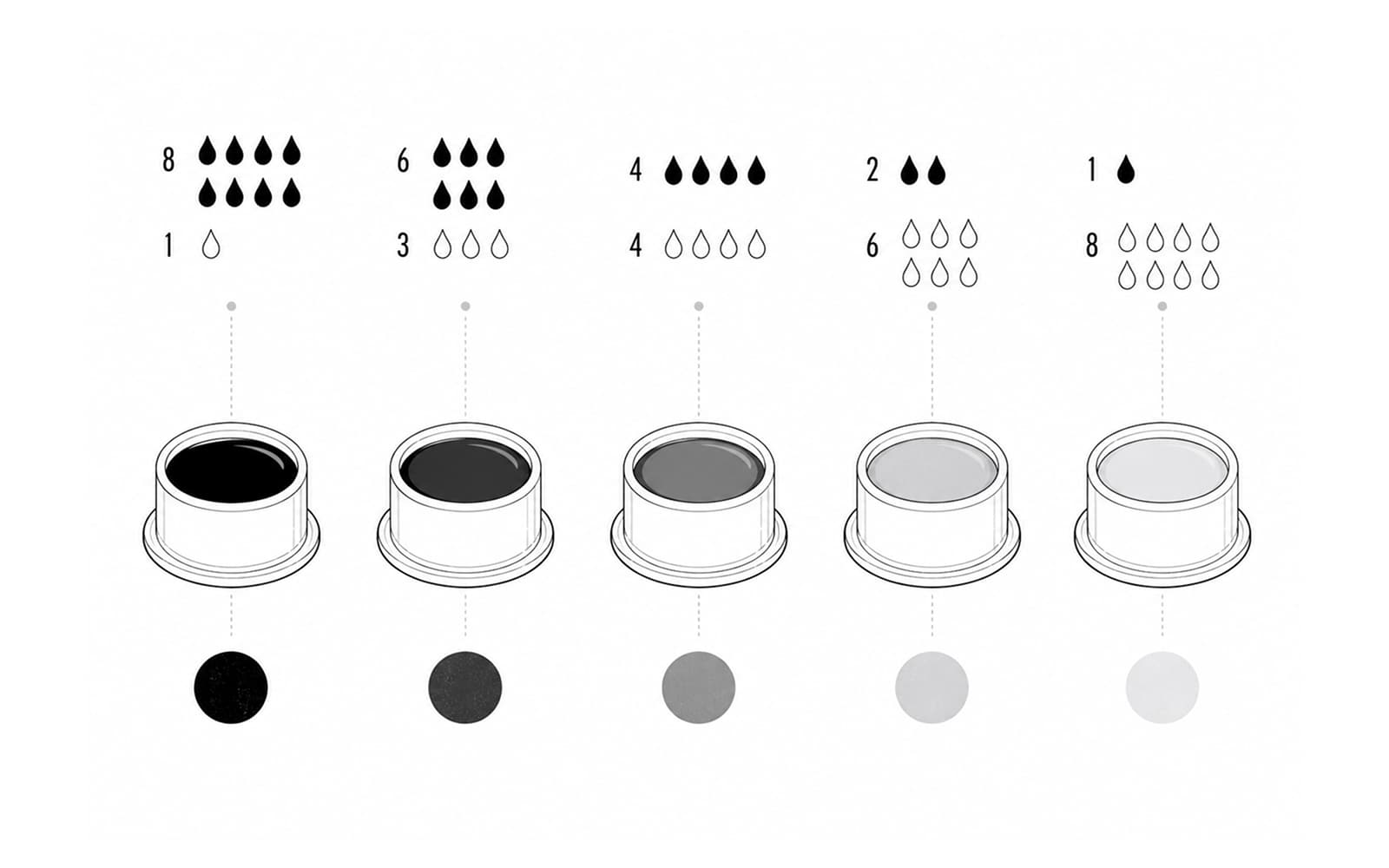
1. A drop-count setup
Example:
10 / 6 / 3 black drops, then fill matching caps to the same established level
This is a practical station record. The black counts are known, but the final totals are not necessarily measured.
If the cap and fill level stay consistent, the setup can still be useful and repeatable inside that workflow.
What it cannot honestly provide is an exact percentage unless the final amount is known.
2. A measured black-to-total proportion
Example:
6 black drops / 20 total drops
Now there is a denominator.
The counted black share is:
6 / 20 x 100 = 30%
The remaining counted amount is 14 drops of the established diluent.
This representation is stronger when you need to compare two recipes mathematically or scale the same proportion to another measured total.
3. A manufacturer premixed wash system
Many professional ink manufacturers sell prepared grey wash lines or dedicated dilution products.
Dynamic Color, for example, currently sells a numbered premixed Greywash set with #20, #40, #60, #80 and a #00 mixing solution. Panthera sells prepared grey systems as well as dedicated products described for dilution and shading. World Famous sells a Special Shading Solution intended to thin or dilute tattoo inks.
The important rule is simple:
Do not reverse-engineer a manufacturer shade name into your own percentage formula unless the manufacturer explicitly defines it that way.
A product label, shade number, visual name and homemade black:diluent ratio are different data types.
A percentage needs a denominator
The cleanest mathematical definition for a measured counted setup is:
black share = black amount / final total amount x 100
With 6 black drops:
| Measured final total | Diluent count | Counted black share | | ---: | ---: | ---: | | 12 drops | 6 | 50% | | 20 drops | 14 | 30% | | 30 drops | 24 | 20% | | 40 drops | 34 | 15% |
The numerator never changed. The denominator did.
That is why a note such as 6 drops = 30% is incomplete. It is only true for a specific measured total.
A better record is:
6 black / 20 total = 30% black by counted drops
The phrase by counted drops matters because drops are being used as countable units, not as a universal laboratory volume.
Cap size and fill level belong to a drop-count recipe
A quick station setup often uses matching caps and a familiar fill line rather than measuring the total number of drops every time.
That is a legitimate workflow record, but the cap context is part of the recipe.
Compare these two notes:
Weak record
10 / 6 / 3
Better drop-count record
Large matching caps | same normal fill level | 10 / 6 / 3 black drops | dark to light
The second version tells future-you what the counts actually depended on.
Tattooing101's current grey-wash setup guide also highlights this dependency: it documents a 10 / 6 / 3 style station example and warns that using smaller caps makes the same black-drop counts darker because less room remains for dilution.
That example is useful evidence of the workflow, not proof that 10 / 6 / 3 is the correct recipe for every artist.
How to read a 1:3 grey wash ratio correctly
Ratio notation is compact, but only if the convention is written down.
Suppose your studio note defines the format as:
black : diluent
Then:
1:1 black:diluent
- 1 part black
- 1 part diluent
- 2 total parts
- black share =
1 / 2 = 50%
1:2 black:diluent
- 1 part black
- 2 parts diluent
- 3 total parts
- black share =
1 / 3 = 33.3%
1:3 black:diluent
- 1 part black
- 3 parts diluent
- 4 total parts
- black share =
1 / 4 = 25%
3:1 black:diluent
- 3 parts black
- 1 part diluent
- 4 total parts
- black share =
3 / 4 = 75%
A common arithmetic mistake is reading 1:3 as 33% black because 1 is one-third of 3.
That ignores the total. In a black:diluent notation the total is 1 + 3 = 4 parts, so black is 25% of the final mixture.
Write the ratio convention, not just the numbers
1:3 can mean different things in different notes.
It might mean:
- 1 part black to 3 parts diluent;
- 1 part black in 3 total parts;
- a personal naming convention that is not a literal formula.
Those are not equivalent.
For a reusable studio record, write the convention once:
Ratio format: black:diluent
Then 1:3 becomes unambiguous.
If you are saving a measured percentage instead, write that directly:
25% black by counted drops
Percent black is not percent visual darkness
A 25% counted black share is a statement about the recipe math.
It is not a claim that:
- the fresh mark will look 25% as dark as solid black;
- the healed tattoo will retain a specific visual value;
- two different black products at 25% will behave identically;
- the same mixture will look identical on every skin or under every application method.
Ink formulation, pigment load, application, skin, healing and other workflow variables sit outside the ratio calculation.
That is why the Tattoo Grey Wash Calculator labels its percentage as the counted mixture rather than converting it into a predicted healed shade.
Drops are convenient counts, not a universal volume unit
A drop is useful at the station because it is easy to count.
It should not silently become a fixed millilitre conversion.
Drop volume can vary with the dispensing tip, bottle, fluid properties, angle, pressure and handling. If the job requires measured volume, record measured volume. If the job uses whole drops, keep the record in whole drops.
This is the same distinction used in the broader tattoo ink recipe scaling guide: preserve the representation you actually measured instead of inventing precision by converting it into a different unit.
Whole-drop rounding changes some ratios
Once a measured ratio is known, scaling is straightforward in ideal arithmetic:
target black amount = target black share x target total
Suppose the target is 12.5% black and the new measured total is 20 drops.
The ideal black amount is:
0.125 x 20 = 2.5 drops
If the working method uses whole drops, 2.5 cannot be represented exactly.
Two nearby options are:
- 2 black / 20 total = 10%
- 3 black / 20 total = 15%
Neither is exactly 12.5%.
The correct response is not to keep displaying 12.5% as though nothing changed. The recipe should expose the whole-drop approximation and the percentage it actually creates.
This is exactly what the calculator does when scaling a calibrated wash line.
Larger measured totals can represent some ratios more closely
Whole-drop error becomes easier to see with a simple example.
Take a target of 30% black:
- 3 / 10 = 30%
- 6 / 20 = 30%
- 9 / 30 = 30%
Those totals represent the target exactly.
Now take 12.5%:
- ideal at 10 total = 1.25 black drops
- ideal at 20 total = 2.5
- ideal at 30 total = 3.75
- ideal at 40 total = 5
Only the 40-drop total lands exactly on a whole black-drop count.
This is a mathematical observation, not a recommendation to use a particular cap size. It simply explains why small counted batches can have larger percentage steps.
Scaling a measured wash without changing the intended proportion
Suppose you have a measured cap:
6 black / 20 total = 30%
To represent the same target share at 30 total counted drops:
0.30 x 30 = 9 black drops
The result is:
- 9 black
- 21 diluent
- 30 total
- 30% black by counted drops
At 40 total:
0.30 x 40 = 12 black drops
The ideal ratio still lands cleanly on a whole count.
When it does not, save both the target and the actual rounded result.
Preserve the source product identity
Two numerical recipes are not necessarily equivalent when the underlying products change.
A useful grey wash record therefore includes the exact product identity alongside the numbers.
For a custom counted setup, consider recording:
- exact black ink product;
- exact manufacturer-approved dilution product or material used under your applicable rules;
- cap type or measured final total;
- black count for each diluted cap;
- dark-to-light order;
- date or recipe version.
The math remains reproducible only when the ingredients still mean the same thing.
Premixed grey wash and custom dilution solve different recording problems
A premixed manufacturer line already arrives as separate formulated shades. Your job is primarily to preserve the product identity and station order.
A custom wash line adds another layer: you also need to preserve the mixing representation.
For example:
Premixed line record
Brand | exact shade names/numbers | darkest to lightest | product lot if needed
Custom measured record
Brand black | Brand dilution product | 20 total counted drops | 10 / 6 / 3 black | 50 / 30 / 15% counted black
Custom quick record
Brand black | Brand dilution product | matching large caps | same marked fill level | 10 / 6 / 3 black
The quick record should stay a quick record. Do not manufacture percentages afterward if the final total was never measured.
More wash cups are not automatically better
A wash line can contain three diluted values, four, five, six or a premixed set with its own structure.
More prepared steps give you more named station positions. They also create more things to distinguish and record.
The number of cups is a workflow choice, not a quality score.
The Grey Wash Calculator therefore lets you work with three to six diluted cups and keeps solid black outside the diluted sequence. The starting values are editable examples rather than mandatory formulas.
Keep station order stable
A ratio record can be mathematically correct and still be awkward to use if the station order changes every session.
Save the direction together with the recipe:
solid black -> dark -> medium -> light
or the opposite if that is your established layout.
The important part is consistency. A saved list should preserve the order you actually use instead of sorting values later and forcing you to reinterpret the setup while working.
Keep grey wash math separate from stencil shading structure
A wash line answers:
Which prepared black-to-light mixtures are available at the station?
A stencil shading map answers:
Which tonal landmarks need to survive in this particular design?
Those are different jobs.
Use the Tattoo Stencil Shading Guide when the problem is deciding what tonal information belongs in the stencil. Use grey wash ratio math when the problem is recording and repeating the prepared ink setup.
Material safety is not a ratio calculation
The equation black / total can be correct while the material setup is still inappropriate.
StencilStudio therefore does not tell you that any household or generic liquid is suitable for tattoo ink dilution.
Current manufacturer examples show why product instructions matter:
- World Famous Tattoo Ink describes its Special Shading Solution as a product for thinning or diluting black, grey and colored tattoo inks.
- Panthera Ink describes Cristal Shading Solution as a product that can be used to dilute its inks and create different shades.
- Dynamic Color includes its own mixing solution with its current Greywash set and describes that solution as the way to thin the washes into custom shades.
Those are manufacturer-specific product statements, not a universal formulation recipe.
Public-health guidance adds a separate hygiene boundary. CDC has documented tattoo-associated infections linked to contaminated ink and warns that distilled or reverse-osmosis water should not be assumed sterile. When dilution is needed, CDC recommends sterile water and appropriate aseptic practice.
In the European Union, REACH restrictions also apply to substances in mixtures used for tattooing and permanent make-up. The regulation states that mixtures not marked for tattooing or permanent make-up must not be used for those practices.
Follow the current instructions for the exact products you use and the requirements that apply where you practice. This page only explains the arithmetic and record-keeping layer.
A practical grey wash record template
A compact quick setup can look like this:
Portrait wash v3
- Black: manufacturer + exact product
- Dilution material: exact product used under applicable instructions
- Cap: matching large caps
- Fill: same established line
- Sequence: 10 / 6 / 3 black drops
- Order: dark -> mid -> light
- Method: quick drop-count setup
- Date: 2026-08-14
A measured version can look like this:
Portrait wash v4
- Black: manufacturer + exact product
- Dilution material: exact product
- Measured total: 20 counted drops per cap
- Black sequence: 10 / 6 / 3
- Counted black shares: 50% / 30% / 15%
- Diluent counts: 10 / 14 / 17
- Order: dark -> mid -> light
- Method: measured counted ratio
- Date: 2026-08-14
The second format is easier to scale mathematically because the denominator is preserved.
Common grey wash ratio mistakes
Calling a black-drop count a percentage
6 black drops has no percentage until the final total is known.
Reading 1:3 as 33% without defining the ratio
If the notation means black:diluent, 1:3 is 25% black because there are four total parts.
Treating a premixed shade number as a homemade formula
Manufacturer naming systems are product systems. Do not infer undocumented percentages from the label.
Converting drops to millilitres with a generic constant
If volume matters, measure volume with the workflow you actually use.
Scaling a percentage and hiding whole-drop rounding
Show the count that was actually dispensed and the percentage that count really creates.
Assuming recipe percentage predicts healed value
It does not. Keep mixture math separate from biological and application outcomes.
Saving numbers without the product identity
A ratio without the exact black and dilution context becomes harder to reconstruct later.
Use the calculator when the arithmetic becomes the job
The Tattoo Grey Wash Calculator supports two levels of precision on purpose:
- Quick setup keeps black drops tied to a consistent fill-to-level instruction and does not pretend the percentage is known.
- Exact ratio asks for a measured total, calculates the remaining diluent count, reports the counted percentage and scales the line with whole-drop rounding exposed.
It also keeps the current recipe in local browser storage when you choose to save it, so no account or cloud recipe upload is required.
Source basis
This guide separates arithmetic from material guidance and uses the following current sources for the boundaries above:
- Dynamic Color Greywash set: current premixed shade system and dedicated mixing solution.
- World Famous Special Shading Solution: manufacturer description of a tattoo-ink dilution product.
- Panthera Cristal Shading Solution: manufacturer description of a shading/dilution product.
- CDC tattoo-associated NTM infection report: contamination risk, the non-sterility of distilled/reverse-osmosis water, and sterile-water recommendation when dilution is needed.
- EU REACH restriction for tattoo inks: European requirements for substances and mixtures used in tattooing and permanent make-up.
- Tattooing101 grey wash setup: practitioner-facing evidence for the common drops-plus-fill workflow and the effect of cap size on that workflow. It is used here to document practice variation, not as the safety authority.
FAQ
What is a 1:3 tattoo grey wash ratio?
Only the written convention can answer that precisely. If 1:3 means one part black to three parts diluent, there are four total parts and the black share is 25%.
Is 10 / 6 / 3 a standard tattoo grey wash recipe?
It is a documented example of a multi-cap drop workflow, not a universal standard. Cap size, final fill level, ink product, dilution system and artist workflow all affect what those counts represent.
How do I calculate black percentage from drops?
You need the measured final total. Divide black drops by total counted drops and multiply by 100. Six black drops in 20 total drops equals 30% black by counted drops.
Is a 30% grey wash the same as a 30% healed grey value?
No. Thirty percent describes the counted recipe only. It does not predict fresh or healed visual darkness.
Can I scale a grey wash ratio to a different cap total?
Yes, when the original proportion is actually known. Multiply the target black share by the new measured total, then expose any whole-drop rounding instead of hiding it.
Should I use water or a mixing solution for grey wash?
This guide does not choose materials for you. Follow the current instructions for the exact tattoo ink and dilution products you use plus the requirements that apply where you practice. CDC specifically warns against assuming distilled or reverse-osmosis water is sterile.
Related Guides
Keep reading from here
How to Record and Scale Tattoo Ink Recipes
Record tattoo ink mixes as ratios, normalize parts, scale batches correctly, handle whole-drop rounding, and version recipes without confusing repeatable math with healed color.
tattoo ink recipe · tattoo ink mixing ratio
Read guide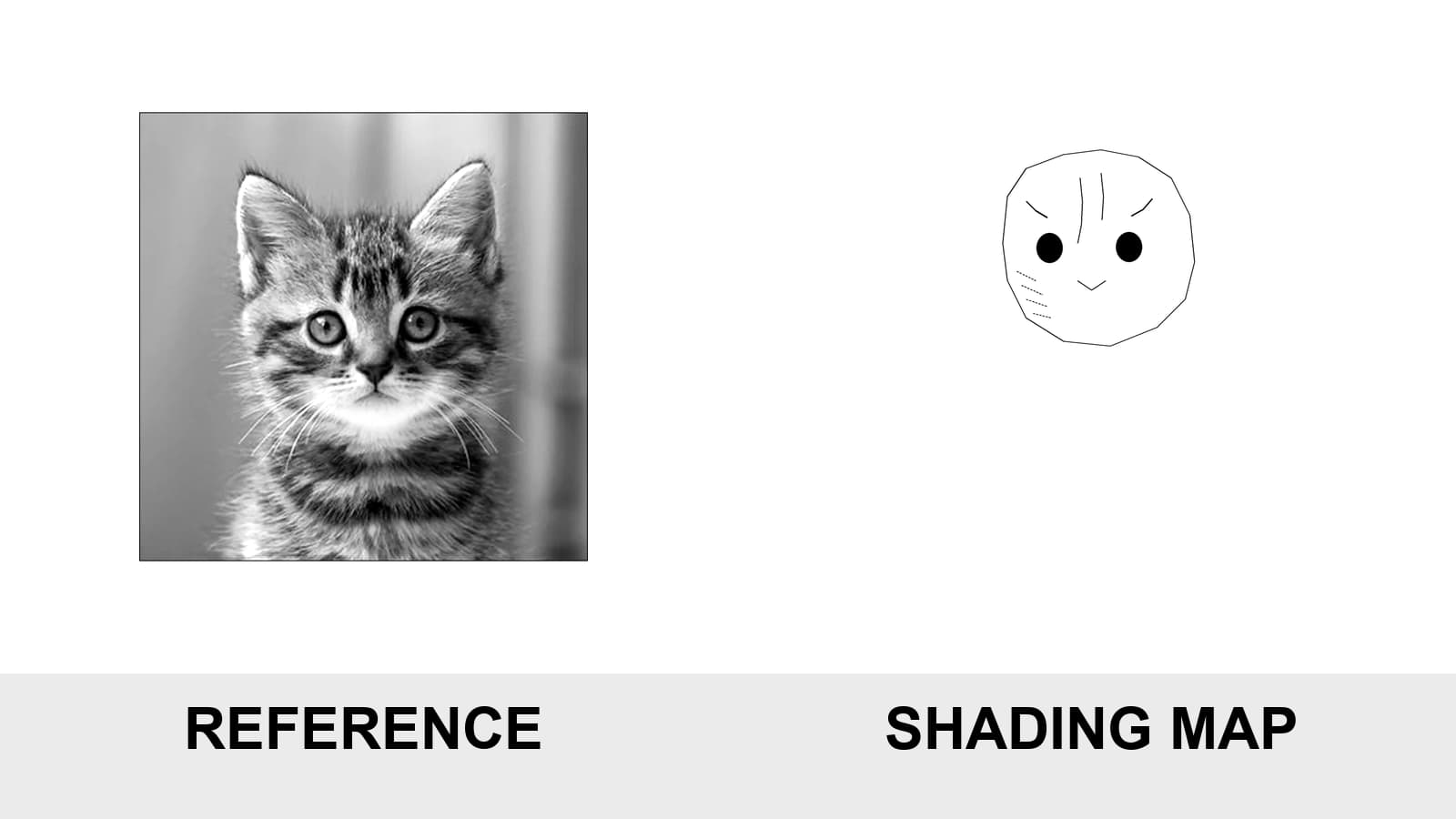
Tattoo Stencil Shading: Map Shadows Without Overloading the Stencil
Learn which shadow landmarks belong in a tattoo stencil, how to map hard edges and soft fades, and how to avoid transfers that are either empty or overloaded.
tattoo stencil shading · shading map stencil
Read guideAuthor
Andrea Mezzadra
Founder and product builder at StencilStudio
Andrea builds StencilStudio and tests how the tools fit into real stencil prep, using real references and outputs to document what works, what changes, and where artist judgment still matters.
In the App
Build the wash line you actually use.
Start with editable black-drop counts, or calibrate the final cap total when you need real counted percentages and ratio scaling.