8 units
4
Red
3
Black
1
Yellow


Studio Workflow
Record tattoo ink mixes as ratios, normalize parts, scale batches correctly, handle whole-drop rounding, and version recipes without confusing repeatable math with healed color.
tattoo ink recipe · tattoo ink mixing ratio · tattoo ink drops · tattoo color mix
Ratio math
Start with 4 parts Red, 3 Black, 1 Yellow. The ideal ratio is 50 / 37.5 / 12.5%. Scaling is exact until the requested unit forces a fraction you cannot physically dispense.
8 units
4
Red
3
Black
1
Yellow
16 units
8
Red
6
Black
2
Yellow
24 units
12
Red
9
Black
3
Yellow
12 whole drops
Ideal: 6 / 4.5 / 1.5
Half drops expose the difference between the ideal formula and the batch you can actually count.
6 / 4 / 2
50 / 33.3 / 16.7%
6 / 5 / 1
50 / 41.7 / 8.3%
Both batches total 12. Neither is the original 50 / 37.5 / 12.5% ratio. Record the actual rounded batch instead of silently replacing the master recipe.
Ready to scale a real formula? The calculator keeps the master ratio separate from the executable batch and shows the whole-drop deviation.
Open Ink Recipe CalculatorThis is ratio math only. It does not simulate physical pigment, certify compatibility, or predict a healed color.
A useful tattoo ink recipe is not "a bit of red, some black, then yellow until it looks right." It is a record another version of you can reconstruct weeks later.
That means preserving two different things:
Keeping those separate solves most scaling mistakes. It also stops a rounded drop count from silently replacing the formula you meant to preserve.
This guide is about that documentation problem. It is not a color-mixing chart, a pigment simulator, or a claim that a mathematically repeated mix will produce an identical healed result.
A ratio is only reusable if the ingredient names still point to the same products.
For every ingredient, record at least:
"Red / Black / Yellow" is too vague for a long-lived recipe. Two manufacturers can sell colors with similar names and different pigment systems, concentrations, carriers, opacity, undertones, and handling. Even products from one brand can change formulation over time.
Treat the product identity as part of the recipe, not decoration around it.
A practical line looks more like:
Brand A - Deep Red | 4 parts
than:
Red | 4 drops
The first preserves the intended ingredient and its role in the formula. The second may describe only one batch.
Parts are usually the cleanest way to store a formula because they describe proportion without locking the recipe to one batch size.
Consider:
The ratio is:
4 : 3 : 1
The total is 8 parts. Divide each ingredient by 8 to normalize the recipe:
4 / 8 = 50%3 / 8 = 37.5%1 / 8 = 12.5%So these are three equivalent ways to describe the same ideal proportion:
| Representation | Red | Black | Yellow | | --- | ---: | ---: | ---: | | Parts | 4 | 3 | 1 | | Ratio | 4 | 3 | 1 | | Percent | 50% | 37.5% | 12.5% |
Percentages are useful for comparing formulas. Parts are often easier to edit and scale. Drops are useful only after you choose a real batch size and accept the limits of whole-drop measurement.
Two notes can look different and still describe the same formula.
For example:
4 : 3 : 18 : 6 : 212 : 9 : 3all reduce to the same ratio.
Normalizing to percentages makes that obvious:
50% / 37.5% / 12.5%
This matters when an old notebook contains recipes made at different totals. Do not compare raw drop counts first. Compare the normalized proportions.
The reverse is also important. Two batches with the same total number of drops are not the same recipe if their normalized proportions differ.
Once the master formula is normalized, scaling is mechanical.
For each ingredient:
ingredient amount = ingredient parts / total parts x target batch
Using the 4 : 3 : 1 recipe:
4 / 8 x 8 = 43 / 8 x 8 = 31 / 8 x 8 = 14 / 8 x 16 = 83 / 8 x 16 = 61 / 8 x 16 = 24 / 8 x 24 = 123 / 8 x 24 = 91 / 8 x 24 = 3Those totals scale cleanly because each ideal amount lands on a whole unit.
When you have more ingredients, awkward totals, or repeated batches to prepare, this is the point where a dedicated ratio calculator should do the arithmetic. The calculator's job is deterministic: normalize the formula, scale it to a requested total, and expose any rounding. The recipe record should still preserve the original ratio separately.
Drops are convenient in a studio, but they are discrete. Many perfectly valid ratios cannot be represented exactly at every small drop total.
Take the same 4 : 3 : 1 formula and ask for a 12-drop batch.
The ideal mathematical amounts are:
50% x 12 = 6 drops37.5% x 12 = 4.5 drops12.5% x 12 = 1.5 dropsIf your working method requires whole drops, 4.5 and 1.5 cannot be dispensed exactly as written.
Two possible 12-drop approximations are:
6 / 4 / 2 -> 50% / 33.3% / 16.7%6 / 5 / 1 -> 50% / 41.7% / 8.3%Both total 12 drops. Neither preserves the original 50 / 37.5 / 12.5% formula exactly.
That is not a calculator failure. It is a consequence of mapping a continuous ratio onto a small number of whole units.
A common mistake is to calculate ideal values, round each ingredient independently, and assume the requested batch total is still preserved.
Depending on the numbers, independent rounding can leave you one unit over or under the requested total.
A better record includes:
Then the deviation is visible instead of hidden.
Each representation solves a different job.
Use parts when you want a recipe that can be scaled later without tying it to one cap or session.
4 : 3 : 1 is compact, easy to version, and independent of whether tomorrow's batch is 8, 16, or 24 measured units.
Use percentages when comparing versions or checking whether two differently sized records describe the same proportion.
Percentages also make rounding error easier to see because you can compare the rounded batch back to the master formula.
Drops are convenient when that is how you physically dispense a small batch. But record them as the actual batch, not as a universal volume unit.
Drop size can vary with bottle tip, fluid behavior, angle, pressure, temperature, and technique. A recipe written only as drops is therefore tied to a process as well as a ratio.
For larger or more controlled preparation, a measured volume can avoid some whole-drop rounding problems. The same ratio math applies.
Do not convert a drop count into milliliters using an assumed universal drop volume unless your own dispensing system has been characterized for that use.
Suppose your master formula is:
Muted Red v1 = 4 : 3 : 1
You prepare a 12-drop session batch and choose:
6 Red / 4 Black / 2 Yellow
Do not overwrite the master recipe with 6 : 4 : 2. That changes the formula.
Instead keep both:
Master recipe
Session batch
That record tells you what you intended and what you actually mixed.
A reusable notebook needs history.
If you intentionally change the formula, create a new version.
For example:
Muted Red v1
4 Red / 3 Black / 1 Yellow
Muted Red v2
4 Red / 2.5 Black / 1 Yellow
The point of v2 is not administrative neatness. It protects the experiment. Weeks later, you can tell whether a difference came from a changed formula or from the many other variables around application and healing.
Useful version notes include:
Do not retroactively edit v1 to match what you now prefer. Keep the lineage.
"Repeatable color" can mean three different things. They should not be collapsed into one promise.
This is mathematical.
If the master formula is 4 : 3 : 1, the normalized percentages are always 50 / 37.5 / 12.5%. Scaling that ideal ratio is deterministic.
This is what a recipe calculator can reliably help with.
This depends on how consistently the physical batch is prepared.
Relevant variables can include:
Good records improve this layer. They do not eliminate every physical variation.
This is not determined by ratio math alone.
A repeated formula does not guarantee an identical fresh appearance or healed color across people, placements, techniques, sessions, pigment lots, or time.
The recipe is a controlled input, not a biological prediction.
A digital swatch can be useful as a notebook cue: "this is the family I was aiming for."
It should not be treated as a measurement of the physical mixture.
RGB values describe emitted light on a display. Tattoo pigments are physical materials interacting with illumination, skin, application, and healing. There is no simple RGB formula that can exactly reconstruct an arbitrary tattoo pigment mixture or predict its healed appearance.
If a calculator shows an approximate color preview, treat it as orientation only. Keep the numeric recipe and exact product identities as the reproducible record.
A valid ratio only tells you that the arithmetic is valid.
It does not establish that two products are compatible, appropriate to combine, sterile after handling, compliant with local requirements, or suitable for a particular use.
Use manufacturer instructions and the professional requirements that apply to your practice for those questions. A calculator or recipe notebook should not invent a safety guarantee from percentages.
A compact studio record can contain:
Recipe name
Muted Red
Version
v1
Master formula
Working batch
Process notes
That is enough information to reconstruct the decision instead of relying on memory.
Master recipe:
5 Blue / 2 Black / 1 White
Total parts: 8.
Normalized:
Target 24 units:
No rounding is required.
Notebook A:
6 Red / 3 Brown / 3 Yellow
Notebook B:
2 Red / 1 Brown / 1 Yellow
Both normalize to:
50 / 25 / 25%
They are the same ideal ratio recorded at different totals.
Master recipe:
7 / 2 / 1
Normalized:
70 / 20 / 10%
Target: 7 whole drops.
Ideal amounts:
There is no exact whole-drop representation at a total of 7. Either choose and record an approximation, increase the batch total until the error is acceptable for your process, or use a measurement method that supports finer increments.
The important part is not pretending the rounded batch is mathematically identical to the master recipe.
A multi-color custom ink recipe and a black-plus-diluent grey-wash ladder are related station-side math, but they are not the same job.
If you are building a repeatable sequence of diluted black caps, use the Tattoo Grey Wash Calculator. It is designed around cap capacity, black/dilution counts, and a multi-cap wash line rather than arbitrary multi-color recipe documentation.
Keeping those owners separate avoids turning one guide into a catch-all mixing page.
Before you call a custom mix repeatable, check:
If those ten points are present, the recipe can be reconstructed and compared later even when the final visual outcome still depends on variables outside the formula.
Save the master formula in parts or an equivalent ratio, and keep normalized percentages for comparison. Record drops or measured volume for the actual working batch. This keeps the ideal formula independent from one session's batch size and rounding.
Add the recipe parts, divide each ingredient's parts by that total, then multiply by the new target batch. If the result produces fractional drops and you require whole drops, the batch becomes an approximation. Record the ideal values and the actual rounded allocation separately.
No. A drop is a practical dispensing count, not a universal fixed volume. Drop size can vary with the bottle tip, fluid, angle, pressure, temperature, and technique. Use drop counts as part of a controlled studio process rather than assuming one drop always represents the same physical volume.
No. Repeating the ratio controls one input. Exact products and lots, preparation, application, skin, placement, healing, and other variables can affect the visual result. Recipe math supports repeatability of the formula; it does not guarantee a biological outcome.
Related Guides
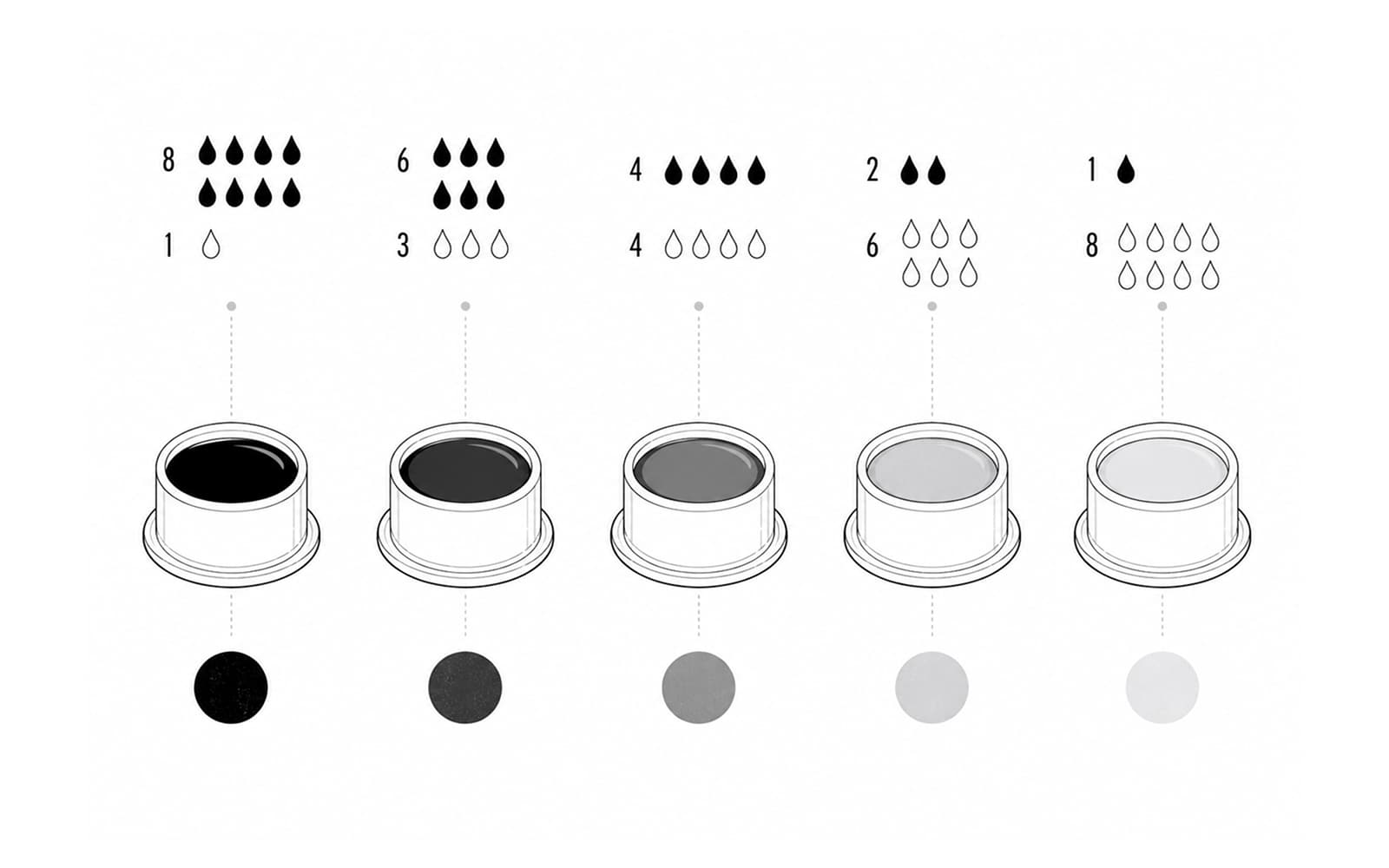
Understand tattoo grey wash ratios without false precision. Compare drop-count setups, black:diluent ratios, measured percentages, whole-drop rounding, and premixed wash systems.
tattoo grey wash · tattoo gray wash
Read guide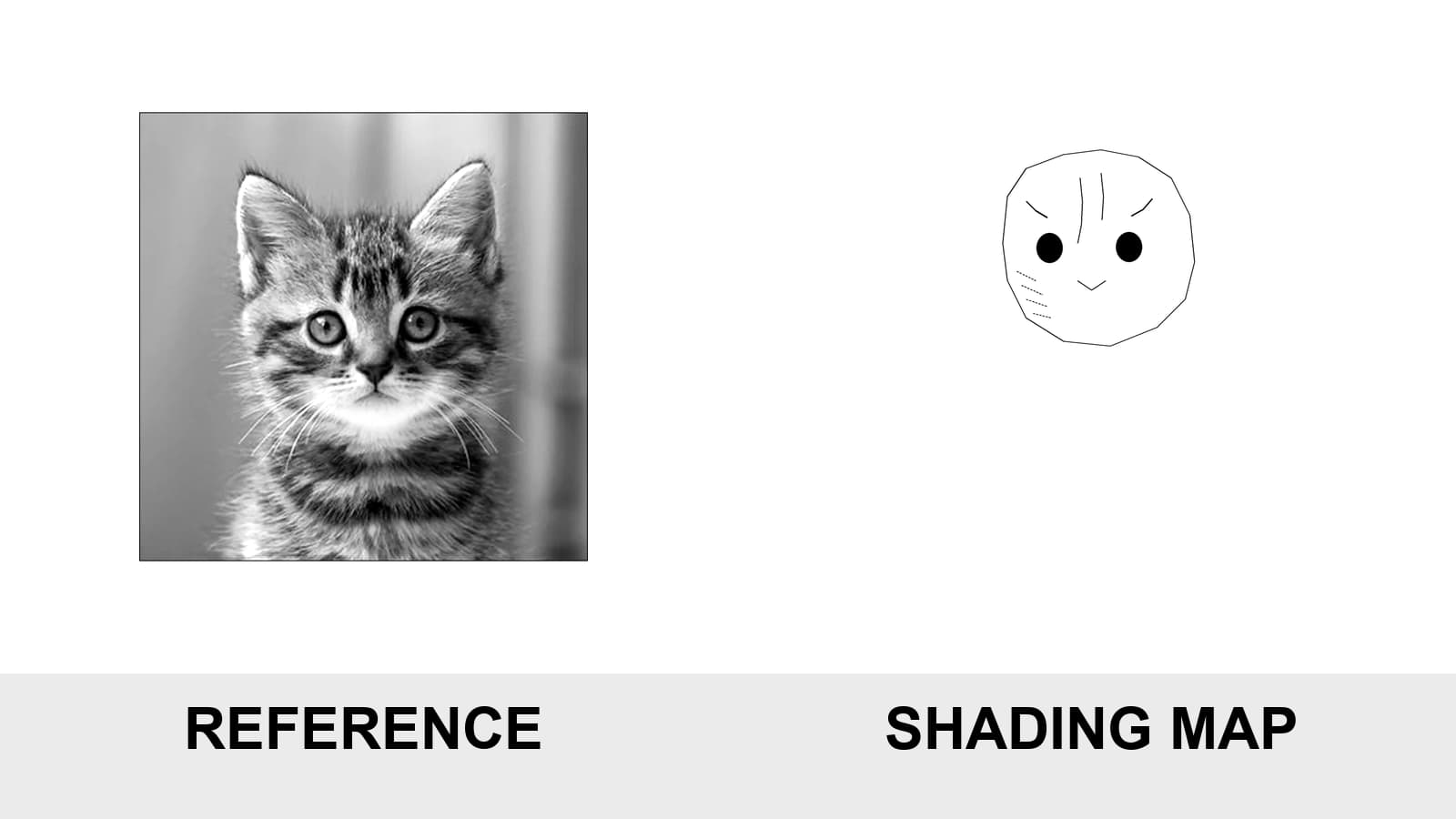
Learn which shadow landmarks belong in a tattoo stencil, how to map hard edges and soft fades, and how to avoid transfers that are either empty or overloaded.
tattoo stencil shading · shading map stencil
Read guideAuthor
Founder and product builder at StencilStudio
Andrea builds StencilStudio and tests how the tools fit into real stencil prep, using real references and outputs to document what works, what changes, and where artist judgment still matters.
In the App
Use the formula as the source of truth, record the batch you actually mixed, and keep execution tools separate from healed-color claims.