

Studio Workflow
Tattoo Needle Chart: Sizes, Codes & Cartridge Groupings Explained
Read tattoo needle and cartridge codes without guessing: diameter shorthand, literal needle count, RL vs RS, Magnum families, taper, Bugpin terminology, and where manufacturer-specific naming must stay separate.
tattoo needle chart · tattoo needle sizes · tattoo needle codes · RL vs RS · tattoo cartridge sizes · magnum tattoo needles
- August 14, 2026
- September 9, 2026
- 12 min
20-second label decoder
What does 1207RL mean?
In Peak's published labeling system, 12 is #12 / 0.35 mm, 07 is seven pins, and RL is Round Liner. Use the examples to learn the field pattern, then verify the actual manufacturer before decoding another brand.
Read a reviewed pattern
1207RL
Reviewed manufacturer-style teaching pattern
12
Diameter / gauge mark
#12 · 0.35 mm
07
Pin count
7 pins
RL
Grouping
Round Liner
Peak publishes this three-part label grammar: #12 maps to 0.35 mm, 07 is the needle count, and RL is Round Liner. Learn the pattern here, then verify the maker before applying it to another brand.
Compare broad families
Round Liner
A compact round family. Compare literal count, physical pin diameter and the exact maker construction rather than assuming every RL of the same count has the same footprint.
Do not infer machine settings from the code. Grouping, count, diameter and taper describe the needle configuration; they do not define voltage, stroke, depth, hand speed, skin response or healed outcome.
A code such as 1207RL can be read quickly when the manufacturer uses the common three-part pattern:
12= diameter or gauge shorthand;07= seven pins;RL= Round Liner.
In Peak's published labeling system, #12 means 0.35 mm, 07 means 7 needles, and RL means Round Liner.
That pattern is useful, but it is not a universal parser for every brand. For cross-brand comparison, keep four fields separate:
- pin count;
- physical pin diameter in millimetres;
- broad grouping family;
- manufacturer-specific taper, suffix and product-line terminology.
If you have an actual box in front of you, check the maker and product line first. Then use the Tattoo Needle and Cartridge Finder to decode the common structure and record only the fields you can verify.
Quick tattoo needle chart
This is a descriptive geometry chart, not a recommendation chart.
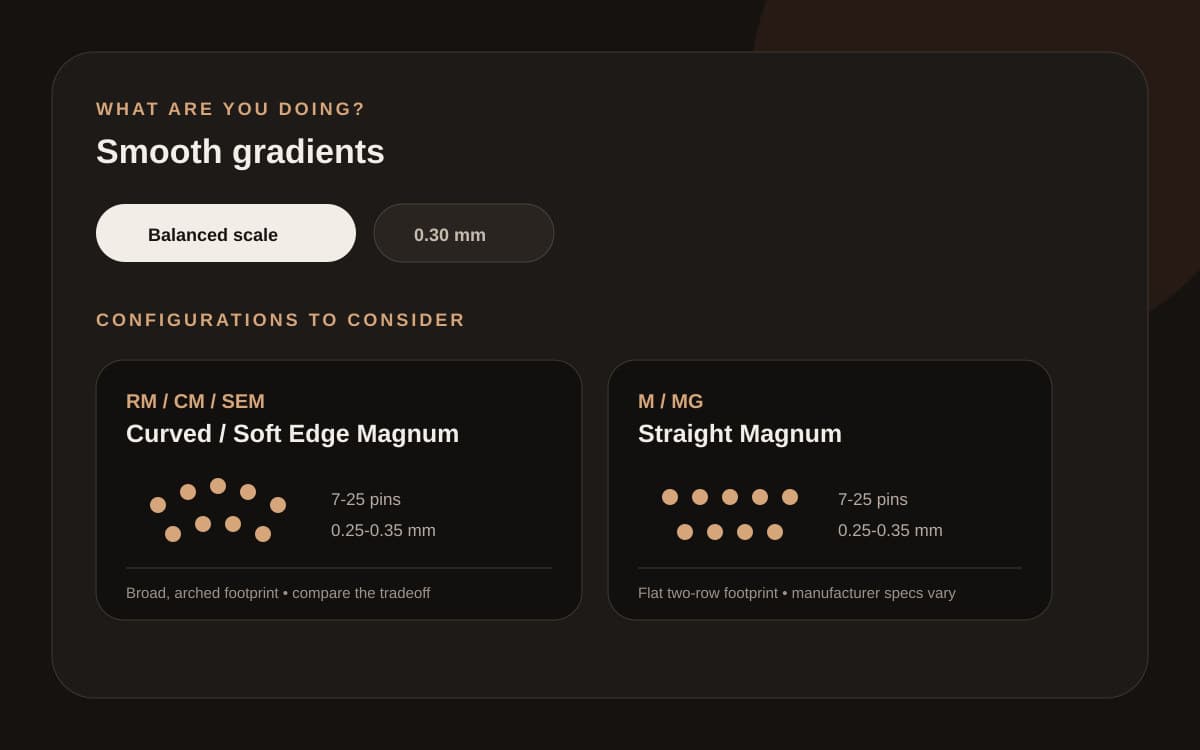
| Family | Common label examples | Broad geometry | | --- | --- | --- | | Round Liner | RL | Compact round grouping | | Round Shader | RS | More open round grouping | | Flat | F / Flat | Single flat row | | Straight Magnum | M / M1 / MG | Broad multi-row grouping with a comparatively straight leading edge | | Curved / Soft Edge Magnum | CM / RM / SE / SEM | Broad Magnum geometry with a curved or softened leading edge | | Specialty | maker-specific | Product-specific construction or terminology |
After the family, compare the literal count, physical pin diameter, taper, and the maker's exact construction.
The labels above are examples, not a universal dictionary. Peak publishes RL, RS, F and M1 in its own label grammar. FK Irons publishes a broader set of abbreviations. Cheyenne uses its own cartridge-family vocabulary, including Round Liner, Round Shader, Magnum and Soft Edge. The overlap is useful, but each manufacturer remains authoritative for its own products.
How to read 1207RL
A common three-part pattern is:
12 + 07 + RL
In Peak's current labeling guide:
| Printed field | Meaning in that manufacturer system | | --- | --- | | 12 | #12, corresponding to 0.35 mm needle thickness | | 07 | 7 needles in the grouping | | RL | Round Liner |
That is the fastest useful answer to 1207RL.
It still does not prove that another manufacturer encodes every product string the same way. Product lines can add suffixes, publish specialty constructions, or expose physical diameter directly instead of relying on the same shorthand.
The Peak labeling guide is a strong example because it documents the maker's own grammar rather than asking you to infer it.
Gauge number vs physical needle diameter
If you remember one rule from this chart, use this one:
When comparing products across manufacturers, prefer the stated physical pin diameter in millimetres over an unsourced gauge alias.
0.30 mm is a physical measurement. A printed #10, 10, 00, or another shorthand is a naming convention that needs manufacturer context.
Current reviewed manufacturer material includes examples such as:
| Gauge mark in the cited manufacturer material | Physical pin diameter | | --- | ---: | | #8 | 0.25 mm | | #10 | 0.30 mm | | #12 | 0.35 mm | | #13 | 0.40 mm in the cited FK glossary |
Peak and FK Irons both publish several of these familiar mappings in their own documentation. That makes the shorthand useful to recognize. It does not turn a remembered gauge chart into a universal cross-brand conversion rule.
The Finder therefore treats 08, 10 and 12 as common shorthand suggestions, not manufacturer-verified physical specifications. Other numeric prefixes stay unconverted until the maker's documentation establishes the physical diameter.
Do not apply American Wire Gauge mathematics to tattoo needle shorthand. These tattoo-industry labels should be interpreted through the manufacturer or product specification, not through an unrelated wire-gauge formula.
What you can safely infer from a needle label
A good decoder separates what the label or maker actually tells you from what would be a guess.
| Field | Usually safe to record when verified | Do not infer from it alone | | --- | --- | --- | | Pin count | Literal number of pins | Exact final mark width | | Physical diameter | Maker-stated value in mm | Skin result or technique | | Family | Broad grouping geometry | Universal best use or machine setting | | Taper | Maker's label, plus physical length when published | Cross-brand equivalence | | Specialty suffix | Exact maker/product term | A global standard | | System | Cartridge, traditional, or unknown | Machine compatibility |
This is the same separation used by the Needle and Cartridge Finder.
Pin count is literal, but it is not line width
A 7RL contains a count clue: seven pins in a Round Liner grouping.
What it does not tell you by itself is the exact physical mark width or exact tightness of that group.
Two seven-pin Round Liners can differ because of:
- individual pin diameter;
- spacing within the group;
- tight, extra-tight, open, hollow, power, or other product-specific construction;
- taper;
- cartridge or solder geometry;
- manufacturer tolerances and design choices.
That is why the Finder does not calculate a universal final line width from count plus diameter. The label narrows the hardware description. The actual product specification finishes the comparison.
Likewise, a 0.35 mm individual needle diameter does not mean the tattooed mark will be 0.35 mm wide. Pin diameter is one physical property of the hardware, not a prediction of the deposited mark.
RL: Round Liner
RL is the broad Round Liner family.
The defining idea is geometry: pins are grouped into a compact round arrangement. FK Irons describes Round Liner as needles in a tight circular grouping. Manufacturer catalogs then subdivide that broad family with their own tight, extra-tight, hollow, open, power, or other constructions.
When reading an RL product, compare:
- literal pin count;
- physical pin diameter in mm;
- the maker's exact construction name;
- taper label and, when supplied, taper length;
- the manufacturer's own grouping description.
Do not reduce those fields to a rule such as "3RL is fine and 9RL is bold." Count can change the physical grouping, but count alone does not define the complete construction or final mark.
Specialty liners stay attached to the maker
A specialty liner is not automatically a new universal family.
If a maker sells a Hollow Liner, Open Liner, Power Liner, Extra Tight Liner, or another named construction, preserve that term with the manufacturer and product line. Normalize it to the broad RL family only when the maker's own documentation supports that relationship.
RS vs RL: what actually changes
RS means Round Shader in the reviewed terminology sources.
It is still a round grouping, but the pins are generally arranged more openly than a Round Liner. Cheyenne's current terminology describes Round Shader separately from its liner configuration, and current manufacturer material distinguishes the spacing of those groups.
The useful comparison is geometry:
| Question | RL | RS | | --- | --- | --- | | Overall grouping | Compact round | More open round | | Broad family | Round Liner | Round Shader | | Can equal pin counts have the same footprint? | Not guaranteed | Not guaranteed | | Does the family define voltage, depth or stroke? | No | No |
The exact result can still differ with count, physical diameter, spacing, taper and product construction. Use RL and RS to identify the grouping family, not to prescribe a universal tattoo setup.
Straight Magnum: M, M1, MG and related labels
Magnum terminology is one of the places where code memorization can become misleading quickly.
The broad straight-Magnum idea is a wide multi-row grouping with a comparatively straight leading edge.
Peak uses M1 in its labeling documentation for a Magnum arrangement. FK material uses Magnum terminology and additional abbreviations. Other makers can use different labels or row descriptions.
When you see M1, M, or MG, ask:
- Which manufacturer and product line use this label?
- What does that maker mean by it?
- What is the literal count?
- What is the physical pin diameter?
- Is row construction and taper published?
The goal is not to translate every Magnum label into one universal setup. Identify the broad geometry, then keep the maker's exact term.
Curved Magnum, Round Magnum and Soft Edge Magnum
You may encounter labels such as:
CM: Curved Magnum;RM: Round Magnum;SE: Soft Edge;SEM: Soft Edge Magnum;- other maker-specific variants.
Cheyenne describes Soft Edge as also called curved or round Magnum and describes the leading edge as slightly rounded. FK Irons also describes Curved or Soft Edge Magnum as a broad Magnum family with a curved edge.
That supports a useful broad geometry family.
It does not prove that every CM, RM, SE or SEM product has the same curvature, spacing, count range, taper, or exact construction.
A safe normalization is:
Curved / Soft Edge Magnum family -> preserve the exact manufacturer label underneath it.
Straight Magnum vs curved Magnum
The easiest visual distinction is the leading edge.
Straight Magnum: comparatively straight leading edge across a broad multi-row grouping.
Curved / Soft Edge Magnum: arched or softened leading edge.
When comparing two actual products, keep these fields separate:
- family: straight or curved;
- count;
- physical pin diameter;
- taper;
- exact manufacturer construction.
The family name does not replace the other four fields.
Flat needles
Flat needles place pins in a single row with a flat leading edge.
F or Flat describes a broad geometry, not every product dimension. Read the maker's count, physical diameter, taper, delivery system and product-line notes.
A Flat grouping should remain its own family rather than being silently treated as a one-row Magnum.
Bugpin is not one fixed diameter
Bugpin is a good example of why manufacturer context matters.
FK Irons describes Bugpin as thinner needles, usually around 0.25 mm, which is already qualified language rather than a universal numeric definition.
Current manufacturer catalogs vary further:
- Kwadron's 0.25 mm / #8 Round Liner says that configuration is referred to by some as Bugpin;
- Peak's Bugpin Magnum catalog currently includes both
0.25 mmand0.30 mmBugpin variants; - Peak's Bugpin Curved Magnum catalog also includes multiple physical diameters.
So the safe data model is:
Bugpin = preserve the maker's specialty label + record the actual physical pin diameter.
Do not convert the word Bugpin into a hard-coded millimetre value.
What taper means
Taper describes the length over which the individual needle narrows toward its point.
Manufacturers commonly use labels such as Short, Medium, Long and Extra Long, but the physical lengths attached to those labels can vary by product line.
Peak provides a concrete example. Its labeling guide lists these lengths for its Triton and Quartz lines:
- Short Taper: 2.5 mm;
- Medium Taper: 3.5 mm;
- Long Taper: 5.5 mm;
- Extra Long Taper: 7.5 mm.
The same Peak documentation lists different taper lengths for another line.
That is direct evidence for keeping two fields when the maker supplies them:
- the printed taper label;
- the physical taper length.
It is not evidence that every product called "Long Taper" is 5.5 mm.
The chart does not turn taper into a universal performance recommendation. It records what the physical label means when the maker documents it.
Cartridge vs traditional is a separate field
A Round Liner can exist as a traditional needle-on-bar construction or inside a cartridge system.
The grouping family and the delivery system are separate fields:
- family: RL, RS, Flat, Magnum, curved Magnum, specialty;
- system: cartridge, traditional, or unknown.
RL describes grouping geometry. It does not, by itself, tell you which delivery system is in front of you or whether a cartridge fits a specific machine.
Cartridge compatibility is a different lookup
A cartridge code and a machine-fitment claim answer different questions.
The Needle and Cartridge Finder answers:
What configuration is this, and which physical fields can I record safely?
The Tattoo Cartridge Compatibility Checker answers:
Does the documented machine -> grip -> cartridge interface support this exact hardware path?
Compatibility needs generation-specific manufacturer evidence. A cartridge that looks like a standard format is not automatically verified compatible, and the Needle Finder does not infer fit from geometry.
A better way to decode an actual box
When you have a cartridge or needle box in front of you:
1. Find the manufacturer and product line
Do this before interpreting an unfamiliar suffix. A code has meaning inside a naming system.
2. Read the compact code if the pattern is recognizable
A common pattern can separate diameter shorthand, count and broad grouping. The Finder now returns Common convention, Partial, or Unknown instead of forcing every string through one parser.
3. Find the physical pin diameter
If the maker publishes 0.30 mm, record 0.30 mm. Do not replace it with a remembered gauge alias.
4. Record the literal count
Seven pins means seven pins. Keep that separate from any prediction about final footprint.
5. Identify the broad family
RL, RS, Flat, straight Magnum and curved or Soft Edge Magnum are useful broad buckets when manufacturer terminology supports them.
6. Preserve specialty names
Keep Bugpin, Tight, Hollow, Power, Textured, Stacked, or another meaningful product suffix instead of deleting it to make the label fit a generic dictionary.
7. Record taper exactly as published
If you have only Long Taper, preserve that label. If the maker also supplies a physical taper length, store that separately.
8. Stop before you invent performance
A hardware label does not define:
- exact final line width;
- voltage;
- machine stroke;
- hand speed;
- needle depth or hang;
- skin response;
- healing outcome;
- a universal "best" configuration.
If you want to keep those verified fields separated, open the Tattoo Needle and Cartridge Finder.
How the Needle and Cartridge Finder continues the job
The Finder is now deliberately a configuration decoder, not a technique selector.
It provides two complementary paths inside the same workspace:
- common-format code parsing for recognizable labels such as
1207RL, with Common / Partial / Unknown evidence states; - structured recording of grouping, literal count, physical diameter, system, taper, manufacturer and product line.
A common diameter shorthand is shown as a convention to verify, not silently promoted into a manufacturer-confirmed millimetre value. Unknown codes remain unknown until you supply reliable product context.
This guide explains the vocabulary. The Finder gives you a structured place to decode and record an actual configuration. Machine and cartridge fitment stays with the separate Cartridge Compatibility Checker.
Current manufacturer source basis
This guide's core terminology and label-decoding claims were rechecked against current manufacturer material on September 9, 2026.
Primary references include:
- Peak needle labeling guide: maker-specific label anatomy, diameter shorthand, count,
RL,RS,F,M1, specialty suffixes and product-line taper examples; - FK Irons tattoo terminology glossary: grouping families, common abbreviations, Bugpin context, diameter/gauge examples and taper terminology;
- Cheyenne glossary: Cheyenne cartridge families, Round Liner / Round Shader terminology and Soft Edge naming;
- Kwadron 0.25 mm Round Liner specification: product-specific
0.25 mm (#8)notation and qualified Bugpin terminology; - Peak Bugpin Magnum catalog and Bugpin Curved Magnum catalog: current examples showing why Bugpin should not be normalized to one fixed diameter.
Each source is authoritative for its own products and terminology. None is treated as proof that every manufacturer uses one universal code grammar.
Author
Andrea Mezzadra
Founder and product builder at StencilStudio
Andrea builds StencilStudio and tests how the tools fit into real stencil prep, using real references and outputs to document what works, what changes, and where artist judgment still matters.
In the App
Have an actual cartridge or needle specification in front of you?
Use the free Needle and Cartridge Finder to decode common label structure, then record the family, literal pin count, physical pin diameter, taper, system and manufacturer context without forcing the label through a universal parser.